
Write “I'm so happy for you” for the third time in one week and the word starts to feel thin. Happy fits everything from mild relief to news that changes your year, and that range is exactly why it tells a reader so little. Glad needs a reason after it. Delighted belongs in a polite reply. Jubilant needs a crowd. Every word here comes with a sentence you could send today, and a warning wherever it falls flat.
Best Words to Use Instead of Happy
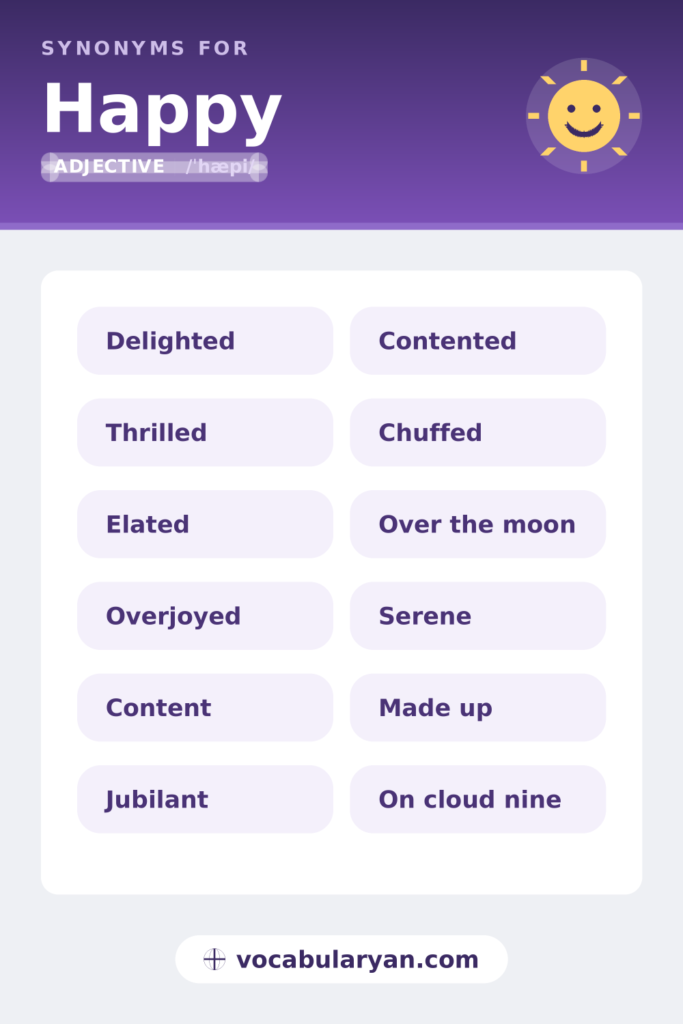
Common Synonyms for Happy
Most writing never needs a stronger word than these. They carry ordinary good news, polite replies and everyday conversation without drawing attention to themselves, which is usually what the situation calls for.
Delighted
Formal writing
Meaning
Very pleased, especially about something specific that has just happened or been offered.
When to use it
The standard choice in polite English for invitations and announcements. “Delighted to accept” sounds gracious, while “very happy to accept” sounds flat.
- We'd be delighted to join you for dinner on Saturday.
- The head teacher was delighted with how the students handled the visit.
Skip it for small daily pleasures. “Delighted with my sandwich” sounds overdone. ❌
Thrilled
Spoken
Meaning
Extremely pleased and excited about something.
When to use it
The natural spoken choice for big personal news. It also works in the negative for irony, where “not thrilled” means quietly annoyed.
- They're thrilled about the baby, and they've already painted the spare room.
- I'm thrilled you got the place, you worked hard for it.
Glad
Everyday
Meaning
Pleased about one particular thing, usually one you can name.
When to use it
The reason almost always follows, which is why glad rarely stands alone the way happy does.
- I'm glad you called before you left.
- She was glad of the extra hour once the traffic cleared.
“I felt glad all day” sounds odd with no reason attached. Use happy instead. ❌
Pleased
Everyday
Meaning
Satisfied and happy, especially with a result or with what someone has done.
When to use it
It belongs to judgement rather than mood. A teacher is pleased with your progress, though nobody is pleased at a birthday party.
- The coach was pleased with how the new players handled the pressure.
- We are pleased to confirm your booking for the fourteenth.
Cheerful
Everyday
Meaning
Visibly happy and good-humoured in a way other people notice.
When to use it
It describes behaviour more than inner feeling, which is why it fits a person, a song or even a kitchen.
- She stayed cheerful through the whole delay, joking with the other passengers.
- The flat felt brighter once he painted the kitchen a cheerful yellow.
Content
Everyday
Meaning
Satisfied with what you have and wanting nothing more.
When to use it
Watch the pronunciation: conTENT for the feeling, CONtent for what fills a box.
- After years of moving around, he feels content in one place at last.
- The cat looked content on the windowsill and had no plans to move.
Never for excitement. “Content about the promotion” misses the feeling entirely. ❌
Joyful
Formal writing
Meaning
Feeling or showing deep happiness, often at a shared occasion.
When to use it
Weddings, reunions and homecomings take it easily. It fits cards and ceremonies more than conversation.
- The station filled with joyful families welcoming the soldiers home.
- It was a joyful service, and nobody wanted to leave afterwards.
Avoid it in business writing, where it reads as sentimental. ❌
Upbeat
Everyday
Meaning
Positive and optimistic in tone or outlook.
When to use it
It describes the surface rather than the depth, which is why managers, reports, messages and markets are all upbeat.
- Despite the setback, the team stayed upbeat in the meeting.
- Her email struck an upbeat note even though the numbers were down.
Not for deep personal happiness. “Upbeat about the baby” sounds cold. ❌
Satisfied
Everyday
Meaning
Pleased because something has met the standard you set.
When to use it
No more and no less than expected, which is why it suits customers, results and endings rather than moods.
- Readers were satisfied with the ending, even the ones who guessed it.
- He stepped back, satisfied that the shelf was finally level.
Merry
Formal writing
Meaning
Cheerful and lively, often noisily so.
When to use it
Nearly retired outside greetings, where it survives everywhere in Merry Christmas. Elsewhere it usually implies drink.
- A merry crowd spilled out of the pub at closing time.
- Merry Christmas from everyone at the office.
Nobody describes their own mood as merry today. Use cheerful. ❌
Jolly
Everyday
Meaning
Cheerful, friendly and good-humoured.
When to use it
The word attached to Father Christmas, and old-fashioned enough to sound warm. British English also uses it as an intensifier, as in jolly good.
- Her uncle was a jolly man who laughed hardest at his own jokes.
- That's a jolly good idea, and I wish I had thought of it.
Gratified
Formal writing
Meaning
Pleased and satisfied, especially at being recognised or proved right.
When to use it
One of the few words here that implies an audience. It appears far more in writing than in speech, where pleased does the same work more plainly.
- She was gratified to see her research cited in the final report.
- He was gratified by the number of former students who wrote to him.
Strong Words for Very Happy
Every word here goes above happy, and none of them substitutes freely for the others. What separates them is the cause: a win, a reunion, a crowd, or a moment that will not last.
Elated
Formal writing
Meaning
Extremely happy and excited, especially straight after success or good news.
When to use it
It marks a peak moment rather than a lasting state, strong enough to change how someone walks out of a room.
- She walked out of the exam hall elated, because every question she had revised came up.
- The crew were elated when the boat finally reached the harbour.
Overjoyed
Everyday
Meaning
Extremely happy, beyond what you can easily contain.
When to use it
Kept for the biggest news: a recovery, a reunion, a longed-for yes.
- Her parents were overjoyed when the hospital finally sent her home.
- He was overjoyed to hear his sister had been accepted.
Use it for small pleasures and it loses its force. ❌
Ecstatic
Everyday
Meaning
Overwhelmingly happy and excited.
When to use it
Used for reactions rather than moods. Speech also stretches it to strong approval, as in “I'm not ecstatic about the price.”
- Fans were ecstatic when the band announced a second night.
- My daughter was ecstatic about the puppy and could not sit still.
Euphoric
Formal writing
Meaning
Intensely happy in a way that feels heightened and short-lived.
When to use it
Medicine and journalism both use it, which gives it a clinical edge the other strong words lack.
- The first mile felt euphoric, though the fourth brought her back down.
- The office turned euphoric for about an hour after the deal closed.
It hints the feeling will not last, so avoid it for steady happiness. ❌
Jubilant
Formal writing
Meaning
Openly and triumphantly happy, especially in celebration of a victory.
When to use it
News reports use it constantly for crowds after a final or supporters after a result.
- Jubilant supporters poured into the square within minutes of the announcement.
- The front pages the next morning were jubilant.
One person alone is rarely jubilant. Keep it for crowds. ❌
Exuberant
Formal writing
Meaning
Full of energy and high spirits that are obvious to everyone.
When to use it
It suits performances, crowds and children more than quiet adults, because the feeling has to be visible.
- The exuberant welcome outside the airport lasted twenty minutes.
- He gave an exuberant performance the audience talked about for weeks.
Gleeful
Everyday
Meaning
Delighted, often with a hint of mischief or triumph over someone.
When to use it
That edge is why gleeful rarely reads as purely warm, and why it fits rivalry so well.
- He was gleeful about beating his brother at chess for the first time.
- There was a gleeful note in her voice when she read out the score.
Giddy
Everyday
Meaning
Excited and light-headed with happiness.
When to use it
It works for young love, big wins and anyone who cannot stop talking.
- They were giddy with relief once the results came through.
- She felt giddy walking home after the interview went so well.
Blissful
Formal writing
Meaning
Perfectly happy and completely undisturbed.
When to use it
Weddings, holidays and sleep take it easily, while achievements rarely do, because bliss suggests rest rather than reward.
- Three blissful days passed before anyone mentioned work.
- He fell into a blissful sleep the moment the plane took off.
Beaming
Everyday
Meaning
Smiling broadly with happiness.
When to use it
It tells you nothing about the cause, which is why it nearly always arrives with the reason attached.
- The beaming graduate held the certificate up for the camera.
- She came back beaming and told us the offer had arrived.
Radiant
Formal writing
Meaning
So happy that it shows in the face and the whole appearance.
When to use it
Brides, new parents and anyone photographed on a good day attract it.
- She looked radiant walking back down the aisle.
- He was radiant all afternoon, showing everyone photographs of the baby.
Exhilarated
Formal writing
Meaning
Excited and invigorated, usually after something physical or risky.
When to use it
It names the rush of one moment rather than lasting joy, and fades from the sentence as quickly as from the body.
- They came off the water exhilarated and soaked.
- She felt exhilarated after the first ride, and queued straight up again.
Buoyant
Formal writing
Meaning
Cheerful and optimistic, with a sense of lightness.
When to use it
English applies it to people and to markets alike, which is why a buoyant mood and a buoyant quarter both sound natural.
- The team stayed buoyant even two goals down.
- The market stayed buoyant all summer.
Rapturous
Formal writing
Meaning
Expressing intense delight, especially loudly and in public.
When to use it
Usage has narrowed it almost entirely to applause, welcomes and reviews. Calling a person rapturous now reads as archaic.
- The soloist returned to rapturous applause.
- The film opened to rapturous reviews.
Ebullient
Formal writing
Meaning
Overflowing with cheerful energy and enthusiasm.
When to use it
The word profile writers use when a personality dominates a room. It suits description far more than self-report.
- Her ebullient manner filled the room before she said a word.
- He was in ebullient form at the reunion.
Calm and Quiet Words for Happy
Not all happiness has excitement in it, and the strong words misfire badly when there is none. What follows describes satisfaction that has settled, where nothing is missing and nothing more is wanted.
Contented
Everyday
Meaning
Quietly happy and satisfied with your situation over a period of time.
When to use it
Content describes the state at this moment, while contented describes it settling in. A contented life and a contented cat both suggest nothing further is wanted.
- He led a contented life in a village he never left.
- She gave a contented sigh and put her feet up.
Serene
Formal writing
Meaning
Calm, peaceful and untroubled.
When to use it
Closer to peace than to pleasure. Writers apply it to faces, water and landscapes as readily as to moods.
- She looked serene despite the noise around her.
- The lake was serene that early, and so was everyone standing beside it.
Fulfilled
Everyday
Meaning
Happy because your life or work feels meaningful.
When to use it
It comes from purpose rather than from good news. Someone can be fulfilled and exhausted on the same day, which no other word here allows.
- Teaching left her more fulfilled than any job before it.
- He feels fulfilled now that the workshop is finally his own.
Carefree
Everyday
Meaning
Happy because nothing is worrying you.
When to use it
English attaches it most often to childhood, holidays and the years before responsibility arrives.
- Those were carefree summers, before exams mattered.
- She seemed carefree for the first time in months.
Light-hearted
Everyday
Meaning
Cheerful and free of seriousness.
When to use it
It describes a mood, a film or a conversation rather than a settled character. A light-hearted remark is one nobody is meant to examine closely.
- The meeting stayed light-hearted until the numbers came up.
- It is a light-hearted film, and nobody should look for a message in it.
At peace
Everyday
Meaning
Calm and no longer troubled, especially after accepting something.
When to use it
It appears constantly around death and grief, so the surrounding sentence matters more than usual.
- She seemed at peace with the decision by the end of the week.
- He was at peace in the garden and rarely came indoors before dark.
It appears constantly around death and grief, so check the context first. ❌
Untroubled
Formal writing
Meaning
Free of worry or anxiety.
When to use it
Reserved mostly for faces, sleep and stretches of time rather than for people in general, because it marks an absence rather than a presence.
- He slept untroubled for the first night in weeks.
- Her face was untroubled, which told me the news had been good.
Blithe
Formal writing
Meaning
Cheerful in a casual way that shows little concern.
When to use it
Modern usage has settled almost entirely on that lack of concern, so blithe disregard is now far commoner than a blithe mood.
- She gave a blithe wave and carried on walking.
- He answered with blithe confidence and got every detail wrong.
Informal and Slang Words for Happy
Speech and messages take all of these comfortably. Most would look out of place in an application or a report, and three of them mark the speaker's region as plainly as an accent does.
Chuffed
British English
Meaning
Very pleased, especially with yourself or with something you have achieved.
When to use it
Among the most common words in British speech for quiet satisfaction, and it suits a personal win better than someone else's.
- He was chuffed with his exam results.
- I'm dead chuffed you remembered.
American readers often will not know it. Keep it for British audiences. ❌
Made up
British English
Meaning
Delighted about something that has happened.
When to use it
Northern English, and one of the few regional expressions national broadcasters run unedited, largely through football interviews.
- I'm made up for him, he deserved that goal.
- She was made up when the tickets arrived.
Buzzing
British English
Meaning
Excited and elated, usually just after good news.
When to use it
Current British slang for excitement that has not settled yet. It dates faster than the older idioms, so it fits a message today and may read oddly in a decade.
- Buzzing about the tickets, cannot wait for Friday.
- The whole group was buzzing after the show.
Stoked
Spoken
Meaning
Very excited and pleased about something.
When to use it
American slang out of surfing and skateboarding, holding the sense of being fired up rather than merely pleased. It lands badly in a work email.
- I'm stoked you're coming.
- He was stoked about the new board.
Pumped
Spoken
Meaning
Excited and energised about something still to come.
When to use it
Borrowed from the gym and now standard in sport and sales alike. Where thrilled looks back at news, pumped looks forward to an event.
- The whole squad is pumped for Saturday.
- I'm pumped for this one, let's go.
Chirpy
Spoken
Meaning
Cheerful and lively in a talkative way.
When to use it
Aimed most often at someone brighter in the morning than everyone around them. Said flatly, it carries a trace of accusation.
- You're chirpy today.
- She sounded chirpy on the phone, which was a relief.
Tickled pink
Spoken
Meaning
Very amused and pleased at the same time.
When to use it
Usually prompted by a small gesture rather than a large event. It sounds affectionate from older speakers and slightly arch from younger ones.
- Gran was tickled pink by the card.
- He was tickled pink to be asked.
Pleased as punch
Spoken
Meaning
Extremely pleased and making no attempt to hide it.
When to use it
The phrase comes from the Punch and Judy puppet, which explains the note of self-satisfaction in it.
- He was pleased as punch with the new bike.
- She was pleased as punch when they printed her letter.
Idioms That Mean Happy
English keeps these idioms almost entirely for speech, and every one means extremely happy. They earn their place by carrying warmth that single words rarely manage, though none survives contact with formal writing.
Over the moon
Spoken
Meaning
Extremely happy about something that has happened.
When to use it
British speech's favourite version, kept almost exclusively for personal news. Football has done more to spread it than any other source.
- He's over the moon about the new job, and he hasn't stopped talking about it.
- We were over the moon when the offer was accepted.
Keep it out of formal emails and cover letters. ❌
On cloud nine
Spoken
Meaning
Extremely happy for a sustained stretch of time.
When to use it
One of the few idioms here that describes days rather than a single reaction, which is why it suits the weeks after an engagement or an offer.
- She's been on cloud nine since the engagement.
- He was on cloud nine for a fortnight after the results.
On top of the world
Spoken
Meaning
Extremely happy and confident at once.
When to use it
The confidence does most of the work, so it suits the days after an achievement rather than the moment of it.
- After the promotion he felt on top of the world.
- She came out of the audition on top of the world.
Walking on air
Spoken
Meaning
So happy that everything feels effortless.
When to use it
Used for the period after news that changes something. Speakers choose it when over the moon feels too abrupt.
- They were walking on air for a week after the wedding.
- He has been walking on air since the phone call.
In high spirits
Formal writing
Meaning
Cheerful and lively.
When to use it
The only idiom here that survives in reports, reviews and match coverage, and it describes a group as comfortably as an individual.
- The squad arrived in high spirits despite the long flight.
- The party set off in high spirits on the first morning.
Thrilled to bits
Spoken
Meaning
Extremely pleased.
When to use it
Warmer and more informal than thrilled alone, and unmistakably British. It suits thanks for a gift or a gesture better than a reaction to news.
- She was thrilled to bits with the flowers.
- They were thrilled to bits to see him back at work.
In seventh heaven
Spoken
Meaning
Completely happy and content.
When to use it
Dated enough to sound affectionate and still understood everywhere. It fits small private pleasures rather than public triumphs.
- Give him a fishing rod and a quiet river and he's in seventh heaven.
- She was in seventh heaven with a whole afternoon to read.
Grinning from ear to ear
Spoken
Meaning
Smiling very widely with happiness.
When to use it
The only entry here that describes the face rather than the feeling behind it.
- He came out grinning from ear to ear with the trophy.
- She was grinning from ear to ear the whole way home.
When Happy Means Willing
In “happy to help,” happy has nothing to do with joy. The sense is willingness, and the words that replace it there would sound wrong describing a mood.
- Glad to Warm and personal, and the closest everyday match: glad to help.
- Pleased to The polite choice for customer and client writing: pleased to confirm your booking.
- Willing to Neutral and slightly reluctant, since it states agreement without enthusiasm.
- Ready to Emphasises that nothing is holding you back, which suits a project update.
- More than willing to Adds warmth back to willing, and works well in a reply to a request.
- Only too glad to Formal and gracious, common in letters and speeches.
When Happy Means Lucky
A happy accident holds no feeling at all. Here happy means fortunate, a sense that survives mainly in fixed phrases and in formal writing.
- Fortunate The standard formal replacement, used for outcomes better than expected.
- Lucky The everyday version, and the one that stresses pure chance.
- Timely Right when it was needed, said of arrivals, warnings, and reminders.
- Opportune A formal near-twin of timely, used mostly of moments.
- Providential Suggests help from beyond chance, and carries a religious echo.
- Felicitous Well chosen rather than lucky, said of phrases, names, and pairings.
How to Choose the Right Synonym for Happy
Start with how strong the feeling is. For everyday good news, happy, glad, and pleased cover nearly everything: glad when you name the reason, pleased when a result meets your standard. Once the feeling rises, speakers say thrilled or over the moon, while writers use delighted or elated. At the top, overjoyed fits life-changing personal news and jubilant fits a celebrating crowd, and swapping the two makes both sentences sound wrong. When there is no excitement at all, only calm acceptance, content is the word that fits.
Pick by how strong the word sounds and where you are writing it: glad with a reason attached, delighted in a polite reply, thrilled out loud, content when nothing more is wanted.
Opposite Words for Happy
- Sad
- Miserable
- Gloomy
- Heartbroken
- Discontented
- Downcast
Test Your Word Choice
Question 1: Your acceptance letter needs one word: “I would be ___ to attend the ceremony.”
Use delighted in formal replies. Over the moon belongs to speech, and upbeat describes tone rather than a response to an invitation.
Question 2: Which word describes someone who wants nothing more than what they already have?
Content is calm satisfaction without wanting more. Elated marks a peak moment, and cheerful describes visible brightness.
Question 3: “___ crowds filled the streets after the championship.” Which one fits a news report?
News reports use jubilant for celebrating crowds. Glad and pleased are too mild and too private for the scene.
Question 4: A colleague in Manchester says he is “made up” about the result. He means:
Made up means delighted in northern English speech. It has nothing to do with inventing anything.
FAQs
What is the strongest synonym for happy?
Overjoyed, ecstatic, and elated all reach the top of the scale. Overjoyed fits life-changing personal news, ecstatic fits an overwhelming reaction, and elated fits a moment of triumph.
What is a formal word for happy?
Delighted works in most formal writing, especially replies to invitations and announcements. Pleased and gratified suit reports, while elated and jubilant belong to news coverage.
What is the difference between happy and glad?
Happy describes a general state, while glad reacts to one specific thing and usually names it: glad you came, glad to hear it. You can be happy for no reason, but glad almost always has one.
What can I say instead of happy in an email?
Pleased to confirm, delighted to accept, and glad to help cover most email situations. Keep over the moon and chuffed for messages to people you know well.
Is content a synonym for happy?
Content belongs at the calm end of happy and rules out excitement. Say content when nothing more is wanted, and something stronger when good news has just arrived.
