
You forget an important date, and when you say, “I’m sorry,” the words feel too small for the regret and guilt sitting in your chest. A brief apology can sound polite, yet it may not reflect the depth of responsibility you feel.
That is where idioms for apology become useful. These expressions appear when someone admits a mistake, asks for forgiveness, or tries to repair trust. Some sound humble and soft, while others carry deeper emotion.
We’ll look at how these phrases work in sentences and short dialogue. You’ll notice when one fits a minor slip and when another suits a serious fault. By the end, you can express apology with greater care and precision. Here are the words that carry the weight.
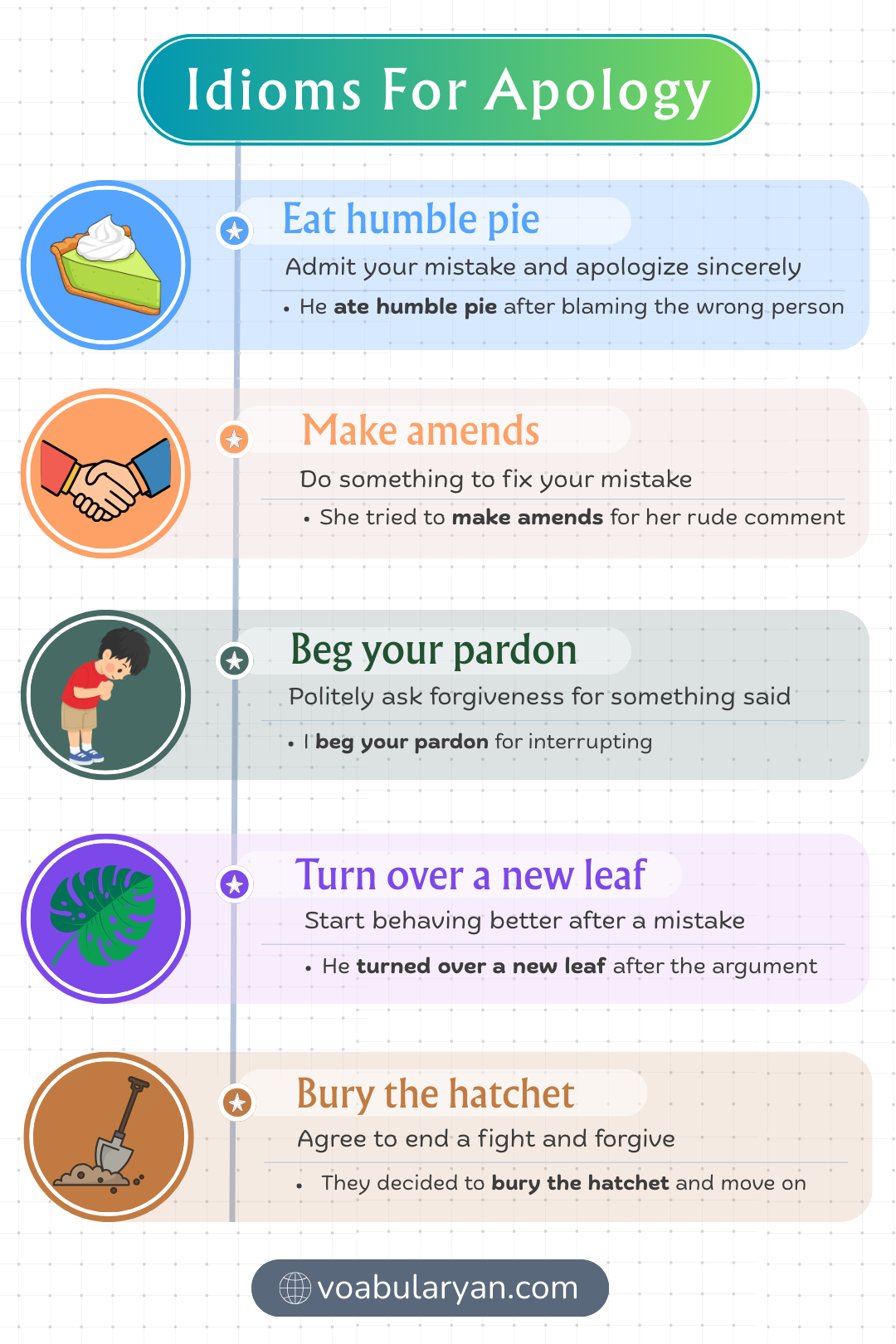
Apology Idioms For Admitting Fault And Taking Responsibility
Take The Blame
Meaning: Accept responsibility for a mistake or problem.
When To Use It: When a situation needs accountability, even if it feels uncomfortable.
Collocations: take the blame for, take the blame for the mistake, take the blame instead, take the blame publicly
Example Sentences:
- She decided to Take The Blame for the wrong booking.
- He Take The Blame so the team could avoid trouble.
Dialogue:
Aisha: The manager is asking who changed the schedule.
Bilal: I will Take The Blame and explain it.
Closest Alternatives:
- accept responsibility
- take responsibility
Own Up
Meaning: Admit a mistake honestly instead of hiding it.
When To Use It: When someone needs to confess to a small or serious fault.
Collocations: own up to, own up to a mistake, own up to the truth, own up about
Example Sentences:
- He finally Own Up to losing the keys.
- She refused to Own Up and kept blaming others.
Dialogue:
Hamza: The teacher knows someone cheated on the quiz.
Noor: Whoever did it should Own Up now.
Closest Alternatives:
- admit it
- confess
Come Clean
Meaning: Tell the full truth after keeping something secret.
When To Use It: When honesty is needed to fix trust or end confusion.
Collocations: come clean about, come clean to, come clean with, come clean and admit
Example Sentences:
- She chose to Come Clean about the missed deadline.
- It is better to Come Clean before rumors spread.
Dialogue:
Sana: You have been quiet since yesterday.
Fahad: I need to Come Clean about what I did.
Closest Alternatives:
- tell the truth
- be honest
Apology Idioms For Making Things Right
Make It Up To You
Meaning: Do something kind to fix harm caused by a mistake.
When To Use It: When someone feels sorry and wants to repair a relationship.
Collocations: make it up to you, make it up to you later, make it up to you somehow, try to make it up
Example Sentences:
- I will Make It Up To You by replacing the book I ruined.
- She promised to Make It Up To You after missing the birthday dinner.
Dialogue:
Farah: You forgot our plan again, and I waited alone.
Bilal: I’m sorry, I’ll Make It Up To You this weekend.
Closest Alternatives:
- make amends
- make it right
Right The Wrong
Meaning: Fix a bad action by correcting what was harmed.
When To Use It: When someone wants to repair damage caused by unfairness or error.
Collocations: right the wrong, right the wrongs, right the wrong done, try to right
Example Sentences:
- He tried to Right The Wrong by returning the lost wallet.
- The company must Right The Wrong and refund the extra charges.
Dialogue:
Hiba: They blamed you for something you did not do.
Yasir: I’ll speak up and Right The Wrong today.
Closest Alternatives:
- correct the mistake
- set things right
Do The Right Thing
Meaning: Choose the honest and fair action, even if difficult.
When To Use It: When someone faces a moral choice and wants to act fairly.
Collocations: do the right thing, do the right thing by, do the right thing and, try to do
Example Sentences:
- She decided to Do The Right Thing and report the cheating.
- Even when angry, he chose to Do The Right Thing and apologize.
Dialogue:
Rehan: Nobody saw me take the extra change.
Zara: Still, Do The Right Thing and return it.
Closest Alternatives:
- act with integrity
- do what is right
Apology Idioms For Fixing The Relationship After A Fight
Patch Things Up
Meaning: Fix a relationship after a disagreement or hurt feelings.
When To Use It: When two people want to stop fighting and be friendly again.
Collocations: patch things up with, patch things up after, patch things up quickly, patch things up over
Example Sentences:
- They met for coffee to Patch Things Up after the argument.
- I called her to Patch Things Up before the trip.
Dialogue:
Hina: Are you still upset about yesterday?
Rayan: No, I want to Patch Things Up today.
Closest Alternatives:
- reconcile
- make up
Make Amends
Meaning: Do something to correct a wrong and show regret.
When To Use It: When an apology is not enough and action is needed.
Collocations: make amends for, make amends with, make amends after, make amends by
Example Sentences:
- He brought a replacement to Make Amends for the broken gift.
- She worked extra hours to Make Amends for the mistake.
Dialogue:
Adeel: I shouldn’t have said that in front of everyone.
Mariam: Then Make Amends and speak to him kindly.
Closest Alternatives:
- put it right
- make it right
Clear The Air
Meaning: Talk openly to remove tension and misunderstanding.
When To Use It: When a problem stays quiet but still causes stress.
Collocations: clear the air with, clear the air about, clear the air after, clear the air between
Example Sentences:
- We sat down to Clear The Air about the rumors.
- She asked for a meeting to Clear The Air with her friend.
Dialogue:
Zara: Things feel awkward since that message.
Usman: Let’s Clear The Air and talk.
Closest Alternatives:
- talk it out
- set things straight
Mend Fences
Meaning: Repair a relationship that has been damaged by conflict.
When To Use It: When two sides want peace after a long dispute.
Collocations: mend fences with, mend fences after, mend fences between, mend fences over
Example Sentences:
- He visited his uncle to Mend Fences after months of silence.
- They tried to Mend Fences over the money issue.
Dialogue:
Noman: Are you going to call your cousin?
Farah: Yes, I want to Mend Fences.
Closest Alternatives:
- rebuild ties
- reconcile
Smooth Things Over
Meaning: Reduce anger or trouble so the situation feels calmer.
When To Use It: When tension rises and someone tries to keep peace.
Collocations: smooth things over with, smooth things over after, smooth things over quickly, smooth things over by
Example Sentences:
- She apologized to Smooth Things Over with the neighbors.
- He offered to help to Smooth Things Over after the mistake.
Dialogue:
Irfan: The client sounded annoyed on the call.
Lina: I will Smooth Things Over with an apology.
Closest Alternatives:
- calm things down
- ease tensions
Make Peace
Meaning: End conflict and agree to stop fighting.
When To Use It: When people decide to move from anger to agreement.
Collocations: make peace with, make peace after, make peace between, make peace at last
Example Sentences:
- They agreed to Make Peace and stop arguing about the past.
- I hope they Make Peace before the wedding.
Dialogue:
Haris: This fight is going on too long.
Saba: I know, it’s time to Make Peace.
Closest Alternatives:
- settle the dispute
- reconcile
Hold Out An Olive Branch
Meaning: Offer peace after a conflict.
When To Use It: When someone takes the first step to repair a relationship.
Collocations: hold out an olive branch to, hold out an olive branch after, hold out an olive branch by
Example Sentences:
- She sent a kind text to Hold Out An Olive Branch.
- He brought dessert to Hold Out An Olive Branch to his neighbor.
Dialogue:
Danish: Are you waiting for him to apologize?
Kiran: No, I will Hold Out An Olive Branch first.
Closest Alternatives:
- offer peace
- extend a hand
Let Bygones Be Bygones
Meaning: Forget past conflicts and stop bringing them up.
When To Use It: When both sides want a fresh start without old grudges.
Collocations: let bygones be bygones and, let bygones be bygones between, let bygones be bygones after
Example Sentences:
- We decided to Let Bygones Be Bygones and enjoy the day.
- She asked him to Let Bygones Be Bygones after the apology.
Dialogue:
Amna: Are you still upset about last month?
Saif: No, let’s Let Bygones Be Bygones.
Closest Alternatives:
- move on
- forgive and forget
Eat Humble Pie
Meaning: Admit you were wrong and accept it with humility.
When To Use It: When someone must accept blame after acting proud or sure.
Collocations: eat humble pie after, eat humble pie and, eat humble pie in public
Example Sentences:
- I had to Eat Humble Pie when my guess was completely wrong.
- He Eat Humble Pie and apologized to the whole group.
Dialogue:
Neha: You said the plan would fail.
Tariq: I know, now I must Eat Humble Pie.
Closest Alternatives:
- admit you were wrong
- swallow your pride
Key Takeaways
Idioms for apology cover many ways to admit fault, express regret, and repair trust after a mistake. Tone matters, since some phrases feel casual in conversation while others suit polite writing and serious moments. Many idioms keep stable wording and word order, so small changes can weaken the meaning. We also notice how context shapes the message, whether the issue is minor, like a mix-up, or bigger, like hurtful words. Honest ownership and making amends stay at the center.
FAQs
Q1. What does “my bad” mean?
It means a quick, casual way to admit a small mistake. In idioms for apology, it can fit things like stepping in someone’s way or sending the wrong file.
Q2. What does “I owe you an apology” mean?
It means the speaker admits fault and knows a serious sorry is needed. In idioms for apology, it often follows hurt feelings, broken plans, or rude words.
Q3. What does “sorry for the mix-up” mean?
It means something went wrong because of confusion, not on purpose. In idioms for apology, it can fit wrong times, wrong messages, or a simple plan mistake.
Q4. What does “please accept my apologies” mean?
It is a more formal way to say sorry and ask for forgiveness. In idioms for apology, it can fit a late reply, a missed meeting, or a public mistake.
Q5. What does “I didn’t mean it” mean when apologizing?
It means the speaker regrets what was said or done and says there was no bad intention. In idioms for apology, it can follow a harsh comment said in anger.
Q6. What does “let me make it up to you” mean?
It means the speaker wants to fix the situation with an action, not just words. In idioms for apology, it can be offering a new plan after canceling.
You May Also Like
