
You work on a group project while one person avoids every task, and someone mutters, “He’s useless.” The word lands hard, but it doesn’t capture the frustration and quiet resentment building in the room. Strong feelings about someone who doesn’t pull their weight rarely fit into a single plain word.
The right phrase can say more. Idioms for useless person let you talk about someone unhelpful or unreliable with greater precision. Some sound humorous, meant for light venting, while others carry the weight of real disappointment.
We’ll walk through each one with real examples and short conversations. You’ll sense which phrase fits playful teasing and which suits genuine frustration, without sounding harsh yourself. Here are the words that say what you mean.
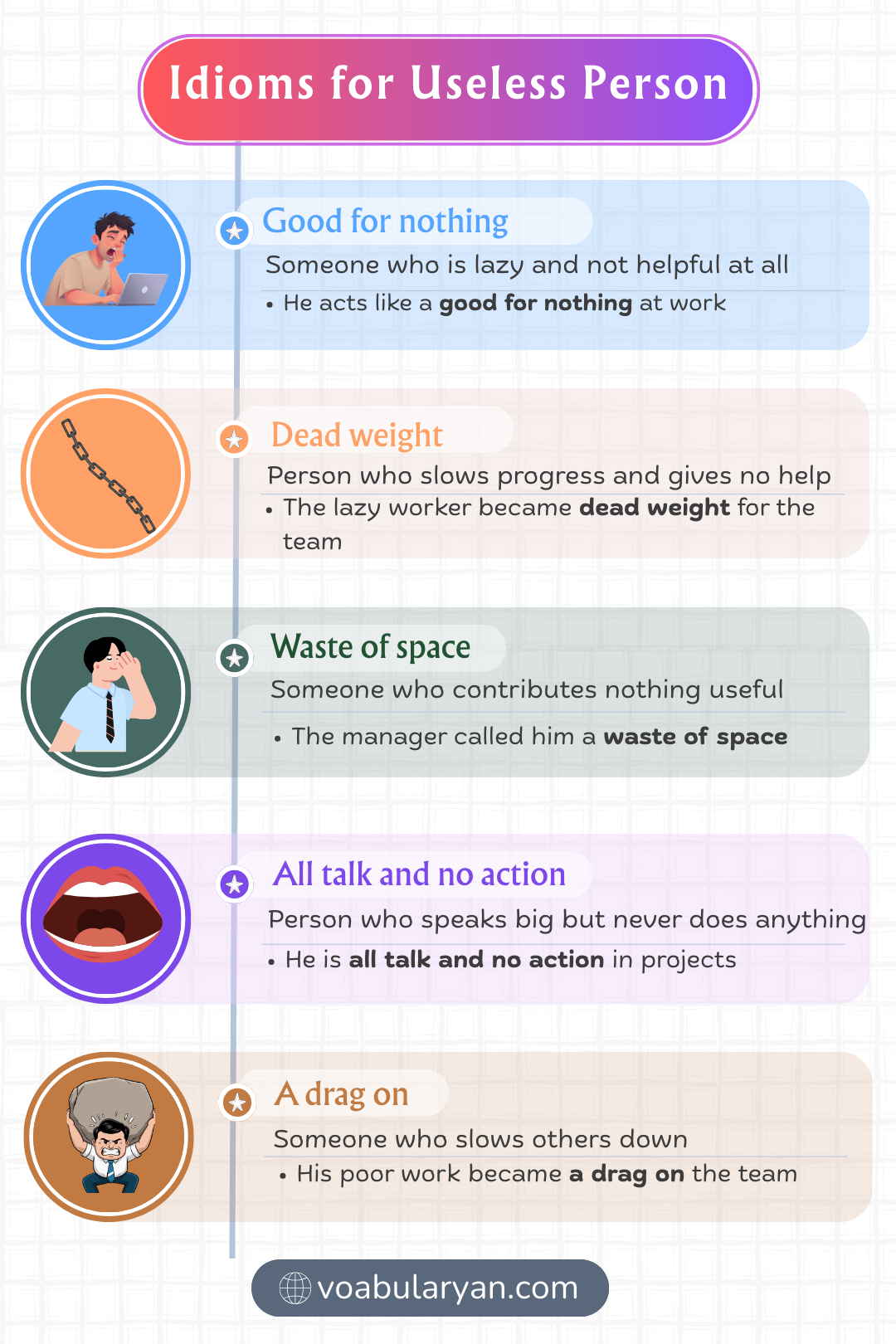
Idioms For A Useless Person In A Team Or Workplace
Dead Weight
Meaning: a person or thing that slows progress and adds no help.
When To Use It: say it when someone becomes a burden to a group.
Collocations: carry dead weight, feel like dead weight, dead weight on the team
Example Sentences:
- He felt like dead weight because he did not contribute.
- The broken tool became dead weight during the trip.
Dialogue:
Amina: He is acting like dead weight on this project.
Rayan: Yes, the team needs real help.
Closest Alternatives:
- burden
- useless load
Not Pulling Your Weight
Meaning: not doing your fair share of the work.
When To Use It: say it when effort is unequal in a group task.
Collocations: not pulling your weight on the team, not pulling your weight at home
Example Sentences:
- He is not pulling your weight during group work.
- She said I was not pulling your weight this week.
Dialogue:
Hira: I am tired of this imbalance.
Sameer: Yes, he is not pulling your weight.
Closest Alternatives:
- not doing your share
- slacking off
Let Someone Else Do The Heavy Lifting
Meaning: allow another person to do the hardest work.
When To Use It: say it when someone avoids effort and relies on others.
Collocations: let someone else do the heavy lifting on tasks, let someone else do the heavy lifting in the project
Example Sentences:
- He let someone else do the heavy lifting and took credit.
- She chose to let someone else do the heavy lifting in the debate.
Dialogue:
Noor: He barely helped, yet he wants praise.
Faris: He let someone else do the heavy lifting.
Closest Alternatives:
- leave the hard work to others
- rely on others
Take A Back Seat
Meaning: accept a less important role and let others lead.
When To Use It: say it when someone steps aside or becomes less active.
Collocations: take a back seat in decisions, take a back seat to safety, take a back seat during talks
Example Sentences:
- I will take a back seat and let her lead.
- His plans took a back seat to family needs.
Dialogue:
Mariam: Why are you not leading today?
Adil: I will take a back seat for now.
Closest Alternatives:
- step aside
- be less involved
Idioms For A Useless Person Who Does Nothing
Not Lift A Finger
Meaning: refuse to help or do any work at all.
When To Use It: say it when someone stays inactive while others handle tasks.
Collocations: not lift a finger to help, not lift a finger around the house, not lift a finger all day
Example Sentences:
- He did not Not Lift A Finger to clean up after dinner.
- She would Not Lift A Finger while everyone else worked.
Dialogue:
Hiba: He will Not Lift A Finger unless asked twice.
Zeeshan: That lack of effort is frustrating.
Closest Alternatives:
- do nothing
- refuse to help
Sit On Your Hands
Meaning: do nothing when action is needed.
When To Use It: say it when someone holds back instead of helping.
Collocations: sit on your hands and wait, stop sitting on your hands, sit on your hands during a crisis
Example Sentences:
- They Sit On Your Hands while the problem grew.
- He chose to Sit On Your Hands instead of speaking up.
Dialogue:
Mina: We cannot Sit On Your Hands anymore.
Bilal: Agreed, it is time for action.
Closest Alternatives:
- stay inactive
- do nothing
Like A Bump On A Log
Meaning: sitting still and doing nothing useful.
When To Use It: say it when someone stays passive and unhelpful.
Collocations: sit like a bump on a log, stand like a bump on a log
Example Sentences:
- He sat Like A Bump On A Log while others prepared.
- She stood Like A Bump On A Log and did not respond.
Dialogue:
Areeba: He just sat Like A Bump On A Log.
Fahad: Yes, there was no effort at all.
Closest Alternatives:
- like a statue
- doing nothing
Couch Potato
Meaning: a person who spends too much time sitting and watching TV.
When To Use It: say it when someone is very inactive at home.
Collocations: be a couch potato, turn into a couch potato, lazy couch potato
Example Sentences:
- During vacations, he became a Couch Potato.
- She felt like a Couch Potato after a whole weekend inside.
Dialogue:
Nadia: I have been a Couch Potato all day.
Farhan: Time for some movement.
Closest Alternatives:
- very inactive person
- lazybones
Idioms For A Useless Person Who Gives Low Effort
Phone It In
Meaning: do a task with little effort or care.
When To Use It: say it when someone performs poorly because they do not try.
Collocations: phone it in at work, phone it in on a project, phone it in today
Example Sentences:
- He phoned it in during the presentation and missed key points.
- She phoned it in on the report and left errors.
Dialogue:
Amina: That speech felt rushed and flat.
Rayan: Yes, he phoned it in with low effort.
Closest Alternatives:
- do the bare minimum
- half-do it
Dog It
Meaning: do something slowly, badly, or with weak effort.
When To Use It: say it when someone drags through work without energy.
Collocations: dog it on a job, dog it during practice, dog it through the day
Example Sentences:
- He dogged it in practice and did not improve.
- She dogged it on the assignment and turned it in late.
Dialogue:
Hira: He was slow and careless today.
Sameer: Yes, he really dogged it in training.
Closest Alternatives:
- slack off
- drag your feet
All Talk And No Action
Meaning: someone speaks a lot but does not do anything.
When To Use It: say it when promises stay empty and nothing happens.
Collocations: all talk and no action as usual, be all talk and no action
Example Sentences:
- He promises change, but he is all talk and no action.
- Their plan sounds big, yet it is all talk and no action.
Dialogue:
Noor: Do you think he will help this time?
Faris: I doubt it, he is all talk and no action.
Closest Alternatives:
- empty promises
- talk big
Take The Easy Way Out
Meaning: choose a simple option that avoids real effort.
When To Use It: say it when someone avoids a harder but better choice.
Collocations: take the easy way out of a problem, take the easy way out and quit
Example Sentences:
- He took the easy way out and blamed someone else.
- She took the easy way out instead of fixing the mistake.
Dialogue:
Zara: He left the group without explaining.
Omar: Yes, he took the easy way out.
Closest Alternatives:
- avoid responsibility
- choose the simplest option
Let Things Slide
Meaning: allow mistakes or bad behavior without reacting.
When To Use It: say it when someone chooses not to correct a problem.
Collocations: let things slide this time, let things slide at work, let things slide in class
Example Sentences:
- The teacher let things slide once, but not again.
- I let things slide for peace, but it bothered me.
Dialogue:
Mina: Why did you not complain?
Saad: I decided to let things slide to avoid conflict.
Closest Alternatives:
- ignore it
- overlook it
Idioms For A Useless Person Who Avoids Responsibility
Pass The Buck
Meaning: shift blame or duty to another person.
When To Use It: say it when someone avoids responsibility for a mistake.
Collocations: pass the buck to someone else, keep passing the buck, stop passing the buck
Example Sentences:
- He passed the buck instead of fixing the problem.
- She passed the buck to her teammate during the meeting.
Dialogue:
Amina: He keeps passing the buck every time.
Rayan: Yes, he avoids responsibility.
Closest Alternatives:
- shift blame
- dodge responsibility
Off The Hook
Meaning: no longer responsible or in trouble for something.
When To Use It: say it when someone is released from blame or duty.
Collocations: let someone off the hook, get off the hook, be off the hook
Example Sentences:
- The coach let him off the hook after the apology.
- I thought I was off the hook, but the work returned.
Dialogue:
Hira: Am I off the hook for the mistake?
Sameer: Not yet, there is still a task to finish.
Closest Alternatives:
- free from blame
- not in trouble
Beat Around The Bush
Meaning: avoid saying something directly.
When To Use It: say it when someone delays the main point.
Collocations: stop beating around the bush, keep beating around the bush
Example Sentences:
- He beat around the bush instead of giving the answer.
- She beat around the bush because she felt nervous.
Dialogue:
Noor: Just say what happened.
Faris: Stop beating around the bush and be direct.
Closest Alternatives:
- speak indirectly
- avoid the point
Idioms For A Useless Person Who Keeps Delaying Tasks
Drag Your Feet
Meaning: delay on purpose and avoid doing something.
When To Use It: say it when someone is slow because they do not want to act.
Collocations: drag your feet on a decision, drag your feet about homework, stop dragging your feet
Example Sentences:
- He Drag Your Feet on the paperwork for weeks.
- She Drag Your Feet because she did not want to answer.
Dialogue:
Hiba: He keeps Drag Your Feet on this choice.
Zeeshan: Yes, he is avoiding the decision.
Closest Alternatives:
- delay
- stall
Drag It Out
Meaning: make something last longer than needed.
When To Use It: say it when a talk, task, or process is stretched.
Collocations: drag it out for hours, drag it out too long, don’t drag it out
Example Sentences:
- They Drag It Out with extra arguments.
- He Drag It Out instead of giving a short answer.
Dialogue:
Mina: Please do not Drag It Out.
Bilal: Fine, I will keep it short.
Closest Alternatives:
- stretch it
- prolong it
Take Your Sweet Time
Meaning: move slowly without hurrying at all.
When To Use It: say it when someone is taking longer than expected.
Collocations: take your sweet time getting ready, take your sweet time about it
Example Sentences:
- He Take Your Sweet Time while everyone waited.
- She Take Your Sweet Time getting dressed.
Dialogue:
Areeba: You Take Your Sweet Time every morning.
Fahad: I know, I like to stay calm.
Closest Alternatives:
- take your time
- move slowly
Take A Rain Check
Meaning: decline now but accept at a later time.
When To Use It: say it when a plan is postponed politely.
Collocations: take a rain check on dinner, take a rain check for next week
Example Sentences:
- I will Take A Rain Check on lunch today.
- She had to Take A Rain Check because of work.
Dialogue:
Nadia: Can I Take A Rain Check for tomorrow?
Farhan: Sure, we can meet later.
Closest Alternatives:
- postpone
- do it another time
Idioms For A Useless Person Who Wastes Time Instead Of Working
Killing Time
Meaning: spend time doing small things while waiting.
When To Use It: say it when someone has free time before an event.
Collocations: killing time at the station, killing time before class, killing time until
Example Sentences:
- We were killing time before the movie started.
- She sat there killing time until her ride came.
Dialogue:
Amina: What are you doing here?
Rayan: Just killing time until my meeting.
Closest Alternatives:
- pass the time
- wait around
Goofing Off
Meaning: avoiding work by acting silly or wasting time.
When To Use It: say it when someone should be working but is not.
Collocations: goofing off in class, goofing off at work, stop goofing off
Example Sentences:
- They were goofing off during the group task.
- He kept goofing off instead of studying.
Dialogue:
Hira: Why is the work not finished?
Sameer: They were goofing off again.
Closest Alternatives:
- fooling around
- wasting time
Zoning Out
Meaning: stop paying attention and drift into thoughts.
When To Use It: say it when someone’s focus fades for a moment.
Collocations: zoning out in class, zoning out during a talk, start zoning out
Example Sentences:
- I was zoning out during the long lecture.
- She started zoning out while he explained the rules.
Dialogue:
Noor: Did you hear what she said?
Faris: No, I was zoning out for a second.
Closest Alternatives:
- daydream
- lose focus
Out To Lunch
Meaning: not thinking clearly or not paying attention.
When To Use It: say it when someone seems mentally absent.
Collocations: be out to lunch today, seem out to lunch
Example Sentences:
- He looked out to lunch during the meeting.
- I was out to lunch and missed the question.
Dialogue:
Mina: You keep staring at the wall.
Saad: Sorry, I am out to lunch today.
Closest Alternatives:
- not focused
- absent-minded
Can’t Be Bothered
Meaning: not willing to make the effort.
When To Use It: say it when someone refuses to do something small.
Collocations: can’t be bothered to reply, can’t be bothered with chores
Example Sentences:
- He can’t be bothered to clean his desk.
- She can’t be bothered with the long argument.
Dialogue:
Zara: Are you joining the group today?
Omar: I can’t be bothered right now.
Closest Alternatives:
- not motivated
- not willing
Idioms For A Useless Person Who Is Slow On Purpose
As Slow As Molasses
Meaning: moving or happening extremely slowly.
When To Use It: say it when progress feels painfully slow.
Collocations: as slow as molasses today, as slow as molasses in winter, move as slow as molasses
Example Sentences:
- The line was As Slow As Molasses this morning.
- My computer felt As Slow As Molasses after the update.
Dialogue:
Hiba: This traffic is As Slow As Molasses.
Zeeshan: Yes, the delay is awful.
Closest Alternatives:
- very slow
- at a snail’s pace
Bone Idle
Meaning: extremely lazy and unwilling to work.
When To Use It: say it when someone avoids effort completely.
Collocations: bone idle all day, feel bone idle, called him bone idle
Example Sentences:
- He was Bone Idle and ignored every task.
- She felt Bone Idle after a long week.
Dialogue:
Mina: He is Bone Idle today.
Bilal: Yes, there is zero effort.
Closest Alternatives:
- very lazy
- doing nothing
Key Takeaways
This topic brings together common phrases about delay, slow pace, and doing little or nothing when action is expected. Meaning depends on tone and situation, so a line can sound teasing, annoyed, or neutral in different moments. Many idioms keep stable wording and word order, so changing even one small part can make them sound unnatural. Across the examples, the language reflects real moments such as putting things off, stretching a task, moving too slowly, and avoiding effort, and it fits everyday conversation and simple writing.
FAQs
Q1. What does “a waste of space” mean when describing a useless person?
It means someone is seen as having no value in a group, which makes it harsh. Idioms for useless person like this often appear in angry talk, such as blaming someone for doing nothing at work.
Q2. What does “dead weight” mean about a useless person in a team?
It means someone adds burden and does not help progress. Idioms for useless person like this fit group tasks, like a teammate who avoids duties and slows everyone down.
Q3. What does “all talk and no action” mean in this context?
It means someone promises a lot but does nothing useful. Idioms for useless person like this fit cases like boasting about help, then never showing up when work starts.
Q4. What does “a lost cause” mean when someone seems useless?
It means people think change will not happen, so effort feels wasted. Idioms for useless person like this fit repeated failure, like someone ignoring rules again and again.
Q5. What does “good for nothing” mean, and how strong is it?
It means someone is judged as worthless, and it is very insulting. Idioms for useless person like this can be used in fights, like when anger leads to cruel words.
Q6. What does “not worth their salt” mean about ability?
It means someone does not meet the basic standard for their job or role. Idioms for useless person like this fit poor work, like a worker who cannot handle simple tasks.
You May Also Like