
You sit in a meeting where people discuss plans, numbers, and the next big decision. Someone says, “Let’s get down to business,” and the room shifts toward focus. The phrase works, yet it barely captures the steady effort and careful decisions behind professional life.
That is where idioms for business become useful in learning English. These expressions appear when people talk about deals, workplace challenges, or the pursuit of steady profit and growth. Some sound sharp and direct, while others carry quiet confidence in professional talk.
We’ll look at how these phrases work in everyday sentences and short dialogue. You’ll sense when one fits a quick meeting remark and when another reflects a serious business decision. Here are the words people use when work and ambition meet.
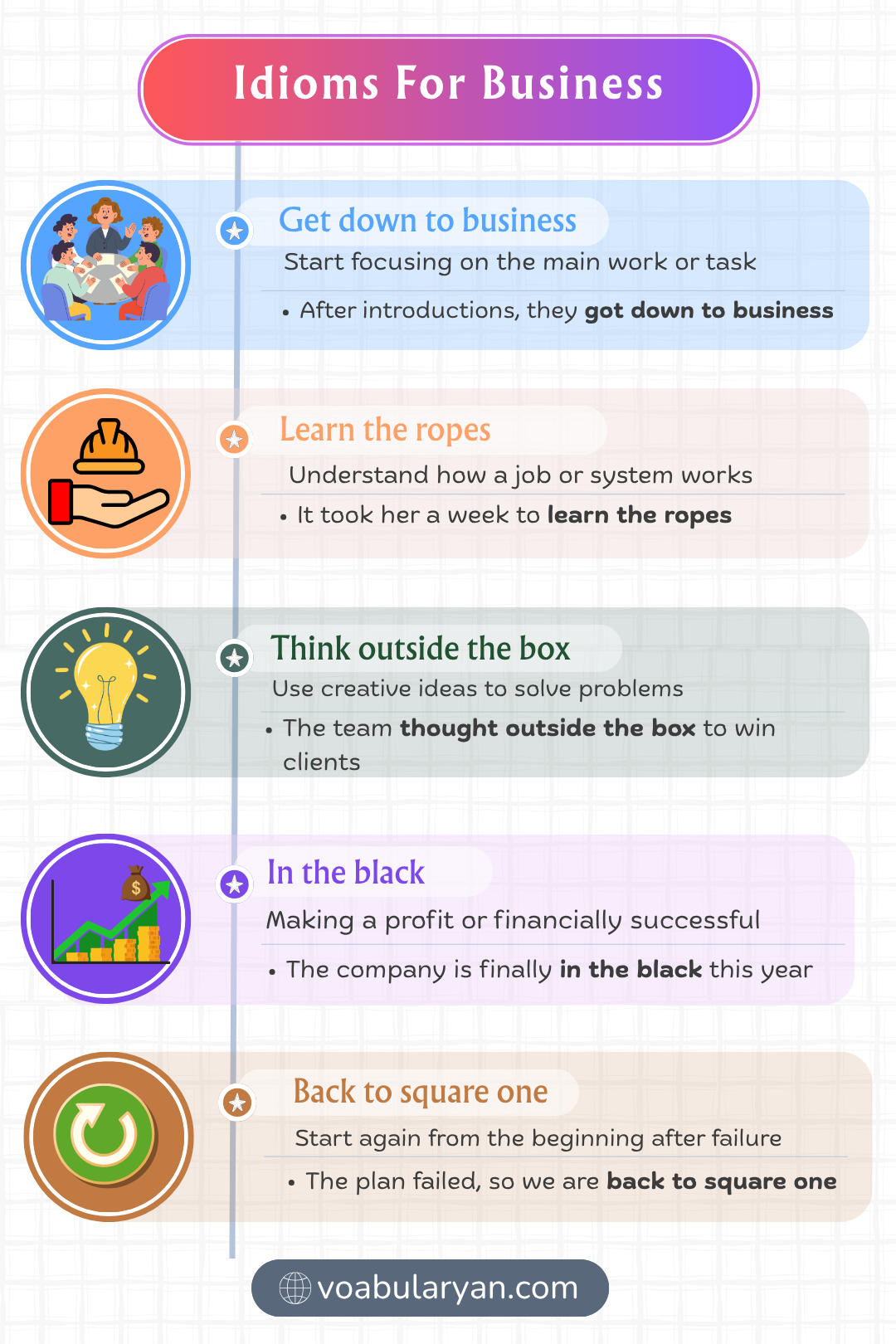
Idioms For Business Meetings And Communication
Break The Ice
Meaning: Start a friendly talk to reduce tension in a new situation.
When To Use It: When people feel awkward, and someone starts an easy first conversation.
Collocations: break the ice with, break the ice by, break the ice at, help break the ice
Example Sentences:
- She Break The Ice by asking a friendly question.
- A quick joke helped Break The Ice in the meeting.
Dialogue:
Amina: The room feels so quiet and tense.
Bilal: Let’s Break The Ice with introductions and a short laugh.
Closest Alternatives:
- start a conversation
- ease the tension
Touch Base
Meaning: Make brief contact to share updates or confirm plans.
When To Use It: When a short message or call is enough to stay connected.
Collocations: touch base with, touch base about, touch base on, touch base later
Example Sentences:
- I will Touch Base with her after lunch about the schedule.
- They Touch Base on Friday to confirm the final details.
Dialogue:
Hina: Do you know what time the client is arriving?
Omar: Not yet, I will Touch Base with them now.
Closest Alternatives:
- check in
- get in touch
In The Loop
Meaning: Included in information and updates about what is happening.
When To Use It: When someone needs news or details to follow a plan.
Collocations: keep someone in the loop, stay in the loop, be in the loop, out of the loop
Example Sentences:
- Please keep me In The Loop about any changes.
- She was In The Loop, so she knew the decision early.
Dialogue:
Sara: Why did I hear about this so late?
Usman: Sorry, you were not In The Loop on that message chain.
Closest Alternatives:
- informed
- up to date
On The Same Page
Meaning: Agreeing and sharing the same understanding about something.
When To Use It: When people need matching goals, roles, or expectations.
Collocations: be on the same page, get on the same page, stay on the same page, on the same page about
Example Sentences:
- Before we start, let’s get On The Same Page about the goal.
- The team was On The Same Page, so the work moved faster.
Dialogue:
Nadia: Are we presenting one plan or two options?
Rafael: One plan, and we are On The Same Page now.
Closest Alternatives:
- agree
- share the same understanding
Cut To The Chase
Meaning: Get to the main point without extra details.
When To Use It: When time is short and the key message matters most.
Collocations: cut to the chase and, cut to the chase about, cut to the chase here, let’s cut to the chase
Example Sentences:
- Let’s Cut To The Chase and talk about the price.
- She Cut To The Chase and said the project was delayed.
Dialogue:
Mariam: Can you explain what you really want from us?
Tariq: Sure, I will Cut To The Chase and say it plainly.
Closest Alternatives:
- get to the point
- be direct
Idioms For Business Starts And Momentum
Get The Ball Rolling
Meaning: Start something so progress can begin.
When To Use It: When a plan needs a first action to move forward.
Collocations: get the ball rolling on, get the ball rolling with, get the ball rolling by, help get the ball rolling
Example Sentences:
- Let’s Get The Ball Rolling with a quick call this morning.
- One email Get The Ball Rolling on the new schedule.
Dialogue:
Nadia: Are we waiting for the final approval?
Haris: No, Get The Ball Rolling and we can adjust later.
Closest Alternatives:
- kick things off
- start things up
Hit The Ground Running
Meaning: Begin quickly and do well from the start.
When To Use It: When someone starts a role or task and performs strongly right away.
Collocations: hit the ground running in, hit the ground running on, ready to hit the ground running, hit the ground running from day one
Example Sentences:
- She Hit The Ground Running and finished the report on her first day.
- The team Hit The Ground Running after training and met the deadline.
Dialogue:
Amina: How is the new hire doing so far?
Bilal: He Hit The Ground Running and solved problems fast.
Closest Alternatives:
- start strong
- get off to a fast start
Jump On The Bandwagon
Meaning: Join something popular because many others are doing it.
When To Use It: When people follow a trend mainly to fit in or not miss out.
Collocations: jump on the bandwagon and, jump on the bandwagon to, jump on the bandwagon with, quick to jump on the bandwagon
Example Sentences:
- He Jump On The Bandwagon and bought the shoes everyone posted online.
- Many brands Jump On The Bandwagon once the style became popular.
Dialogue:
Sana: Why did she start liking that team suddenly?
Kamran: She Jump On The Bandwagon after they began winning.
Closest Alternatives:
- follow the crowd
- join the trend
Idioms For Business Decisions And Responsibility
Call The Shots
Meaning: Control decisions and tell others what will happen.
When To Use It: When one person or group has the main authority in a situation.
Collocations: call the shots in, call the shots on, call the shots for, let someone call the shots
Example Sentences:
- In that meeting, she Call The Shots and set the final plan.
- The director Call The Shots on the budget and the timeline.
Dialogue:
Hina: Why did the team change the design so fast?
Omar: The client Call The Shots, so we followed their choice.
Closest Alternatives:
- be in control
- make the decisions
The Ball Is In Your Court
Meaning: It is your turn to act or decide what happens next.
When To Use It: When responsibility shifts to another person after an offer or request.
Collocations: the ball is in your court now, the ball is in your court to, the ball is in your court after, put the ball in your court
Example Sentences:
- We sent the contract, so The Ball Is In Your Court now.
- I gave my answer, and The Ball Is In Your Court to respond.
Dialogue:
Ayesha: I shared the dates and the budget range.
Bilal: Great, The Ball Is In Your Court to pick one option.
Closest Alternatives:
- it’s up to you
- your move
Bite The Bullet
Meaning: Face something hard and do it without more delay.
When To Use It: When an unpleasant task cannot be avoided and must be done.
Collocations: bite the bullet and, bite the bullet on, bite the bullet about, finally bite the bullet
Example Sentences:
- He Bite The Bullet and admitted the mistake to his boss.
- She Bite The Bullet and paid the fine the same day.
Dialogue:
Mariam: Are you still delaying the dentist visit?
Rafael: No, I will Bite The Bullet and go tomorrow morning.
Closest Alternatives:
- face it
- do the hard thing
Idioms For Business Ideas And Problem Solving
Think Outside The Box
Meaning: Think in a new way, not the usual way.
When To Use It: When a problem needs a creative answer, not the normal one.
Collocations: think outside the box to, think outside the box and, need to think outside the box, encourage someone to think outside the box
Example Sentences:
- We had to Think Outside The Box to solve the delivery delay.
- She Think Outside The Box and found a cheaper way to ship.
Dialogue:
Nadia: This plan keeps failing for the same reason.
Haris: Then we must Think Outside The Box and change the approach.
Closest Alternatives:
- think creatively
- find a new approach
Hit The Nail On The Head
Meaning: Say the exact right thing about a situation.
When To Use It: When someone explains a problem or point with perfect accuracy.
Collocations: hit the nail on the head about, hit the nail on the head with, really hit the nail on the head, you hit the nail on the head
Example Sentences:
- You Hit The Nail On The Head about why the team is stressed.
- She Hit The Nail On The Head with her quick summary.
Dialogue:
Amina: Why is the client still unhappy after the update?
Bilal: You Hit The Nail On The Head, it is the slow response time.
Closest Alternatives:
- be exactly right
- pinpoint the issue
Back To The Drawing Board
Meaning: Start again because the current plan failed.
When To Use It: When an idea does not work and a new plan is needed.
Collocations: go back to the drawing board, back to the drawing board again, send us back to the drawing board, back to the drawing board on
Example Sentences:
- The test failed, so it is Back To The Drawing Board.
- Their budget cut sent the team Back To The Drawing Board.
Dialogue:
Sana: Did the manager approve the design?
Kamran: No, it is Back To The Drawing Board after that feedback.
Closest Alternatives:
- start over
- rethink the plan
A Tough Nut To Crack
Meaning: A problem that is hard to solve or understand.
When To Use It: When something takes time, effort, or skill to figure out.
Collocations: a tough nut to crack for, be a tough nut to crack, prove a tough nut to crack, still a tough nut to crack
Example Sentences:
- The last puzzle was A Tough Nut To Crack for the whole group.
- Her silent mood was A Tough Nut To Crack that day.
Dialogue:
Hina: Why is this case taking so long?
Rashid: It is A Tough Nut To Crack, with few facts to start.
Closest Alternatives:
- hard problem
- tricky to solve
Idioms For Business Focus And Priorities
On The Back Burner
Meaning: Delayed for now, while other things get attention first.
When To Use It: When a plan is paused because a higher priority takes over.
Collocations: put it on the back burner, keep it on the back burner, on the back burner for now, leave it on the back burner
Example Sentences:
- We put the travel plan On The Back Burner until exams end.
- The team kept the redesign On The Back Burner during the busy season.
Dialogue:
Hina: Are we still starting the new project this month?
Omar: Not yet, it is On The Back Burner until the audit ends.
Closest Alternatives:
- on hold
- postponed
Keep Your Eye On The Ball
Meaning: Stay focused on what matters and avoid distractions.
When To Use It: When attention must stay sharp to reach a goal.
Collocations: keep your eye on the ball and, keep your eye on the ball during, keep your eye on the ball when, told him to keep your eye on the ball
Example Sentences:
- She told the team to Keep Your Eye On The Ball during the final week.
- He stayed calm and Keep Your Eye On The Ball in the last round.
Dialogue:
Mariam: The comments online are getting loud again.
Rafael: Ignore them and Keep Your Eye On The Ball.
Closest Alternatives:
- stay focused
- pay attention
Get Down To Business
Meaning: Stop small talk and start working seriously.
When To Use It: When it is time to focus on the main task or topic.
Collocations: get down to business and, get down to business with, time to get down to business, let’s get down to business
Example Sentences:
- After greetings, they Get Down To Business and reviewed the contract.
- We should Get Down To Business before the day gets away from us.
Dialogue:
Ayesha: Can we talk about weekend plans later?
Bilal: Sure, let’s Get Down To Business and finish this report first.
Closest Alternatives:
- get to work
- focus on the task
Idioms For Business Time And Deadlines
At The Eleventh Hour
Meaning: At the last possible moment, just before it is too late.
When To Use It: When something happens right before a deadline or final decision.
Collocations: at the eleventh hour, arrive at the eleventh hour, decide at the eleventh hour, done at the eleventh hour
Example Sentences:
- They submitted the form At The Eleventh Hour before the portal closed.
- A deal was reached At The Eleventh Hour after long talks.
Dialogue:
Nadia: Did the client finally answer?
Haris: Yes, At The Eleventh Hour, but we got the approval.
Closest Alternatives:
- at the last minute
- just in time
Burning The Midnight Oil
Meaning: Working late into the night for a long time.
When To Use It: When someone stays up late to study, finish work, or meet a deadline.
Collocations: burn the midnight oil, burning the midnight oil on, burning the midnight oil to, burn the midnight oil for
Example Sentences:
- She was Burning The Midnight Oil to finish her final report.
- He kept Burning The Midnight Oil during exam week.
Dialogue:
Amina: Why are you still awake at two?
Bilal: I am Burning The Midnight Oil to meet tomorrow’s deadline.
Closest Alternatives:
- work late
- stay up studying
Call It A Day
Meaning: Stop working for now and finish for the day.
When To Use It: When work is enough for the moment and it is time to rest.
Collocations: call it a day, decide to call it a day, let’s call it a day, ready to call it a day
Example Sentences:
- After the last task, they Call It A Day and went home.
- I will Call It A Day because the rest can wait until morning.
Dialogue:
Sana: Do we keep working or stop here?
Kamran: Let’s Call It A Day and continue tomorrow.
Closest Alternatives:
- stop for now
- wrap it up
Idioms For Business Goals And Standards
Raise The Bar
Meaning: Set a higher standard that others must reach.
When To Use It: When someone improves the expected level of quality or performance.
Collocations: raise the bar for, raise the bar in, raise the bar on, raise the bar with
Example Sentences:
- Her presentation Raise The Bar for the whole team this year.
- The new rules Raise The Bar on safety during training.
Dialogue:
Hina: Why is everyone checking every detail twice now?
Omar: The manager Raise The Bar, so the standard is higher.
Closest Alternatives:
- set a higher standard
- increase expectations
A Win-Win Situation
Meaning: A result where both sides benefit and feel satisfied.
When To Use It: When an agreement helps everyone involved, not just one side.
Collocations: a win-win situation for, create a win-win situation, a win-win situation where, a true win-win situation
Example Sentences:
- The new schedule is A Win-Win Situation for staff and customers.
- Sharing the space was A Win-Win Situation for both groups.
Dialogue:
Mariam: Why did they accept the smaller discount?
Rafael: Because it was A Win-Win Situation and kept the deal fair.
Closest Alternatives:
- mutually beneficial
- good for both sides
Idioms For Business Risk And Strategy
Put All Your Eggs In One Basket
Meaning: Rely on one plan only, so one failure ruins everything.
When To Use It: When a choice is risky because there is no backup option.
Collocations: put all your eggs in one basket and, put all your eggs in one basket by, avoid putting all your eggs in one basket, don’t put all your eggs in one basket
Example Sentences:
- He Put All Your Eggs In One Basket by investing all his savings in one shop.
- They Put All Your Eggs In One Basket when they trusted one supplier only.
Dialogue:
Nadia: Should we accept this one big client and drop the rest?
Haris: No, we cannot Put All Your Eggs In One Basket.
Closest Alternatives:
- take a big risk
- have no backup
Money Talks
Meaning: Money can influence decisions more than words or feelings.
When To Use It: When payment or wealth affects what people choose to do.
Collocations: money talks in, money talks when, money talks here, because money talks
Example Sentences:
- In that company, Money Talks and raises come fast for top sellers.
- He got special treatment because Money Talks in that place.
Dialogue:
Amina: Why did they change their mind so quickly?
Bilal: Because Money Talks, and the offer was huge.
Closest Alternatives:
- money has influence
- cash is king
Idioms For Business Work Culture And What Happens In The Background
Behind The Scenes
Meaning: Happening privately, away from public view or attention.
When To Use It: When work is done quietly by helpers, planners, or staff.
Collocations: behind the scenes work, behind the scenes effort, behind the scenes talks, behind the scenes planning
Example Sentences:
- The deal was shaped Behind The Scenes before the public meeting.
- She did Behind The Scenes work that kept the event running smoothly.
Dialogue:
Hina: How did the show run so well without delays?
Omar: A lot happened Behind The Scenes all week.
Closest Alternatives:
- privately
- out of sight
Business As Usual
Meaning: Normal activity continues, even during change or trouble.
When To Use It: When people keep working as normal despite news or problems.
Collocations: back to business as usual, keep it business as usual, carry on business as usual, return to business as usual
Example Sentences:
- After the storm passed, it was Business As Usual at the shop.
- Even with the new rules, the office stayed Business As Usual.
Dialogue:
Ayesha: Are they closing early because of the protest?
Bilal: No, it is Business As Usual today.
Closest Alternatives:
- normal routine
- as normal
Strictly Business
Meaning: Serious and professional, without personal feelings involved.
When To Use It: When keeping a conversation focused on work matters only.
Collocations: keep it strictly business, strictly business meeting, strictly business talk, make it strictly business
Example Sentences:
- Their talk stayed Strictly Business and ended in ten minutes.
- She kept it Strictly Business during the negotiation.
Dialogue:
Mariam: Are you upset with him, or is it only work?
Rafael: It is Strictly Business, nothing personal.
Closest Alternatives:
- professional only
- no personal feelings
Taking Care Of Business
Meaning: Handling tasks and responsibilities in a firm, effective way.
When To Use It: When someone is getting work done and managing duties.
Collocations: take care of business, taking care of business at, taking care of business today, time to take care of business
Example Sentences:
- She stayed late, Taking Care Of Business before the deadline.
- He is Taking Care Of Business and fixing the main issues first.
Dialogue:
Noor: Why did you skip lunch again?
Rayan: I am Taking Care Of Business before the client arrives.
Closest Alternatives:
- handle it
- get it done
Back In Business
Meaning: Working again after a pause, loss, or problem.
When To Use It: When operations return after repair, recovery, or reopening.
Collocations: back in business again, finally back in business, back in business after, get back in business
Example Sentences:
- The café is Back In Business after the power repair.
- With the new machine, the factory was Back In Business.
Dialogue:
Hina: Did the website start working again?
Omar: Yes, we are Back In Business at last.
Closest Alternatives:
- up and running
- operating again
Go About Your Business
Meaning: Continue your work or daily activity without stopping.
When To Use It: When someone carries on normally and does not get involved.
Collocations: go about your business as usual, go about your business quietly, go about your business without, went about his business
Example Sentences:
- After the warning, they went Go About Your Business calmly.
- She told them to Go About Your Business and not gather around.
Dialogue:
Amina: Should we stay and watch what is happening?
Bilal: No, just Go About Your Business and keep moving.
Closest Alternatives:
- carry on
- continue as normal
This Line Of Business
Meaning: A type of work or industry someone is involved in.
When To Use It: When talking about the field of work a person or company does.
Collocations: in this line of business, in that line of business, work in this line of business, succeed in this line of business
Example Sentences:
- In This Line Of Business, trust matters as much as price.
- She learned a lot from mistakes in This Line Of Business.
Dialogue:
Mariam: Why do they check every detail so carefully?
Rafael: In This Line Of Business, one error can cost a lot.
Closest Alternatives:
- this field
- this industry
Idioms For Business Boundaries And Personal Space
Mind Your Own Business
Meaning: Stop interfering and focus on your own matters.
When To Use It: When someone is being nosy or asking personal questions.
Collocations: mind your own business and, tell someone to mind your own business, just mind your own business, should mind your own business
Example Sentences:
- He told her to Mind Your Own Business when she asked about his pay.
- I said Mind Your Own Business after the third rude question.
Dialogue:
Nadia: Why are you reading my messages?
Haris: Sorry, I will Mind Your Own Business from now on.
Closest Alternatives:
- stay out of it
- keep your nose out
A Dirty Business
Meaning: An activity linked to dishonest or immoral behavior.
When To Use It: When talking about deals or actions that feel unfair or corrupt.
Collocations: a dirty business, a dirty business of, get into a dirty business, politics is a dirty business
Example Sentences:
- He said the deal was A Dirty Business and refused to sign.
- Bribery is A Dirty Business that harms everyone involved.
Dialogue:
Mina: Why did she quit that company so fast?
Adil: She said it was A Dirty Business behind the scenes.
Closest Alternatives:
- corrupt work
- shady dealing
Monkey Business
Meaning: Silly or dishonest behavior that causes trouble.
When To Use It: When someone is fooling around, cheating, or acting suspiciously.
Collocations: no monkey business, stop the monkey business, some monkey business, monkey business going on
Example Sentences:
- The teacher said, “No Monkey Business,” before the test began.
- I suspect Monkey Business with those numbers in the report.
Dialogue:
Hina: Why is the cashier counting again and again?
Rashid: I do not know, but it feels like Monkey Business.
Closest Alternatives:
- foolish behavior
- dishonest tricks
Idioms For Business Intent And Seriousness
Mean Business
Meaning: Be serious and fully determined to do something.
When To Use It: When someone is not joking and expects action or results.
Collocations: mean business about, mean business when, really mean business, show you mean business
Example Sentences:
- She Mean Business about the deadline and did not accept excuses.
- He Mean Business when he said the rules would be enforced.
Dialogue:
Hina: Do you think the manager will actually change the policy?
Omar: Yes, she Mean Business this time.
Closest Alternatives:
- be serious
- be determined
We Mean Business
Meaning: A group is serious and ready to take action.
When To Use It: When a team or company wants to show firm intent.
Collocations: we mean business now, we mean business about, we mean business when, show that we mean business
Example Sentences:
- The message said, We Mean Business, and the plan started at once.
- They told the supplier, We Mean Business, and asked for a firm date.
Dialogue:
Mariam: Why did they send a formal notice so quickly?
Rafael: It signals We Mean Business and expect a response.
Closest Alternatives:
- we are serious
- we are determined
Business Before Pleasure
Meaning: Work and duties come first, before fun and leisure.
When To Use It: When responsibilities must be handled before relaxing.
Collocations: business before pleasure, it’s business before pleasure, always business before pleasure, a case of business before pleasure
Example Sentences:
- It is Business Before Pleasure until the report is finished.
- They agreed on Business Before Pleasure during the busy season.
Dialogue:
Ayesha: Are you coming to the movie tonight?
Bilal: Not yet, it is Business Before Pleasure today.
Closest Alternatives:
- duty first
- work comes first
Idioms For Business Health And Sick Leave
Under The Weather
Meaning: Feeling slightly ill and not at full strength.
When To Use It: When someone has a minor sickness and feels weak or tired.
Collocations: feel under the weather, a bit under the weather, look under the weather, be under the weather today
Example Sentences:
- She stayed home because she was Under The Weather all morning.
- I am Under The Weather, so I will rest after lunch.
Dialogue:
Nadia: You look tired, are you okay?
Haris: I am Under The Weather, so I will take it slow.
Closest Alternatives:
- not feeling well
- a bit sick
Throw In The Towel
Meaning: Give up because continuing feels too hard.
When To Use It: When someone stops trying after repeated trouble or failure.
Collocations: throw in the towel on, throw in the towel and, ready to throw in the towel, refuse to throw in the towel
Example Sentences:
- After three rejections, he almost Throw In The Towel.
- They did not Throw In The Towel even after losing money.
Dialogue:
Mina: Are you quitting the project now?
Adil: I feel like Throw In The Towel, but I will try once more.
Closest Alternatives:
- give up
- quit
Key Takeaways
This page on idioms for business brings together common expressions used for meetings, decisions, teamwork, and deadlines. Meaning depends on tone and setting, so one phrase can sound polite, firm, or blunt in different moments. Some fit spoken talk, while others suit emails or formal writing. Many idioms keep stable wording and word order, so small changes can weaken the meaning or sound unnatural. The examples show how these expressions can sit smoothly in sentences without extra wording, while keeping the point direct and professional.
FAQs
Q1. What does “cut to the chase” mean in a business meeting discussion?
It means getting to the main point without extra talk. In idioms for business, it fits meetings that are short, tense, or time-limited.
Q2. What does “touch base” mean when coworkers talk about work updates?
It means making brief contact to share an update or confirm progress. In idioms for business, it often relates to projects, follow-ups, and quick check-ins.
Q3. What does “on the same page” mean in team planning and agreement?
It means sharing the same understanding and plan. In idioms for business, it fits teamwork when roles, goals, or decisions need to match.
Q4. What does “call the shots” mean in a workplace decision situation?
It means having the power to decide what will happen. In idioms for business, it connects with leadership, authority, and final approval.
Q5. What does “raise the bar” mean when talking about work standards?
It means setting a higher level of quality or performance. In idioms for business, it fits targets, rules, and expectations that become tougher.
Q6. What does “back to the drawing board” mean after a failed plan?
It means starting again with a new plan after something does not work. In idioms for business, it matches strategy changes after weak results or mistakes.
You May Also Like
