
During a meeting, you share an idea and say, “Please listen.” The request is direct, yet it may not capture your need for real focus and full interest from the room. In tense moments like this, basic language can feel too flat for the urgency or excitement behind your words.
That is why idioms for attention appear so often in conversation and writing. These expressions describe gaining interest, drawing a crowd, or holding someone’s concentration. Some feel dramatic and bold, while others sound playful or subtle.
We’ll look at what these phrases mean, how they fit into sentences, and how they sound in short dialogue. By the end, you can express attention and engagement with language that feels natural. Here are the words that make people listen.
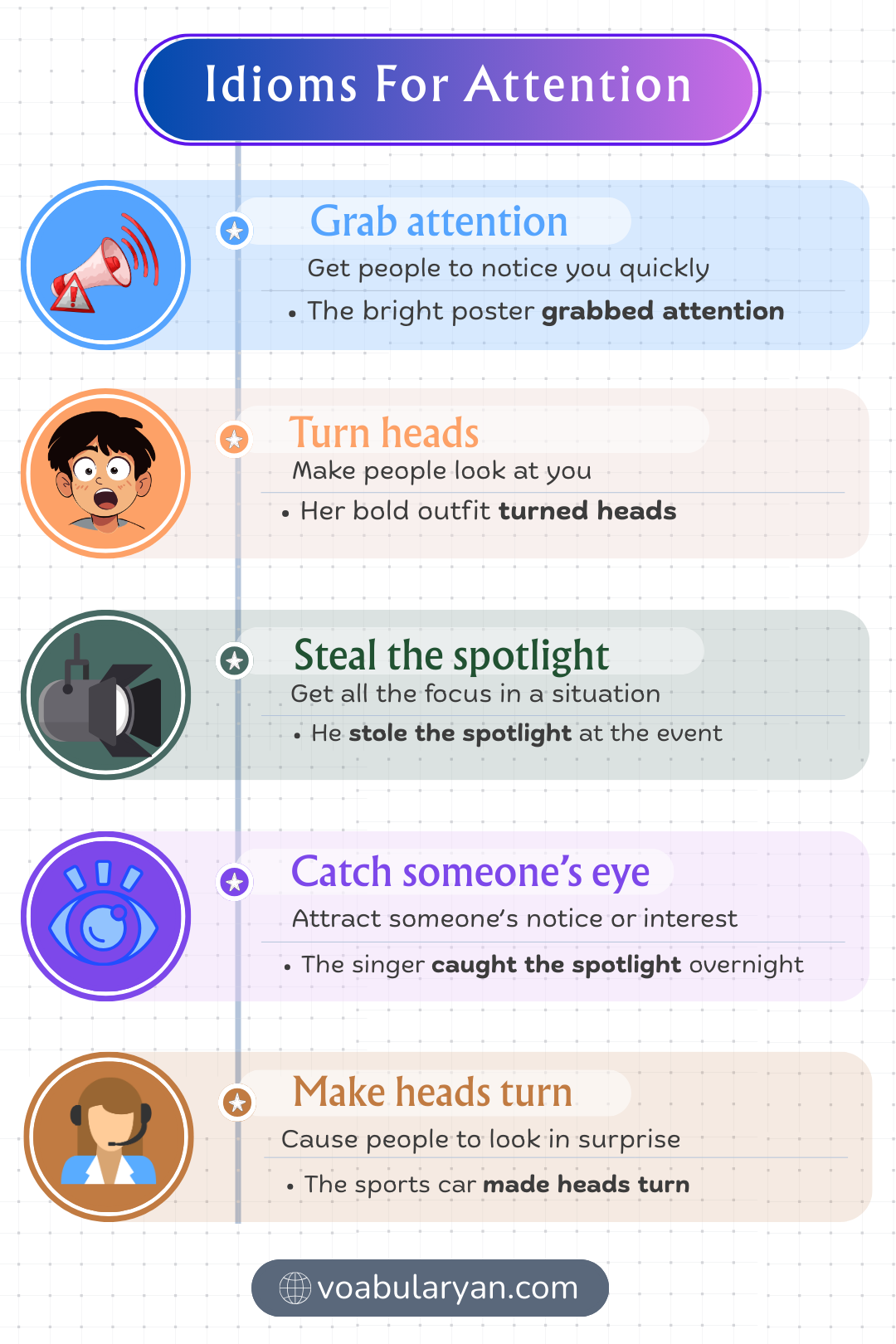
Attention Idioms For Getting Noticed
Catch Someone’s Eye
Meaning: attract someone’s attention because something looks interesting.
When To Use It: say it when a person notices something quickly in a place.
Collocations: catch someone’s eye across the room, catch someone’s eye in a shop, catch the teacher’s eye
Example Sentences:
- The bright poster caught someone’s eye near the entrance.
- Her new haircut caught someone’s eye right away.
Dialogue:
Aisha: That jacket caught someone’s eye as we walked in.
Bilal: Yes, the color stood out.
Closest Alternatives:
- grab attention
- stand out
Turn Heads
Meaning: make people look because someone or something is impressive.
When To Use It: say it when appearance or style gets noticed in public.
Collocations: turn heads on the street, turn heads at the party, turn heads with a look
Example Sentences:
- His sharp suit turned heads at the event.
- The new car turned heads as it passed.
Dialogue:
Sara: That dress really turned heads tonight.
Hamza: It had a bold look.
Closest Alternatives:
- attract looks
- draw attention
Steal The Spotlight
Meaning: take most attention away from others in a moment.
When To Use It: say it when one person becomes the main focus.
Collocations: steal the spotlight at a show, steal the spotlight during a speech, steal the spotlight from someone
Example Sentences:
- Her speech stole the spotlight at the ceremony.
- The cute puppy stole the spotlight in every photo.
Dialogue:
Mina: He stole the spotlight without trying.
Yusuf: Everyone watched his performance.
Closest Alternatives:
- outshine others
- take center stage
In The Limelight
Meaning: being watched and noticed by many people.
When To Use It: say it when someone is the focus of public attention.
Collocations: in the limelight for years, stay in the limelight, step into the limelight
Example Sentences:
- The singer stayed in the limelight after the hit song.
- She felt nervous in the limelight.
Dialogue:
Hira: Life in the limelight seems stressful.
Owais: Yes, there is constant attention.
Closest Alternatives:
- in the public eye
- in the spotlight
Draw A Crowd
Meaning: make many people gather to watch.
When To Use It: say it when an event or act attracts many viewers.
Collocations: draw a crowd quickly, draw a crowd at the market, draw a crowd outside
Example Sentences:
- The street magician drew a crowd in minutes.
- The loud music drew a crowd to the corner.
Dialogue:
Nida: That performer really drew a crowd.
Fahad: The tricks were amazing.
Closest Alternatives:
- attract people
- gather a crowd
Make A Scene
Meaning: act loudly in public and cause embarrassment.
When To Use It: say it when someone argues or reacts strongly in public.
Collocations: make a scene in public, make a scene at the store, don’t make a scene
Example Sentences:
- He made a scene at the counter over a small mistake.
- She tried not to make a scene in front of everyone.
Dialogue:
Zain: He made a scene over nothing.
Farah: Yes, it became very awkward.
Closest Alternatives:
- cause a fuss
- create a disturbance
Attention Idioms For Signs That Stand Out
Wave A Red Flag
Meaning: show a warning sign that something may be wrong.
When To Use It: use it when a detail suggests risk, trouble, or dishonesty.
Collocations: wave a red flag for safety, wave a red flag in a relationship, wave a red flag during talks
Example Sentences:
- His sudden change of story waved a red flag for me.
- The missing receipt waved a red flag during the review.
Dialogue:
Mariam: That message waved a red flag for me.
Hassan: Yes, it sounds suspicious.
Closest Alternatives:
- signal a warning
- set off alarm bells
Raise Eyebrows
Meaning: cause surprise, doubt, or mild shock in others.
When To Use It: use it when something seems unusual or unexpected.
Collocations: raise eyebrows at a decision, raise eyebrows with a comment, raise eyebrows among friends
Example Sentences:
- Her sudden decision raised eyebrows at the meeting.
- The high price raised eyebrows in the store.
Dialogue:
Sana: That announcement raised eyebrows.
Bilal: It was a surprising move.
Closest Alternatives:
- surprise people
- cause suspicion
Attention Idioms For When Something Feels Familiar
Ring A Bell
Meaning: seem familiar, but the exact memory is not clear.
When To Use It: use it when a name, place, or idea feels known.
Collocations: ring a bell for me, ring a bell vaguely, ring a bell from school
Example Sentences:
- That actor’s name rings a bell, but I cannot place it.
- The street name rings a bell from our last trip.
Dialogue:
Ayesha: Does “Mr. Carter” ring a bell?
Usman: Yes, I remember the name, not the face.
Closest Alternatives:
- sound familiar
- remind me
Make Waves
Meaning: cause strong public reaction or create noticeable change.
When To Use It: use it when actions bring attention, impact, or trouble.
Collocations: make waves in the office, make waves with a new idea, make waves in the industry
Example Sentences:
- Her bold speech made waves in the community.
- The new rule made waves at work.
Dialogue:
Nadia: That plan will make waves.
Hamza: Yes, it will bring attention fast.
Closest Alternatives:
- cause a stir
- create an impact
Attention Idioms For Listening Closely
Lend An Ear
Meaning: listen with care to what someone is saying.
When To Use It: say it when someone needs attention, comfort, or a patient listener.
Collocations: lend an ear to a friend, lend an ear for a minute, lend an ear to complaints
Example Sentences:
- She lent an ear when I talked about my worries.
- Please lend an ear while I explain the problem.
Dialogue:
Mariam: Can you lend an ear for a moment?
Usman: Yes, I am ready to listen.
Closest Alternatives:
- listen closely
- hear someone out
All Ears
Meaning: fully ready and eager to listen.
When To Use It: say it when someone wants to hear the details.
Collocations: be all ears, I’m all ears, we’re all ears
Example Sentences:
- Tell me the plan, I’m all ears.
- When she started the story, we were all ears.
Dialogue:
Hina: I have news about the trip.
Saad: Great, I’m all ears.
Closest Alternatives:
- listening closely
- eager to hear
Perk Up Your Ears
Meaning: start listening more carefully because something is important.
When To Use It: say it when new details sound interesting or serious.
Collocations: perk up your ears at a name, perk up your ears when news arrives
Example Sentences:
- He perked up his ears when he heard his name.
- She perked up her ears at the mention of free tickets.
Dialogue:
Anaya: He perked up his ears at that offer.
Bilal: Yes, it caught his interest fast.
Closest Alternatives:
- pay attention
- listen up
Ears Pricked Up
Meaning: suddenly listening because something sounded interesting.
When To Use It: say it when someone becomes alert after a sound or word.
Collocations: ears pricked up at a noise, ears pricked up when a topic came up
Example Sentences:
- My ears pricked up when I heard my favorite song.
- Her ears pricked up at the word “winner.”
Dialogue:
Zoya: My ears pricked up when I heard that name.
Hassan: Mine too, it sounded important.
Closest Alternatives:
- become alert
- listen closely
Attention Idioms For Staying Alert And Informed
Keep Your Ear To The Ground
Meaning: stay alert for news or hints about what is happening.
When To Use It: use it when waiting for updates or early signs.
Collocations: keep your ear to the ground for news, keep your ear to the ground about changes, keep your ear to the ground at work
Example Sentences:
- I kept my ear to the ground for any update on the schedule.
- She kept her ear to the ground about the new rules.
Dialogue:
Fatima: I kept my ear to the ground all week.
Saad: Good, early news matters here.
Closest Alternatives:
- stay informed
- listen for news
Keep An Ear Out
Meaning: listen carefully for a sound, name, or message.
When To Use It: use it when expecting something to be heard soon.
Collocations: keep an ear out for a call, keep an ear out for announcements, keep an ear out for footsteps
Example Sentences:
- Please keep an ear out for my name at the desk.
- He kept an ear out for the doorbell.
Dialogue:
Hira: Keep an ear out for the delivery.
Ali: Sure, I will listen for the bell.
Closest Alternatives:
- listen for
- watch for (informal)
Attention Idioms For Ignoring Or Not Listening
Fall On Deaf Ears
Meaning: be ignored, even though it is said seriously.
When To Use It: use it when warnings or requests get no response.
Collocations: fall on deaf ears at work, fall on deaf ears in the family, fall on deaf ears despite warnings
Example Sentences:
- My warning fell on deaf ears during the meeting.
- Her request fell on deaf ears at home.
Dialogue:
Sara: My advice fell on deaf ears again.
Imran: That must feel frustrating.
Closest Alternatives:
- be ignored
- be brushed off
Turn A Deaf Ear
Meaning: refuse to listen to something on purpose.
When To Use It: use it when someone ignores words deliberately.
Collocations: turn a deaf ear to complaints, turn a deaf ear to advice, turn a deaf ear to criticism
Example Sentences:
- He turned a deaf ear to the complaints.
- She turned a deaf ear to rude comments.
Dialogue:
Nadia: He turned a deaf ear to my point.
Omar: He chose to ignore the truth.
Closest Alternatives:
- ignore on purpose
- brush off
Listen With Half An Ear
Meaning: listen without full attention.
When To Use It: use it when someone is distracted while listening.
Collocations: listen with half an ear during calls, listen with half an ear while working, listen with half an ear to the news
Example Sentences:
- I listened with half an ear while cooking dinner.
- She listened with half an ear and missed the details.
Dialogue:
Amina: I listened with half an ear to the talk.
Bilal: That is why the details slipped by.
Closest Alternatives:
- not pay attention
- only partly listen
Go In One Ear And Out The Other
Meaning: be heard but not remembered or followed.
When To Use It: use it when words are quickly forgotten.
Collocations: go in one ear and out the other with kids, go in one ear and out the other during lectures
Example Sentences:
- My reminders went in one ear and out the other.
- His advice went in one ear and out the other yesterday.
Dialogue:
Hassan: It went in one ear and out the other.
Mariam: Then the message did not stick.
Closest Alternatives:
- be forgotten quickly
- not sink in
Key Takeaways
This set covers common ways English talks about being noticed, watching closely, and pulling focus in a moment. Meaning depends on tone and the situation, so the same idea can sound light, serious, or suspicious. Many fixed phrases keep stable wording and word order, so small changes can make them sound unusual. The examples reflect everyday moments such as a surprising comment, a warning sign, or a name that feels familiar, and they can fit both conversation and simple writing.
FAQs
Q1. What does “all eyes on me” mean?
It means everyone is watching one person. In idioms for attention, it fits moments like walking onto a stage or entering a room where people turn and look.
Q2. What does “steal the show” mean?
It means one person or thing gets the most notice and praise. In idioms for attention, it can be a singer, a speaker, or even a funny moment that stands out.
Q3. What does “in the spotlight” mean?
It means being the main focus of attention. In idioms for attention, it can describe a performer, a winner, or someone being talked about by everyone.
Q4. What does “make a scene” mean?
It means acting loudly in public so people notice, often in an awkward way. In idioms for attention, it can be shouting in a store or arguing in front of others.
Q5. What does “draw the line” mean in attention situations?
It means setting a firm limit when attention or behavior goes too far. In idioms for attention, it can sound like “I draw the line at rude jokes.”
Q6. What does “take center stage” mean?
It means becoming the main focus in a place or event. In idioms for attention, it can describe a person leading a talk or an idea becoming the main topic.
You May Also Like