
You finish a conversation, gather your things, and say, “I have to go.” The words are correct, yet they rarely capture the feeling of departure and the quiet emotion that can come with leaving. Sometimes it feels casual and quick, and other times it carries a deeper sense of moving on.
That is where idioms for leaving become useful in learning English. These expressions appear when people talk about goodbyes, sudden exits, or the moment someone decides to move on. Some sound light and friendly, while others reflect a sense of finality.
We’ll look at how these phrases work in everyday sentences and short dialogue. You’ll sense when one fits a quick exit and when another expresses a more lasting farewell. Here are the words that capture the moment of leaving.
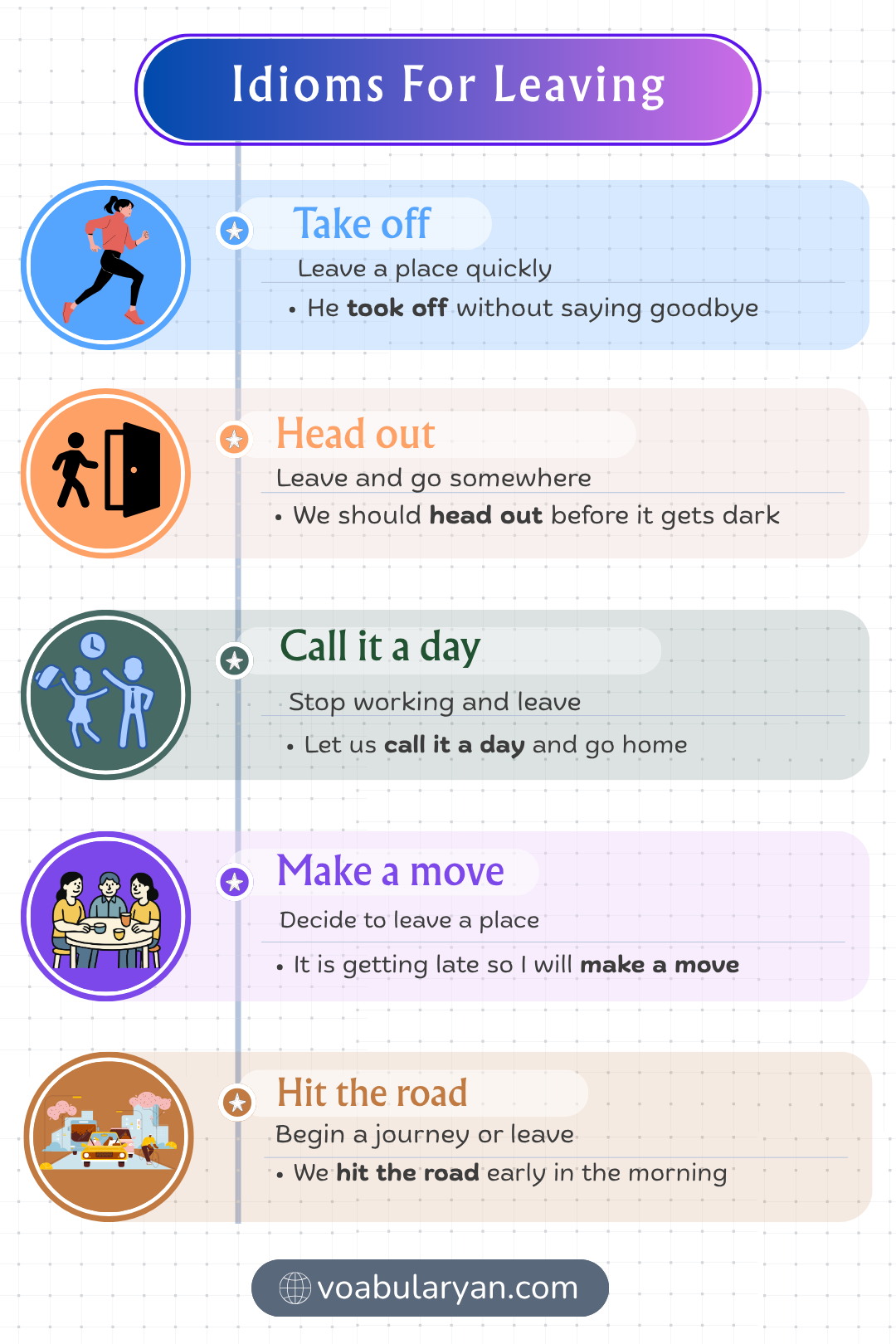
Leaving Idioms For Leaving Quickly
Take Off
Meaning: Leave suddenly or begin quickly after a slow start.
When To Use It: When someone departs fast, or progress begins fast after waiting.
Collocations: take off quickly, take off early, take off for, take off from
Example Sentences:
- We Take Off at dawn to avoid traffic on the highway.
- Sales Take Off after the ad ran during the final game.
Dialogue:
Nadia: Are we leaving now or after lunch?
Omar: We should Take Off now before the rain starts.
Closest Alternatives:
- leave quickly
- speed up
Make Tracks
Meaning: Leave a place quickly, often without waiting.
When To Use It: When it is time to go, especially because of urgency.
Collocations: make tracks for, make tracks home, make tracks now, make tracks out of
Example Sentences:
- It is getting late, so we should Make Tracks soon.
- He saw the storm clouds and Make Tracks toward the station.
Dialogue:
Hina: Do you want another coffee?
Bilal: No, let’s Make Tracks before the shops close.
Closest Alternatives:
- head out
- leave in a hurry
Bail Out
Meaning: Leave a bad situation suddenly to avoid more trouble.
When To Use It: When plans go wrong and staying would cause more problems.
Collocations: bail out of, bail out early, bail out at the last minute, bail out on
Example Sentences:
- I had to Bail Out of the meeting when my child got sick.
- He Bail Out at the last minute when the plan felt unsafe.
Dialogue:
Sara: Why did he disappear during the trip?
Usman: He Bail Out when the weather turned rough.
Closest Alternatives:
- back out
- pull out
Get Going
Meaning: Start moving or start an activity without more delay.
When To Use It: When action begins after waiting, planning, or resting.
Collocations: get going now, get going soon, get going again, get going with
Example Sentences:
- We should Get Going before the line gets too long.
- After a short rest, she Get Going and finished the last section.
Dialogue:
Areeba: Are you ready, or still packing?
Sameer: Ready, let’s Get Going before it gets dark.
Closest Alternatives:
- start off
- set off
Head For The Hills
Meaning: Leave quickly to avoid danger or serious trouble.
When To Use It: When a situation feels risky and escape feels urgent.
Collocations: head for the hills when, head for the hills and, told them to head for the hills
Example Sentences:
- When the fight started, they Head For The Hills at once.
- He saw the police lights and Head For The Hills quickly.
Dialogue:
Noor: That crowd is getting loud and angry.
Rayan: Then Head For The Hills before it turns ugly.
Closest Alternatives:
- run away
- get out fast
Take A Hike
Meaning: Go away and stop bothering someone.
When To Use It: When someone is annoyed and wants the other person to leave.
Collocations: tell someone to take a hike, take a hike and, took a hike
Example Sentences:
- He kept teasing her, so she said, Take A Hike.
- The salesman would not stop, so she told him, Take A Hike.
Dialogue:
Hassan: He is still asking for money again.
Zara: Tell him to Take A Hike and close the door.
Closest Alternatives:
- go away
- get lost
Take Flight
Meaning: Leave quickly, or begin to succeed and grow fast.
When To Use It: When someone escapes fast, or when progress becomes rapid.
Collocations: take flight quickly, take flight after, take flight from, take flight in
Example Sentences:
- At the first shout, the crowd Take Flight toward the exits.
- Her business began to Take Flight after the second year.
Dialogue:
Mariam: Did the plan finally start working?
Tariq: Yes, it Take Flight once the funding arrived.
Closest Alternatives:
- take off
- flee
Dash Off
Meaning: Leave quickly, or write something quickly without much time.
When To Use It: When someone hurries away, or produces writing in a rush.
Collocations: dash off to, dash off a note, dash off home, dash off quickly
Example Sentences:
- I had to Dash Off to the bank before it closed.
- She Dash Off a short note and sent it right away.
Dialogue:
Sadia: Can you stay for ten more minutes?
Kamil: Sorry, I must Dash Off to pick up my sister.
Closest Alternatives:
- hurry off
- scribble quickly
Make A Break For It
Meaning: Try to escape quickly when a chance appears.
When To Use It: When a brief opening makes escape possible.
Collocations: make a break for it, make a break for it when, make a break for it and, made a break for it
Example Sentences:
- When the gate opened, they Make A Break For It at once.
- He waited, then Make A Break For It when the guard turned away.
Dialogue:
Lina: The door is open for a second.
Rashid: Now, Make A Break For It before it closes again.
Closest Alternatives:
- bolt
- make a run for it
Leaving Idioms For Leaving Quietly
Duck Out
Meaning: Leave quietly to avoid attention or an unwanted task.
When To Use It: When someone exits early to avoid talk, duty, or awkward moments.
Collocations: duck out of, duck out early, duck out before, duck out for a minute
Example Sentences:
- He Duck Out of the meeting before questions started.
- She Duck Out early to avoid the long goodbye.
Dialogue:
Mina: Where did he go after the speech ended?
Adnan: He Duck Out to avoid the crowd.
Closest Alternatives:
- sneak out
- slip away
Slip Away
Meaning: Leave quietly and smoothly, without anyone noticing.
When To Use It: When a person wants a quiet exit without questions or attention.
Collocations: slip away from, slip away quietly, slip away unnoticed, slip away for a moment
Example Sentences:
- She Slip Away from the party before the photos began.
- He tried to Slip Away quietly after dinner ended.
Dialogue:
Saira: Did you say goodbye to everyone before leaving?
Naveed: No, I Slip Away to keep it low-key.
Closest Alternatives:
- sneak off
- duck out
Slip Out
Meaning: Leave for a short time, usually without making it obvious.
When To Use It: When someone steps out briefly during an event or busy moment.
Collocations: slip out of, slip out for, slip out quietly, slip out the back
Example Sentences:
- I Slip Out for water during the long lecture.
- He Slip Out of the shop to take a quick call.
Dialogue:
Hina: Why did you miss the last two minutes?
Danish: I Slip Out for a quick call.
Closest Alternatives:
- step out
- duck out
Skip Out
Meaning: Leave suddenly without permission, duty, or paying what is owed.
When To Use It: When someone avoids responsibility by leaving at the wrong time.
Collocations: skip out on, skip out of, skip out early, skip out without paying
Example Sentences:
- He Skip Out on the bill and caused a big argument.
- She did not Skip Out on work, even when tired.
Dialogue:
Noor: Why is the manager so upset right now?
Rayan: Someone Skip Out on the payment again.
Closest Alternatives:
- bail out
- walk out
Fade Away
Meaning: Become weaker until it almost disappears from attention.
When To Use It: When feelings, memories, or interest slowly lose strength over time.
Collocations: fade away slowly, fade away over time, fade away into, begin to fade away
Example Sentences:
- The excitement began to Fade Away after the first week.
- Her worries Fade Away once she heard the good news.
Dialogue:
Adeel: Are you still angry about that comment?
Rida: No, it will Fade Away with time.
Closest Alternatives:
- die down
- wear off
Drift Off
Meaning: Fall asleep slowly, often without meaning to.
When To Use It: When tiredness takes over during quiet moments or late nights.
Collocations: drift off to sleep, drift off during, drift off in class, drift off on the sofa
Example Sentences:
- He Drift Off during the movie after a long day.
- She Drift Off to sleep while the rain tapped the window.
Dialogue:
Mariam: Did you finish the book last night?
Owais: No, I Drift Off after a few pages.
Closest Alternatives:
- fall asleep
- nod off
Leaving Idioms For Ending Something And Heading Out
Call It A Day
Meaning: Stop working now because enough has been done for today.
When To Use It: When work is finished, or energy is low, and stopping feels right.
Collocations: call it a day early, call it a day after, call it a day and, decide to call it a day
Example Sentences:
- After the final email, we Call It A Day and leave the office.
- She checks the last detail, then Call It A Day before dinner.
Dialogue:
Hannah: We fixed the main issue, should we continue?
Omar: No, let’s Call It A Day and start fresh tomorrow.
Closest Alternatives:
- stop for the day
- knock off
Pack Up
Meaning: Put things away so leaving or stopping becomes possible.
When To Use It: When an activity ends and items must be gathered and stored.
Collocations: pack up and leave, pack up your things, pack up the gear, pack up for the night
Example Sentences:
- The rain started, so they Pack Up the chairs and tents.
- After class, she Pack Up her books and walks out quietly.
Dialogue:
Mina: Are we done with the booth for today?
Faisal: Yes, Pack Up the banners and the table cloth.
Closest Alternatives:
- gather your things
- put away
Pack It In
Meaning: Stop doing something, especially work, because it is ending.
When To Use It: When effort feels done, or conditions make continuing pointless.
Collocations: pack it in for today, pack it in early, tell someone to pack it in, ready to pack it in
Example Sentences:
- It is past midnight, so we should Pack It In soon.
- After the engine failed, they Pack It In and called for help.
Dialogue:
Sara: The noise is getting worse, should we keep drilling?
Bilal: No, Pack It In and we will try again tomorrow.
Closest Alternatives:
- stop working
- call it a day
Wrap Up
Meaning: Finish the last parts and bring something to an end.
When To Use It: When a task, meeting, or event is close to finishing.
Collocations: wrap up the meeting, wrap up the work, wrap up the call, wrap up quickly
Example Sentences:
- Let’s Wrap Up the meeting with the final decision.
- She Wrap Up the report and sends it before the deadline.
Dialogue:
Nadia: Do we still have more points to discuss?
Haris: Just one, then we Wrap Up and head out.
Closest Alternatives:
- finish up
- conclude
Bow Out
Meaning: Leave a role or activity in a polite, calm way.
When To Use It: When someone steps aside so others can continue without conflict.
Collocations: bow out of, bow out gracefully, bow out early, decide to bow out
Example Sentences:
- He chose to Bow Out of the contest due to injury.
- She will Bow Out after the first round and let others lead.
Dialogue:
Areeba: Why is she not joining the final meeting?
Sameer: She decided to Bow Out and avoid more tension.
Closest Alternatives:
- step aside
- withdraw
Call It Quits
Meaning: Decide to stop because continuing no longer feels worth it.
When To Use It: When someone ends an effort after repeated trouble or no progress.
Collocations: call it quits on, call it quits after, call it quits for good, ready to call it quits
Example Sentences:
- After three failed tries, he Call It Quits on fixing the old phone.
- They Call It Quits after the argument and ended the partnership.
Dialogue:
Laila: Are you still trying to repair that laptop?
Rafi: No, I will Call It Quits and buy a new one.
Closest Alternatives:
- give up
- stop trying
Leaving Idioms For Leaving And Moving On
Hit The Road
Meaning: Leave and begin a trip, often right away.
When To Use It: When someone is ready to go and wants to start traveling.
Collocations: hit the road for, hit the road to, hit the road early, time to hit the road
Example Sentences:
- We should Hit The Road before traffic gets heavy.
- They Hit The Road for Karachi at dawn.
Dialogue:
Zara: Are we leaving after breakfast or later?
Saad: Right after breakfast, then we Hit The Road.
Closest Alternatives:
- head out
- set off
Head Out
Meaning: Leave a place and go somewhere else.
When To Use It: When someone is departing, without focusing on the trip details.
Collocations: head out to, head out for, head out now, head out early
Example Sentences:
- I will Head Out to the store for milk.
- She Head Out early to catch the first bus.
Dialogue:
Amina: Where are you going with your bag?
Bilal: I will Head Out for the office right now.
Closest Alternatives:
- leave
- go out
Move On
Meaning: Leave something behind and continue forward.
When To Use It: When a person stops focusing on the past and continues with life.
Collocations: move on from, move on with, ready to move on, time to move on
Example Sentences:
- After the loss, the team chose to Move On and train again.
- She tried to Move On from the argument and stay calm.
Dialogue:
Hina: Are you still upset about that message?
Danish: A little, but I need to Move On.
Closest Alternatives:
- let it go
- put it behind you
Roll Out
Meaning: Leave or start moving, often in a casual way.
When To Use It: When someone departs or begins something, usually with ease.
Collocations: roll out of, roll out at, roll out early, roll out with
Example Sentences:
- We will Roll Out at six to avoid the rush.
- They Roll Out of the garage and turned toward the highway.
Dialogue:
Mariam: When are you leaving for the trip?
Owais: We Roll Out at sunrise, so I will sleep early.
Closest Alternatives:
- head out
- set off
Walk Away
Meaning: Leave a place or stop being involved in something.
When To Use It: When someone chooses to leave instead of arguing or continuing.
Collocations: walk away from, choose to walk away, walk away quietly, walk away and
Example Sentences:
- He decided to Walk Away from the deal after the price changed.
- She Walk Away from the argument before it got worse.
Dialogue:
Noor: Why did you stop talking to him mid-sentence?
Rayan: I had to Walk Away to stay calm.
Closest Alternatives:
- leave
- back out
Leaving Idioms For Leaving A Place For Good
Clear Out
Meaning: Leave a place quickly, often so it becomes empty.
When To Use It: When people go away fast, or when a space must be emptied.
Collocations: clear out of, clear out quickly, clear out the room, tell them to clear out
Example Sentences:
- The guard told everyone to Clear Out before the doors closed.
- We Clear Out the garage and found old photos in a box.
Dialogue:
Nadia: Why are they leaving so fast after the speech?
Omar: They want to Clear Out before the traffic starts.
Closest Alternatives:
- leave
- empty the place
Get Out Of Dodge
Meaning: Leave quickly to avoid trouble or danger.
When To Use It: When a situation feels risky and someone decides to escape.
Collocations: get out of Dodge fast, time to get out of Dodge, get out of Dodge before, need to get out of Dodge
Example Sentences:
- When the argument turned ugly, we Get Out Of Dodge right away.
- He saw the police arrive and Get Out Of Dodge in seconds.
Dialogue:
Hina: That crowd is starting to push and shout.
Bilal: Then let’s Get Out Of Dodge before it gets worse.
Closest Alternatives:
- leave fast
- make a quick exit
Leaving Idioms For Leaving Home And Independence
Leave The Nest
Meaning: Move away from home to live more independently.
When To Use It: When someone starts life on their own after living with parents.
Collocations: leave the nest, ready to leave the nest, time to leave the nest, finally left the nest
Example Sentences:
- She Leave The Nest after college and rented a small apartment.
- He plans to Leave The Nest once he finds steady work.
Dialogue:
Hina: Why is your mother packing so many things for you?
Danish: Because I will Leave The Nest next week.
Closest Alternatives:
- move out
- start living on your own
Fly The Coop
Meaning: Leave a place, often suddenly, to be free.
When To Use It: When someone escapes a situation or leaves home for independence.
Collocations: fly the coop, ready to fly the coop, try to fly the coop, finally flew the coop
Example Sentences:
- He wanted to Fly The Coop and start fresh in another city.
- The cat tried to Fly The Coop when the door was left open.
Dialogue:
Sara: Where did your brother go after the argument?
Usman: He Fly The Coop and stayed with a friend.
Closest Alternatives:
- break free
- slip away
Leaving Idioms For Quitting A Job Or Duty
Walk Off The Job
Meaning: Leave work suddenly as a protest or refusal to continue.
When To Use It: When someone quits in the middle of a shift due to anger or unfair treatment.
Collocations: walk off the job over, walk off the job after, walk off the job in protest, threaten to walk off the job
Example Sentences:
- The workers Walk Off The Job after the pay cut was announced.
- He almost Walk Off The Job when the manager shouted at him.
Dialogue:
Mariam: Why is the counter closed during work hours?
Tariq: Two staff Walk Off The Job after the argument.
Closest Alternatives:
- quit on the spot
- leave in protest
Jump Ship
Meaning: Leave a group or job to join something better.
When To Use It: When someone abandons a team, plan, or company because it looks risky.
Collocations: jump ship to, jump ship for, jump ship when, decide to jump ship
Example Sentences:
- Several employees Jump Ship to a rival company with higher pay.
- He chose to Jump Ship when the project lost funding.
Dialogue:
Hina: Why did the senior designer resign so suddenly?
Omar: She Jump Ship after hearing about the layoffs.
Closest Alternatives:
- leave for a better offer
- abandon the team
Ship Out
Meaning: Leave or be sent away, often quickly or firmly.
When To Use It: When someone is told to go somewhere else or move out.
Collocations: ship out to, ship out tomorrow, ship out at dawn, ship out orders
Example Sentences:
- He had to Ship Out at sunrise for the new assignment.
- They told him to Ship Out after the last warning.
Dialogue:
Noor: Why is he packing his bag in a hurry?
Rayan: He got orders to Ship Out tonight.
Closest Alternatives:
- head out
- be sent away
Leaving Idioms For Formal Goodbyes
Take Your Leave
Meaning: Leave politely after a visit or meeting ends.
When To Use It: When someone departs in a formal or respectful way.
Collocations: take your leave of, took my leave, take your leave politely, prepare to take your leave
Example Sentences:
- After tea, she Take Your Leave and thanked everyone warmly.
- He Take Your Leave of the manager at the office door.
Dialogue:
Mina: Are you staying for dessert too?
Adnan: No, I will Take Your Leave after this cup.
Closest Alternatives:
- excuse yourself
- leave politely
Bid Farewell
Meaning: Say goodbye in a warm or formal way.
When To Use It: When parting feels meaningful, final, or respectful.
Collocations: bid farewell to, bid farewell and, bid farewell with, bid farewell before
Example Sentences:
- They Bid Farewell to their guests at the gate.
- She Bid Farewell to her old job on her last day.
Dialogue:
Noor: Did you speak to your teacher before leaving?
Rayan: Yes, I Bid Farewell and thanked her for everything.
Closest Alternatives:
- say goodbye
- take leave
Take Leave Of
Meaning: Say goodbye to someone before leaving.
When To Use It: When the farewell is polite, careful, or a little formal.
Collocations: take leave of someone, took leave of, take leave of her, take leave of him
Example Sentences:
- He Take Leave Of his aunt before the bus arrived.
- She went upstairs to Take Leave Of her guests quietly.
Dialogue:
Hina: Why did you go back inside for a minute?
Danish: I had to Take Leave Of my uncle first.
Closest Alternatives:
- bid farewell
- say goodbye
Part Ways
Meaning: Separate and go in different directions, ending a shared path.
When To Use It: When people stop working together or stop being together.
Collocations: part ways with, part ways after, part ways peacefully, decide to part ways
Example Sentences:
- After five years, the partners chose to Part Ways.
- They Part Ways at the corner and promised to call.
Dialogue:
Amina: Are they still running the shop together?
Bilal: No, they decided to Part Ways last month.
Closest Alternatives:
- split up
- go separate ways
Leaving Idioms For Leaving By Travel Or Motion
Pull Out
Meaning: Leave or withdraw from a place, plan, or agreement.
When To Use It: When someone stops taking part after being involved already.
Collocations: pull out of, pull out at the last minute, pull out suddenly, pull out early
Example Sentences:
- The company Pull Out of the deal after the price changed.
- We had to Pull Out of the trip because the roads were closed.
Dialogue:
Amina: Are they still joining the event tomorrow?
Sameer: No, they will Pull Out because of budget issues.
Closest Alternatives:
- withdraw
- back out
Step Out
Meaning: Leave for a short time, often to get air or handle something.
When To Use It: When someone exits briefly from a room, meeting, or group.
Collocations: step out for, step out a moment, step out of, step out briefly
Example Sentences:
- She had to Step Out for a minute to take a call.
- He Step Out of the meeting when he felt dizzy.
Dialogue:
Hiba: Why did he leave right in the middle?
Kashif: He had to Step Out and speak to the receptionist.
Closest Alternatives:
- leave briefly
- go outside
Break Camp
Meaning: Pack up and leave a camping place.
When To Use It: When a group finishes camping and prepares to move on.
Collocations: break camp at dawn, break camp and move, break camp early, time to break camp
Example Sentences:
- We Break Camp at sunrise and started the hike.
- They Break Camp quickly when the weather turned cold.
Dialogue:
Nadia: Are we staying one more night by the lake?
Omar: No, we will Break Camp and head back today.
Closest Alternatives:
- pack up camp
- move on
Key Takeaways
Idioms For Leaving covers common phrases for going away, exiting early, and ending a situation. We mention different tones, from polite and formal to casual and blunt, because context changes the meaning in conversation and writing. Many keep stable wording and word order, so small changes can sound unnatural in speech or writing. Examples across the page reflect different situations, from quick departures to respectful goodbyes, while keeping meaning tied to the setting and the relationship.
FAQs
Q1. What does “hit the road” mean when someone is leaving?
“Hit the road” means leaving to start a trip or head out soon. In idioms for leaving, it often sounds casual, like friends ending a visit and going home.
Q2. What does “make tracks” mean in everyday talk?
“Make tracks” means leaving quickly, often without delay. In idioms for leaving, it fits moments like rushing to catch a bus or heading out before it gets late.
Q3. What does “take off” mean when it is not about flying?
“Take off” can mean leaving suddenly or starting to go somewhere. In idioms for leaving, it can sound a bit rushed, like walking out fast after a short talk.
Q4. What does “duck out” mean, and is it rude?
“Duck out” means leaving quietly, often without being noticed. In idioms for leaving, it can feel polite if the exit avoids disturbance, but rude if it avoids a goodbye.
Q5. What does “slip away” suggest about how someone leaves?
“Slip away” suggests a quiet, gentle exit, usually without attention. In idioms for leaving, it fits leaving a crowded place, like a party, without stopping the moment.
Q6. What does “call it a day” mean when work is ending?
“Call it a day” means stopping work or an effort because it is time to finish. In idioms for leaving, it fits ending a shift, closing a task, or wrapping up plans.
You May Also Like
