
You watch a child run across a field, laughing without worry, and say, “They’re so young.” The words are true, but they miss the bright energy and fearless curiosity that make early years what they are. Plain language often cannot reach that far.
The right idiom can. Idioms for young let you speak about children, teenagers, and anyone full of fresh hope with more color. Some sound playful and warm, while others carry a quiet reflection on passing time.
We’ll walk through each one with real examples and short conversations. You’ll sense which phrase fits a moment of pure joy and which suits a gentle thought about growing older. Here are the words that capture what it means to be young.
Youth Idioms For Feeling Young In Spirit
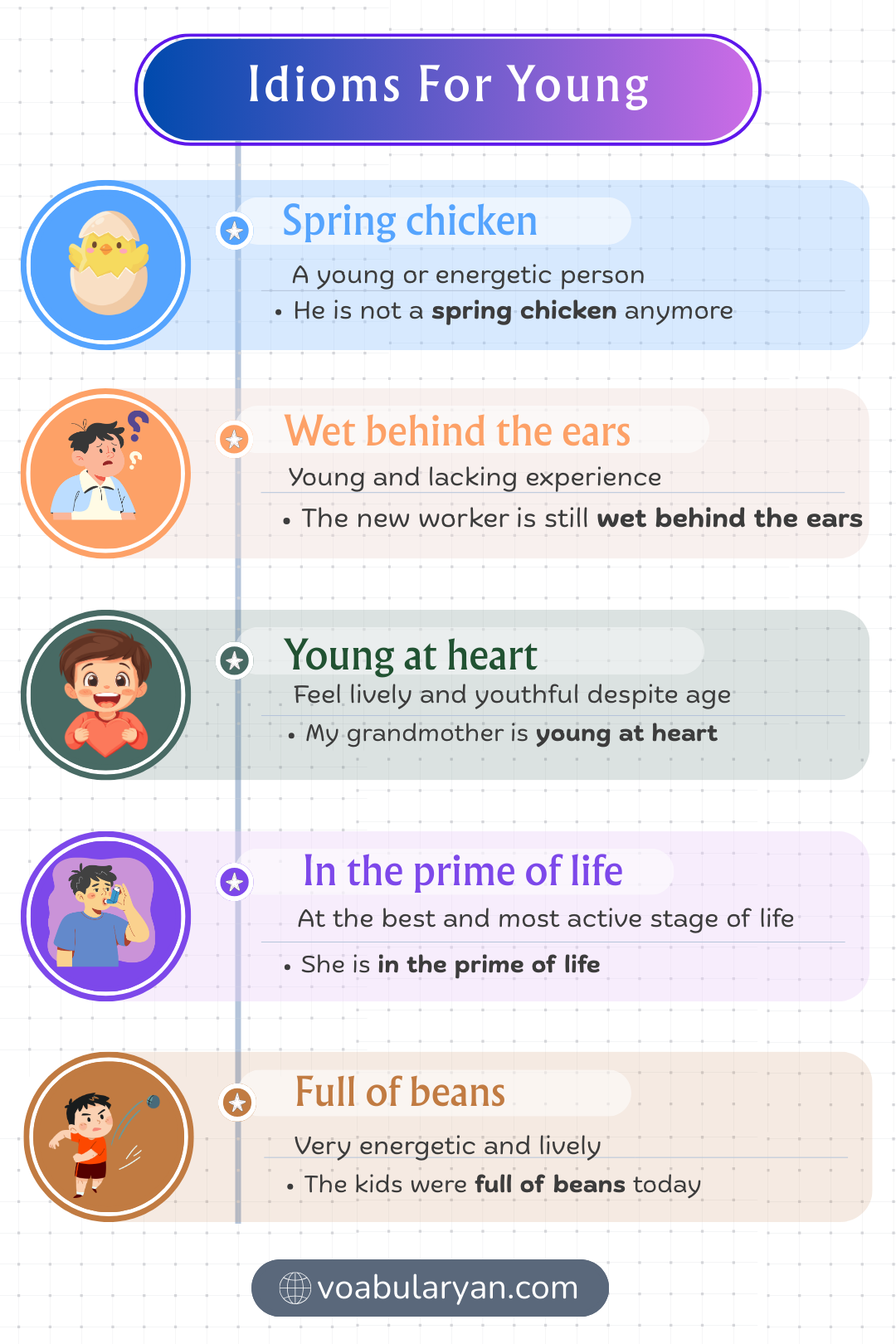
Young At Heart
Meaning: feeling youthful in spirit, even when not young.
When To Use It: say it about someone who stays playful and positive.
Collocations: stay young at heart, feel young at heart, young at heart forever
Example Sentences:
- My grandpa is young at heart and loves games.
- She feels young at heart when she dances.
Dialogue:
Hiba: Your aunt is so lively.
Saif: Yes, she is young at heart.
Closest Alternatives:
- youthful
- full of life
A Child At Heart
Meaning: having a playful nature, like a child inside.
When To Use It: say it about someone who keeps childlike joy.
Collocations: still a child at heart, remain a child at heart
Example Sentences:
- He is a child at heart and laughs at silly jokes.
- She stays a child at heart around her nephews.
Dialogue:
Mina: He collects toy cars even now.
Saad: That is because he is a child at heart.
Closest Alternatives:
lighthearted
playful
Youth Idioms For Being Energetic And New
Young Blood
Meaning: a new and energetic person in a group.
When To Use It: use it when fresh people bring new energy or ideas.
Collocations: bring in young blood, need young blood, hire young blood
Example Sentences:
- The team added Young Blood to speed up the work.
- The coach trusted Young Blood to change the game.
Dialogue:
Amina: They brought in Young Blood this season.
Hassan: Yes, the energy feels different now.
Closest Alternatives:
- fresh faces
- new talent
The Night Is Young
Meaning: it is still early, so there is time for more fun.
When To Use It: use it when plans can continue because the evening is not late.
Collocations: the night is young, since the night is young
Example Sentences:
- Let’s stay out a bit longer, The Night Is Young.
- We can talk more because The Night Is Young.
Dialogue:
Mina: Do not rush home yet, The Night Is Young.
Bilal: True, we still have time.
Closest Alternatives:
- it’s still early
- plenty of time
New Kid On The Block
Meaning: a new person or thing in a place or group.
When To Use It: use it when someone new arrives and gets noticed.
Collocations: the new kid on the block, be the new kid on the block
Example Sentences:
- The café is the New Kid On The Block in our area.
- He felt like the New Kid On The Block on his first day.
Dialogue:
Sana: I am the New Kid On The Block here.
Hamza: Give it time, you will fit in with the group.
Closest Alternatives:
- newcomer
- new arrival
Youth Idioms For Inexperience Or Being Naive
Born Yesterday
Meaning: not easily fooled, despite what someone thinks.
When To Use It: say it when rejecting a trick or a weak excuse.
Collocations: I was not born yesterday, do you think I was born yesterday
Example Sentences:
- I was not born yesterday, so I asked for the receipt.
- She was not born yesterday, and she noticed the lie.
Dialogue:
Hina: He thinks I will accept that story.
Usman: Tell him you were not born yesterday.
Closest Alternatives:
- not naive
- not easily tricked
Knee-High To A Grasshopper
Meaning: very young, still in early childhood.
When To Use It: say it when recalling someone as a small child.
Collocations: was knee-high to a grasshopper, knee-high to a grasshopper back then
Example Sentences:
- He was knee-high to a grasshopper when we moved here.
- I knew her when she was knee-high to a grasshopper.
Dialogue:
Ayesha: Do you remember Ali as a kid?
Bilal: Yes, he was knee-high to a grasshopper.
Closest Alternatives:
- very young
- just a child
Youth Idioms For Acting Your Age And Maturity
Act Your Age
Meaning: behave in a way that suits your age level.
When To Use It: say it when someone behaves too childish for their age.
Collocations: tell someone to act your age, act your age for once
Example Sentences:
- He told his brother to act your age during the ceremony.
- She said, act your age, and stop the silly arguing.
Dialogue:
Sana: He keeps making faces in class.
Bilal: Someone should tell him to act your age.
Closest Alternatives:
- behave properly
- grow up
Old Head On Young Shoulders
Meaning: a young person who thinks and acts very maturely.
When To Use It: say it when a young person shows good judgment.
Collocations: have an old head on young shoulders
Example Sentences:
- She has an old head on young shoulders and makes smart choices.
- He showed an old head on young shoulders during the crisis.
Dialogue:
Amina: He handled that problem so calmly.
Rayan: Yes, he has an old head on young shoulders.
Closest Alternatives:
- mature for their age
- wise beyond years
Wise Beyond Your Years
Meaning: showing knowledge and judgment above your age.
When To Use It: say it when a young person speaks with real insight.
Collocations: seem wise beyond your years, be wise beyond your years
Example Sentences:
- She is wise beyond your years for a fourteen-year-old.
- He sounded wise beyond your years in that talk.
Dialogue:
Hira: Her advice was calm and thoughtful.
Sameer: Yes, she is wise beyond your years.
Closest Alternatives:
- unusually mature
- old head on young shoulders
Youth Idioms For Getting Older
Not Getting Any Younger
Meaning: time is passing, so waiting too long may reduce chances.
When To Use It: use it when age or time makes delay feel risky.
Collocations: I’m not getting any younger, we’re not getting any younger, not getting any younger now
Example Sentences:
- I booked the trip because I’m Not Getting Any Younger.
- He trained again since he’s Not Getting Any Younger.
Dialogue:
Hiba: I want to start now, I’m Not Getting Any Younger.
Zeeshan: That makes sense, time keeps moving.
Closest Alternatives:
- time is running out
- time is passing
Robbing The Cradle
Meaning: dating someone much younger than oneself.
When To Use It: use it when talking about a large age gap in dating.
Collocations: accused of robbing the cradle, joked about robbing the cradle
Example Sentences:
- His friends teased him for Robbing The Cradle.
- People whispered about Robbing The Cradle at the wedding.
Dialogue:
Mina: They say he is Robbing The Cradle.
Bilal: The age gap is what sparks the talk.
Closest Alternatives:
- dating younger
- big age gap
Mutton Dressed As Lamb
Meaning: an older person trying to look much younger.
When To Use It: use it when style seems too youthful for the person’s age.
Collocations: looks like mutton dressed as lamb, called mutton dressed as lamb
Example Sentences:
- The outfit made her look like Mutton Dressed As Lamb.
- He felt like Mutton Dressed As Lamb in that flashy jacket.
Dialogue:
Areeba: That look feels like Mutton Dressed As Lamb.
Fahad: Yes, it seems too youthful for him.
Closest Alternatives:
- trying to look young
- dressing too young
Key Takeaways
This topic gathers familiar sayings about getting older, feeling time pass, and reactions to age gaps between people. Meaning depends on tone and situation, so a line can sound humorous, sharp, or plain in different moments. Many idioms keep stable wording and word order, so changing even a small part can make them sound unnatural. Across the examples, the language reflects real moments such as deciding not to wait, hearing gossip about a couple, and noticing when someone tries to look much younger, and it fits everyday conversation and simple writing.
FAQs
Q1. What does “young at heart” mean?
It means an older person still feels youthful inside. Idioms for young like this describe someone who stays playful, curious, and lively, such as joining games or laughing easily with friends.
Q2. What does “wet behind the ears” mean?
It means someone is inexperienced and new to a role. Idioms for young like this fit first jobs or first big duties, like a new worker learning rules and making small mistakes.
Q3. What does “green as grass” mean about a young person?
It means someone is very untrained and easy to mislead. Idioms for young like this can describe a beginner who believes promises too fast, like trusting a deal without checking details.
Q4. What does “no spring chicken” mean?
It means someone is not young anymore, often said in a joking tone. Idioms for young like this can sound playful, like after feeling tired during sports or a long walk.
Q5. What does “puppy love” mean?
It means a young first romance that feels strong but may not last. Idioms for young like this fit school crushes, like blushing, passing notes, and quick feelings that change.
Q6. What does “fresh out of school” mean?
It means someone has just graduated and is new to adult work life. Idioms for young like this fit first interviews or first jobs, like learning office rules and meeting deadlines.
You May Also Like