
You walk along the shore, feeling warm sand under your feet, and say, “I love the beach.” The sentence is honest, yet it barely captures the relaxed freedom and quiet joy of that moment. The beach often brings images of sunshine and waves without pressure.
That is where idioms for the beach become useful in learning English. These expressions appear when people talk about rest or a carefree mood. Some sound playful and light, while others reflect calm reflection or easy happiness.
We’ll look at how these phrases work in sentences and short dialogue. You’ll sense when one fits a peaceful afternoon and when another suits a lively holiday. Here are the words shaped by the feeling of the beach.
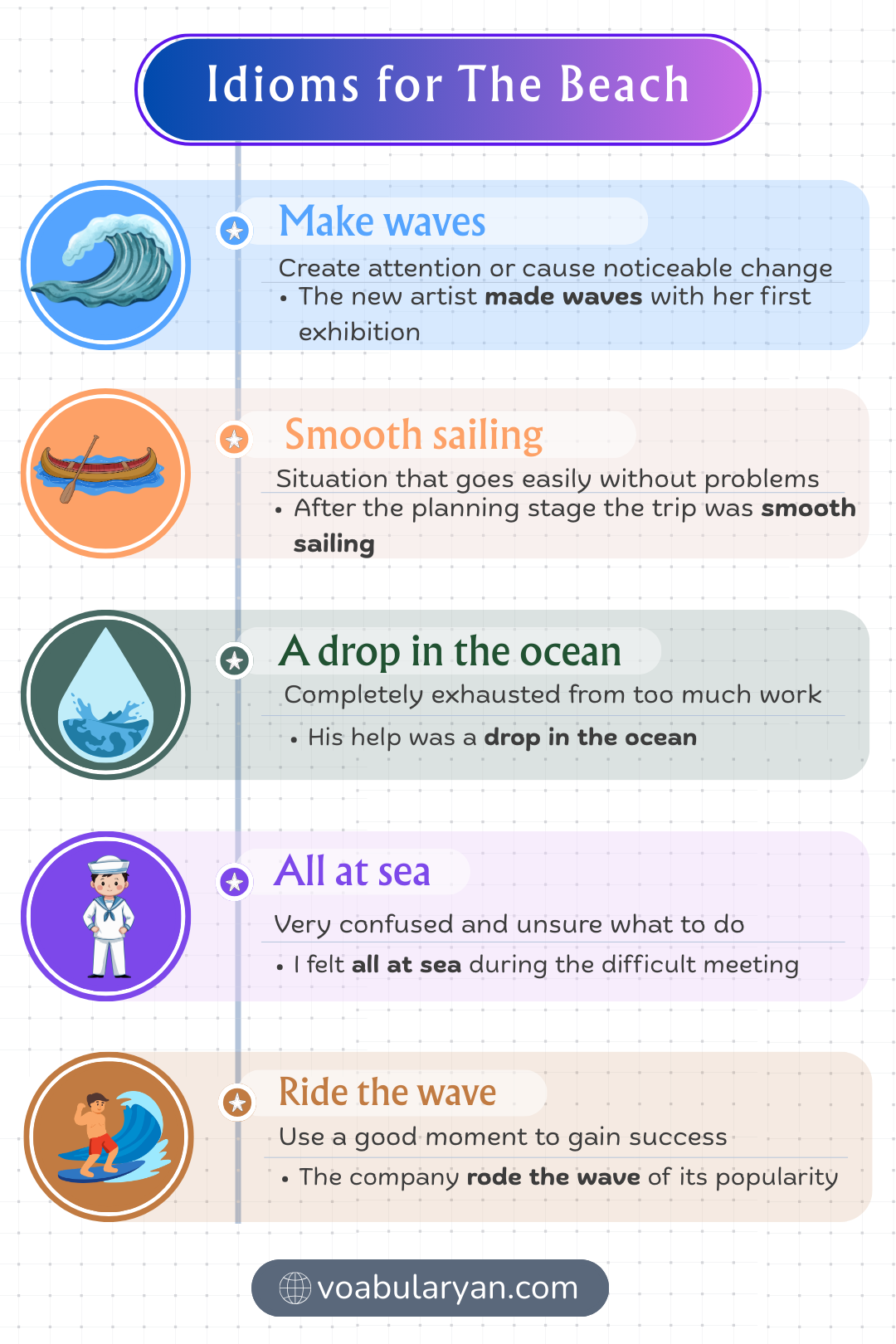
Beach Idioms for Relaxation and Enjoyment
A Day at the Beach
Meaning: a relaxed, enjoyable day spent at the beach, often associated with leisure and fun.
When To Use It: use it when referring to a stress-free, fun day spent by the water, typically relaxing.
Collocations: perfect day at the beach, have a day at the beach
Example Sentences:
- We had a perfect day at the beach with no worries.
- The kids spent the whole day at the beach playing in the sand.
Dialogue:
Tom: Let’s go for a day at the beach this weekend!
Mia: That sounds like a perfect plan.
Closest Alternatives:
- relaxing day
- beach getaway
Beach Bum
Meaning: a person who spends a lot of time at the beach, often in a laid-back, carefree manner.
When To Use It: use it to describe someone who loves the beach and enjoys the beach lifestyle.
Collocations: true beach bum, become a beach bum, beach bum lifestyle
Example Sentences:
- He’s a beach bum who never wants to leave the shore.
- She moved to the coast and became a full-time beach bum.
Dialogue:
Sara: I think I’m ready to become a beach bum.
Chris: That sounds like a dream lifestyle.
Closest Alternatives:
- beach lover
- sun seeker
Surf’s Up
Meaning: a phrase used to indicate that the waves are good for surfing, or it’s time to surf.
When To Use It: use it when the conditions are perfect for surfing or when it’s time to go surfing.
Collocations: surf’s up for surfing, surf’s up this morning
Example Sentences:
- Surf’s up! Let’s hit the waves before it gets crowded.
- He shouted, “Surf’s up,” and we ran to catch the perfect wave.
Dialogue:
Jake: Surf’s up! The waves are perfect today.
Lily: I’m ready to ride those waves.
Closest Alternatives:
- perfect waves
- time to surf
Beach Idioms for Emotions and Feelings
Walking on Sunshine
Meaning: Feeling extremely happy or full of joy.
When To Use It: Say it when someone is feeling ecstatic or in a very positive mood.
Collocations: walking on sunshine after good news, feeling like walking on sunshine, walk on sunshine all day
Example Sentences:
- She was walking on sunshine after getting the promotion.
- I’ve been walking on sunshine since I heard the news.
Dialogue:
Lily: I’m walking on sunshine today!
Jacob: That’s because of the good news you got!
Closest Alternatives:
- in a great mood
- on cloud nine
In Hot Water
Meaning: in trouble or facing a difficult situation.
When To Use It: Say it when someone is in a problematic or risky situation.
Collocations: in hot water with the boss, get in hot water, find yourself in hot water
Example Sentences:
- He’s in hot water after missing the deadline.
- She found herself in hot water over the misunderstanding.
Dialogue:
Sophia: I think I’m in hot water with the teacher.
Ethan: You need to fix the problem quickly.
Closest Alternatives:
- in trouble
- in a jam
On the Rocks
Meaning: in a difficult or unstable situation, often used for relationships.
When To Use It: Say it when something is not going well or is in danger of ending.
Collocations: relationship on the rocks, career on the rocks, marriage on the rocks
Example Sentences:
- Their relationship is on the rocks after the argument.
- His career was on the rocks because of the mistake.
Dialogue:
Mia: I think their marriage is on the rocks.
Oliver: It looks like they’re struggling to communicate.
Closest Alternatives:
- in trouble
- in a rough patch
Over the Moon
Meaning: extremely happy or delighted.
When To Use It: Say it when someone is overjoyed or thrilled about something.
Collocations: over the moon with excitement, feel over the moon, over the moon with joy
Example Sentences:
- She was over the moon when she heard the good news.
- He was over the moon after winning the game.
Dialogue:
Sophie: I’m over the moon about my promotion!
Aaron: I can see your joy!
Closest Alternatives:
- ecstatic
- thrilled
In Deep Water
Meaning: in a difficult or dangerous situation, often with serious consequences.
When To Use It: Say it when someone is facing a tough challenge or trouble.
Collocations: in deep water with the law, find yourself in deep water, get in deep water
Example Sentences:
- She’s in deep water with her manager after the mistake.
- They got in deep water with the authorities over the issue.
Dialogue:
Nina: I think I’m in deep water with the project.
John: You better act fast to resolve it.
Closest Alternatives:
- in trouble
- in a difficult situation
Beach Idioms for Risk and Opportunity
Cast Your Net
Meaning: to try to reach or gather a wide range of possibilities or opportunities.
When To Use It: use it when referring to making an effort to reach out or gather many things or people, often for a specific goal.
Collocations: cast your net wide, cast your net in search of
Example Sentences:
- He decided to cast his net in search of new business opportunities.
- By casting her net far, she found many interesting job offers.
Dialogue:
Rachel: I’ve been casting my net for a new project.
David: That’s a smart way to find the best opportunities.
Closest Alternatives:
- broaden your scope
- reach out
Jump In with Both Feet
Meaning: to commit fully to something without hesitation or fear.
When To Use It: use it when encouraging someone to dive into a situation or challenge wholeheartedly.
Collocations: jump in with both feet into a project, jump in with both feet at work
Example Sentences:
- She decided to jump in with both feet and start the new business.
- I’m ready to jump in with both feet and take on this challenge.
Dialogue:
Mia: Are you ready to start the project?
Max: I’m going to jump in with both feet and give it my best.
Closest Alternatives:
- dive in
- go all in
The Tide Is Turning
Meaning: a situation is changing for the better, or a reversal of fortune is happening.
When To Use It: use it when things are improving or when there is a shift in a situation towards a more positive direction.
Collocations: the tide is turning in favor, the tide is turning against
Example Sentences:
- After months of struggle, the tide is turning for the business.
- He finally felt like the tide was turning in his favor after the tough times.
Dialogue:
Emma: It seems like the tide is turning for us at last.
Lucas: Yes, things are finally looking up.
Closest Alternatives:
- change in fortune
- things are improving
Beach Idioms for Change and Transformation
The Tide Will Turn
Meaning: A difficult or challenging situation will improve eventually.
When To Use It: Say it when hope is rising after a tough period or when you believe things will get better.
Collocations: the tide will turn soon, wait for the tide to turn, when the tide turns
Example Sentences:
- Don’t worry, the tide will turn in your favor soon.
- After months of hard work, the tide will turn, and we’ll see results.
Dialogue:
Rachel: I feel like things will never improve.
James: Just wait, the tide will turn, you’ll see.
Closest Alternatives:
- things will get better
- a change is coming
Ebb and Flow
Meaning: the natural movement of something that increases and decreases over time, like emotions or situations.
When To Use It: Say it when describing something that changes in intensity or frequency, such as emotions, work, or life events.
Collocations: the ebb and flow of life, the ebb and flow of emotions, ebb and flow of success
Example Sentences:
- The ebb and flow of her moods can be difficult to manage.
- Life is full of ebb and flow, so we must adapt.
Dialogue:
Liam: It’s hard to stay positive sometimes.
Emma: That’s the ebb and flow of life—some days are better than others.
Closest Alternatives:
- ups and downs
- highs and lows
Beach Idioms for Struggle and Effort
Like a Fish Out of Water
Meaning: to feel uncomfortable or out of place in an unfamiliar situation.
When To Use It: use it when someone is in an environment or situation that they are not accustomed to.
Collocations: feel like a fish out of water, act like a fish out of water, put someone like a fish out of water
Example Sentences:
- I felt like a fish out of water at the new job.
- He was like a fish out of water at the party, not knowing anyone.
Dialogue:
Alice: How did you feel at your new school?
Ben: I felt like a fish out of water at first.
Closest Alternatives:
- out of place
- uncomfortable
The Calm Before the Storm
Meaning: a peaceful or quiet period before a difficult or chaotic situation begins.
When To Use It: use it when things are calm just before something challenging or intense happens.
Collocations: calm before the storm in a meeting, the calm before the storm at work
Example Sentences:
- This quiet afternoon is just the calm before the storm; the busy week starts tomorrow.
- We enjoyed the peaceful moment; it was the calm before the storm of the festival.
Dialogue:
Zoe: Things are so quiet today.
Ryan: Yes, it’s the calm before the storm; the weekend will be hectic.
Closest Alternatives:
- quiet before the chaos
- peaceful moment before trouble
Key Takeaways
This collection highlights idioms related to the beach, each capturing different aspects of life’s ebb and flow. The phrases reflect the natural movement and unpredictable nature of both emotions and situations, much like the tides. Whether it’s about facing challenges with the belief that the tide will turn or experiencing life’s natural ups and downs through the ebb and flow, these idioms remind us of the inevitable changes and opportunities for growth. Beach-themed idioms evoke both the calm and the chaotic parts of our journey.
FAQs
Q1. What does “catch some rays” mean when talking about the beach?
It means to relax and sunbathe on the beach, soaking up the sun. This is a common idiom for the beach. For example, people say it when they’re enjoying a sunny day outdoors.
Q2. What does “in the sand” refer to at the beach?
“In the sand” often refers to being directly on the beach, either lying down or playing. It’s a relaxed idiom for the beach, like when you’re lounging by the sea.
Q3. What does “walking on the beach” symbolize in idioms?
“Walking on the beach” symbolizes peaceful relaxation, often used in moments of calm. It’s one of the more serene idioms for the beach. For instance, it’s common to describe someone relaxing by the shore.
Q4. What does “shoreline stroll” mean?
A “shoreline stroll” refers to walking along the edge of the beach. It’s often used in the context of enjoying a beach day while taking in the view and the sounds of the sea.
Q5. How do people use “beachcomber” in conversation?
“Beachcomber” refers to someone who searches along the shore for interesting items. This idiom is used to describe casual beach-goers or people who enjoy collecting things from the beach.
Q6. Is “tanning on the beach” an idiom?
Yes, “tanning on the beach” refers to lying in the sun to get a tan. It’s commonly used to describe people relaxing under the sun while enjoying a day at the beach.
You May Also Like
