
You walk through a forest and say, “The trees are beautiful.” The sentence is true, yet it barely captures their quiet strength and deep roots that hold the ground in place. Trees often symbolize growth, patience, and steady life.
That is where idioms for trees become useful in learning English. These expressions appear when people talk about family, growth, or feeling lost in a crowd. Some sound calm and reflective, while others carry vivid imagery.
We’ll look at how these phrases work in sentences and short dialogue. You’ll sense when one fits a thoughtful comment and when another suits a light joke. Here are the words that grow from the image of trees.
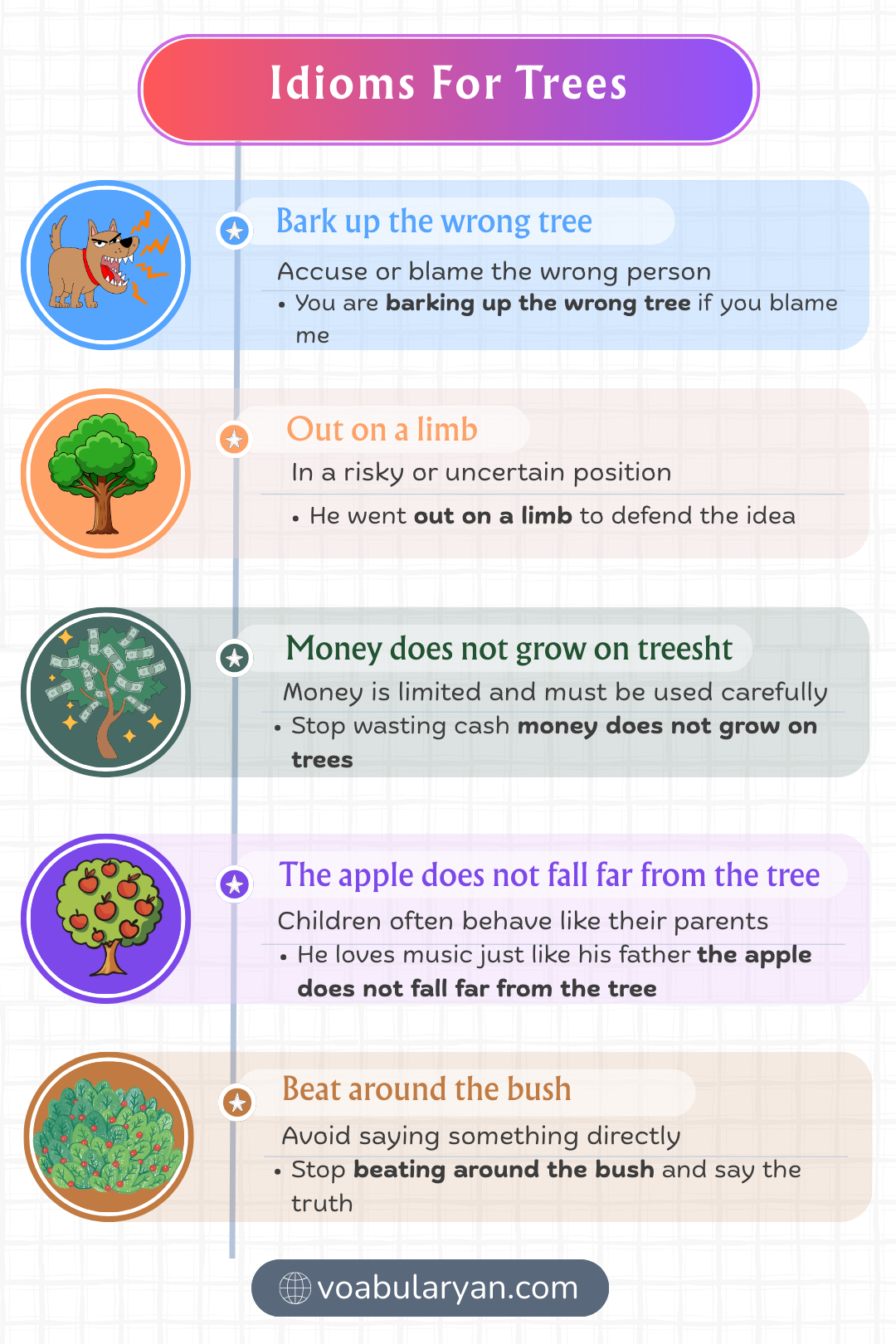
Idioms About Tree Roots and Foundations
Get To The Root Of The Matter
Meaning: understand the core or main cause of a problem.
When To Use It: Say it when someone tries to find the true cause behind an issue.
Collocations: get to the root of the matter quickly, get to the root of the issue, get to the root of the problem
Example Sentences:
- The investigation finally got to the root of the matter.
- We need to get to the root of the matter before making a decision.
Dialogue:
Ayesha: We must get to the root of the matter.
Omar: Yes, that will help us find the solution.
Closest Alternatives:
- uncover the cause
- find the source
Rooted In Tradition
Meaning: deeply connected to or based on traditional values or customs.
When To Use It: Say it when something or someone has strong ties to tradition.
Collocations: rooted in tradition for generations, rooted in tradition and culture, rooted in tradition and beliefs
Example Sentences:
- The festival is rooted in tradition, passed down for centuries.
- Their family values are rooted in tradition.
Dialogue:
Mina: This event is rooted in tradition.
Zain: It’s wonderful to see such history celebrated.
Closest Alternatives:
- based on tradition
- tied to history
Idioms About Strength and Growth in Trees
Strong As An Oak
Meaning: very strong, stable, and reliable.
When To Use It: Say it when describing someone or something that shows great strength or resilience.
Collocations: strong as an oak tree, as strong as an oak in character, strong as an oak in tough times
Example Sentences:
- He’s strong as an oak and can handle any challenge.
- After all these years, their relationship is still strong as an oak.
Dialogue:
Lena: He is strong as an oak after everything he’s been through.
Ryan: His resilience is impressive.
Closest Alternatives:
- rock-solid
- unshakable
Branching Out
Meaning: expanding into new areas or trying new things.
When To Use It: Say it when someone is exploring new opportunities or growing in different directions.
Collocations: branching out into new markets, branching out in interests, branching out with a new project
Example Sentences:
- She’s branching out and starting her own business.
- The company is branching out to international markets.
Dialogue:
Sara: He’s branching out and trying something new.
Imran: It’s exciting to see him grow like that.
Closest Alternatives:
- expanding
- diversifying
Growing Like A Weed
Meaning: growing very quickly, often in an unexpected or uncontrolled way.
When To Use It: Say it when someone or something is growing rapidly, sometimes out of control.
Collocations: growing like a weed in popularity, growing like a weed in size, growing like a weed in success
Example Sentences:
- The company is growing like a weed with all the new customers.
- Her business is growing like a weed and getting noticed.
Dialogue:
Nadia: His business is growing like a weed!
Farhan: It’s amazing how fast he’s expanding.
Closest Alternatives:
- growing rapidly
- expanding quickly
Idioms About Change and Transformation Through Trees
Turn Over A New Leaf
Meaning: start fresh and make positive changes in life.
When To Use It: Say it when someone decides to improve or change their habits or behavior.
Collocations: turn over a new leaf in life, turn over a new leaf after a mistake, turn over a new leaf with work
Example Sentences:
- After the difficult year, he decided to turn over a new leaf.
- She turned over a new leaf and started a healthier lifestyle.
Dialogue:
Amina: I’m ready to turn over a new leaf.
Ali: That’s great; a fresh start can bring new energy.
Closest Alternatives:
- start anew
- make a fresh start
Weathering The Storm Like A Tree
Meaning: endure difficult times and stay strong through challenges.
When To Use It: Say it when someone handles a tough situation without giving up.
Collocations: weathering the storm like a tree during a crisis, weathering the storm like a tree in tough times
Example Sentences:
- Through all the hardships, she kept weathering the storm like a tree.
- They continued weathering the storm like a tree through the difficult months.
Dialogue:
Sara: We’ve been through so much, but we are still standing.
Zain: Yes, we are weathering the storm like a tree.
Closest Alternatives:
- ride out the storm
- endure tough times
Idioms About Abundance and Fruit in Trees
Bear Fruit
Meaning: to produce results, especially after hard work or effort.
When To Use It: Say it when efforts or plans start to show positive outcomes.
Collocations: bear fruit in the long run, bear fruit after hard work, efforts bear fruit
Example Sentences:
- His years of practice finally bore fruit when he won the competition.
- The new marketing strategy is starting to bear fruit.
Dialogue:
Amina: After all that work, it’s finally bearing fruit.
Hassan: Yes, the results are showing now.
Closest Alternatives:
- yield results
- pay off
The Fruit Doesn’t Fall Far From The Tree
Meaning: children often resemble or act like their parents, either in looks or behavior.
When To Use It: Say it when a child has qualities or characteristics similar to their parents.
Collocations: the fruit doesn’t fall far from the tree in looks, the fruit doesn’t fall far from the tree in behavior, the fruit doesn’t fall far from the tree in talent
Example Sentences:
- He’s as talented as his father; the fruit doesn’t fall far from the tree.
- She’s just like her mother; the fruit doesn’t fall far from the tree.
Dialogue:
Nadia: He has the same calm nature as his father.
Farhan: The fruit doesn’t fall far from the tree, does it?
Closest Alternatives:
- like father, like son
- like mother, like daughter
Idioms About Family Connections and Trees
A Chip Off The Old Block
Meaning: a person who closely resembles one of their parents, usually in behavior or appearance.
When To Use It: Say it when someone is very similar to their parent, especially in traits or actions.
Collocations: a chip off the old block in looks, a chip off the old block in character, be a chip off the old block like their father
Example Sentences:
- He’s a chip off the old block, just like his father.
- She’s a chip off the old block in terms of creativity.
Dialogue:
Maya: Your son looks just like you!
John: Yes, he’s a chip off the old block.
Closest Alternatives:
- like father, like son
- a mini-me
Lost In The Wilderness
Meaning: confused and unsure, with no clear direction.
When To Use It: Say it when someone is uncertain, lost, or facing a confusing situation.
Collocations: lost in the wilderness with no plan, feel lost in the wilderness, lost in the wilderness of life
Example Sentences:
- After the sudden change, I felt lost in the wilderness.
- She was lost in the wilderness without a clear idea of what to do.
Dialogue:
Tariq: I’m feeling lost in the wilderness with this task.
Nadia: It’s okay, we can find our way together.
Closest Alternatives:
- feel directionless
- be at a loss
Key Takeaways
When it comes to building trust, honesty is key. Honesty is the best policy, and being on the level with others creates strong relationships. Phrases like “the proof is in the pudding” emphasize how actions and outcomes matter more than promises. At the same time, we also need to recognize that sometimes, actions speak louder than words—what people do often says more than what they say. Whether you’re making a promise, or trying to sort through tough situations, always remember: keeping your word is crucial to maintaining trust and respect.
FAQs
Q1. What does the idiom “barking up the wrong tree” mean?
It means pursuing a mistaken course of action or making a wrong assumption. This idiom is often used when someone is wasting their efforts or targeting the wrong issue.
Q2. When would you use the idiom “a tree falls in the forest”?
This idiom is used to question whether something is real or meaningful if no one is there to witness it. It is often discussed in philosophical conversations about perception.
Q3. What does “can’t see the forest for the trees” mean?
It refers to focusing on small details and missing the larger picture. It’s often used when someone is too involved in details and overlooks the bigger problem or situation.
Q4. What is meant by “up a tree” in an idiomatic sense?
It means being in a difficult or trapped situation. It’s used to describe someone who’s facing a problem with no easy way out.
Q5. How is “turn over a new leaf” used in idioms for trees?
It means to change one’s behavior or start fresh, often after a mistake or bad habit. It’s used to suggest someone is trying to improve themselves.
Q6. What does it mean when someone says “money doesn’t grow on trees”?
It means that money is not easy to obtain, and people should be careful with how they spend it. It’s commonly used to remind someone that resources are limited.
You May Also Like
