
You walk away from a conversation with a tight chest and say, “I’m upset.” The word is honest, but it doesn’t carry the anger and hurt tangled together inside. Upset can mean disappointment, embarrassment, or quiet frustration, yet each feeling lands differently.
The right phrase can untangle them. Idioms for upset let you speak about conflict, bad news, or personal letdowns with more precision. Some sound sharp, meant for moments that burn, while others carry sadness that lingers long after.
We’ll walk through each one with real examples and short conversations. You’ll sense which phrase fits a minor frustration and which suits deeper disappointment that weighs on you. Here are the words that match what you actually feel.
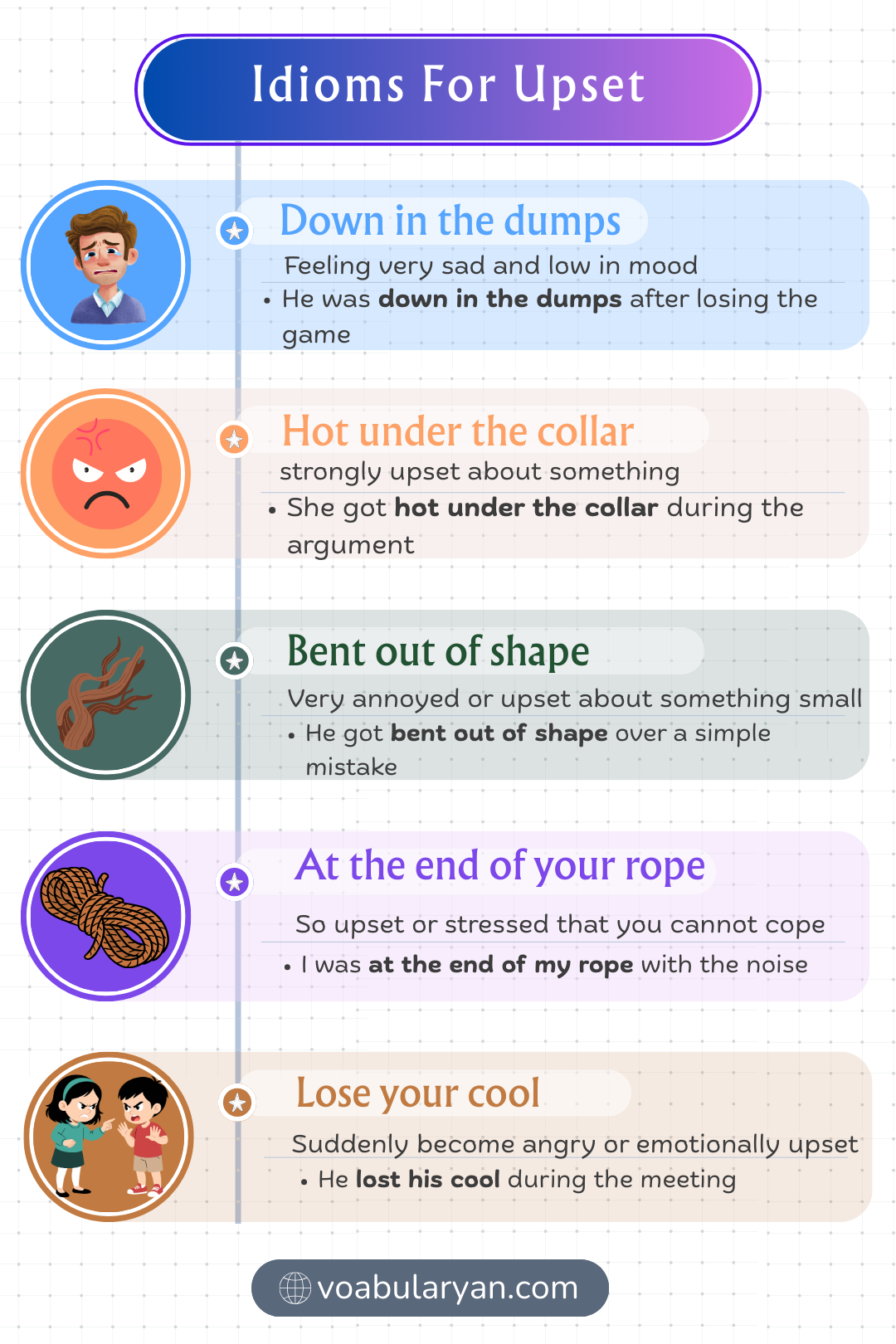
Upset Idioms For Feeling Angry All Of A Sudden
Blow Your Top
Meaning: suddenly become extremely angry and shout or react.
When To Use It: say it when anger erupts fast after a trigger.
Collocations: blow your top at someone, blow your top over a mistake, nearly blow your top
Example Sentences:
- He blew his top when the report went missing.
- She blew her top over the broken phone.
Dialogue:
Amina: He blew his top in front of everyone.
Rayan: The anger came out all at once.
Closest Alternatives:
- lose your temper
- explode
See Red
Meaning: become so angry that calm thinking fades.
When To Use It: say it when anger rises instantly because of an insult.
Collocations: see red at an insult, see red when lied to
Example Sentences:
- I saw red when he mocked my sister.
- She saw red after reading the rude message.
Dialogue:
Hira: He insulted her in public.
Sameer: No wonder she saw red.
Closest Alternatives:
- get furious
- become enraged
Hit The Roof
Meaning: become very angry very quickly.
When To Use It: say it when someone reacts with sudden rage.
Collocations: hit the roof over a lie, hit the roof when late
Example Sentences:
- Dad hit the roof when he saw the dent.
- She hit the roof over the rude comment.
Dialogue:
Noor: Why is he shouting?
Faris: He hit the roof about the damage.
Closest Alternatives:
- blow your top
- lose your temper
Go Ballistic
Meaning: react with extreme anger and loud behavior.
When To Use It: say it when someone loses control from anger.
Collocations: go ballistic over a mistake, go ballistic at the news
Example Sentences:
- He went ballistic when the plan changed.
- She went ballistic over the broken promise.
Dialogue:
Mina: He went ballistic in the hallway.
Saad: That level of rage is not normal.
Closest Alternatives:
- blow a fuse
- go crazy with anger
Blow A Fuse
Meaning: suddenly lose patience and become angry.
When To Use It: say it when someone snaps after pressure.
Collocations: blow a fuse at someone, blow a fuse over delays
Example Sentences:
- She blew a fuse after waiting for two hours.
- He blew a fuse when the file disappeared.
Dialogue:
Zara: I heard him yelling from outside.
Omar: Yes, he blew a fuse over the delay.
Closest Alternatives:
- snap
- lose your temper
Fly Off The Handle
Meaning: get angry suddenly and react too strongly.
When To Use It: say it when anger is quick and out of proportion.
Collocations: fly off the handle at criticism, fly off the handle over nothing
Example Sentences:
- He flew off the handle at a small mistake.
- She flew off the handle when she felt ignored.
Dialogue:
Ayesha: Why did he shout like that?
Bilal: He flew off the handle over a small thing.
Closest Alternatives:
- overreact
- lose your temper
Go Through The Roof
Meaning: rise very quickly to an extreme level.
When To Use It: say it when anger or prices increase suddenly.
Collocations: anger went through the roof, prices went through the roof
Example Sentences:
- His anger went through the roof when he heard the lie.
- The costs went through the roof after the change.
Dialogue:
Hina: How did she react to the news?
Usman: Her anger went through the roof.
Closest Alternatives:
- rise sharply
- shoot up
Throw A Fit
Meaning: show anger in a loud, childish way.
When To Use It: say it when someone complains loudly or behaves badly.
Collocations: throw a fit over a toy, throw a fit at the store
Example Sentences:
- He threw a fit when he did not get his way.
- She threw a fit over the seating plan.
Dialogue:
Mariam: He threw a fit in the lobby.
Adil: It was a lot of drama.
Closest Alternatives:
- have a tantrum
- make a scene
Lose It
Meaning: lose control of emotions and act wildly.
When To Use It: say it when someone cannot stay calm anymore.
Collocations: lose it completely, lose it at someone, almost lose it
Example Sentences:
- I almost lost it when the alarm kept ringing.
- She lost it after hearing the unfair decision.
Dialogue:
Noor: He started shouting and pacing.
Faris: Yes, he lost it under the stress.
Closest Alternatives:
- break down
- lose control
Upset Idioms For Feeling Irritated And Annoyed
Hot Under The Collar
Meaning: feeling suddenly angry or upset.
When To Use It: say it when a comment or event makes anger rise fast.
Collocations: hot under the collar about a remark, hot under the collar over delays, get hot under the collar
Example Sentences:
- He got Hot Under The Collar when they blamed him.
- She felt Hot Under The Collar during the argument.
Dialogue:
Mina: I am getting Hot Under The Collar hearing that.
Bilal: That kind of insult can sting.
Closest Alternatives:
- irritated
- angry
Have A Short Fuse
Meaning: get angry very quickly and easily.
When To Use It: say it when someone loses patience fast.
Collocations: have a short fuse today, have a short fuse with people, known to have a short fuse
Example Sentences:
- He Have A Short Fuse when he is tired.
- She Have A Short Fuse and snaps over small things.
Dialogue:
Areeba: He Have A Short Fuse these days.
Fahad: Yes, his patience is low.
Closest Alternatives:
- quick-tempered
- easily angered
Get Steamed Up
Meaning: become angry and worked up.
When To Use It: say it when anger builds during a situation.
Collocations: get steamed up about politics, get steamed up over a mistake, get steamed up during a debate
Example Sentences:
- He Get Steamed Up when people cut in line.
- She Get Steamed Up over the unfair rule.
Dialogue:
Nadia: I Get Steamed Up just thinking about it.
Farhan: That anger is strong.
Closest Alternatives:
- get angry
- get worked up
Up In Arms
Meaning: strongly angry and ready to protest.
When To Use It: say it when many people object loudly.
Collocations: up in arms about changes, up in arms over prices, community up in arms
Example Sentences:
- Parents were Up In Arms about the new rule.
- The neighborhood got Up In Arms over the noise.
Dialogue:
Sara: Everyone is Up In Arms about the decision.
Owais: The anger is spreading fast.
Closest Alternatives:
- outraged
- protesting
Get Bent Out Of Shape
Meaning: become upset or angry over something.
When To Use It: say it when a reaction feels stronger than the issue.
Collocations: get bent out of shape over nothing, get bent out of shape about a comment
Example Sentences:
- Do not Get Bent Out Of Shape over a small delay.
- He Get Bent Out Of Shape about one little mistake.
Dialogue:
Hira: I Get Bent Out Of Shape too easily.
Usman: That reaction can grow fast.
Closest Alternatives:
- overreact
- get upset
Rub Someone The Wrong Way
Meaning: annoy someone without meaning to.
When To Use It: say it when a person’s style or words cause irritation.
Collocations: rub someone the wrong way with a tone, rub someone the wrong way at first
Example Sentences:
- His jokes Rub Someone The Wrong Way sometimes.
- Her direct tone can Rub Someone The Wrong Way.
Dialogue:
Amina: His attitude Rub Someone The Wrong Way.
Hassan: Yes, it feels a bit rude.
Closest Alternatives:
- annoy
- irritate
Upset Idioms For Feeling Fed Up And Overwhelmed
At The End Of Your Rope
Meaning: having no patience or energy left to deal with problems.
When To Use It: say it when stress has built up and coping feels hard.
Collocations: be at the end of your rope, feel at the end of your rope
Example Sentences:
- I was at the end of my rope after weeks of noise.
- She felt at the end of her rope with the constant delays.
Dialogue:
Amina: I am at the end of my rope today.
Rayan: That sounds like deep stress.
Closest Alternatives:
- at your limit
- worn out
At Your Wit’s End
Meaning: unable to think of what to do next.
When To Use It: say it when every option feels used up.
Collocations: be at your wit’s end, feel at your wit’s end
Example Sentences:
- I am at my wit’s end with this broken printer.
- He was at his wit’s end trying to calm the baby.
Dialogue:
Hira: Nothing I do works.
Sameer: I get it, you are at your wit’s end.
Closest Alternatives:
- out of ideas
- desperate
Hit A Wall
Meaning: suddenly stop making progress, often from tiredness.
When To Use It: say it when energy drops or progress stops sharply.
Collocations: hit a wall during training, hit a wall halfway through
Example Sentences:
- I hit a wall halfway through my homework.
- She hit a wall during practice and needed rest.
Dialogue:
Noor: I cannot focus anymore.
Faris: Sounds like you hit a wall from fatigue.
Closest Alternatives:
- run out of energy
- get stuck
Have It Up To Here
Meaning: be extremely annoyed and unable to tolerate more.
When To Use It: say it when patience is completely used up.
Collocations: have it up to here with excuses, have it up to here with noise
Example Sentences:
- I have it up to here with the same excuse.
- She had it up to here with the late arrivals.
Dialogue:
Mina: He is late again.
Saad: I have it up to here with this habit.
Closest Alternatives:
- fed up
- sick of it
Have A Meltdown
Meaning: lose emotional control and react strongly.
When To Use It: say it when someone breaks down from stress or anger.
Collocations: have a meltdown at work, have a meltdown in public
Example Sentences:
- He had a meltdown after the sudden bad news.
- She had a meltdown when the plan collapsed.
Dialogue:
Zara: She started crying and shouting.
Omar: Yes, she had a meltdown from pressure.
Closest Alternatives:
- break down
- lose it
Blow Off Steam
Meaning: release stress or anger through activity.
When To Use It: say it when someone needs a safe way to calm down.
Collocations: blow off steam after work, blow off steam by walking, blow off steam at the gym
Example Sentences:
- I went for a walk to blow off steam.
- He played football to blow off steam after school.
Dialogue:
Ayesha: I feel tense and annoyed.
Bilal: Let us blow off steam with a walk.
Closest Alternatives:
- let off steam
- cool down
Kick Up A Fuss
Meaning: complain loudly and make a big issue.
When To Use It: say it when someone reacts strongly to a problem.
Collocations: kick up a fuss about service, kick up a fuss over a mistake
Example Sentences:
- He kicked up a fuss about the wrong order.
- She kicked up a fuss over the small delay.
Dialogue:
Hina: Did he really argue with the staff?
Usman: Yes, he kicked up a fuss about the bill.
Closest Alternatives:
- make a scene
- complain loudly
Upset Idioms For Feeling Sad And Hurt
Down In The Dumps
Meaning: feeling sad and low for a while.
When To Use It: say it when mood drops and energy feels weak.
Collocations: down in the dumps today, down in the dumps after news, feel down in the dumps
Example Sentences:
- He was Down In The Dumps after the bad result.
- I feel Down In The Dumps on rainy days sometimes.
Dialogue:
Mina: I am Down In The Dumps this morning.
Bilal: That sounds like deep sadness.
Closest Alternatives:
- feel low
- depressed
Feel Blue
Meaning: feel sad or a little depressed.
When To Use It: say it when sadness is present without a clear reason.
Collocations: feel blue today, feel blue for no reason, make me feel blue
Example Sentences:
- I Feel Blue when I think about that day.
- She Feel Blue after moving away from friends.
Dialogue:
Areeba: I Feel Blue these days.
Fahad: A change can bring sadness.
Closest Alternatives:
- feel sad
- feel low
Heart Sinks
Meaning: feel sudden disappointment or worry.
When To Use It: say it when bad news arrives or hope drops quickly.
Collocations: my heart sinks when, heart sinks at the thought
Example Sentences:
- My Heart Sinks when I see that message.
- Her Heart Sinks at the sound of his voice.
Dialogue:
Nadia: My Heart Sinks every time I hear that name.
Farhan: That is strong disappointment.
Closest Alternatives:
- feel crushed
- feel let down
Long Face
Meaning: a sad look on someone’s face.
When To Use It: say it when someone looks unhappy or worried.
Collocations: wear a long face, have a long face all day
Example Sentences:
- He had a Long Face after the meeting.
- She wore a Long Face when the plan failed.
Dialogue:
Sara: Why the Long Face today?
Owais: I am dealing with a problem.
Closest Alternatives:
- sad expression
- gloomy look
Down And Out
Meaning: without money, hope, or support.
When To Use It: say it when someone is in a very hard situation.
Collocations: down and out after losing a job, feel down and out
Example Sentences:
- He was Down And Out after losing everything.
- She felt Down And Out and needed help.
Dialogue:
Hira: He looks Down And Out lately.
Usman: Life has been hard on him.
Closest Alternatives:
- broke and hopeless
- in trouble
Fall Apart
Meaning: lose control emotionally or mentally.
When To Use It: say it when someone cannot cope and breaks down.
Collocations: fall apart under pressure, fall apart after the news, start to fall apart
Example Sentences:
- He began to Fall Apart after the argument.
- She did not Fall Apart, even under pressure.
Dialogue:
Amina: I almost Fall Apart when I heard it.
Hassan: That kind of shock is heavy.
Closest Alternatives:
- break down
- lose control
Upset Idioms For Crying And Holding Back Tears
Cry Your Eyes Out
Meaning: cry a lot for a long time from strong sadness.
When To Use It: say it when someone is deeply upset and cannot stop crying.
Collocations: cry your eyes out all night, cry your eyes out over a breakup, cry your eyes out after bad news
Example Sentences:
- She cried her eyes out after losing her pet.
- He cried his eyes out when his friend moved away.
Dialogue:
Amina: I cried my eyes out last night.
Rayan: That kind of pain is heavy.
Closest Alternatives:
- sob hard
- cry a lot
Tears Well Up
Meaning: tears start to gather in the eyes.
When To Use It: say it when emotion rises and crying is close.
Collocations: tears well up suddenly, tears well up in her eyes, feel tears well up
Example Sentences:
- Tears welled up when he read the letter.
- Tears welled up in her eyes during the goodbye.
Dialogue:
Hira: Her voice shook as she spoke.
Sameer: Yes, tears welled up right away.
Closest Alternatives:
- eyes fill with tears
- start to cry
Fight Back The Tears
Meaning: try hard not to cry.
When To Use It: say it when someone holds emotion in public.
Collocations: fight back the tears during a speech, fight back the tears at a funeral
Example Sentences:
- He fought back the tears while thanking the team.
- She fought back the tears when she heard the news.
Dialogue:
Noor: He looked like he might cry.
Faris: He was fighting back the tears with effort.
Closest Alternatives:
- hold back tears
- keep from crying
A Lump In Your Throat
Meaning: a tight feeling that comes before crying.
When To Use It: say it when emotion makes speaking hard.
Collocations: get a lump in your throat, feel a lump in your throat
Example Sentences:
- I got a lump in my throat during the farewell.
- She felt a lump in her throat when she saw the photo.
Dialogue:
Mina: I could not even speak.
Saad: That lump in your throat can stop the words.
Closest Alternatives:
- feel choked up
- feel emotional
Upset Phrases For Being Disturbed Or Thrown Off
Het Up
Meaning: become suddenly upset, angry, or too excited to stay calm.
When To Use It: say it when emotions rise fast and patience drops quickly.
Collocations: get het up about small issues, get het up over comments, get het up during an argument
Example Sentences:
- He got Het Up when the plan changed at the last minute.
- She got Het Up over one small mistake and raised her voice.
Dialogue:
Sana: I got Het Up when they blamed me.
Bilal: That accusation would upset anyone.
Closest Alternatives:
- get worked up
- get upset
Put Out
Meaning: feel annoyed or bothered by what someone did.
When To Use It: say it when a comment or action causes irritation.
Collocations: feel put out by the delay, feel put out at the comment, left someone put out
Example Sentences:
- He felt Put Out when they forgot to invite him.
- She was Put Out by the sudden change in plans.
Dialogue:
Amina: I feel Put Out about how that went.
Hassan: The tone was not kind.
Closest Alternatives:
- annoyed
- offended
Drop Your Bundle
Meaning: lose calm control and react in a messy emotional way.
When To Use It: say it when someone breaks down or overreacts under pressure.
Collocations: drop your bundle over bad news, drop your bundle after a mistake, drop your bundle in public
Example Sentences:
- He Drop Your Bundle when the report went missing.
- She almost Drop Your Bundle after hearing the sudden news.
Dialogue:
Nadia: I nearly Drop Your Bundle in front of everyone.
Farhan: That kind of pressure can be too much.
Closest Alternatives:
- fall apart
- lose it
Upset The Applecart
Meaning: disturb a plan and ruin how things were going.
When To Use It: say it when an action causes trouble for a settled situation.
Collocations: upset the applecart with a surprise change, upset the applecart at work, upset the applecart during talks
Example Sentences:
- One rumor Upset The Applecart and the deal stopped.
- His sudden move Upset The Applecart for the whole group.
Dialogue:
Mina: That decision Upset The Applecart for everyone.
Bilal: Yes, it caused real trouble.
Closest Alternatives:
- ruin the plan
- throw things off
Key Takeaways
This topic brings together common phrases that describe irritation, emotional flare ups, and actions that disturb calm situations. Meaning depends on tone and situation, so a line can sound mild, sharp, or dramatic in different moments. Many idioms keep stable wording and word order, so changing even one small part can make them sound unnatural. Across the examples, the language reflects real moments such as feeling bothered, getting worked up, losing control, and disrupting plans, and it fits both everyday conversation and simple writing.
FAQs
Q1. What does “blow a fuse” mean when someone gets upset?
It means losing control of anger suddenly. Idioms for upset like this fit moments like shouting after a mistake or reacting fast to bad news.
Q2. What does “get worked up” mean when someone feels upset?
It means becoming more upset over time, often from worry or anger. Idioms for upset like this fit arguments, long waits, or small problems that grow bigger.
Q3. What does “lose your cool” mean in an upsetting moment?
It means failing to stay calm and reacting in a sharp way. Idioms for upset like this fit public arguments, tense talks, or rude comments.
Q4. What does “hit the roof” mean when someone is very upset?
It means getting extremely angry very fast. Idioms for upset like this fit strong reactions, like a parent hearing about serious rule-breaking.
Q5. What does “have a fit” mean, and is it always serious?
It means reacting with strong emotion, often anger or frustration. Idioms for upset like this can sound serious or playful, depending on the situation and tone.
Q6. What does “take it personally” mean when someone is upset?
It means feeling hurt because a comment seems aimed at self-worth. Idioms for upset like this fit teasing, criticism, or jokes that land in a painful way.
You May Also Like
