
You watch rain pour down the street or stand by the sea listening to the waves. “It’s just water,” someone says, yet the word barely captures the force of a sudden flood or the calm of a quiet river. Plain language often feels too small for something that can be both gentle and powerful.
That is where idioms for water become useful in learning English. These expressions appear in daily talk about rain, oceans, or even strong emotion. Some sound light and playful, while others carry the pull of a deep current or steady flow.
We’ll walk through each one with real examples and short conversations. You’ll sense which phrase fits a peaceful moment and which suits a sudden surge of feeling. Here are the words that move like water through everyday speech.
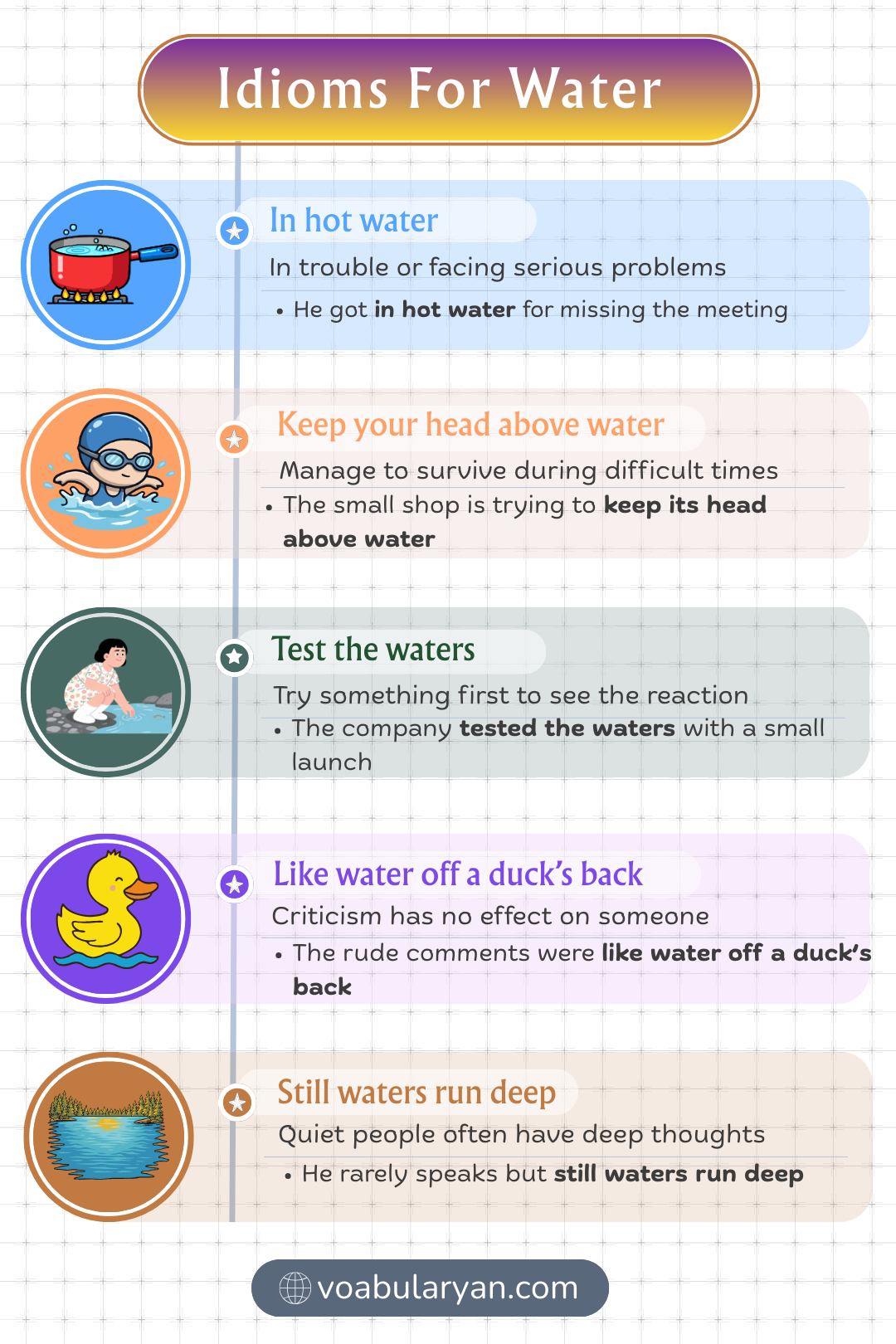
Water Idioms For Trouble And Risk
In Deep Water
Meaning: in a serious and difficult situation with no easy answer.
When To Use It: Say it when problems feel hard to solve or escape.
Collocations: be in deep water at work, get in deep water with debt, find yourself in deep water
Example Sentences:
- After the mistake, he was in deep water with his boss.
- She got in deep water when the bills piled up.
Dialogue:
Sara: I am in deep water after that decision.
Imran: That sounds like a serious problem.
Closest Alternatives:
- in trouble
- in a tight spot
In Hot Water
Meaning: in trouble because of a mistake or rule break.
When To Use It: Say it when someone faces anger, blame, or punishment.
Collocations: be in hot water with parents, get in hot water at school, land in hot water
Example Sentences:
- He was in hot water for missing the meeting.
- She got in hot water after the argument.
Dialogue:
Hina: I am in hot water with my teacher.
Ali: That must feel very stressful.
Closest Alternatives:
- in trouble
- in the doghouse
Troubled Waters
Meaning: a time of conflict, worry, or serious difficulty.
When To Use It: Say it when a group faces tension or big problems.
Collocations: go through troubled waters, in troubled waters, steer through troubled waters
Example Sentences:
- The team stayed calm in troubled waters.
- Their family went through troubled waters last year.
Dialogue:
Nadia: We are in troubled waters right now.
Usman: We need steady patience.
Closest Alternatives:
- hard times
- difficult period
Muddy The Waters
Meaning: make a situation more confusing than it already is.
When To Use It: Say it when extra talk or details create confusion.
Collocations: muddy the waters in a debate, muddy the waters with excuses, muddy the waters further
Example Sentences:
- His long answer muddied the waters instead of helping.
- She muddied the waters with mixed stories.
Dialogue:
Ayesha: That comment muddied the waters.
Hamza: Now the main point feels unclear.
Closest Alternatives:
- confuse the issue
- complicate things
Come Hell Or High Water
Meaning: no matter what happens, the plan will be done.
When To Use It: Say it when someone is fully determined to act.
Collocations: come hell or high water, do it come hell or high water
Example Sentences:
- He will finish the project, come hell or high water.
- She will attend the event, come hell or high water.
Dialogue:
Mariam: I am going, come hell or high water.
Bilal: That is strong determination.
Closest Alternatives:
- no matter what
- at all costs
Dead In The Water
Meaning: unable to move forward because progress has stopped.
When To Use It: Say it when a plan fails or cannot continue.
Collocations: project dead in the water, idea dead in the water, plan dead in the water
Example Sentences:
- Without funding, the plan was dead in the water.
- The deal became dead in the water after the call.
Dialogue:
Zain: Our proposal is dead in the water.
Iqra: Then we need a new plan.
Closest Alternatives:
- stuck
- not going anywhere
Water Idioms For Surviving Hard Times
Keep Your Head Above Water
Meaning: manage to survive during difficulty, without falling behind.
When To Use It: say it when life feels hard but someone is still coping.
Collocations: keep your head above water financially, keep your head above water at work, barely keep your head above water
Example Sentences:
- After the rent rise, we tried to Keep Your Head Above Water.
- She works two jobs to Keep Your Head Above Water.
Dialogue:
Hiba: I am trying to Keep Your Head Above Water this month.
Rayan: That takes real effort.
Closest Alternatives:
- get by
- cope
Tread Water
Meaning: stay in the same place without making progress.
When To Use It: say it when efforts do not move things forward.
Collocations: tread water at work, tread water in a project, keep treading water
Example Sentences:
- The team kept Tread Water and missed the deadline again.
- I felt we were Tread Water with no clear plan.
Dialogue:
Mariam: We are Tread Water on this task.
Bilal: We need real progress soon.
Closest Alternatives:
- stand still
- make no progress
Sink Or Swim
Meaning: succeed by yourself or fail without help.
When To Use It: say it when someone must learn fast under pressure.
Collocations: a sink or swim situation, thrown in sink or swim, sink or swim at a new job
Example Sentences:
- On the first day, it felt Sink Or Swim.
- He was left to Sink Or Swim in the new role.
Dialogue:
Sana: This job feels Sink Or Swim already.
Omar: Yes, the pressure is high.
Closest Alternatives:
- make it or fail
- learn the hard way
Water Idioms For Change And Momentum
Turn The Tide
Meaning: change a situation so the result starts going the other way.
When To Use It: Say it when progress shifts from losing to gaining.
Collocations: turn the tide in a match, turn the tide of opinion, turn the tide against them
Example Sentences:
- One smart move turned the tide in the final round.
- Her calm speech turned the tide during the meeting.
Dialogue:
Sana: That decision turned the tide for our team.
Bilal: It changed the whole direction.
Closest Alternatives:
- change the course
- reverse the situation
Stem The Tide
Meaning: stop something harmful from growing or spreading further.
When To Use It: Say it when action slows down a rising problem.
Collocations: stem the tide of violence, stem the tide of rumors, stem the tide of losses
Example Sentences:
- New rules helped stem the tide of complaints.
- Quick action stemmed the tide of panic in the room.
Dialogue:
Ayesha: We must stem the tide of confusion.
Hamza: A clear plan can reduce the damage.
Closest Alternatives:
- slow down
- hold back
Ride The Wave
Meaning: keep moving with success while it lasts.
When To Use It: Say it when good results keep coming for a while.
Collocations: ride the wave of success, ride the wave after a win, ride the wave of popularity
Example Sentences:
- After the win, they rode the wave into the next game.
- She rode the wave of praise for weeks.
Dialogue:
Mariam: We are riding the wave right now.
Imran: The momentum feels very strong.
Closest Alternatives:
- enjoy the streak
- keep the momentum
Go With The Flow
Meaning: accept changes and stay calm instead of resisting.
When To Use It: Say it when plans shift and someone stays relaxed.
Collocations: just go with the flow, go with the flow today, go with the flow in life
Example Sentences:
- When the plan changed, I went with the flow.
- She likes to go with the flow at events.
Dialogue:
Lena: I will go with the flow tonight.
Ryan: That keeps the mood easy.
Closest Alternatives:
- take things as they come
- stay relaxed
Make Waves
Meaning: cause trouble or strong reaction by acting differently.
When To Use It: Say it when someone challenges rules or upsets others.
Collocations: make waves at work, make waves in the group, do not make waves
Example Sentences:
- He made waves by questioning the old rules.
- She did not want to make waves during the meeting.
Dialogue:
Noor: I do not want to make waves.
Omar: Keeping peace matters in this moment.
Closest Alternatives:
- stir things up
- cause a stir
Water Idioms For Starting Something New
Testing The Waters
Meaning: trying something lightly to see how it goes.
When To Use It: say it when someone starts carefully before committing fully.
Collocations: testing the waters with a new job, testing the waters before joining, testing the waters at first
Example Sentences:
- She is Testing The Waters with a new class.
- I kept Testing The Waters before making a choice.
Dialogue:
Hina: I am Testing The Waters with this idea.
Saad: That gives a safer start.
Closest Alternatives:
- try it out
- explore cautiously
Get Your Feet Wet
Meaning: gain first experience in something new.
When To Use It: say it when someone begins and learns basic parts.
Collocations: get your feet wet in teaching, get your feet wet at a new job, get your feet wet with small tasks
Example Sentences:
- He got Get Your Feet Wet by helping on simple tasks.
- She will Get Your Feet Wet in sales this week.
Dialogue:
Mina: I want to Get Your Feet Wet in this field.
Hasan: Starting small builds experience.
Closest Alternatives:
- start out
- gain experience
Dip Your Toe In The Water
Meaning: try a new thing in a small and careful way.
When To Use It: say it when someone is unsure and wants a gentle start.
Collocations: dip your toe in the water with a hobby, dip your toe in the water first, dip your toe in the water before deciding
Example Sentences:
- She Dip Your Toe In The Water with one short lesson.
- I will Dip Your Toe In The Water before buying anything.
Dialogue:
Areeba: I will Dip Your Toe In The Water first.
Fahad: That keeps the risk low.
Closest Alternatives:
- test the waters
- try a little
Dive Right In
Meaning: start something quickly and with full energy.
When To Use It: say it when someone begins without hesitation.
Collocations: dive right in and start, dive right in with both hands, ready to dive right in
Example Sentences:
- He Dive Right In and joined the team on day one.
- She chose to Dive Right In after a short talk.
Dialogue:
Sana: I will Dive Right In and learn fast.
Bilal: That shows real confidence.
Closest Alternatives:
- jump in
- start immediately
Wade Into Something
Meaning: begin a difficult topic or task slowly and carefully.
When To Use It: say it when a situation is complex or sensitive.
Collocations: wade into a debate, wade into a problem, wade into the details
Example Sentences:
- He Wade Into Something and asked careful questions.
- She Wade Into Something after reading the full report.
Dialogue:
Zoya: We should Wade Into Something slowly.
Hamza: Yes, it is a sensitive issue.
Closest Alternatives:
- ease into
- approach carefully
Water Idioms For Conflict And Calm
Pour Oil On Troubled Waters
Meaning: calm a tense situation and reduce anger between people.
When To Use It: Say it when someone tries to settle a conflict peacefully.
Collocations: pour oil on troubled waters in an argument, pour oil on troubled waters between friends
Example Sentences:
- She poured oil on troubled waters during the family dispute.
- He poured oil on troubled waters by speaking in a calm voice.
Dialogue:
Amina: I tried to pour oil on troubled waters.
Hassan: That helped lower the tension.
Closest Alternatives:
- calm things down
- smooth things over
Water Under The Bridge
Meaning: past problems no longer matter now.
When To Use It: Say it when old issues are forgiven and left behind.
Collocations: it is water under the bridge now, let it be water under the bridge
Example Sentences:
- The argument is water under the bridge now.
- That mistake is water under the bridge, so we moved on.
Dialogue:
Sadia: It is water under the bridge.
Bilal: Yes, the past is done.
Closest Alternatives:
- in the past
- bygones be bygones
Water Idioms For People And Relationships
Fish Out Of Water
Meaning: feeling uncomfortable and out of place in a new situation.
When To Use It: say it when surroundings feel unfamiliar and confidence drops.
Collocations: feel like a fish out of water at a party, fish out of water in a new job, look like a fish out of water
Example Sentences:
- In the new school, I felt Fish Out Of Water.
- He looked Fish Out Of Water at the formal dinner.
Dialogue:
Sana: I feel Fish Out Of Water in that group.
Omar: New places can feel very strange.
Closest Alternatives:
- out of place
- uncomfortable
Like A Duck To Water
Meaning: doing something easily from the start.
When To Use It: say it when a person learns fast and looks natural.
Collocations: take to it like a duck to water, fit in like a duck to water
Example Sentences:
- She took to dancing Like A Duck To Water.
- He handled the new role Like A Duck To Water.
Dialogue:
Hina: She learned it Like A Duck To Water.
Saad: Yes, she has real talent.
Closest Alternatives:
- learn quickly
- be a natural
Take To Something Like A Fish To Water
Meaning: start enjoying and doing something very easily.
When To Use It: say it when someone fits a new activity at once.
Collocations: take to the job like a fish to water, take to training like a fish to water
Example Sentences:
- He took to cooking Take To Something Like A Fish To Water.
- She took to the new class Take To Something Like A Fish To Water.
Dialogue:
Mina: He took to it Take To Something Like A Fish To Water.
Hasan: It matched his skills.
Closest Alternatives:
- take to it quickly
- feel at home
Water Off A Duck’s Back
Meaning: criticism has no effect and does not upset someone.
When To Use It: say it when harsh words do not change a person’s mood.
Collocations: like water off a duck’s back, it is water off a duck’s back to him
Example Sentences:
- The insults were Water Off A Duck’s Back to her.
- For him, complaints are Water Off A Duck’s Back.
Dialogue:
Areeba: The comments were Water Off A Duck’s Back.
Fahad: She stays calm no matter what.
Closest Alternatives:
- not bothered
- shrug it off
Blood Is Thicker Than Water
Meaning: family ties matter more than other relationships.
When To Use It: say it when family loyalty influences a choice.
Collocations: blood is thicker than water in the end
Example Sentences:
- He helped his brother because Blood Is Thicker Than Water.
- She stayed close to family, since Blood Is Thicker Than Water.
Dialogue:
Zoya: He chose family, Blood Is Thicker Than Water.
Hamza: That belief values loyalty.
Closest Alternatives:
- family comes first
- family loyalty
Water Idioms For Truth And Belief
Not Hold Water
Meaning: not seem true because the reason is weak.
When To Use It: Say it when an excuse or claim sounds unconvincing.
Collocations: does not hold water, explanation does not hold water, argument does not hold water
Example Sentences:
- His story did not hold water after a few questions.
- That excuse does not hold water with the facts.
Dialogue:
Ayesha: This claim does not hold water.
Hamza: The evidence is missing.
Closest Alternatives:
- not believable
- not convincing
Hold Water
Meaning: seem true because the reasons are strong.
When To Use It: Say it when an idea stands up to questions.
Collocations: argument holds water, claim holds water, theory holds water
Example Sentences:
- Her explanation holds water and fits the facts.
- The plan holds water after a careful review.
Dialogue:
Mina: This idea holds water.
Omar: The logic is solid.
Closest Alternatives:
- make sense
- stand up
Still Waters Run Deep
Meaning: quiet people often have strong feelings or deep thoughts.
When To Use It: Say it when someone seems calm but has depth.
Collocations: still waters run deep for him, still waters run deep with her
Example Sentences:
- He speaks little, but still waters run deep.
- She seems calm, yet still waters run deep.
Dialogue:
Sara: He is quiet, but still waters run deep.
Imran: Yes, there is a lot of thought there.
Closest Alternatives:
- quiet but thoughtful
- more than meets the eye
Water Idioms For Money And Pressure
Drown In Debt
Meaning: owe so much money that it feels impossible to manage.
When To Use It: say it when bills and loans pile up and cause stress.
Collocations: drown in debt from loans, drown in debt after expenses, nearly drown in debt
Example Sentences:
- After the medical bills, he began to Drown In Debt.
- She feared she would Drown In Debt if rent rose again.
Dialogue:
Mariam: I feel like I will Drown In Debt soon.
Bilal: That can create deep stress.
Closest Alternatives:
- be buried in debt
- owe a lot
A Drop In The Ocean
Meaning: a very small amount compared to what is needed.
When To Use It: say it when help or change is too small to matter.
Collocations: a drop in the ocean compared to costs, just a drop in the ocean, feel like a drop in the ocean
Example Sentences:
- That discount was A Drop In The Ocean next to the total.
- One donation felt A Drop In The Ocean for the repairs.
Dialogue:
Hina: This refund is A Drop In The Ocean.
Saad: Yes, the full cost is huge.
Closest Alternatives:
- a tiny amount
- hardly anything
Water Idioms For Influence And Reaction
Pour Cold Water On Something
Meaning: Reduce excitement by reacting in a discouraging way.
When To Use It: Say it when someone lowers hope with doubt or criticism.
Collocations: pour cold water on the idea, pour cold water on plans, pour cold water on excitement
Example Sentences:
- His comment poured cold water on something we were planning.
- She poured cold water on something by pointing out the risks.
Dialogue:
Hira: He poured cold water on something I felt happy about.
Usman: That kind of doubt can change the mood fast.
Closest Alternatives:
- dampen enthusiasm
- kill the mood
Throw Cold Water On
Meaning: Stop a hopeful feeling by reacting with doubt.
When To Use It: Say it when someone quickly cools excitement or confidence.
Collocations: throw cold water on the plan, throw cold water on a suggestion, throw cold water on hopes
Example Sentences:
- She threw cold water on the proposal in front of everyone.
- He threw cold water on our excitement with one sharp remark.
Dialogue:
Amina: She threw cold water on my idea right away.
Hassan: That can feel very disappointing.
Closest Alternatives:
- discourage
- pour cold water on something
Break The Ice
Meaning: Start friendly talk so people feel less awkward.
When To Use It: Say it when a first meeting feels tense or quiet.
Collocations: break the ice with a joke, break the ice at a meeting, break the ice quickly
Example Sentences:
- A short joke broke the ice before the discussion began.
- He broke the ice by asking a simple question.
Dialogue:
Sara: I tried to break the ice with a warm greeting.
Imran: That small start made the room feel more comfortable.
Closest Alternatives:
- start a conversation
- ease the tension
Key Takeaways
This topic brings together common phrases that use water to express struggle, ease, caution, distance, and family ties. Meaning depends on tone and situation, so a line can feel serious, light, or sharp in different moments. Many idioms keep stable wording and word order, so changing even one small part can make them sound unnatural. Across the examples, the language reflects real moments such as money pressure, first attempts, quick learning, harsh comments, and feeling out of place, and it fits both everyday conversation and simple writing.
FAQs
Q1. What does “water under the bridge” mean in normal conversation today?
It means an old problem is finished and not worth bringing up again. In idioms for water, it often fits past arguments, like “That mistake is water under the bridge now.”
Q2. What does “in hot water” mean, and what kind of trouble is it?
It means someone is in trouble with a person or a group in charge. In idioms for water, it can mean blame or punishment, like “She’s in hot water with her teacher.”
Q3. What does “hold water” mean when someone doubts an explanation?
It means the explanation seems believable after thinking about it. In idioms for water, it is common in debates, like “That reason doesn’t hold water with the team.”
Q4. What does “tread water” mean when talking about work or plans?
It means staying busy but not moving forward much. In idioms for water, it often points to slow progress, like “The project is treading water while approvals are pending.”
Q5. What does “pour cold water on” mean when someone reacts to an idea?
It means someone discourages an idea or reduces excitement about it. In idioms for water, it fits meetings or plans, like “His comment poured cold water on the proposal.”
Q6. What does “test the waters” mean before making a bigger decision?
It means trying something in a small way to see how it goes. In idioms for water, it can mean a first step, like “They tested the waters with a small trial run.”
You May Also Like
