
You step outside on a gray morning, and the cold air bites at your face. “It’s winter,” you say, but the word barely captures the deep chill and quiet stillness in the air. Winter can feel peaceful, harsh, or even lonely, and plain language often sounds too light for that mood.
The right phrase can hold it. Idioms for winter bring seasonal images into everyday speech. Some suggest heavy snow and icy roads, while others reflect emotional coldness or a long, silent stretch of time.
We’ll walk through each one with real examples and short conversations. You’ll sense which phrase fits a bright, frosty morning and which suits a darker, reflective mood. Here are the words that carry the feeling of winter.
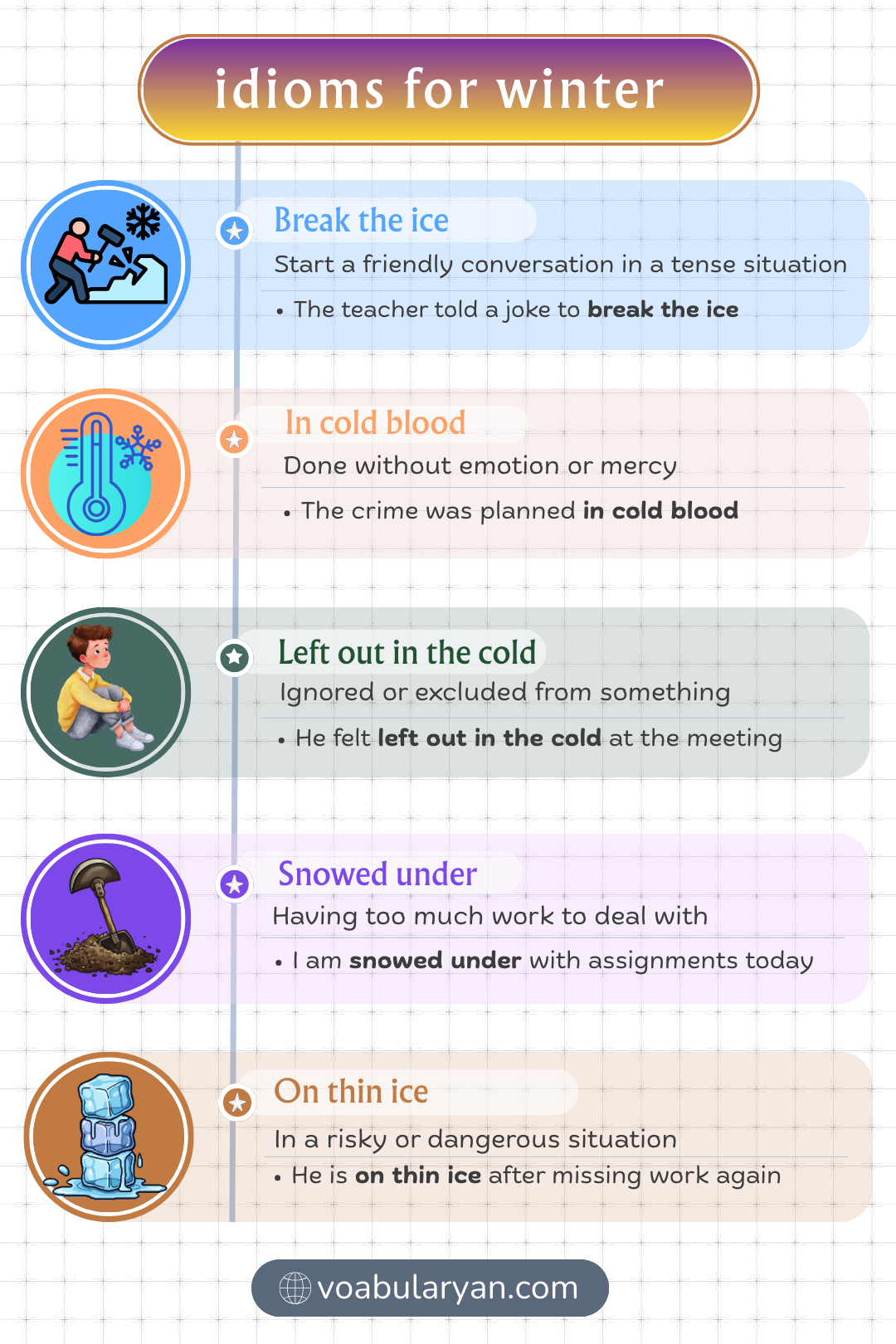
Winter Idioms For Social Situations And People
Break The Ice
Meaning: start a friendly talk to reduce tension.
When To Use It: say it at first meetings when people feel shy.
Collocations: break the ice with a joke, break the ice at a meeting, break the ice quickly
Example Sentences:
- A quick joke helped Break The Ice before the discussion began.
- She asked an easy question to Break The Ice with guests.
Dialogue:
Mina: I tried to Break The Ice with a simple question.
Hasan: That helped the room feel more relaxed.
Closest Alternatives:
- start a conversation
- ease tension
Icy Reception
Meaning: an unfriendly welcome that feels cold.
When To Use It: say it when people respond without warmth or interest.
Collocations: get an icy reception, receive an icy reception, face an icy reception
Example Sentences:
- He got an Icy Reception when he arrived late.
- The new plan met an Icy Reception from the team.
Dialogue:
Ayesha: I got an Icy Reception at the door.
Usman: That kind of coldness is hard to miss.
Closest Alternatives:
- cold welcome
- unfriendly response
Icy Stare
Meaning: a cold look that shows anger or dislike.
When To Use It: say it when someone looks at you with clear disapproval.
Collocations: give an icy stare, shoot an icy stare, an icy stare across the room
Example Sentences:
- She gave an Icy Stare after he mocked her idea.
- He shot an Icy Stare when his name was mentioned.
Dialogue:
Hina: She gave me an Icy Stare in the hallway.
Sameer: That look carried real anger.
Closest Alternatives:
- cold glare
- hard look
Frosty Demeanor
Meaning: a cold attitude that feels distant and unfriendly.
When To Use It: say it when someone acts stiff and not welcoming.
Collocations: a frosty demeanor toward someone, keep a frosty demeanor, show a frosty demeanor
Example Sentences:
- His Frosty Demeanor made the room feel tense.
- She kept a Frosty Demeanor during the whole talk.
Dialogue:
Sara: His Frosty Demeanor surprised me today.
Omar: He seemed very distant the whole time.
Closest Alternatives:
- cold attitude
- unfriendly manner
A Frosty Silence
Meaning: a cold quiet that shows anger or disapproval.
When To Use It: say it when no one speaks because feelings are tense.
Collocations: fall into a frosty silence, sit in a frosty silence, a frosty silence followed
Example Sentences:
- After the comment, A Frosty Silence filled the room.
- Their argument ended, and A Frosty Silence followed.
Dialogue:
Nadia: Then A Frosty Silence came over the table.
Farhan: That quiet felt full of tension.
Closest Alternatives:
- tense silence
- cold quiet
Cold Fish
Meaning: a person who shows little warmth or emotion.
When To Use It: say it when someone seems distant in social moments.
Collocations: a cold fish in public, seem like a cold fish, act like a cold fish
Example Sentences:
- He seems a Cold Fish in groups, even when happy.
- She can appear a Cold Fish during small talk.
Dialogue:
Mariam: People say he is a Cold Fish.
Bilal: Maybe he is just shy.
Closest Alternatives:
- emotionally distant
- not very warm
Winter Idioms For Work, Pressure, And Being Busy
Snowed Under
Meaning: overwhelmed with too much work and too little time.
When To Use It: used when tasks pile up and the workload feels heavy.
Collocations: snowed under with work, snowed under at the office, completely snowed under
Example Sentences:
- I am Snowed Under with emails and reports this week.
- She felt Snowed Under after taking on two extra projects.
Dialogue:
Hina: I am Snowed Under and cannot catch up.
Omar: That sounds like a heavy workload.
Closest Alternatives:
- overwhelmed
- swamped
Snowed In
Meaning: unable to leave because heavy snow blocks travel.
When To Use It: used when weather stops movement and people must stay inside.
Collocations: snowed in at home, snowed in by a storm, get snowed in overnight
Example Sentences:
- We got Snowed In and missed the morning train.
- They were Snowed In for two days after the storm.
Dialogue:
Amina: We are Snowed In again today.
Sameer: Yes, the roads are blocked.
Closest Alternatives:
- stuck at home
- unable to travel
Snow Job
Meaning: a smooth story meant to trick someone into believing it.
When To Use It: used when talk sounds convincing but feels dishonest.
Collocations: give someone a snow job, a complete snow job, call it a snow job
Example Sentences:
- His excuse felt like a Snow Job from start to finish.
- She heard the pitch and knew it was a Snow Job.
Dialogue:
Nadia: That explanation was a Snow Job.
Farhan: Yes, it sounded fake.
Closest Alternatives:
- con
- misleading talk
Snowball Effect
Meaning: a small issue grows quickly into a much bigger problem.
When To Use It: used when one change leads to larger and larger results.
Collocations: create a snowball effect, snowball effect of delays, snowball effect in costs
Example Sentences:
- One late payment caused a Snowball Effect in fees.
- The small delay led to a Snowball Effect across the schedule.
Dialogue:
Sara: That first delay started a Snowball Effect.
Bilal: Yes, it kept growing into a bigger mess.
Closest Alternatives:
- chain reaction
- ripple effect
Cold Hard Truth
Meaning: a painful fact that cannot be denied or avoided.
When To Use It: used when reality is unpleasant but must be faced.
Collocations: face the cold hard truth, accept the cold hard truth, tell the cold hard truth
Example Sentences:
- The Cold Hard Truth was that the plan could not work.
- He finally accepted the Cold Hard Truth about the situation.
Dialogue:
Mina: I had to face the Cold Hard Truth today.
Hasan: That kind of reality can hurt at first.
Closest Alternatives:
- harsh reality
- painful fact
Winter Idioms For Risk, Trouble, And Uncertain Situations
Walking On Thin Ice
Meaning: being in a risky situation where one mistake can cause trouble.
When To Use It: say it when someone is close to losing trust or getting punished.
Collocations: walking on thin ice at work, walking on thin ice with parents, walking on thin ice after a mistake
Example Sentences:
- After being late again, he was Walking On Thin Ice at work.
- She knew she was Walking On Thin Ice after that argument.
Dialogue:
Hina: I feel like I am Walking On Thin Ice with my teacher.
Sameer: One more slip could bring real trouble.
Closest Alternatives:
- on shaky ground
- in a risky spot
Tip Of The Iceberg
Meaning: a small visible part of a much bigger problem.
When To Use It: say it when signs appear but the full issue is larger.
Collocations: just the tip of the iceberg, tip of the iceberg of a problem, tip of the iceberg in the case
Example Sentences:
- That complaint is the Tip Of The Iceberg in this situation.
- The delay was the Tip Of The Iceberg of bigger issues.
Dialogue:
Ayesha: This is only the Tip Of The Iceberg.
Usman: So there is much more behind it.
Closest Alternatives:
- only a small part
- the beginning of a bigger issue
Winter Idioms For Fear, Doubt, And Nerves
Cold Feet
Meaning: suddenly feeling nervous and not wanting to continue.
When To Use It: used when someone backs out before a big step.
Collocations: get cold feet before a wedding, get cold feet before a speech, have cold feet at the last minute
Example Sentences:
- He got Cold Feet right before the interview.
- She had Cold Feet and canceled the plan at night.
Dialogue:
Hina: I have Cold Feet about tomorrow.
Omar: Big moments can bring real fear.
Closest Alternatives:
- lose nerve
- back out
Cold Sweat
Meaning: sudden sweating caused by fear, shock, or illness.
When To Use It: used when the body reacts strongly to stress or bad news.
Collocations: break out in a cold sweat, wake in a cold sweat, cold sweat of fear
Example Sentences:
- He broke out in a Cold Sweat after the loud crash.
- I woke in a Cold Sweat from a bad dream.
Dialogue:
Amina: I was in a Cold Sweat all of a sudden.
Sameer: That sounds like strong shock.
Closest Alternatives:
- sudden sweating
- sweat with fear
Freeze Up
Meaning: suddenly become unable to act or speak.
When To Use It: used when fear or pressure stops a person in the moment.
Collocations: freeze up on stage, freeze up during an exam, freeze up under pressure
Example Sentences:
- She Froze Up when the teacher called her name.
- I Freeze Up when I have to speak in public.
Dialogue:
Nadia: I Freeze Up every time I present.
Farhan: Pressure can block speech fast.
Closest Alternatives:
- get stuck
- go blank
Winter Idioms For Waiting, Delays, And Putting Things On Hold
Put Something On Ice
Meaning: pause a plan and delay action until later.
When To Use It: say it when a decision is postponed because timing is not right.
Collocations: put the project on ice, put talks on ice, put the plan on ice
Example Sentences:
- We had to Put Something On Ice until the budget was approved.
- She Put Something On Ice after the team changed.
Dialogue:
Hiba: Should we Put Something On Ice for now?
Ahmed: Yes, the timing is not good yet.
Closest Alternatives:
- put a pin in it
- postpone it
In A Deep Freeze
Meaning: in a state of no progress or activity for a long time.
When To Use It: say it when plans stop moving and nothing changes.
Collocations: talks in a deep freeze, plans in a deep freeze, relationship in a deep freeze
Example Sentences:
- The negotiations stayed In A Deep Freeze for months.
- Their plans were In A Deep Freeze after the sudden setback.
Dialogue:
Sana: The whole plan is In A Deep Freeze again.
Bilal: Yes, there is zero movement right now.
Closest Alternatives:
- at a standstill
- on hold
Frozen In Time
Meaning: seeming unchanged, as if many years never passed.
When To Use It: say it when a place or moment feels exactly the same.
Collocations: look frozen in time, feel frozen in time, a village frozen in time
Example Sentences:
- The old shop felt Frozen In Time with its faded signs.
- That photo leaves the day Frozen In Time forever.
Dialogue:
Mina: This street feels Frozen In Time.
Hasan: Yes, even the details look the same.
Closest Alternatives:
- unchanged
- stuck in the past
Winter Idioms For Health, Tiredness, And Feeling Unwell
Under The Weather
Meaning: feeling slightly sick and not at full strength.
When To Use It: say it when someone feels ill but not seriously.
Collocations: feel under the weather today, a bit under the weather, still under the weather
Example Sentences:
- I am Under The Weather today, so I stayed home.
- She felt Under The Weather and skipped the outing.
Dialogue:
Mina: I am Under The Weather since morning.
Hasan: Rest might help your energy return.
Closest Alternatives:
- feel unwell
- feel sick
Run Hot And Cold
Meaning: change feelings often between liking and not liking something.
When To Use It: say it when interest or emotion keeps switching.
Collocations: run hot and cold about the plan, run hot and cold on someone, run hot and cold over time
Example Sentences:
- He Run Hot And Cold about moving to a new city.
- She Ran Hot And Cold on the idea all week.
Dialogue:
Nadia: I Run Hot And Cold about this choice.
Farhan: Mixed feelings can cause real doubt.
Closest Alternatives:
- feel unsure
- be on the fence
Cold Comfort
Meaning: small comfort that does not really help the pain.
When To Use It: say it when a “good point” still feels disappointing.
Collocations: that is cold comfort, offer cold comfort, little cold comfort
Example Sentences:
- The refund was Cold Comfort after the trip was ruined.
- Being right was Cold Comfort when the damage was done.
Dialogue:
Zara: That apology is Cold Comfort now.
Faisal: Yes, the harm is already done.
Closest Alternatives:
- little consolation
- small comfort
Winter Idioms For Snow, Ice, And Winter Images
Blanket Of Snow
Meaning: a thick layer of snow covering the ground.
When To Use It: say it when snow covers an area smoothly and widely.
Collocations: a blanket of snow on the hills, blanket of snow covered streets, fresh blanket of snow
Example Sentences:
- A Blanket Of Snow covered the town by morning.
- The yard lay under a Blanket Of Snow after the storm.
Dialogue:
Hina: The street has a Blanket Of Snow today.
Sameer: Yes, it looks very quiet outside.
Closest Alternatives:
- layer of snow
- snow cover
Pure As The Driven Snow
Meaning: completely innocent and without guilt.
When To Use It: say it when someone claims they did nothing wrong.
Collocations: pure as the driven snow in this case, claim to be pure as the driven snow
Example Sentences:
- He acted Pure As The Driven Snow during the argument.
- She said she was Pure As The Driven Snow in the matter.
Dialogue:
Mina: He says he is Pure As The Driven Snow.
Hasan: Then he believes he has no fault.
Closest Alternatives:
- innocent
- blameless
Snowball’s Chance In Hell
Meaning: almost no chance of success at all.
When To Use It: say it when something is nearly impossible.
Collocations: a snowball’s chance in hell of winning, not a snowball’s chance in hell, have a snowball’s chance in hell
Example Sentences:
- We have a Snowball’s Chance In Hell of finishing in ten minutes.
- He had a Snowball’s Chance In Hell of changing her mind.
Dialogue:
Ayesha: Do we have a Snowball’s Chance In Hell?
Usman: No, the odds are tiny.
Closest Alternatives:
- almost impossible
- no chance
Winter Idioms For Warmth And Staying Cozy
Bundle Up
Meaning: dress in extra layers to stay comfortable in cold weather.
When To Use It: say it before going out when the air is cold.
Collocations: bundle up in a coat, bundle up before going out, bundle up for the wind
Example Sentences:
- It is freezing, so Bundle Up before you step outside.
- The kids Bundle Up in scarves before the early bus.
Dialogue:
Amina: I will Bundle Up before the walk.
Sameer: Good idea, the wind is sharp today.
Closest Alternatives:
- dress warmly
- wrap up
Wrapped Up Warm
Meaning: dressed in thick clothes to stay comfortable in cold weather.
When To Use It: say it when someone is well covered in winter clothing.
Collocations: wrapped up warm in a coat, wrapped up warm with a scarf, wrapped up warm for the cold
Example Sentences:
- She was Wrapped Up Warm in a thick coat and gloves.
- He stayed Wrapped Up Warm during the night shift outside.
Dialogue:
Hina: I am Wrapped Up Warm for the trip.
Omar: Great, the air feels colder than yesterday.
Closest Alternatives:
- dressed warmly
- bundled up
Warm As Toast
Meaning: comfortably warm and cozy.
When To Use It: say it when a place or person feels pleasantly heated.
Collocations: warm as toast inside, warm as toast under blankets, warm as toast by the heater
Example Sentences:
- After the cold rain, the room felt Warm As Toast.
- Under the blanket, I was Warm As Toast within minutes.
Dialogue:
Sara: This chair is Warm As Toast near the heater.
Bilal: Yes, it feels very cozy here.
Closest Alternatives:
- nice and warm
- cozy
Snug As A Bug In A Rug
Meaning: very comfortable, safe, and cozy in a place.
When To Use It: say it when someone feels settled and protected.
Collocations: snug as a bug in a rug in bed, snug as a bug in a rug under a blanket, snug as a bug in a rug at home
Example Sentences:
- After a long day, she was Snug As A Bug In A Rug in bed.
- The puppy looked Snug As A Bug In A Rug in its basket.
Dialogue:
Mina: I am Snug As A Bug In A Rug right now.
Hasan: That sounds perfectly comfortable.
Closest Alternatives:
- very cozy
- safe and warm
Cold Hands, Warm Heart
Meaning: a kind person may still seem physically cold.
When To Use It: say it when someone is caring, even if their hands are cold.
Collocations: cold hands, warm heart they say, cold hands warm heart saying
Example Sentences:
- He smiled and said Cold Hands, Warm Heart as he offered help.
- She laughed, Cold Hands, Warm Heart, and held the cup anyway.
Dialogue:
Ayesha: My fingers are icy, Cold Hands, Warm Heart.
Usman: True, your kindness is obvious.
Closest Alternatives:
- kind at heart
- caring person
Cold Turkey
Meaning: stop a habit suddenly, without slowly reducing it.
When To Use It: say it when someone quits something all at once.
Collocations: quit cold turkey, stop cold turkey, go cold turkey
Example Sentences:
- He quit sugar Cold Turkey and felt rough at first.
- She stopped smoking Cold Turkey after the scare.
Dialogue:
Nadia: I went Cold Turkey last month.
Farhan: That takes strong willpower.
Closest Alternatives:
- quit suddenly
- stop all at once
Key Takeaways
This topic brings together common phrases that connect winter language with everyday feelings, from heavy snow and being stuck indoors to cold fear, sickness, and harsh facts. Meaning depends on tone and situation, so a line can sound playful, serious, or critical in different moments. Many idioms keep stable wording and word order, so changing even one small part can make them sound unnatural. Across the examples, the language reflects real moments such as sudden storms, growing problems, shaky nerves, and cold disappointment, and it fits both everyday conversation and simple writing.
FAQs
Q1. What does “in the dead of winter” mean?
It means the coldest and hardest part of winter. People say it to stress harsh weather, like “They traveled in the dead of winter,” when roads, cold, and daylight feel challenging.
Q2. What does “snowed under” mean in daily talk?
It means being very busy and overwhelmed. People say “I’m snowed under” when work or school piles up, even if there is no snow outside.
Q3. What does “break the ice” mean, and why is it a winter idiom?
It means starting a friendly talk to ease awkwardness. The winter link comes from ice that blocks movement, so “break the ice” suggests making things feel easier.
Q4. What is the meaning of “cold shoulder”?
It means ignoring someone on purpose or acting unfriendly. People might say it after feeling rejected, like “He gave me the cold shoulder” after a disagreement.
Q5. What does “left out in the cold” mean?
It means being excluded or ignored. It can describe missing plans, being kept out of a group, or not getting support, like “She felt left out in the cold.”
Q6. Is “cold feet” a winter idiom, and what does it mean?
It is an idiom that can fit winter talk, but it often means sudden fear or doubt. People say it before a big step, like “He got cold feet before the speech.”
You May Also Like
