
Read your own resume back and count the opportunities. Most drafts carry three or four, and every one of them is doing the same vague work: something became possible and you were near it. The replacements are not interchangeable, because each names a different kind of possibility. A prospect has a future. An opening has a gap. A window has a deadline. Every word here comes with two sentences you could paste into a bullet, and a warning wherever it weakens the claim.
Best Words to Use Instead of Opportunity
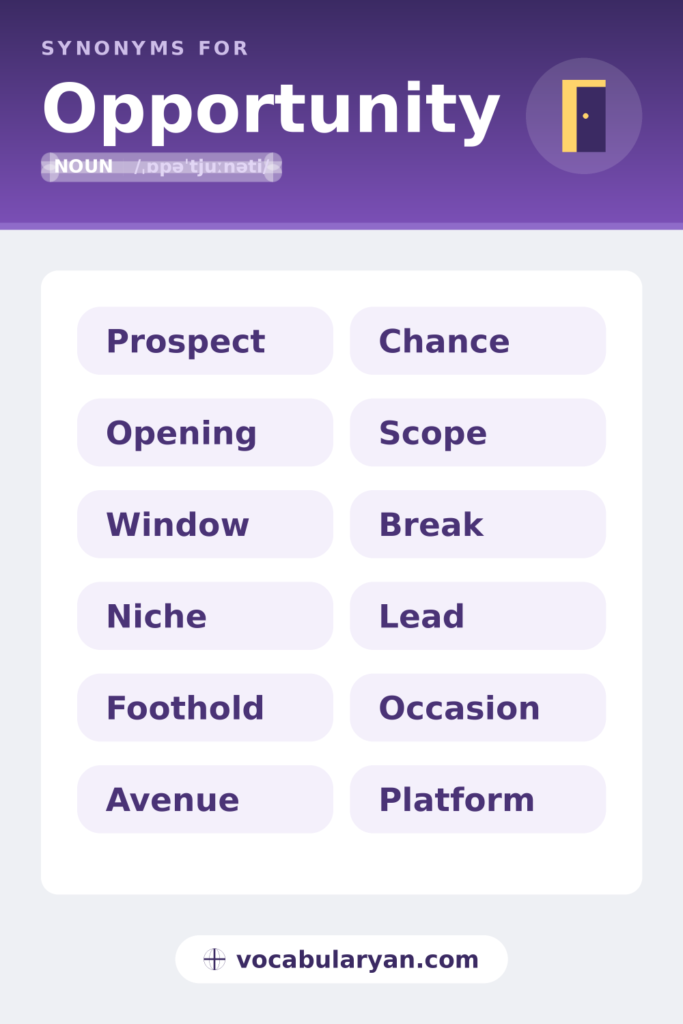
Stronger Words for Opportunity on a Resume
Recruiters read bullets for evidence of judgement. Each word here says something specific about what you saw and what you did with it.
Prospect
Resume bullet
Meaning
A future possibility that already looks likely to succeed.
When to use it
It carries more confidence than opportunity, because a prospect has been assessed rather than merely noticed. That makes it the strongest choice when the bullet continues with a number.
- Qualified 40 enterprise prospects and converted 12 within the first quarter.
- Built the prospect list that became the region's largest account.
Opening
Resume bullet
Meaning
A gap that has become available for someone to fill or enter.
When to use it
It names a space rather than a moment, which suits market gaps and unfilled roles equally. Hiring managers read it as concrete because an opening can be pointed at.
- Spotted an opening in the mid-market segment and built the pitch that won it.
- Filled a six-month opening on the delivery team without adding headcount.
It also means a job vacancy, so a bullet about openings can read as recruitment work you did not do. ❌
Lead
Resume bullet
Meaning
A piece of information pointing toward a possible customer or deal.
When to use it
Sales and marketing resumes take it as standard vocabulary, and it is countable, which is why it survives quantified bullets so well.
- Generated 300 qualified leads a month through partner referrals.
- Reworked the scoring model so sales worked the strongest leads first.
Platform
Resume bullet
Meaning
A position that makes further action possible.
When to use it
It describes what an achievement enabled rather than the achievement itself, which is why it suits the second half of a bullet, where impact belongs.
- Used the pilot as a platform for the national rollout a year later.
- The partnership gave the team a platform in three new markets.
Foothold
Resume bullet
Meaning
A small secure position from which to advance further.
When to use it
It admits the win was modest while claiming the strategic value, which reads as honest to anyone who has done the work.
- Won the first two accounts and turned them into a foothold in healthcare.
- Established a foothold in the region before competitors entered.
Springboard
Resume bullet
Meaning
Something that launches further progress.
When to use it
Close to platform, but it implies speed and a single leap rather than a standing position, so it suits a bullet about what happened next.
- Turned the internal tool into a springboard for the client-facing product.
- The certification became a springboard into technical account management.
Potential
Resume bullet
Meaning
Capacity for future development that has not been realised yet.
When to use it
It is the only word here that describes something unproven, which makes it honest about early-stage work and weak as a claim on its own.
- Identified untapped potential in the dormant account base and reactivated 60 of them.
- Assessed the potential of four markets and recommended two.
A bullet that claims potential and stops there claims nothing. Follow it with what you did. ❌
Niche
Resume bullet
Meaning
A specific gap suited to one particular offering.
When to use it
Narrower than opening, and it implies you understood a market well enough to find the part nobody was serving.
- Found a niche in regulated fintech that the wider product had ignored.
- Built the practice around a niche the three larger firms could not staff.
Formal Words for Opportunity in a Cover Letter
Cover letters ask for something, and the word you pick sets how formal the ask sounds. All six carry weight without turning stiff.
Avenue
Cover letter
Meaning
A route toward a result.
When to use it
It describes an approach rather than a moment, which is why it works when you are proposing something instead of reporting it.
- I would welcome the chance to explore this avenue with your team.
- Their research opened an avenue nobody in the sector had tried.
Scope
Cover letter
Meaning
Room to act, grow or make decisions within a situation.
When to use it
It measures how much freedom exists rather than whether a chance exists at all, which is why it appears constantly in discussions about a role's boundaries.
- The role offers real scope to shape the function from the ground up.
- There was little scope for change under the previous structure.
Occasion
Cover letter
Meaning
A particular time when something can properly be done.
When to use it
More formal than chance and tied to a specific moment, so it suits a single event rather than an ongoing possibility.
- I have had occasion to work with your engineering team twice before.
- The conference gave me the occasion to present the findings in full.
Possibility
Cover letter
Meaning
Something that could happen, with no suggestion that it will.
When to use it
The most neutral of these, and the safest when you do not want to overstate how likely something is.
- I am writing to ask about the possibility of a placement this summer.
- We mapped every possibility before committing to one.
Room
Cover letter
Meaning
Available space for something to happen or grow.
When to use it
Plainer than scope and warmer than possibility. It suits an honest sentence about what a situation still allows.
- There is room here to build something the market has not seen.
- The budget left room for one more hire.
Juncture
Cover letter
Meaning
A particular point in time defined by what is happening around it.
When to use it
Formal and slightly literary, and it points at timing rather than at the chance itself. Reports and speeches take it more comfortably than letters.
- At this juncture the company needs someone who has done the work before.
- The merger arrived at an awkward juncture for the product team.
In a cover letter it can read as grand. Use point or moment unless the timing is genuinely the argument. ❌
Everyday Words for Opportunity
Conversation and messages take all of these. Most would look casual in a formal application, and two are pure idiom.
Chance
Everyday
Meaning
A possibility that something good might happen, usually with luck involved.
When to use it
The plainest replacement, and the only one that carries a hint of luck rather than judgement. That hint is why it undersells deliberate work.
- This is my best chance to move into product.
- She got her chance when the lead developer left.
Break
Everyday
Meaning
A sudden piece of luck that changes what is possible.
When to use it
It credits fortune rather than effort, which is why it belongs in an interview story and almost never in a bullet point.
- The referral was the break that got him into the industry.
- She had been waiting years for a break like it.
Window
Everyday
Meaning
A limited period during which action is still possible.
When to use it
The only word here that carries a deadline, which is exactly why it appears in strategy conversations about timing.
- We have a three-month window before the funding closes.
- The window for a quiet launch has already passed.
Vacancy
Everyday
Meaning
An unfilled position in an organisation.
When to use it
The narrowest word on the page, and it means a job and nothing else. Job boards and HR use it constantly.
- The vacancy was filled within a fortnight.
- There are two vacancies on the night shift.
Shot
Everyday
Meaning
An informal chance to try something.
When to use it
Spoken English's most casual version, and it implies you may not get another. It suits an interview answer told as a story.
- They gave me a shot at running the project.
- It was worth a shot even at those odds.
Too casual for a resume, where it reads as luck rather than judgement. ❌
Foot in the door
Everyday
Meaning
A first small opportunity that leads to bigger ones.
When to use it
It names the size of the win honestly, which is its strength in conversation and its weakness on paper.
- The internship was a foot in the door and nothing more.
- Getting a foot in the door took two years of freelance work.
Window of opportunity
Everyday
Meaning
A limited period in which action will succeed.
When to use it
The full phrase adds nothing that window alone does not carry, so it survives mainly in speech and strategy decks.
- The window of opportunity closed the moment the rules changed.
- We had a narrow window of opportunity and used it.
On paper it is four words doing one word's work. Use window. ❌
How to Choose the Right Synonym for Opportunity
Choose by what you actually saw. If it was a gap, say opening or niche. If it was a moment with a deadline, say window. If it was assessed and likely, say prospect, and let the number that follows carry the proof. Chance, break and shot all credit luck, which is why they belong in an interview answer rather than a bullet point, and why a recruiter reading three of them forms a view about how much of the work was yours.
On paper, name the shape of the thing: an opening, a prospect, a niche. Keep chance and break for the story you tell out loud.
Opposite Words for Opportunity
- Obstacle
- Setback
- Barrier
- Dead end
- Constraint
Test Your Word Choice
Question 1: Your bullet ends with a conversion number. Which word sets it up best?
Prospect implies the possibility was assessed before it converted. Chance and break both credit luck, which weakens a quantified claim.
Question 2: You have three months before a funding round closes. That period is a:
Window is the only word here that carries a deadline. A niche is a market gap and a platform is a position to act from.
Question 3: Which word admits the win was small while claiming its strategic value?
Foothold states plainly that the position is secure but modest. Springboard claims a leap, and vacancy means an unfilled job.
FAQs
What is a professional word for opportunity?
Prospect and opening carry the most weight on a resume, because both point at something concrete. Avenue and scope suit a cover letter, where you are proposing rather than reporting.
How do I say opportunity on a resume without repeating it?
Name the shape of what you found. A market gap is an opening or a niche, a likely deal is a prospect, a limited period is a window, and a first small win is a foothold.
What is the difference between opportunity and chance?
An opportunity is a set of circumstances that makes something possible. A chance adds luck, which is why it undersells work you did deliberately.
Is opportunity a weak word on a resume?
It is vague rather than weak. On its own it says something became possible and you were nearby, so the fix is naming what kind of possibility it was and what you did next.
