
You walk into a dark room during a storm and say, “I’m scared.” The word fits, but it doesn’t capture the rush of fear or the tight grip of panic you actually feel. Plain language often falls short when fear takes over.
That is where idioms for afraid come in. These expressions describe fright, nervous tension, or sudden shock. Some sound light and almost playful, while others carry deeper anxiety.
We’ll look at how they work in sentences and short dialogue. By the end, you will know which one fits mild unease and which conveys stronger terror. Here are the words that match the moment.
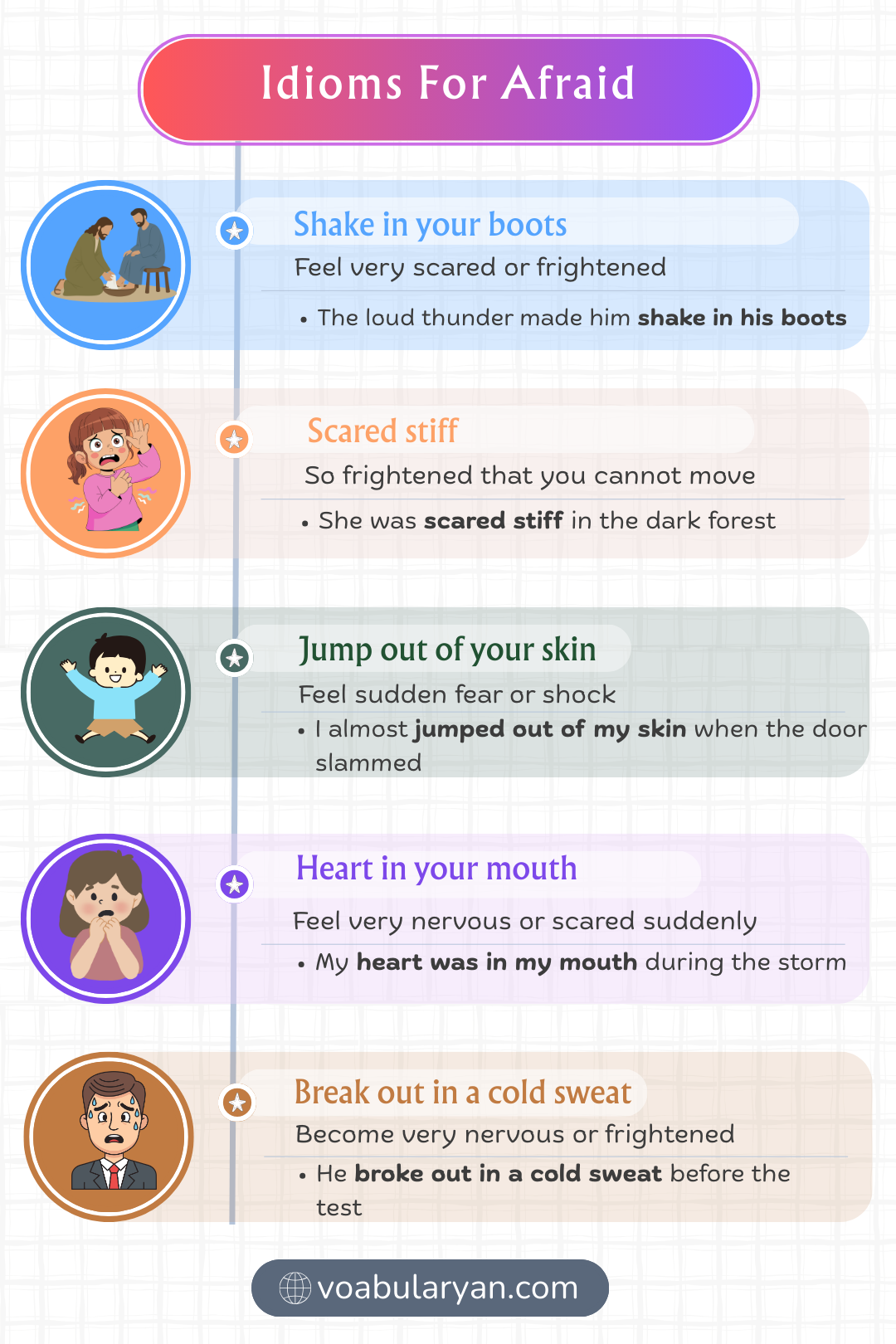
Idioms For Being Afraid
Afraid Of Your Own Shadow
Meaning: being very fearful, even when danger is not present.
When To Use It: say it when someone seems scared of small or normal things.
Collocations: afraid of your own shadow lately, seem afraid of your own shadow, become afraid of your own shadow
Example Sentences:
- After the incident, he was Afraid Of Your Own Shadow for days.
- She looked Afraid Of Your Own Shadow when the door creaked.
Dialogue:
Huda: I feel Afraid Of Your Own Shadow these days.
Kamal: That fear can grow from stress.
Closest Alternatives:
- very fearful
- scared of everything
Like A Deer In Headlights
Meaning: frozen and shocked, not knowing what to do.
When To Use It: say it when someone is surprised and cannot react.
Collocations: look like a deer in headlights, stand like a deer in headlights, feel like a deer in headlights
Example Sentences:
- When the teacher called him, he stood Like A Deer In Headlights.
- She went Like A Deer In Headlights when the alarm rang.
Dialogue:
Anaya: I looked Like A Deer In Headlights up there.
Rafi: Sudden attention can cause shock.
Closest Alternatives:
- freeze up
- be stunned
On Edge
Meaning: feeling nervous and ready to react quickly.
When To Use It: say it when worry or tension makes a person restless.
Collocations: on edge all day, feel on edge, keep someone on edge
Example Sentences:
- He was On Edge while waiting for the phone call.
- She felt On Edge before the final result.
Dialogue:
Saira: I have been On Edge since morning.
Danish: The waiting can build tension.
Closest Alternatives:
- nervous
- tense
Idioms For Sudden Scares
Jump Out Of Your Skin
Meaning: react with sudden shock or fear, often by moving quickly.
When To Use It: say it when a surprise startles someone strongly.
Collocations: jump out of your skin at a noise, jump out of your skin when it happened
Example Sentences:
- I Jump Out Of Your Skin when the door slammed.
- She Jump Out Of Your Skin at the sudden shout.
Dialogue:
Hiba: I Jump Out Of Your Skin when the light flickered.
Zeeshan: That sound would scare anyone.
Closest Alternatives:
- get a fright
- startle badly
Scared Stiff
Meaning: so afraid that the body feels frozen.
When To Use It: say it when fear makes someone unable to move.
Collocations: scared stiff of dogs, scared stiff in the dark, scared stiff for a moment
Example Sentences:
- He was Scared Stiff when he heard footsteps.
- I stood Scared Stiff during the power cut.
Dialogue:
Naila: I was Scared Stiff and could not speak.
Imran: Fear can make the body feel frozen.
Closest Alternatives:
- frozen with fear
- terrified
Scare The Pants Off
Meaning: frighten someone very badly and suddenly.
When To Use It: say it when a scare feels extreme and immediate.
Collocations: scare the pants off me, scare the pants off someone with a prank
Example Sentences:
- That horror scene Scare The Pants Off me.
- He Scare The Pants Off his sister with the mask.
Dialogue:
Saira: You Scare The Pants Off me just now.
Kamil: Sorry, I did not mean to be so scary.
Closest Alternatives:
- scare someone badly
- frighten to death
Caught Off Guard
Meaning: surprised and not ready to respond.
When To Use It: say it when something happens without warning.
Collocations: caught off guard by a question, caught off guard at work, completely caught off guard
Example Sentences:
- The sudden question Caught Off Guard him.
- I was Caught Off Guard by the loud announcement.
Dialogue:
Rabia: I felt Caught Off Guard by that message.
Shahzaib: It came with no warning.
Closest Alternatives:
- taken by surprise
- unprepared
Idioms For Fear In The Body
Shaking Like A Leaf
Meaning: shaking strongly because of fear, cold, or anxiety.
When To Use It: say it when the body trembles and control feels hard.
Collocations: shaking like a leaf with fear, shaking like a leaf from nerves, shaking like a leaf in the cold
Example Sentences:
- He was Shaking Like A Leaf after the sudden bang.
- She stood Shaking Like A Leaf outside the office door.
Dialogue:
Nida: I am Shaking Like A Leaf right now.
Ali: That looks like real fear.
Closest Alternatives:
- trembling
- shaking badly
In A Cold Sweat
Meaning: sweating from fear or shock, even without heat.
When To Use It: say it when anxiety causes sudden sweating.
Collocations: break out in a cold sweat, wake up in a cold sweat, be in a cold sweat
Example Sentences:
- I woke up In A Cold Sweat after a scary dream.
- He broke out In A Cold Sweat when he heard the news.
Dialogue:
Hira: I am In A Cold Sweat thinking about it.
Usman: That is pure panic.
Closest Alternatives:
- sweating bullets
- panic
White As A Sheet
Meaning: looking very pale from fear, illness, or shock.
When To Use It: say it when someone loses color suddenly.
Collocations: go white as a sheet, turn white as a sheet, look white as a sheet
Example Sentences:
- She turned White As A Sheet when the lights went out.
- He looked White As A Sheet after the loud crash.
Dialogue:
Amina: You are White As A Sheet.
Sameer: I got a big shock.
Closest Alternatives:
- very pale
- frightened
Shaky Knees
Meaning: legs feel weak and unsteady from fear or nerves.
When To Use It: say it before a difficult moment or after a scare.
Collocations: get shaky knees, shaky knees before a speech, shaky knees from nerves
Example Sentences:
- I got Shaky Knees before stepping on stage.
- He had Shaky Knees when the elevator stopped.
Dialogue:
Sana: I have Shaky Knees right now.
Bilal: That is strong nerves.
Closest Alternatives:
- weak legs
- feel unsteady
Stomach Dropped
Meaning: a sudden sinking feeling from fear or bad news.
When To Use It: say it when something shocks you in an instant.
Collocations: my stomach dropped when, stomach dropped at the news
Example Sentences:
- My Stomach Dropped when I saw the missed call.
- Her Stomach Dropped as the teacher read the list.
Dialogue:
Zain: My Stomach Dropped when I heard his name.
Iqra: That kind of shock hits fast.
Closest Alternatives:
- heart sank
- feel a sinking feeling
Idioms For Nervous Waiting
On Pins And Needles
Meaning: feeling very nervous while waiting for something to happen.
When To Use It: say it during suspense, especially before news or results.
Collocations: on pins and needles all day, on pins and needles waiting, keep someone on pins and needles
Example Sentences:
- I was On Pins And Needles waiting for the call.
- She stayed On Pins And Needles until the results came.
Dialogue:
Mina: I am On Pins And Needles right now.
Hassan: The waiting can feel intense.
Closest Alternatives:
- on edge
- holding your breath
Held My Breath
Meaning: waited in suspense, feeling nervous about the outcome.
When To Use It: say it when something important is about to happen.
Collocations: held my breath until, held my breath for the result, held my breath as it happened
Example Sentences:
- I Held My Breath until the teacher read my name.
- He Held My Breath as the score appeared on screen.
Dialogue:
Areej: I Held My Breath during that final moment.
Zubair: That kind of suspense is hard.
Closest Alternatives:
- waited anxiously
- on pins and needles
Get Or Have The Jitters
Meaning: feel nervous and shaky, often before an event.
When To Use It: say it before performing, speaking, or starting something new.
Collocations: get the jitters before, have the jitters about, jitters in the morning
Example Sentences:
- I Get Or Have The Jitters before every speech.
- She Get Or Have The Jitters when the test begins.
Dialogue:
Noor: I Get Or Have The Jitters before going in.
Fahad: That is normal before a big moment.
Closest Alternatives:
- feel nervous
- shaky knees
On Tenterhooks
Meaning: feeling tense while waiting and unable to relax.
When To Use It: say it when suspense lasts and nerves stay high.
Collocations: on tenterhooks for news, keep someone on tenterhooks, left on tenterhooks
Example Sentences:
- We were On Tenterhooks for the final decision.
- She stayed On Tenterhooks until he replied.
Dialogue:
Hiba: I am On Tenterhooks about the result.
Sameer: The uncertainty builds tension.
Closest Alternatives:
- on edge
- on pins and needles
Like A Cat On Hot Bricks
Meaning: restless and unable to stay still from worry.
When To Use It: say it when nerves make someone pace or fidget.
Collocations: like a cat on hot bricks all evening, look like a cat on hot bricks, feel like a cat on hot bricks
Example Sentences:
- He was Like A Cat On Hot Bricks before the interview.
- She paced Like A Cat On Hot Bricks around the room.
Dialogue:
Sana: I am Like A Cat On Hot Bricks today.
Bilal: That shows real nervous energy.
Closest Alternatives:
- restless
- can’t sit still
Idioms For Anxiety And Overreaction
Nervous Wreck
Meaning: feeling very anxious and unable to stay calm.
When To Use It: say it when fear or worry feels overwhelming.
Collocations: a nervous wreck before an interview, a nervous wreck about results, feel like a nervous wreck
Example Sentences:
- I was a Nervous Wreck before the stage call.
- She felt like a Nervous Wreck during the long wait.
Dialogue:
Sana: I am a Nervous Wreck right now.
Bilal: That kind of worry can feel heavy.
Closest Alternatives:
- very anxious
- a bundle of nerves
Freak Out
Meaning: react with sudden fear, shock, or panic.
When To Use It: say it when emotions rise fast and control feels hard.
Collocations: freak out about a test, freak out over the news, totally freak out
Example Sentences:
- He Freak Out when he lost his phone.
- She did not Freak Out even with the alarm.
Dialogue:
Areeba: I might Freak Out if it happens again.
Fahad: Take a slow breath and stay calm.
Closest Alternatives:
- panic
- lose it
Have Kittens
Meaning: become extremely worried or upset.
When To Use It: say it when someone reacts strongly to a problem.
Collocations: have kittens over a delay, have kittens about the score
Example Sentences:
- My mom will Have Kittens if I come late.
- He Have Kittens when the plan changed.
Dialogue:
Hina: She will Have Kittens when she hears this.
Saad: Yes, she gets upset fast.
Closest Alternatives:
- get very upset
- panic
Get Your Knickers In A Twist
Meaning: get upset or worried over something small.
When To Use It: say it when someone overreacts or becomes too tense.
Collocations: get your knickers in a twist over nothing, get your knickers in a twist about comments
Example Sentences:
- He Get Your Knickers In A Twist over one small remark.
- She told him not to Get Your Knickers In A Twist.
Dialogue:
Mina: Do not Get Your Knickers In A Twist about it.
Hasan: I know, I am being too tense.
Closest Alternatives:
- overreact
- get worked up
Idioms About Handling Fear
Lose Your Nerve
Meaning: suddenly feel too afraid to continue with something.
When To Use It: say it when confidence drops at the last moment.
Collocations: lose your nerve at the last second, lose your nerve before a jump, lose your nerve during the test
Example Sentences:
- I Lose Your Nerve right before I walked on stage.
- He Lose Your Nerve when the ride started moving.
Dialogue:
Hira: I Lose Your Nerve every time I try.
Usman: That fear can break confidence fast.
Closest Alternatives:
- back out
- get cold feet
Whistle In The Dark
Meaning: act cheerful to hide fear in a scary situation.
When To Use It: say it when someone stays brave while feeling afraid.
Collocations: whistle in the dark to stay calm, whistle in the dark at night
Example Sentences:
- He tried to Whistle In The Dark while walking home alone.
- She began to Whistle In The Dark to hide her fear.
Dialogue:
Amina: I Whistle In The Dark when I feel scared.
Sameer: It helps you look brave.
Closest Alternatives:
- put on a brave face
- act calm
Tongue-Tied
Meaning: unable to speak because of nervousness or surprise.
When To Use It: say it when words fail in a sudden moment.
Collocations: feel tongue-tied, go tongue-tied, left me tongue-tied
Example Sentences:
- I went Tongue-Tied when they asked my name.
- She felt Tongue-Tied during the first question.
Dialogue:
Ayla: I became Tongue-Tied in front of everyone.
Rayan: That happens when pressure rises.
Closest Alternatives:
- speechless
- mind going blank
Key Takeaways
This topic brings together common phrases that describe sudden fear, shaky nerves, and big reactions when stress rises fast. Meaning depends on tone and situation, so the same line can sound humorous, serious, or sharp in different moments. Many idioms keep stable wording and word order, so changing even one small part can make them sound unnatural. Across the examples, the language reflects real moments such as being startled, panicking, and overreacting, and it fits both everyday conversation and simple writing.
FAQs
Q1. What does “scared stiff” mean?
It means fear is so strong that a person feels unable to move for a moment. In idioms for afraid, it can fit a sudden shock, like a loud bang in the dark.
Q2. What does “shake like a leaf” mean?
It means someone is trembling because they are scared or very nervous. In idioms for afraid, it can describe hands shaking after a scare or before bad news.
Q3. What does “jump out of your skin” mean?
It means a surprise makes you react strongly, often by jumping. In idioms for afraid, it can happen when a door slams or someone speaks suddenly.
Q4. What does “have cold feet” mean?
It means feeling afraid and wanting to back out before doing something big. In idioms for afraid, it can fit a speech, a match, or a difficult talk.
Q5. What does “in a panic” mean?
It means fear takes over and thinking becomes rushed and confused. In idioms for afraid, it can describe searching wildly after losing keys or missing a call.
Q6. What does “freeze up” mean when you feel scared?
It means fear makes you stop and struggle to respond right away. In idioms for afraid, it can happen during a confrontation or a sudden emergency.
You May Also Like
