
Sometimes saying someone has a “bad attitude” or a “great attitude” feels too plain. You may want a phrase that captures confidence, pride, sarcasm, or even disrespect. English often relies on figurative expressions to describe personality and behavior in ways that feel sharper and more expressive.
Idioms for attitude include phrases that reflect confidence, arrogance, boldness, or defiance. Some suit casual conversation, while others work well in storytelling or character description. Their tone can shift from playful to critical, and meanings with examples show how each one sounds in context.
We’ll look at their meanings, when they fit best, and how they pair with natural collocations in sentences or short dialogue. You will also notice close alternatives and how tone changes across situations. By the end, you can describe personality and behavior with more range. Let’s look at them.
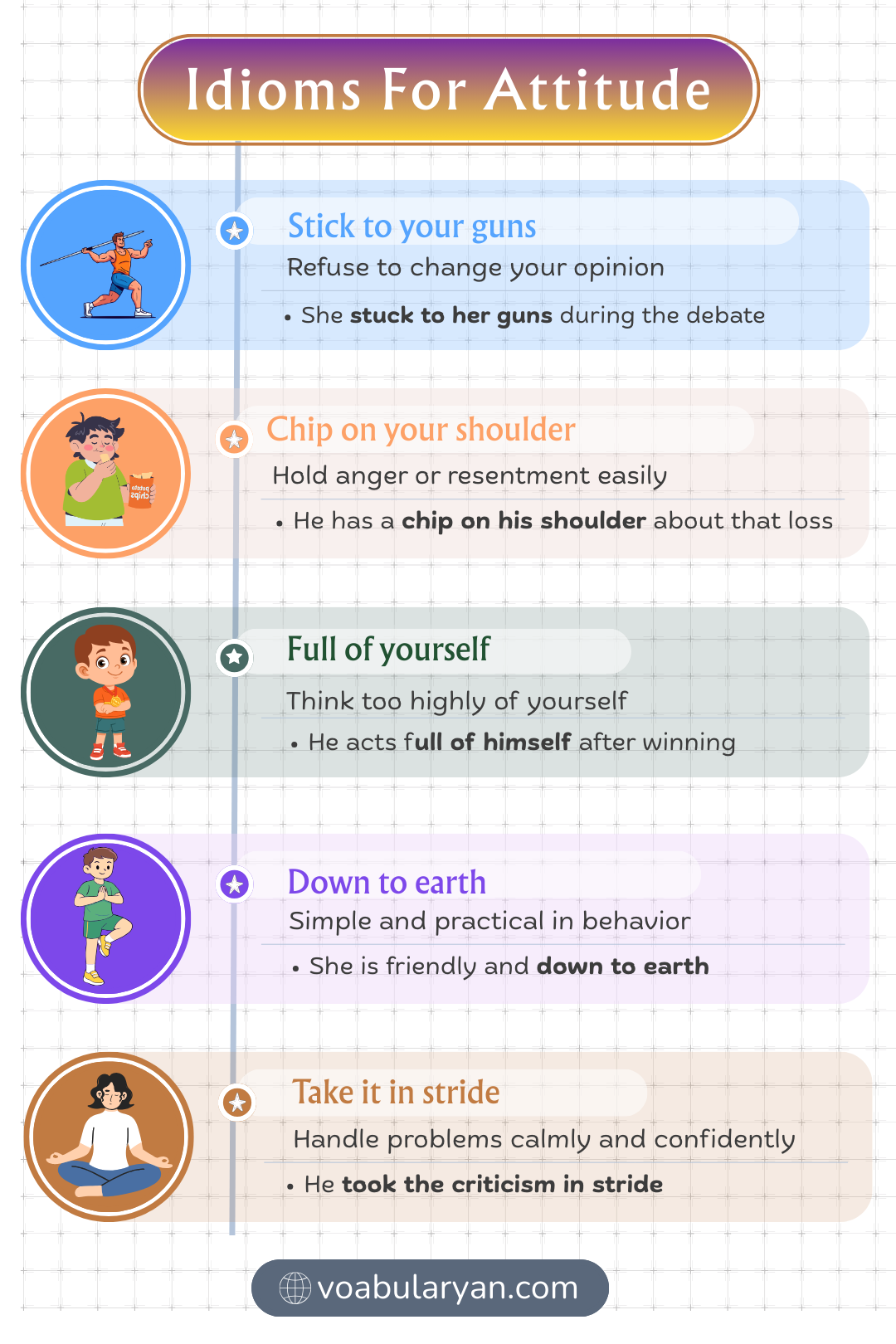
Attitude Idioms For Rude Behavior And Disrespect
Roll Your Eyes
Meaning: show annoyance or disbelief without speaking.
When To Use It: use it when reacting to something silly or frustrating.
Collocations: roll your eyes at a comment
Example Sentences:
- She rolled her eyes at his excuse.
- He rolled his eyes during the talk.
Dialogue:
Liam: She rolled her eyes at me.
Maya: That shows clear annoyance.
Closest Alternatives:
- show irritation
- react with disbelief
Give The Evil Eye
Meaning: look at someone with anger or dislike.
When To Use It: use it when showing silent disapproval.
Collocations: give the evil eye across the room
Example Sentences:
- She gave him the evil eye.
- He gave her the evil eye at dinner.
Dialogue:
Emma: She gave me the evil eye.
Noah: She must be feeling real anger.
Closest Alternatives:
- glare at
- look angrily
Cold Shoulder
Meaning: deliberate act of ignoring someone.
When To Use It: use it when someone avoids interaction on purpose.
Collocations: give someone the cold shoulder
Example Sentences:
- She gave him the cold shoulder.
- He received the cold shoulder at work.
Dialogue:
Grace: She gave me the cold shoulder.
Daniel: That seems quite unfriendly.
Closest Alternatives:
- ignore someone
- treat coldly
Rub The Wrong Way
Meaning: cause irritation or discomfort in someone.
When To Use It: use it when behavior feels annoying.
Collocations: rub someone the wrong way
Example Sentences:
- His tone rubbed me the wrong way.
- That comment rubbed her the wrong way.
Dialogue:
Sophia: His words rubbed me the wrong way.
Lucas: I understand your reaction.
Closest Alternatives:
- annoy
- irritate
Attitude Idioms For Arrogance And Acting Superior
Full Of Yourself
Meaning: thinking too highly of your own importance.
When To Use It: use it when someone acts proud and self-focused.
Collocations: act full of yourself, seem full of yourself
Example Sentences:
- He sounds full of himself lately.
- She became full of herself after success.
Dialogue:
Liam: He is getting full of himself.
Maya: Success should not lead to such pride.
Closest Alternatives:
- self-centered
- arrogant
Have A Big Head
Meaning: become too proud after success.
When To Use It: use it when praise changes someone’s attitude.
Collocations: get a big head
Example Sentences:
- He has a big head now.
- She did not let fame give her a big head.
Dialogue:
Emma: He has a big head these days.
Noah: Too much praise can grow ego.
Closest Alternatives:
- become arrogant
- get conceited
Act High And Mighty
Meaning: behave as if you are better than others.
When To Use It: use it when someone shows false superiority.
Collocations: act high and mighty at work
Example Sentences:
- She acts high and mighty at meetings.
- He acted high and mighty with staff.
Dialogue:
Olivia: He acts high and mighty.
Ethan: That attitude shows weak respect.
Closest Alternatives:
- act superior
- be arrogant
Get On Your High Horse
Meaning: speak in a proud and moralizing way.
When To Use It: use it when someone lectures others proudly.
Collocations: get on your high horse about rules
Example Sentences:
- She got on her high horse again.
- He tends to get on his high horse.
Dialogue:
Grace: Do not get on your high horse.
Daniel: I only wanted fair rules.
Closest Alternatives:
- act superior
- preach
Look Down Your Nose
Meaning: show disrespect by acting superior.
When To Use It: use it when someone treats others poorly.
Collocations: look down your nose at people
Example Sentences:
- He looks down his nose at others.
- She looked down her nose at the idea.
Dialogue:
Ava: She looks down her nose at us.
Ryan: That shows poor manners.
Closest Alternatives:
- act superior
- look down on
Turn Your Nose Up
Meaning: refuse something with dislike or pride.
When To Use It: use it when rejecting an offer proudly.
Collocations: turn your nose up at help
Example Sentences:
- He turned his nose up at the meal.
- She turns her nose up at advice.
Dialogue:
Mila: He turned his nose up at the gift.
Omar: That response felt very rude.
Closest Alternatives:
- reject proudly
- refuse with disdain
Attitude Idioms For Being Moody And Hard To Handle
On Edge
Meaning: feeling nervous, tense, or easily upset.
When To Use It: use it when someone seems anxious or stressed.
Collocations: feel on edge all day, keep someone on edge
Example Sentences:
- She felt on edge before the test.
- He has been on edge lately.
Dialogue:
Liam: I am on edge today.
Maya: Try to stay calm.
Closest Alternatives:
- nervous
- tense
All Over The Place
Meaning: not organized or hard to follow.
When To Use It: use it when thoughts or actions lack order.
Collocations: thoughts all over the place
Example Sentences:
- My ideas were all over the place.
- The report felt all over the place.
Dialogue:
Emma: My speech was all over the place.
Noah: You can improve the flow next time.
Closest Alternatives:
- disorganized
- scattered
Two-Faced
Meaning: dishonest by acting differently with others.
When To Use It: use it when someone pretends to be kind but is not.
Collocations: act two-faced
Example Sentences:
- He was two-faced with his friends.
- She seemed two-faced in that meeting.
Dialogue:
Olivia: She acted two-faced yesterday.
Ethan: That kind of behavior breaks trust.
Closest Alternatives:
- hypocritical
- deceitful
Attitude Idioms For Anger And Losing Control
Have A Short Fuse
Meaning: get angry very quickly and easily.
When To Use It: use it for someone who reacts with anger fast.
Collocations: have a short fuse at work, known to have a short fuse
Example Sentences:
- He has a short fuse during meetings.
- She has a short fuse when stressed.
Dialogue:
Liam: He has a short fuse lately.
Maya: Yes, small problems make him angry.
Closest Alternatives:
- quick-tempered
- easily annoyed
Hot-Headed
Meaning: easily angered and acting without thinking.
When To Use It: use it for someone who reacts with strong emotion.
Collocations: hot-headed person, too hot-headed to listen
Example Sentences:
- He is too hot-headed to stay calm.
- She made a hot-headed decision.
Dialogue:
Emma: He was being hot-headed.
Noah: He should think before he acts.
Closest Alternatives:
- short-tempered
- quick to anger
Lose Your Temper
Meaning: suddenly become very angry.
When To Use It: use it when someone cannot control anger.
Collocations: lose your temper with someone
Example Sentences:
- She lost her temper in class.
- He lost his temper over a mistake.
Dialogue:
Olivia: I lost my temper earlier.
Ethan: The pressure was too much stress.
Closest Alternatives:
- get angry
- snap
Blow Up
Meaning: suddenly become very angry.
When To Use It: use it for a sudden strong reaction.
Collocations: blow up at someone
Example Sentences:
- He blew up at his friend.
- She blew up over the delay.
Dialogue:
Ava: He blew up without warning.
Ryan: The issue made him very upset.
Closest Alternatives:
- explode with anger
- lose control
Lose Your Cool
Meaning: stop staying calm and become upset.
When To Use It: use it when calm behavior changes to anger.
Collocations: lose your cool in public
Example Sentences:
- He lost his cool during the debate.
- She lost her cool over small things.
Dialogue:
Grace: I nearly lost my cool.
Daniel: You usually stay very calm.
Closest Alternatives:
- lose control
- get upset
Go Off The Deep End
Meaning: react in an extreme or uncontrolled way.
When To Use It: use it when someone overreacts strongly.
Collocations: go off the deep end about news
Example Sentences:
- She went off the deep end over nothing.
- He went off the deep end at the meeting.
Dialogue:
Sophia: He went off the deep end.
Lucas: The problem was not that serious.
Closest Alternatives:
- overreact
- lose control
Get Bent Out Of Shape
Meaning: become upset about something small.
When To Use It: use it for strong reaction to minor issues.
Collocations: get bent out of shape over comments
Example Sentences:
- He got bent out of shape over a joke.
- She gets bent out of shape easily.
Dialogue:
Mila: He got bent out of shape again.
Omar: It was a small issue.
Closest Alternatives:
- overreact
- get upset
Throw A Fit
Meaning: show anger in a loud or dramatic way.
When To Use It: use it when someone reacts loudly in anger.
Collocations: throw a fit over rules
Example Sentences:
- He threw a fit at the store.
- She threw a fit over the change.
Dialogue:
Zara: She threw a fit earlier.
Jack: That reaction seemed too dramatic.
Closest Alternatives:
- have a tantrum
- lose your temper
Get Under Someone’s Skin
Meaning: annoy someone deeply over time.
When To Use It: use it when irritation grows slowly.
Collocations: get under someone’s skin easily
Example Sentences:
- His comments got under her skin.
- That noise gets under my skin.
Dialogue:
Olivia: That joke got under my skin.
Ethan: I can see it really bothered you.
Closest Alternatives:
- irritate
- annoy deeply
Blow Things Out Of Proportion
Meaning: treat a small problem as very serious.
When To Use It: use it when someone exaggerates an issue.
Collocations: blow things out of proportion often
Example Sentences:
- He blew things out of proportion.
- She tends to blow things out of proportion.
Dialogue:
Ava: You blew things out of proportion.
Ryan: The mistake was actually small.
Closest Alternatives:
- exaggerate
- overreact
Blow Off Steam
Meaning: release anger or stress in a safe way.
When To Use It: use it after tension or frustration.
Collocations: blow off steam at the gym
Example Sentences:
- He ran to blow off steam.
- She talked to a friend to blow off steam.
Dialogue:
Grace: I need to blow off steam.
Daniel: A walk might ease your stress.
Closest Alternatives:
- calm down
- release tension
Attitude Idioms For Grudges And Negative Mindset
Chip On Your Shoulder
Meaning: carry anger or resentment from the past.
When To Use It: use it when someone seems easily offended.
Collocations: have a chip on your shoulder about something
Example Sentences:
- He has a chip on his shoulder about school.
- She acts like she has a chip on her shoulder.
Dialogue:
Liam: He always has a chip on his shoulder.
Maya: That old grudge still bothers him.
Closest Alternatives:
- hold a grudge
- feel bitter
Sour Grapes
Meaning: pretend not to want something after failing.
When To Use It: use it when someone hides disappointment.
Collocations: call it sour grapes
Example Sentences:
- His comments sound like sour grapes.
- She said she did not care, but it was sour grapes.
Dialogue:
Emma: That sounds like sour grapes.
Noah: He just feels disappointed.
Closest Alternatives:
- hide disappointment
- act bitter
Cry Over Spilled Milk
Meaning: feel upset about something already done.
When To Use It: use it when regret changes nothing.
Collocations: no use crying over spilled milk
Example Sentences:
- There is no point crying over spilled milk.
- She stopped crying over spilled milk.
Dialogue:
Mila: I keep crying over spilled milk.
Omar: It is better to move forward.
Closest Alternatives:
- regret uselessly
- dwell on the past
Attitude Idioms For Speaking Up And Being Direct
Cut To The Chase
Meaning: move directly to the main point.
When To Use It: use it when avoiding long details.
Collocations: cut to the chase in a discussion
Example Sentences:
- Let us cut to the chase and decide.
- He cut to the chase during the talk.
Dialogue:
Ava: Can we cut to the chase?
Ryan: Yes, let us focus on the key point.
Closest Alternatives:
- get to the point
- skip the details
Hit The Nail On The Head
Meaning: say exactly the right thing about a problem.
When To Use It: use it when someone is completely correct.
Collocations: hit the nail on the head about the issue
Example Sentences:
- She hit the nail on the head with her answer.
- He hit the nail on the head about the cause.
Dialogue:
Noah: You hit the nail on the head.
Emma: I am glad my answer was clear.
Closest Alternatives:
- be exactly right
- get it right
Attitude Idioms For Self-Control And Better Reactions
Keep Your Cool
Meaning: stay calm during stress or conflict.
When To Use It: use it when facing pressure or anger.
Collocations: keep your cool under pressure, keep your cool in public
Example Sentences:
- He kept his cool during the debate.
- She tried to keep her cool at work.
Dialogue:
Ava: How did you keep your cool?
Noah: I focused on staying calm.
Closest Alternatives:
- stay composed
- remain calm
Chill Out
Meaning: relax and reduce tension or anger.
When To Use It: use it when someone feels upset.
Collocations: chill out for a while, chill out at home
Example Sentences:
- He told me to chill out.
- She went outside to chill out.
Dialogue:
Emma: Just chill out a little.
Ethan: I will try to feel more relaxed.
Closest Alternatives:
- calm down
- take it easy
Take It Easy
Meaning: avoid stress and move slowly.
When To Use It: use it when suggesting rest or patience.
Collocations: take it easy today, take it easy after work
Example Sentences:
- She decided to take it easy tonight.
- He needs to take it easy for a few days.
Dialogue:
Sophia: You should take it easy now.
Lucas: I will rest and stay calm.
Closest Alternatives:
- relax
- slow down
Go With The Flow
Meaning: accept changes without resistance.
When To Use It: use it when plans shift suddenly.
Collocations: just go with the flow, learn to go with the flow
Example Sentences:
- We chose to go with the flow.
- She prefers to go with the flow.
Dialogue:
Grace: Let us go with the flow.
Daniel: That keeps things more flexible.
Closest Alternatives:
- stay flexible
- take things as they come
Play It By Ear
Meaning: decide what to do as events unfold.
When To Use It: use it when there is no fixed plan.
Collocations: play it by ear tonight, play it by ear this week
Example Sentences:
- We will play it by ear this weekend.
- She likes to play it by ear.
Dialogue:
Aiden: Should we make a plan?
Olivia: Let us play it by ear.
Closest Alternatives:
- improvise
- decide later
Have A Thick Skin
Meaning: not feel hurt by criticism.
When To Use It: use it when facing strong opinions.
Collocations: have a thick skin in business, have a thick skin at work
Example Sentences:
- She has a thick skin in her job.
- He needs a thick skin in sports.
Dialogue:
Chloe: Those words were harsh.
Henry: You need a thick skin sometimes.
Closest Alternatives:
- be tough
- not be sensitive
Attitude Idioms For Confidence And Positive Spirit
On Top Of The World
Meaning: feel extremely happy and proud.
When To Use It: use it after joyful success or good news.
Collocations: feel on top of the world after results
Example Sentences:
- He felt on top of the world after winning.
- She was on top of the world all week.
Dialogue:
Ava: I feel on top of the world.
Noah: That success brought real joy.
Closest Alternatives:
- over the moon
- walk on air
Walk On Air
Meaning: feel very happy and light with joy.
When To Use It: use it after exciting or meaningful events.
Collocations: walk on air after news
Example Sentences:
- She was walking on air after the call.
- He felt like he could walk on air.
Dialogue:
Olivia: I feel like I could walk on air.
Ethan: That must feel like pure happiness.
Closest Alternatives:
- feel thrilled
- be overjoyed
Attitude Idioms For Social Situations And Everyday Choices
Take The Bull By The Horns
Meaning: face a problem directly and bravely.
When To Use It: use it when dealing with difficulty boldly.
Collocations: take the bull by the horns at work
Example Sentences:
- She took the bull by the horns and spoke up.
- He decided to take the bull by the horns.
Dialogue:
Emma: I will take the bull by the horns.
Ryan: That shows real courage.
Closest Alternatives:
- face it directly
- act boldly
Bite Off More Than You Can Chew
Meaning: take on more work than you can handle.
When To Use It: use it when someone accepts too much responsibility.
Collocations: bite off more than you can chew at once
Example Sentences:
- He bit off more than he could chew.
- She realized she had bitten off more than she could chew.
Dialogue:
Mila: I think I bit off more than I could chew.
Omar: That project is very large.
Closest Alternatives:
- take on too much
- overload yourself
Make A Mountain Out Of A Molehill
Meaning: treat a small problem as very big.
When To Use It: use it when someone overreacts.
Collocations: make a mountain out of a molehill over nothing
Example Sentences:
- She made a mountain out of a molehill.
- He tends to make a mountain out of a molehill.
Dialogue:
Sophia: You are making a mountain out of a molehill.
Lucas: It is just a small issue.
Closest Alternatives:
- overreact
- exaggerate
Throw In The Towel
Meaning: give up after trying hard.
When To Use It: use it when someone stops trying.
Collocations: throw in the towel after defeat
Example Sentences:
- He refused to throw in the towel.
- She almost threw in the towel.
Dialogue:
Chloe: I want to throw in the towel.
Henry: Do not give up so quickly.
Closest Alternatives:
- give up
- quit
Key Takeaways
This overview digs into how English uses idioms to convey attitude in interpersonal communication and expression. Attitude idioms often reflect confidence, approval, disapproval, openness, or resistance, and they shape tone in both spoken and written language. Because idioms often rely on figurative meaning rather than literal wording, many keep stable wording and fixed word order that native speakers recognize instantly. Context, social cues, and emotional nuance help listeners or readers link the phrase to the speaker’s attitude rather than to the literal words. Idioms for attitude thus act as concise markers of personal stance across different communication situations.
FAQs
Q2. What does the phrase on top of the world mean?
A: On top of the world means feeling really happy and successful, like everything is going well and you’re at your best.
Q3. How is keep your cool used in everyday conversation?
A: Keep your cool means staying calm, especially when things are stressful. It shows someone’s ability to stay relaxed even under pressure.
Q4. What does it mean to be full of beans?
A: If someone is full of beans, they’re full of energy and excitement. It’s a fun way to say someone is in a great, lively mood.
Q5. What does bite your tongue mean?
A: To bite your tongue means holding back from saying something, usually because it might be hurtful or cause trouble.
Q6. What does it mean to have a heart of gold?
A: If someone has a heart of gold, it means they are really kind and caring, always willing to help others.
Q1. What does it mean when someone has a chip on their shoulder?
A: When someone has a chip on their shoulder, it means they’re upset or holding a grudge about something, and they might act defensively or with a bad attitude.
You May Also Like