
A friend stays late to help you finish a project, and you say, “Thanks, I appreciate it.” The words are polite, yet they barely carry the warmth, gratitude, and deep respect you feel in that moment. Strong feelings of thankfulness often sound smaller than they truly are.
That is where idioms for appreciation become useful. These expressions appear when people talk about kindness or thoughtful actions. Some feel gentle and sincere, while others express stronger admiration.
We’ll look at how these phrases work in sentences and short dialogue. You’ll sense when one fits a casual moment and when another suits deeper praise or quiet loyalty. By the end, you can express appreciation with greater confidence. Here are the words that carry the warmth.
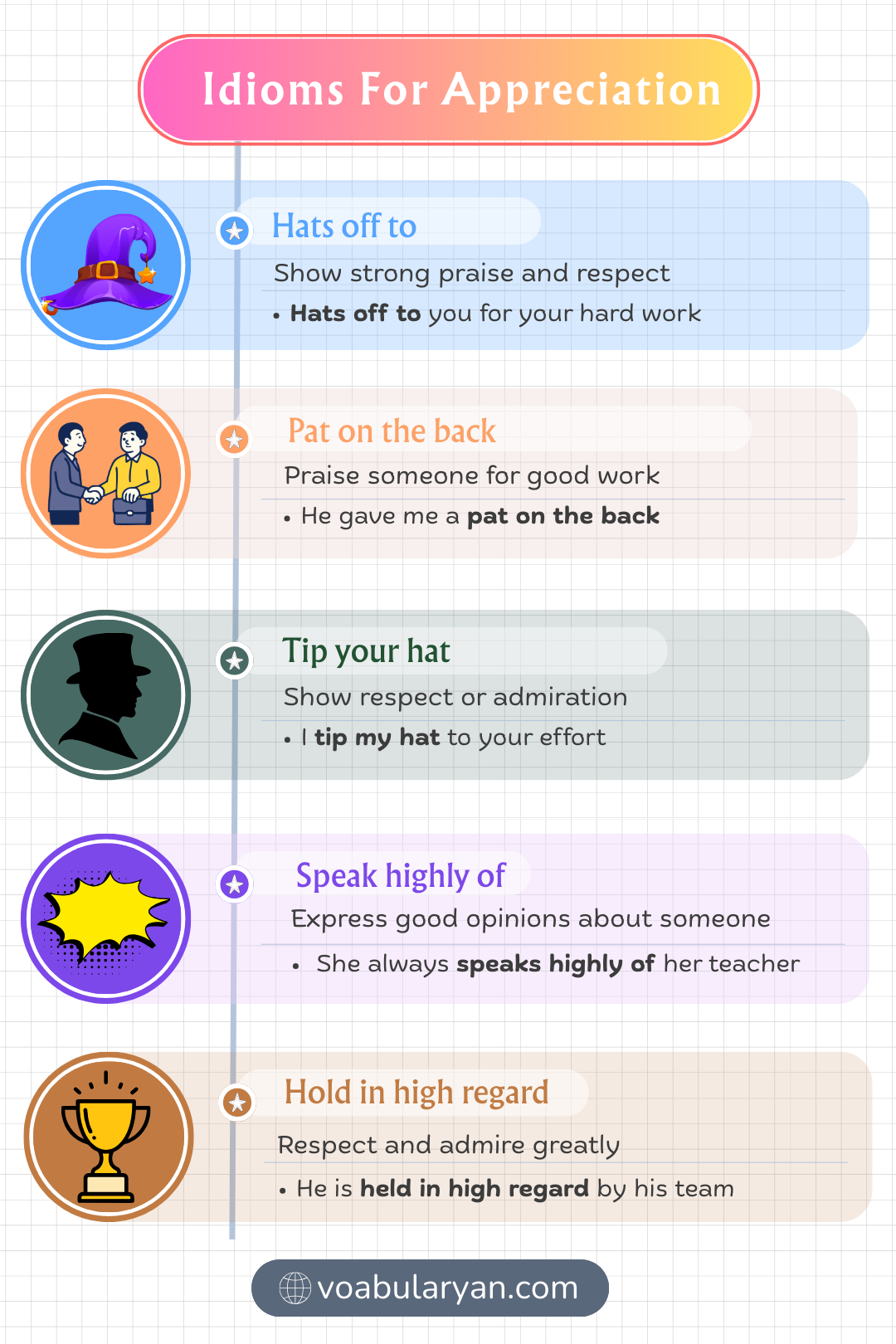
Appreciation Idioms For Praising Someone Directly
Hats Off To You
Meaning: show strong respect for someone’s effort or success.
When To Use It: use it to praise a hard task done well.
Collocations: hats off to you for your work, hats off to you for the win, hats off to you for the courage
Example Sentences:
- Hats off to you for finishing the project on time.
- Hats off to you for staying calm under pressure.
Dialogue:
Amina: Hats off to you for that result.
Bilal: Thanks, it took a lot of effort.
Closest Alternatives:
- well done
- I admire that
Tip Of The Hat
Meaning: a small sign of respect or praise for someone.
When To Use It: use it for polite recognition of effort.
Collocations: a tip of the hat to the team, a tip of the hat for bravery, tip of the hat to her work
Example Sentences:
- A tip of the hat to everyone who helped today.
- A tip of the hat to her for handling it so well.
Dialogue:
Sana: A tip of the hat to your teamwork.
Omar: Thank you, the team stayed focused.
Closest Alternatives:
- a nod of respect
- a small tribute
Pat On The Back
Meaning: praise or approval for doing something well.
When To Use It: use it when someone deserves recognition.
Collocations: deserve a pat on the back, give yourself a pat on the back, get a pat on the back
Example Sentences:
- You deserve a pat on the back for that clean work.
- He got a pat on the back for helping the new student.
Dialogue:
Hira: Give her a pat on the back.
Ali: Yes, her effort was strong.
Closest Alternatives:
- praise
- credit
Give A Thumbs Up
Meaning: show approval or say something is good.
When To Use It: use it when agreeing or praising quickly.
Collocations: give a thumbs up to the plan, give a thumbs up for the idea, give a thumbs up after review
Example Sentences:
- The coach gave a thumbs up after the practice.
- She gave a thumbs up to the final design.
Dialogue:
Nadia: He gave a thumbs up.
Imran: So the plan is approved.
Closest Alternatives:
- approve
- give the go-ahead
Give Someone A Round Of Applause
Meaning: clap to show praise and respect.
When To Use It: use it after a speech, performance, or achievement.
Collocations: give someone a round of applause for the speech, give her a round of applause, give them a round of applause
Example Sentences:
- Please give her a round of applause for her speech.
- They gave him a round of applause after the award.
Dialogue:
Maya: Let’s give him a round of applause.
Zain: He earned that recognition.
Closest Alternatives:
- clap for someone
- applaud
Appreciation Idioms For Giving Proper Credit
Give Credit Where Credit Is Due
Meaning: recognize someone’s effort fairly, even if you disagree elsewhere.
When To Use It: say it when praising a person for something they did well.
Collocations: give credit where credit is due, give credit for hard work, give credit to someone
Example Sentences:
- I must give credit where credit is due for that quick fix.
- She gave credit where credit was due after the team won.
Dialogue:
Nadia: I will give credit where credit is due.
Farhan: Yes, his effort mattered a lot.
Closest Alternatives:
- acknowledge effort
- give praise
Give A Shout-Out
Meaning: mention someone in public to thank or praise them.
When To Use It: say it when you want to recognize a person openly.
Collocations: give a shout-out to my team, give a shout-out for help, give a shout-out to a friend
Example Sentences:
- I want to give a shout-out to our helpers.
- She gave a shout-out to her coach.
Dialogue:
Hiba: Let’s give a shout-out to Amir.
Saad: He did great work today.
Closest Alternatives:
- mention publicly
- express thanks
Appreciation Idioms For Recognizing Great Effort
Go The Extra Mile
Meaning: do more than expected to complete a task well.
When To Use It: use it when effort goes beyond the usual level.
Collocations: go the extra mile for a customer, go the extra mile at work, go the extra mile to help
Example Sentences:
- She went the extra mile to help the new student.
- He goes the extra mile for every client.
Dialogue:
Sara: She went the extra mile on that project.
Imran: Yes, the effort was impressive.
Closest Alternatives:
- do more than required
- go above and beyond
Knocked It Out Of The Park
Meaning: did extremely well and impressed everyone.
When To Use It: use it after a great performance or result.
Collocations: knock it out of the park in a presentation, knock it out of the park on the test, knock it out of the park with the speech
Example Sentences:
- You knocked it out of the park with that presentation.
- She knocked it out of the park in the final match.
Dialogue:
Ayesha: You knocked it out of the park today.
Usman: Thanks, I stayed focused.
Closest Alternatives:
- nailed it
- did brilliantly
Appreciation Idioms For Thanking Someone For Help And Support
Show Someone The Ropes
Meaning: teach someone basic skills for a job or task.
When To Use It: say it when a beginner is learning how things work.
Collocations: show someone the ropes at work, show someone the ropes on day one, show a new hire the ropes
Example Sentences:
- My manager showed me the ropes on my first day.
- She showed him the ropes for the new system.
Dialogue:
Amna: Can you show me the ropes today?
Hamid: Sure, the first steps are easy.
Closest Alternatives:
- teach the basics
- train someone
Give Someone A Leg Up
Meaning: help someone get a better chance to succeed.
When To Use It: say it when support gives someone an advantage.
Collocations: give someone a leg up in life, give someone a leg up at work, give someone a leg up with contacts
Example Sentences:
- His cousin gave him a leg up with an interview.
- The coach gave her a leg up by recommending her.
Dialogue:
Sana: My teacher gave me a leg up with that reference.
Ali: That kind help matters a lot.
Closest Alternatives:
- give a boost
- help someone out
Be All Ears
Meaning: ready to listen with full attention.
When To Use It: say it when you want to hear details.
Collocations: I’m all ears, be all ears for news
Example Sentences:
- Tell me what happened, I’m all ears.
- She leaned closer and was all ears.
Dialogue:
Hira: I’m all ears, so start from the beginning.
Owais: Okay, the story is surprising.
Closest Alternatives:
- listen closely
- pay attention
Key Takeaways
These expressions capture praise, respect, and warm recognition when someone achieves something. The meaning depends on tone and setting, so a phrase can feel formal, friendly, or excited in different moments. Many fixed phrases keep stable wording and word order, so small changes can make them sound odd. Across the examples, the wording fits common situations like a strong performance, a hard task finished, or a helpful effort noticed, and it can work in both conversation and simple writing.
FAQs
Q1. What does “hats off to you” mean?
It means strong respect for someone’s effort or success. In idioms for appreciation, it fits a hard task, like “Hats off to you for staying calm and finishing it.”
Q2. What does “a pat on the back” mean?
It means a small sign of praise for good work or effort. In idioms for appreciation, it can be for simple help too, like cleaning up or solving a quick problem.
Q3. What does “I owe you one” mean?
It means someone feels thankful and wants to return the favor later. In idioms for appreciation, it often follows timely help, like getting a ride or covering a shift.
Q4. What does “give credit where credit is due” mean?
It means the right person should get praise for the work they did. In idioms for appreciation, it fits team tasks, like saying who planned the event.
Q5. What does “a tip of the hat” mean?
It means a polite sign of respect or thanks, often in a quiet way. In idioms for appreciation, it can be for effort that people might not notice.
Q6. What does “much obliged” mean?
It means “thank you,” and it sounds more formal and old-fashioned. In idioms for appreciation, it can fit polite talk, like “Much obliged for your time.”
You May Also Like