
You wait outside an exam room, telling yourself, “I’m nervous,” yet your racing heart and tight chest reveal deeper anxiety. The word feels accurate, but it does not fully capture the worry and inner tension building in that moment.
That is where idioms for anxious become useful. These expressions appear when someone talks about worry, stress, or restless anticipation. Some sound light and almost playful, while others carry heavier emotion.
We’ll look at how these phrases work in sentences and short dialogue. You’ll notice when one fits mild nervousness and when another suits deeper worry. By the end, you can describe anxious feelings with greater precision. Here are the words that match the tightness in your chest.
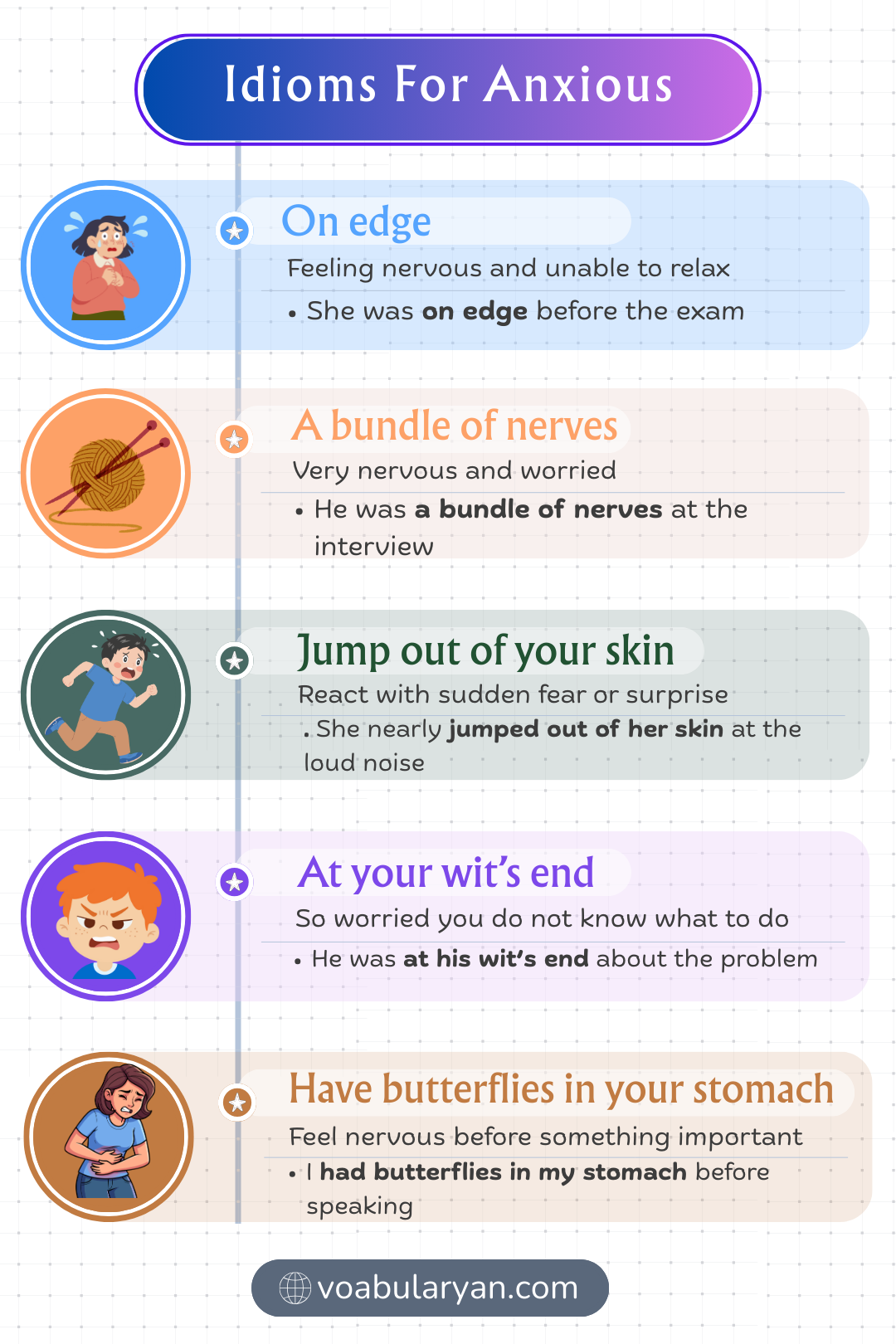
Anxious Idioms For Nervous Feelings In Your Body
Butterflies In My Stomach
Meaning: Feeling nervous excitement that makes the stomach feel uneasy.
When To Use It: Say it before something important, like a talk or a big event.
Collocations: butterflies in my stomach before a test, butterflies in my stomach on stage, butterflies in my stomach about the date
Example Sentences:
- I had butterflies in my stomach before the first match.
- She felt butterflies in my stomach while waiting to speak.
Dialogue:
Hina: I have butterflies in my stomach right now.
Saad: That is normal before a big moment.
Closest Alternatives:
- feel nervous
- feel jittery
Knot In Your Stomach
Meaning: A tight, heavy feeling in the stomach from worry.
When To Use It: Say it when stress or fear makes the body feel tense.
Collocations: a knot in my stomach, feel a knot in your stomach, knot in your stomach with worry
Example Sentences:
- I felt a knot in your stomach when the phone rang.
- He got a knot in your stomach after reading the message.
Dialogue:
Areeba: I have a knot in your stomach.
Faisal: That sounds like strong worry.
Closest Alternatives:
- feel uneasy
- feel tense
Stomach In Knots
Meaning: Feeling very nervous, with strong tightness in the stomach.
When To Use It: Say it when fear or anxiety feels intense.
Collocations: stomach in knots all day, stomach in knots before results, stomach in knots with anxiety
Example Sentences:
- My stomach in knots before the interview.
- Her stomach in knots as the teacher called her name.
Dialogue:
Mariam: My stomach in knots since morning.
Bilal: Waiting can build stress fast.
Closest Alternatives:
- knot in your stomach
- feel very nervous
Heart In Your Throat
Meaning: Feeling sudden fear or shock that makes breathing feel tight.
When To Use It: Say it when something scares or surprises you strongly.
Collocations: heart in your throat for a second, heart in your throat when I heard, heart in your throat with fear
Example Sentences:
- My heart in your throat when the car sped past.
- She had her heart in your throat after the loud crash.
Dialogue:
Zoya: My heart in your throat when I heard that sound.
Hamza: That kind of shock hits fast.
Closest Alternatives:
- feel terrified
- feel startled
Sweating Bullets
Meaning: Feeling extreme nervousness that causes heavy sweating.
When To Use It: Say it when pressure feels intense before an event.
Collocations: sweating bullets before a speech, sweating bullets during the wait, sweating bullets in the exam
Example Sentences:
- I was sweating bullets before the presentation.
- He started sweating bullets as the timer ran down.
Dialogue:
Sara: I am sweating bullets right now.
Owais: That is serious pressure.
Closest Alternatives:
- feel very nervous
- panic
Shaking Like A Leaf
Meaning: Shaking strongly because of fear, cold, or anxiety.
When To Use It: Say it when the body trembles and control feels hard.
Collocations: shaking like a leaf with fear, shaking like a leaf in the cold, shaking like a leaf from nerves
Example Sentences:
- He was shaking like a leaf after the scary scene.
- She stood shaking like a leaf outside the office door.
Dialogue:
Nida: I am shaking like a leaf.
Ali: That looks like real fear.
Closest Alternatives:
- tremble
- shake badly
Anxious Idioms For Feeling On Edge And Unable To Settle
On Edge
Meaning: feeling nervous and unable to relax.
When To Use It: use it when worry makes someone tense and alert.
Collocations: feel on edge, be on edge about results, on edge all day
Example Sentences:
- I felt on edge before the announcement.
- She stayed on edge during the long wait.
Dialogue:
Hana: I am on edge right now.
Bilal: The silence is making the room feel tense.
Closest Alternatives:
- nervous
- uneasy
Can’t Sit Still
Meaning: unable to stay seated because of nervous energy.
When To Use It: use it when stress or excitement makes someone move constantly.
Collocations: can’t sit still in class, can’t sit still while waiting
Example Sentences:
- He can’t sit still before the match begins.
- I can’t sit still when I feel worried.
Dialogue:
Sana: I can’t sit still today.
Umar: Your restless mood is easy to notice.
Closest Alternatives:
- restless
- fidgety
Feeling Jittery
Meaning: feeling shaky and nervous inside.
When To Use It: use it when stress makes the body feel unsettled.
Collocations: feel jittery before a test, feel jittery all morning
Example Sentences:
- I am feeling jittery before my turn to speak.
- She was feeling jittery during the interview.
Dialogue:
Mariam: I am feeling jittery.
Hamza: That sounds like nerves before a big moment.
Closest Alternatives:
- anxious
- shaky
Anxious Idioms For Racing Thoughts And Overthinking
Mind Racing
Meaning: thoughts move too fast, so calm focus becomes difficult.
When To Use It: say it when worries rush in and the mind will not settle.
Collocations: Mind Racing at night, Mind Racing with worry, Mind Racing before a test
Example Sentences:
- My Mind Racing kept me awake long after bedtime.
- Her Mind Racing made the quiet room feel loud.
Dialogue:
Aisha: My Mind Racing is not slowing down tonight.
Hamza: That sounds like heavy worry building up.
Closest Alternatives:
- thoughts running wild
- overthinking
Spiraling Thoughts
Meaning: worries grow bigger and feel harder to stop.
When To Use It: say it when one concern leads to many darker ideas.
Collocations: Spiraling Thoughts at night, Spiraling Thoughts after a mistake, Spiraling Thoughts about the future
Example Sentences:
- After one comment, her Spiraling Thoughts took over.
- His Spiraling Thoughts turned a small problem into a huge one.
Dialogue:
Sana: I keep getting Spiraling Thoughts before sleep.
Bilal: One fear can trigger more fear quickly.
Closest Alternatives:
- downward thinking
- getting stuck in worries
Second Guessing
Meaning: doubting a decision after it is already chosen.
When To Use It: say it when confidence drops and choices feel uncertain.
Collocations: Second Guessing myself, Second Guessing the answer, Second Guessing a decision
Example Sentences:
- I keep Second Guessing my answer after turning in the paper.
- She started Second Guessing her plan after one small setback.
Dialogue:
Hira: I am Second Guessing everything I decided.
Usman: That doubt can weaken confidence fast.
Closest Alternatives:
- doubting yourself
- questioning your choice
Can’t Think Straight
Meaning: feeling confused, so good judgment becomes hard.
When To Use It: say it when stress or shock makes thoughts mixed up.
Collocations: can’t think straight right now, can’t think straight from stress, can’t think straight after the news
Example Sentences:
- After that call, I Can’t Think Straight at all.
- She was so upset that she Can’t Think Straight.
Dialogue:
Nadia: I Can’t Think Straight after what happened.
Farhan: That is a lot of stress at once.
Closest Alternatives:
- feel confused
- can’t focus
Mind Going Blank
Meaning: suddenly forgetting what to say or do.
When To Use It: say it when pressure makes memory fail for a moment.
Collocations: Mind Going Blank in an exam, Mind Going Blank on stage, Mind Going Blank during a talk
Example Sentences:
- In the middle of the speech, my Mind Going Blank surprised me.
- Her Mind Going Blank made her pause before the next line.
Dialogue:
Zain: My Mind Going Blank happened during the answer.
Iqra: That can happen under pressure.
Closest Alternatives:
- draw a blank
- forget for a moment
Anxious Idioms For Social Pressure And Careful Behavior
Walking On Eggshells
Meaning: acting very carefully to avoid making someone angry.
When To Use It: say it when someone is sensitive and the mood feels tense.
Collocations: walking on eggshells around someone, walking on eggshells at home, feel like walking on eggshells
Example Sentences:
- After the argument, I was Walking On Eggshells all day.
- She felt Walking On Eggshells around her boss this week.
Dialogue:
Hadia: I am Walking On Eggshells around him lately.
Rafay: That constant tension wears people down.
Closest Alternatives:
- be very careful
- tiptoe around someone
Holding Your Breath
Meaning: waiting with strong suspense and worry.
When To Use It: say it when the outcome matters and the wait feels heavy.
Collocations: holding your breath for results, holding your breath until news, left us holding our breath
Example Sentences:
- We were Holding Your Breath for the judge’s decision.
- She sat there Holding Your Breath until the call came.
Dialogue:
Areej: I am Holding Your Breath for the results.
Saif: The long wait makes it feel worse.
Closest Alternatives:
- wait anxiously
- on edge
Anxious Idioms For Stress And Worry That Won’t Stop
Stressed Out
Meaning: feeling overwhelmed and tense because of too many worries.
When To Use It: say it when pressure builds and calm thinking becomes hard.
Collocations: stressed out about school, stressed out at work, totally stressed out
Example Sentences:
- I am Stressed Out about the deadline tomorrow.
- She felt Stressed Out after three busy days.
Dialogue:
Areeba: I am Stressed Out and cannot relax.
Fahad: That sounds like heavy pressure.
Closest Alternatives:
- overwhelmed
- under stress
Worrying Yourself Sick
Meaning: worrying so much that the body starts to feel ill.
When To Use It: say it when worry lasts long and affects sleep or appetite.
Collocations: worrying yourself sick over, worrying yourself sick about results
Example Sentences:
- He was Worrying Yourself Sick about the test results.
- She kept Worrying Yourself Sick over a small mistake.
Dialogue:
Mina: I have been Worrying Yourself Sick all week.
Hasan: That much worry can drain anyone.
Closest Alternatives:
- worry a lot
- make yourself ill with worry
Key Takeaways
This topic brings together common phrases that describe anxious feelings in both the mind and body, from racing thoughts to tense reactions. Meaning depends on tone and situation, so a phrase can sound mild, intense, or urgent in different moments. Many idioms keep stable wording and word order, so changing even one small part can make them sound unnatural. Across the examples, the language reflects real moments such as restless waiting, sudden fear, and ongoing stress, and it fits both everyday conversation and simple writing.
FAQs
Q1. What does “have butterflies in your stomach” mean?
It means feeling nervous in a way that makes the stomach feel uneasy. In idioms for anxious, it can happen before an exam, an interview, or a big game.
Q2. What does “on edge” mean?
It means feeling tense and easily upset or startled. In idioms for anxious, it can describe a day when small noises, messages, or delays feel too much.
Q3. What does “a bundle of nerves” mean?
It means someone feels very nervous and cannot settle down. In idioms for anxious, it can fit before a speech, when hands shake and thoughts keep racing.
Q4. What does “break out in a cold sweat” mean?
It means sudden fear or stress makes the body sweat even if it is not hot. In idioms for anxious, it can happen during a scare or bad surprise.
Q5. What does “lose sleep over it” mean?
It means worrying so much that sleep becomes hard. In idioms for anxious, it can describe lying awake and thinking about a problem again and again.
Q6. What does “pacing the floor” mean?
It means walking back and forth because of worry or restlessness. In idioms for anxious, it can fit waiting for important news, like a phone call or test result.
You May Also Like
