
You and a friend start with a small disagreement about homework, and within minutes the room feels tense. Saying “we argued” sounds flat compared to the rising anger and quiet resentment that followed. Everyday speech often uses stronger phrases to capture real conflict and heated back-and-forth.
That is where idioms for arguing become useful. These expressions appear when people describe quarrels or open disagreement. Some carry a light, almost playful tone, while others reflect serious tension.
We’ll look at how these phrases work in sentences and short dialogue. You’ll sense when one fits a mild dispute and when another suits a deeper clash. By the end, you can describe arguments with more precision. Here are the words that match the tension.
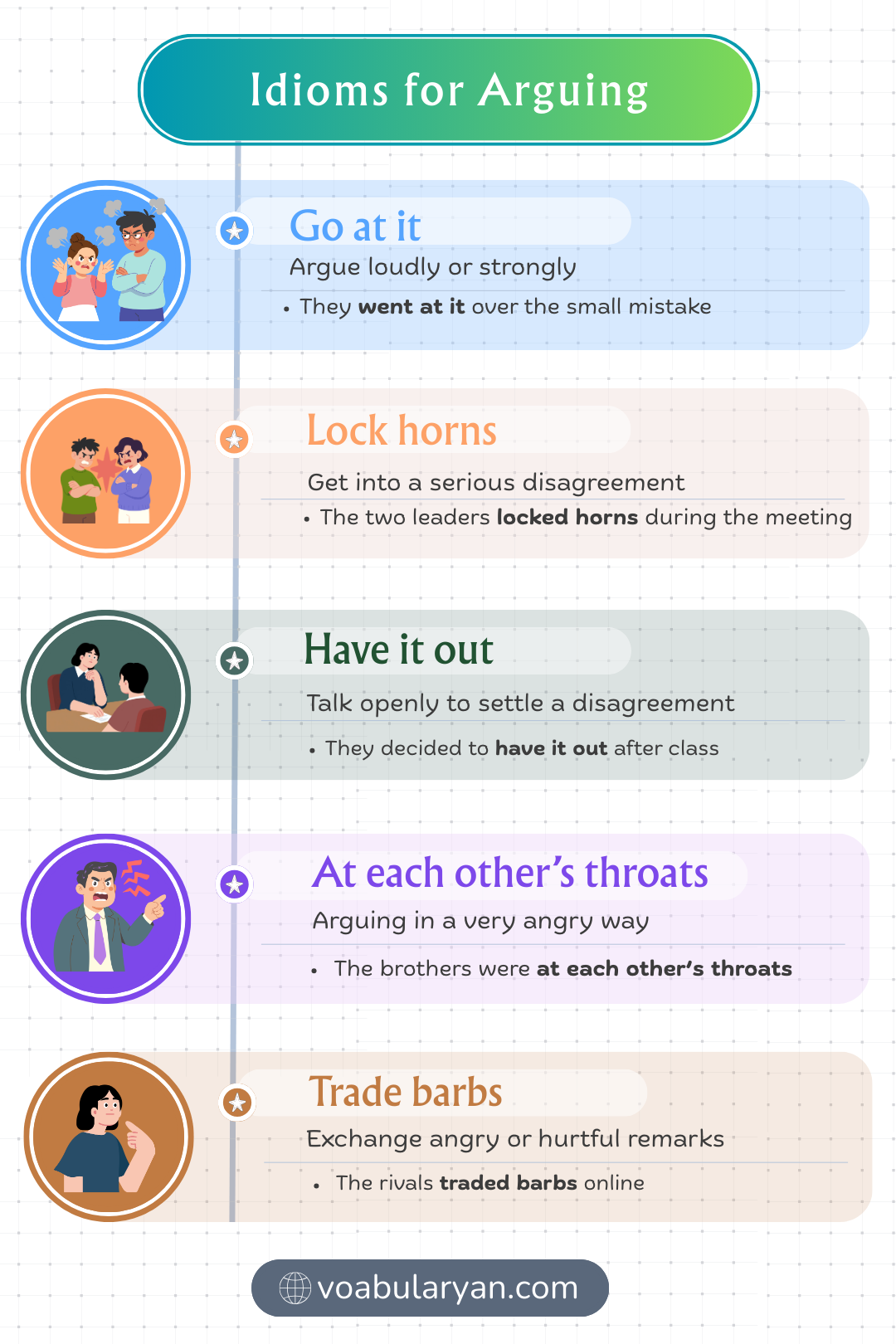
Arguing Idioms For Starting Conflict
Poke The Bear
Meaning: annoy someone and risk a strong angry reaction.
When To Use It: use it when teasing or pushing a person who is already upset.
Collocations: poke the bear at work, poke the bear with a comment, poke the bear again
Example Sentences:
- He poked the bear by bringing up the old argument again.
- She warned him not to poke the bear during the meeting.
Dialogue:
Hina: Do not poke the bear right now.
Zain: I know, he is already angry.
Closest Alternatives:
- provoke someone
- push someone’s buttons
Stir The Pot
Meaning: cause trouble by starting arguments or gossip.
When To Use It: use it when someone creates tension for no good reason.
Collocations: stir the pot in the group, stir the pot with rumors, stop stirring the pot
Example Sentences:
- He stirred the pot by sharing half the story.
- She did not mean to stir the pot, but it happened.
Dialogue:
Areeba: He always stirs the pot.
Danish: Yes, he enjoys the drama.
Closest Alternatives:
- cause trouble
- make things worse
Don’t Get Me Started
Meaning: I have strong feelings, and I could talk for long.
When To Use It: use it when a topic makes you angry or very emotional.
Collocations: don’t get me started on traffic, don’t get me started about prices
Example Sentences:
- Don’t get me started on the delays today.
- Don’t get me started about that rude comment.
Dialogue:
Sana: Don’t get me started on that issue.
Bilal: I can see it really bothers you.
Closest Alternatives:
- I could go on
- that sets me off
Arguing Idioms For Heated Fights And Loud Arguments
At Each Other’s Throats
Meaning: arguing angrily, ready to fight with words.
When To Use It: use it when people are in a heated conflict.
Collocations: be at each other’s throats all day, at each other’s throats over money, at each other’s throats again
Example Sentences:
- They were at each other’s throats during the whole meeting.
- My cousins got at each other’s throats over a small mistake.
Dialogue:
Nora: They are at each other’s throats again.
Faris: Yes, the tension is obvious.
Closest Alternatives:
- fighting bitterly
- arguing fiercely
Sparks Fly
Meaning: strong conflict or strong attraction happens suddenly.
When To Use It: use it when a meeting turns intense very fast.
Collocations: sparks fly between them, sparks fly during the debate
Example Sentences:
- Sparks flew when they argued about the plan.
- Sparks flew the moment they started talking.
Dialogue:
Hiba: Sparks flew in that room.
Owais: The energy was intense.
Closest Alternatives:
- clash strongly
- instant chemistry
On The Warpath
Meaning: very angry and ready to confront someone.
When To Use It: use it when someone is searching for a person to blame.
Collocations: be on the warpath about delays, go on the warpath over a mistake
Example Sentences:
- The manager was on the warpath after the late delivery.
- She went on the warpath when she found the missing files.
Dialogue:
Ayla: He is on the warpath today.
Kamal: Someone made a big mistake.
Closest Alternatives:
- furious
- ready to confront
The Gloves Are Off
Meaning: people stop being polite and fight openly.
When To Use It: use it when a conflict becomes direct and harsh.
Collocations: the gloves are off now, once the gloves are off
Example Sentences:
- After that insult, the gloves were off.
- In the debate, the gloves were off from the start.
Dialogue:
Mina: The gloves are off now.
Rafi: Yes, no more polite talk.
Closest Alternatives:
- no holding back
- open conflict
Make A Scene
Meaning: act loudly in public and draw attention.
When To Use It: use it when someone causes embarrassment in front of others.
Collocations: make a scene in public, make a scene at the restaurant, try not to make a scene
Example Sentences:
- He made a scene at the store over a refund.
- She did not want to make a scene in front of guests.
Dialogue:
Sara: He made a scene in the lobby.
Imran: Everyone started staring.
Closest Alternatives:
- cause a commotion
- create a fuss
Arguing Idioms For Disagreeing And Clashing Opinions
Lock Horns
Meaning: clash strongly because both sides refuse to give in.
When To Use It: use it when two people argue and neither agrees.
Collocations: lock horns over money, lock horns with a rival, lock horns on a plan
Example Sentences:
- They locked horns over the final decision.
- My parents locked horns about the new rules.
Dialogue:
Hala: They locked horns again today.
Tariq: Both are too stubborn.
Closest Alternatives:
- clash
- come into conflict
Butting Heads
Meaning: disagree often because of different views or personalities.
When To Use It: use it for frequent arguments, not just one fight.
Collocations: butt heads at work, butt heads over small things, keep butting heads
Example Sentences:
- We butted heads about the best way to start.
- They butt heads whenever plans change.
Dialogue:
Mehak: We keep butting heads lately.
Hamid: The approach is different for both.
Closest Alternatives:
- disagree often
- clash
Go Head To Head
Meaning: compete or argue directly against someone.
When To Use It: use it for a direct contest or debate.
Collocations: go head to head in a match, go head to head with a rival, go head to head in debate
Example Sentences:
- The teams went head to head in the final.
- They went head to head over the budget plan.
Dialogue:
Amina: They went head to head in the meeting.
Bilal: It was a direct clash.
Closest Alternatives:
- face off
- compete directly
Go Toe To Toe
Meaning: fight or compete equally, without backing down.
When To Use It: use it when both sides are strong and fearless.
Collocations: go toe to toe with a champion, go toe to toe in court, go toe to toe in a debate
Example Sentences:
- She went toe to toe with the top player.
- He went toe to toe with his critic on stage.
Dialogue:
Farah: She went toe to toe with him.
Owais: Yes, she showed real confidence.
Closest Alternatives:
- stand up to
- match someone
Cross Swords
Meaning: argue or fight with someone over an issue.
When To Use It: use it when people clash in words or debate.
Collocations: cross swords with a colleague, cross swords over politics, cross swords in debate
Example Sentences:
- They crossed swords over the new policy.
- I crossed swords with him about the unfair rule.
Dialogue:
Nida: We crossed swords in class today.
Usman: That topic brings strong opinions.
Closest Alternatives:
- argue
- clash
At Loggerheads
Meaning: in strong disagreement, unable to reach agreement.
When To Use It: use it when a dispute stays stuck for a while.
Collocations: at loggerheads with neighbors, at loggerheads over plans, at loggerheads for months
Example Sentences:
- They are at loggerheads about how to spend the money.
- The two groups stayed at loggerheads for weeks.
Dialogue:
Saba: They are at loggerheads again.
Adnan: No one wants to compromise.
Closest Alternatives:
- in disagreement
- deadlocked
Arguing Idioms For Picking Faults And Nitpicking
Have A Bone To Pick
Meaning: have a complaint you want to discuss with someone.
When To Use It: use it before raising an issue that bothered you.
Collocations: have a bone to pick with you, have a bone to pick about behavior, have a bone to pick over a comment
Example Sentences:
- I have a bone to pick with you about yesterday.
- She said she had a bone to pick with the manager.
Dialogue:
Nadia: I have a bone to pick with you.
Omar: Tell me the problem.
Closest Alternatives:
- have a complaint
- want a word
Split Hairs
Meaning: argue about tiny details that do not matter much.
When To Use It: use it when someone focuses on small points.
Collocations: split hairs over wording, split hairs about rules, stop splitting hairs
Example Sentences:
- They split hairs over one word in the email.
- Do not split hairs about the color shade.
Dialogue:
Areeba: He keeps splitting hairs.
Danish: The main point is simple.
Closest Alternatives:
- nitpick
- focus on details
Draw The Line
Meaning: set a firm limit and refuse to go further.
When To Use It: use it when deciding what is not acceptable.
Collocations: draw the line at insults, draw the line with spending, draw the line on behavior
Example Sentences:
- I draw the line at rude jokes.
- She drew the line when they asked for more money.
Dialogue:
Hira: I draw the line at lying.
Ali: That is a fair boundary.
Closest Alternatives:
- set a limit
- put a stop to it
Put Someone In Their Place
Meaning: speak firmly so someone stops acting rude or proud.
When To Use It: use it when correcting bad behavior publicly or sharply.
Collocations: put him in his place, put her in her place, put someone in their place quickly
Example Sentences:
- She put him in his place after the rude remark.
- The coach put them in their place for laughing at others.
Dialogue:
Mina: She put him in his place fast.
Rafi: He needed that reminder.
Closest Alternatives:
- set someone straight
- put someone down
Beat Around The Bush
Meaning: avoid the main point instead of speaking directly.
When To Use It: use it when someone delays the real message.
Collocations: beat around the bush about money, beat around the bush in a talk, stop beating around the bush
Example Sentences:
- He beat around the bush instead of answering.
- She asked me to stop beating around the bush.
Dialogue:
Sara: Stop beating around the bush.
Imran: Okay, I will say it directly.
Closest Alternatives:
- avoid the point
- speak indirectly
Arguing Idioms For Provoking And Trading Insults
Trading Barbs
Meaning: exchanging sharp, insulting remarks back and forth.
When To Use It: use it when two people keep mocking each other.
Collocations: trade barbs during a debate, trade barbs on stage, trade barbs in public
Example Sentences:
- They were trading barbs during the meeting.
- The rivals traded barbs after the match.
Dialogue:
Hassan: They keep trading barbs.
Mariam: Yes, the tension is rising.
Closest Alternatives:
- exchange insults
- trade jabs
Fight Fire With Fire
Meaning: respond to an attack with the same strength.
When To Use It: use it when matching someone’s harsh action or words.
Collocations: fight fire with fire in an argument, fight fire with fire against critics
Example Sentences:
- He tried to fight fire with fire in the debate.
- She chose to fight fire with fire when they pushed her.
Dialogue:
Ayla: He decided to fight fire with fire.
Kamal: That can raise the heat quickly.
Closest Alternatives:
- respond in kind
- hit back
Get Your Back Up
Meaning: become defensive and easily annoyed by a comment.
When To Use It: use it when someone reacts with quick anger.
Collocations: get your back up about criticism, get your back up over a joke, get your back up at work
Example Sentences:
- He got his back up when she corrected him.
- I get my back up if people interrupt me.
Dialogue:
Sana: He got his back up fast.
Bilal: The comment sounded like criticism.
Closest Alternatives:
- get defensive
- take offense
Bad Blood
Meaning: long-lasting anger or dislike between people.
When To Use It: use it when tension stays after a past conflict.
Collocations: bad blood between families, bad blood after a breakup, bad blood over money
Example Sentences:
- There is bad blood between the two teams.
- Years of bad blood made the reunion tense.
Dialogue:
Nida: There is bad blood between them.
Usman: That old argument never ended.
Closest Alternatives:
- lingering resentment
- deep dislike
Arguing Idioms For Arguments That Go Nowhere
Go Round In Circles
Meaning: discuss something without progress or a clear decision.
When To Use It: use it when a talk repeats the same points.
Collocations: go round in circles in a meeting, go round in circles for hours, keep going round in circles
Example Sentences:
- We went round in circles and still picked no plan.
- They go round in circles whenever money comes up.
Dialogue:
Amina: We are going round in circles again.
Bilal: Yes, we need a decision.
Closest Alternatives:
- make no progress
- get nowhere
Get Your Wires Crossed
Meaning: misunderstand each other because of mixed messages.
When To Use It: use it when two people think different things were agreed.
Collocations: get our wires crossed about time, get your wires crossed on details, wires got crossed
Example Sentences:
- We got our wires crossed about the meeting time.
- She got her wires crossed and brought the wrong file.
Dialogue:
Hira: I think we got our wires crossed.
Ali: Yes, the details were mixed up.
Closest Alternatives:
- misunderstand
- mix things up
Arguing Idioms For Cooling Down And Ending The Fight
Bite Your Tongue
Meaning: stop yourself from speaking, even when you want to.
When To Use It: say it when silence feels safer than speaking in that moment.
Collocations: bite your tongue in a meeting, bite your tongue during an argument, bite your tongue and smile
Example Sentences:
- I bit my tongue when he made a rude comment.
- She bit her tongue and waited until later.
Dialogue:
Hina: I had to bite my tongue in front of everyone.
Saad: That was smart in a tense moment.
Closest Alternatives:
- hold back
- keep quiet
Keep Your Cool
Meaning: stay calm and steady, even under pressure.
When To Use It: say it when someone controls anger or stress.
Collocations: keep your cool during a fight, keep your cool under pressure, keep your cool and respond
Example Sentences:
- He kept his cool when the room got loud.
- She kept her cool and answered politely.
Dialogue:
Areeba: I tried to keep my cool.
Danish: Your calm voice kept the peace.
Closest Alternatives:
- stay calm
- stay composed
Let Off Steam
Meaning: release stress or anger in a safe way.
When To Use It: say it after pressure builds and someone needs relief.
Collocations: let off steam after work, let off steam at the gym, let off steam by talking
Example Sentences:
- I went for a run to let off steam.
- She called a friend to let off steam.
Dialogue:
Mehak: I need to let off steam after today.
Usman: A long walk might ease the stress.
Closest Alternatives:
- blow off steam
- vent
Agree To Disagree
Meaning: accept that two sides will not share the same view.
When To Use It: say it when a talk stays polite but no one changes opinions.
Collocations: agree to disagree on politics, agree to disagree and move on, agree to disagree respectfully
Example Sentences:
- We decided to agree to disagree and end the debate.
- They agreed to disagree without getting rude.
Dialogue:
Sana: Let’s agree to disagree on that point.
Ali: Fair enough, the tone stays respectful.
Closest Alternatives:
- leave it there
- accept different views
Take It Outside
Meaning: move a conflict away from others and public view.
When To Use It: say it when a dispute is getting loud in front of people.
Collocations: take it outside right now, take it outside and settle it, take it outside before it grows
Example Sentences:
- The manager told them to take it outside.
- He said, “If you want to argue, take it outside.”
Dialogue:
Nawal: This is getting loud, take it outside.
Faris: Fine, we will talk in a private place.
Closest Alternatives:
- talk elsewhere
- settle it privately
Arguing Idioms For Trouble After An Argument
In Hot Water
Meaning: being in trouble because of a mistake or rule-breaking.
When To Use It: say it when someone faces anger, blame, or punishment.
Collocations: get in hot water at work, be in hot water with parents, land in hot water
Example Sentences:
- He was in hot water after missing the deadline.
- She got in hot water for sharing the answer.
Dialogue:
Amina: I am in hot water with my teacher.
Hassan: That late report caused real trouble.
Closest Alternatives:
- in trouble
- in a tight spot
Throw Someone Under The Bus
Meaning: blame another person to protect yourself.
When To Use It: say it when someone unfairly shifts fault to someone else.
Collocations: throw someone under the bus to save yourself, throw a teammate under the bus, throw a friend under the bus
Example Sentences:
- He threw her under the bus during the meeting.
- She felt hurt when he threw her under the bus.
Dialogue:
Zoya: He threw me under the bus in front of everyone.
Bilal: That is a betrayal of trust.
Closest Alternatives:
- shift the blame
- scapegoat someone
Put The Cat Among The Pigeons
Meaning: cause shock or trouble by saying or doing something unexpected.
When To Use It: say it when one action makes a group upset or noisy.
Collocations: put the cat among the pigeons with a comment, put the cat among the pigeons at a meeting
Example Sentences:
- Her remark put the cat among the pigeons at lunch.
- The sudden news put the cat among the pigeons.
Dialogue:
Mariam: That statement put the cat among the pigeons.
Owais: Yes, it stirred tension fast.
Closest Alternatives:
- stir up trouble
- cause an uproar
Arguing Idioms For Quiet Complaints And Side Comments
Under Your Breath
Meaning: in a very quiet voice, often with anger or dislike.
When To Use It: use it when someone mutters so others may not hear.
Collocations: mutter under your breath, say it under your breath, curse under your breath
Example Sentences:
- He spoke under his breath after the rude comment.
- She complained under her breath while waiting in line.
Dialogue:
Nadia: He said it under his breath.
Omar: I still heard the insult.
Closest Alternatives:
- quietly
- in a low voice
Have Words
Meaning: have a serious argument with someone.
When To Use It: use it when a talk turns into a dispute.
Collocations: have words with a neighbor, have words about money, have words over a mistake
Example Sentences:
- I had words with him about the broken item.
- They had words after the late arrival.
Dialogue:
Sara: I had words with my brother.
Imran: Was it a big argument?
Closest Alternatives:
- argue
- have a row
Key Takeaways
This topic brings together common phrases that describe conflict, tension, and disagreement, from mild clashes to open fights. Meaning depends on tone and situation, so a phrase can sound playful, bitter, or serious in different moments. Many idioms keep stable wording and word order, so changing even one small part can make them sound unnatural. Across the examples, the language reflects real moments such as misunderstanding, sharp replies, and long resentment, and it fits both everyday conversation and simple writing.
FAQs
Q1. What does “butting heads” mean?
It means two people keep disagreeing because both are stubborn about their views. In idioms for arguing, it can fit family rules, group plans, or any clash of opinions.
Q2. What does “at each other’s throats” mean?
It means people are arguing in a very angry way, often with sharp words. In idioms for arguing, it can describe a fight that feels intense and personal.
Q3. What does “have a bone to pick” mean?
It means someone has a complaint they want to bring up. In idioms for arguing, it can start a serious talk, like being upset about a broken promise.
Q4. What does “stir the pot” mean?
It means someone tries to cause trouble by making people argue. In idioms for arguing, it can be repeating gossip or pushing sensitive topics at the wrong time.
Q5. What does “put someone in their place” mean?
It means replying firmly to stop rude behavior or unfair talk. In idioms for arguing, it can happen when someone insults others and gets a sharp response.
Q6. What does “beat around the bush” mean during a disagreement?
It means avoiding the main point instead of saying it directly. In idioms for arguing, it can describe a tense talk where no one admits what they are upset about.
You May Also Like