
Language around neurodiversity can feel sensitive, and certain phrases may confuse or even offend if used without care. You might hear an expression in conversation and wonder whether it fits the context. Understanding how figurative language works helps you choose words that respect lived experience and everyday communication.
Idioms for autism often appear when people talk about the autism spectrum, social cues, communication differences, or sensory overload. Some expressions are neutral, while others may sound informal or outdated depending on the setting. Meanings and natural examples show how tone can shift in speech and writing.
We’ll explore what these phrases mean, when they fit best, and how they connect with common collocations in sentences or short dialogue. You will also notice close alternatives that keep language thoughtful and accurate. By the end, you can recognize which expressions suit different situations. Let’s look at them.
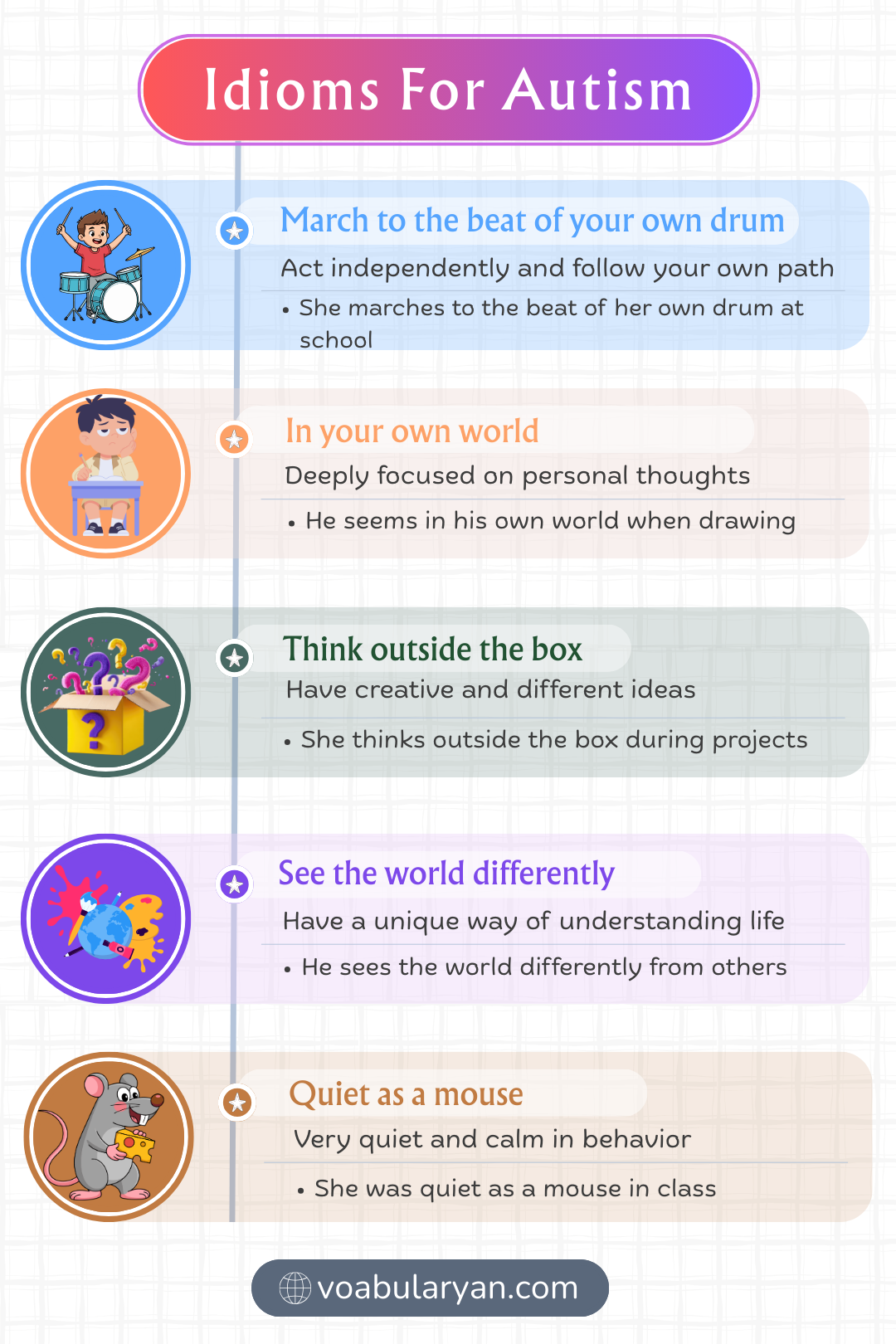
Idioms For Autism
Speaks A Different Language
Meaning: expresses ideas or opinions in a way that is hard to understand.
When To Use It: use it when someone’s way of speaking is very different or confusing.
Collocations: speaks a different language in conversations, feels like speaks a different language
Example Sentences:
- When he talks about technology, it speaks a different language to me.
- Her explanation speaks a different language to the team.
Dialogue:
Anna: I don’t understand his explanation.
Jack: It feels like he speaks a different language.
Closest Alternatives:
- hard to understand
- not make sense
A World Of Their Own
Meaning: a mental or emotional space that is separate from others.
When To Use It: use it when someone seems disconnected or lost in their thoughts.
Collocations: live in a world of their own, find themselves in a world of their own
Example Sentences:
- She often seems to be in a world of her own during meetings.
- He was lost in a world of his own thinking about the project.
Dialogue:
Maya: He is always in a world of his own.
Liam: I think he enjoys being alone with his thoughts.
Closest Alternatives:
- lost in thought
- disconnected
In Their Own World
Meaning: focused on their own thoughts and unaware of what’s around them.
When To Use It: use it when someone is mentally distant or distracted.
Collocations: be in their own world at a party, live in their own world
Example Sentences:
- She was completely in her own world during the conversation.
- He’s always in his own world while studying.
Dialogue:
Chloe: Why is he ignoring us?
Ethan: He’s just in his own world today.
Closest Alternatives:
- daydreaming
- distracted
Idioms For Autism And Quite Focus
Wears Their Heart On Their Sleeve
Meaning: shows emotions openly and clearly.
When To Use It: use it for someone who expresses their feelings honestly.
Collocations: wear your heart on your sleeve, someone who wears their heart on their sleeve
Example Sentences:
- She wears her heart on her sleeve and shows her true feelings.
- He wears his heart on his sleeve, which makes him easy to read.
Dialogue:
Olivia: You can always tell when she’s upset.
Zara: Yes, she wears her heart on her sleeve.
Closest Alternatives:
- open with emotions
- show feelings
One Of A Kind
Meaning: very unique or special, unlike anything else.
When To Use It: use it for something or someone truly different.
Collocations: one of a kind talent, one of a kind gift
Example Sentences:
- Her style is really one of a kind.
- That painting is definitely one of a kind.
Dialogue:
Maya: Your design is truly one of a kind.
Ethan: I wanted it to feel very unique.
Closest Alternatives:
- unique
- special
Coloring Outside The Lines
Meaning: thinking or acting in a creative or unconventional way.
When To Use It: use it for someone who challenges normal ideas or methods.
Collocations: color outside the lines in art, coloring outside the lines at work
Example Sentences:
- He loves coloring outside the lines with his ideas.
- They encourage coloring outside the lines in their projects.
Dialogue:
Lena: I think this design is too unconventional.
Alex: Sometimes, coloring outside the lines leads to new ideas.
Closest Alternatives:
- think creatively
- break the rules
Key Takeaways
This discussion focuses on how people on the autism spectrum interact with figurative expressions like idioms, which often do not match their literal wording and require social and contextual cues to make sense. Many individuals with autism show challenges in idiom comprehension compared with their peers without autism, especially when the phrase cannot be understood literally. Research suggests that this difference relates to the way social language and contextual information are processed. Even though idiom understanding may be harder, targeted support and contextual learning can help individuals gradually bridge this gap and improve their grasp of figurative language in everyday communication.
FAQs
Q1. What does it mean when someone says a person is on the spectrum?
A: Saying someone is on the spectrum refers to them being part of the autism spectrum, meaning they have characteristics linked with autism.
Q2. How is think outside the box connected to autism?
A: Think outside the box means to think in a fresh or unusual way, and it can describe how some people with autism find creative solutions.
Q3. What does it mean to be in your own world?
A: If someone is in your own world, they seem focused on their thoughts or interests and may not notice other things around them.
Q4. Why is walk in someone else’s shoes useful to understand autism?
A: Walk in someone else’s shoes means trying to imagine how another person feels, and this can help others understand the perspective of someone with autism.
Q5. What does march to the beat of your own drum mean?
A: March to the beat of your own drum means doing things in a way that fits one’s own style, even if it is different from what others do.
Q6. What does see things differently say about thinking?
A: See things differently means someone may notice details or think in ways that others do not, and this can describe how many people with autism perceive the world.
You May Also Like
