
You finish a conversation, wave your hand, and say, “Goodbye.” The word works, yet it rarely carries the full emotion and quiet finality that can come with parting. Some farewells feel light and friendly, while others hold a deeper sense of distance.
That is where idioms for goodbye become useful in learning English. These expressions appear when people talk about farewell, parting moments, or the act of going separate ways. Some sound warm and casual, while others reflect lasting goodbyes.
We’ll look at how these phrases work in everyday sentences and short dialogue. You’ll sense when one fits a quick parting and when another suits a more meaningful farewell. Here are the words people use when it is time to say goodbye.
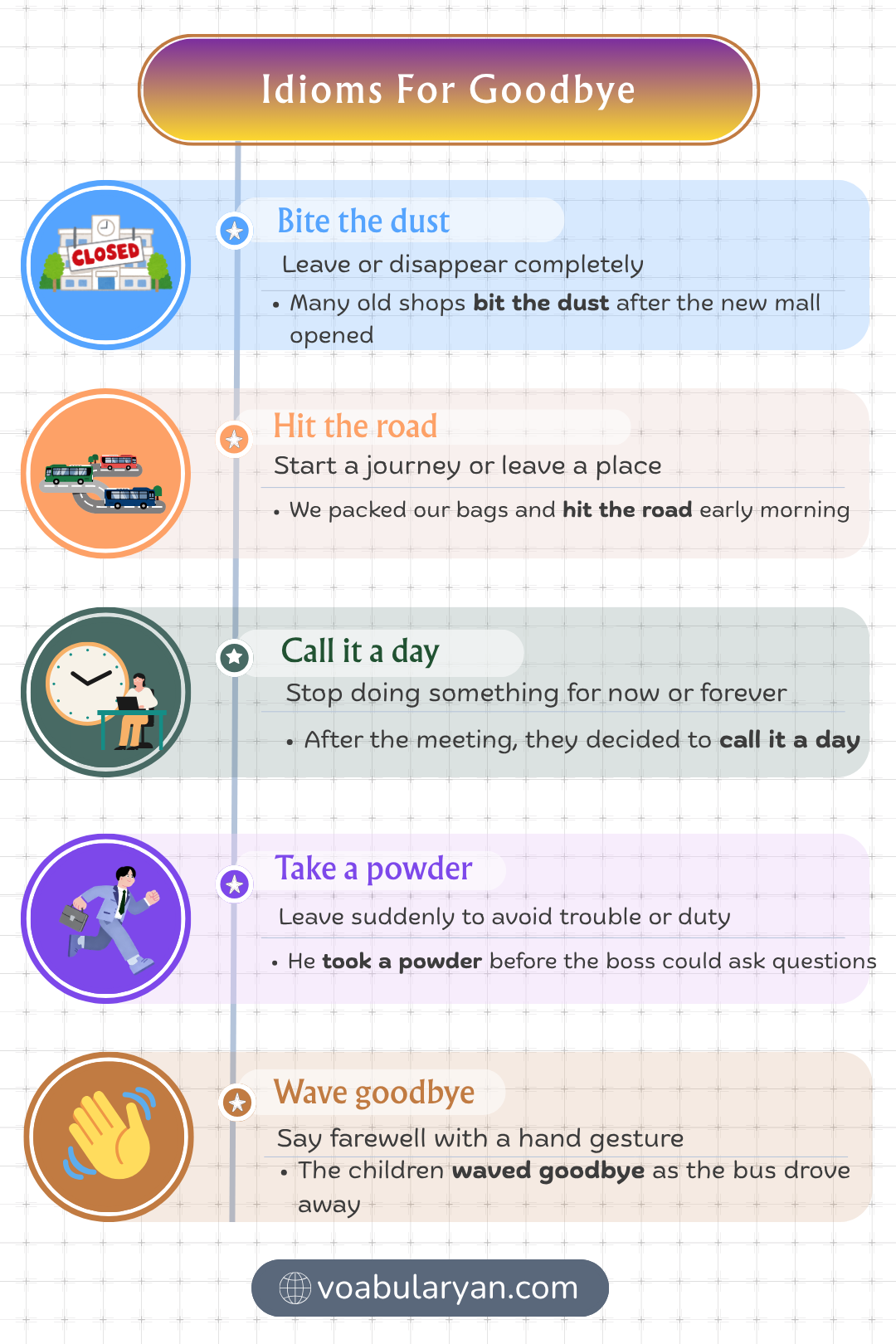
Idioms For Goodbye In Casual Conversations
Catch You Later
Meaning: A casual goodbye that means meeting again at another time.
When To Use It: When leaving a chat and expecting to meet again soon.
Collocations: catch you later then, catch you later today, catch you later tonight, catch you later after class
Example Sentences:
- I have to go now, Catch You Later after lunch.
- Thanks for the help, Catch You Later when you are free.
Dialogue:
Mina: I need to run, my bus is here.
Adnan: No problem, Catch You Later.
Closest Alternatives:
- talk to you later
- bye for now
See You Later
Meaning: A friendly goodbye that means meeting again soon.
When To Use It: When leaving a place and expecting another meeting.
Collocations: see you later then, see you later today, see you later at school, see you later tonight
Example Sentences:
- I have a call to take, See You Later.
- See You Later at the cafe around five.
Dialogue:
Hina: Are you coming back after the appointment?
Danish: Yes, See You Later.
Closest Alternatives:
- catch you later
- talk to you soon
See Ya
Meaning: A very casual goodbye between friends.
When To Use It: When leaving quickly in an informal moment.
Collocations: see ya soon, see ya later, see ya tomorrow, see ya at work
Example Sentences:
- I am heading out now, See Ya.
- See Ya tomorrow morning at the gate.
Dialogue:
Adeel: Are you done for today?
Rida: Yes, See Ya.
Closest Alternatives:
- bye
- later
See You Around
Meaning: A casual goodbye that suggests meeting again sometime.
When To Use It: When leaving without a fixed plan for the next meeting.
Collocations: see you around here, see you around campus, see you around sometime, see you around then
Example Sentences:
- I am leaving now, See You Around.
- It was nice talking, See You Around sometime.
Dialogue:
Noor: I might not be at the next meeting.
Rayan: That is fine, See You Around.
Closest Alternatives:
- catch you sometime
- until next time
Take Care
Meaning: A warm goodbye that wishes safety and good health.
When To Use It: When leaving and showing concern or kindness.
Collocations: take care of yourself, take care now, take care and, take care out there
Example Sentences:
- It is late, so Take Care on your way home.
- Take Care, and call me when you arrive.
Dialogue:
Sara: I will message you after I reach home.
Usman: Good, Take Care.
Closest Alternatives:
- stay safe
- be well
So Long
Meaning: A goodbye that can sound friendly or slightly old fashioned.
When To Use It: When parting for a while, or ending a long talk.
Collocations: so long then, so long for now, so long everyone, so long my friend
Example Sentences:
- The visit is over, So Long for now.
- So Long, and thanks for everything this week.
Dialogue:
Mariam: I will be away for a few weeks.
Owais: So Long, and travel safely.
Closest Alternatives:
- goodbye
- farewell
Idioms For Goodbye In Polite Or Formal Farewells
Fare Thee Well
Meaning: A formal way to say goodbye, often for a long time.
When To Use It: When parting feels final, respectful, or tied to travel or distance.
Collocations: fare thee well, I bid you fare thee well, wish you fare thee well
Example Sentences:
- At the station, she whispered Fare Thee Well and stepped back.
- He wrote Fare Thee Well at the end of the farewell letter.
Dialogue:
Mina: Why did he sound so serious when he left?
Adnan: He said Fare Thee Well, like it might be a long time.
Closest Alternatives:
- goodbye
- farewell
Bid Adieu
Meaning: Say goodbye in a formal way, often for good.
When To Use It: When leaving feels final or when speech is ceremonial.
Collocations: bid adieu to, bid adieu and, bid adieu with, bid adieu before
Example Sentences:
- She Bid Adieu to her old life and moved across the country.
- They Bid Adieu to the guests after the last song.
Dialogue:
Noor: Did you speak to your teacher before leaving?
Rayan: Yes, I Bid Adieu and thanked her for the support.
Closest Alternatives:
- say farewell
- take leave
Take Your Leave
Meaning: Leave politely after a visit, meeting, or event.
When To Use It: When someone departs with respect and a calm goodbye.
Collocations: take your leave of, took my leave, take your leave politely, prepare to take your leave
Example Sentences:
- After dinner, he Take Your Leave and thanked the host.
- She Take Your Leave of the team before the office closed.
Dialogue:
Hina: Are you staying for dessert as well?
Danish: No, I will Take Your Leave after this cup of tea.
Closest Alternatives:
- excuse yourself
- leave politely
Idioms For Goodbye When You Must Leave Fast
Hit The Road
Meaning: Leave and begin a trip, often right away.
When To Use It: When someone is ready to leave and start traveling.
Collocations: hit the road for, hit the road to, time to hit the road, hit the road early
Example Sentences:
- We should Hit The Road before the traffic gets heavy.
- They Hit The Road at dawn to reach the city on time.
Dialogue:
Amina: Are we leaving after breakfast or later?
Bilal: After breakfast, then we Hit The Road.
Closest Alternatives:
- set off
- head out
Take Off
Meaning: Leave quickly, or begin moving fast.
When To Use It: When someone departs in a hurry or starts a trip fast.
Collocations: take off quickly, take off for, take off at, take off right away
Example Sentences:
- He Take Off as soon as the call ended.
- We Take Off for Lahore after a short stop for fuel.
Dialogue:
Hina: Why did you leave so suddenly?
Danish: I had to Take Off before it got too late.
Closest Alternatives:
- dash off
- leave quickly
Get Going
Meaning: Start moving, or begin an activity.
When To Use It: When it is time to leave or begin something after waiting.
Collocations: get going now, get going soon, get going on, get going with
Example Sentences:
- Let’s Get Going or we will miss the bus.
- They Get Going on the plan right after the meeting ended.
Dialogue:
Noor: Are we still waiting for the others?
Rayan: No, let’s Get Going.
Closest Alternatives:
- start off
- move out
Make Tracks
Meaning: Leave quickly and head away.
When To Use It: When someone wants to go fast, often without delay.
Collocations: make tracks for, make tracks to, make tracks home, make tracks out of
Example Sentences:
- It is getting late, so we should Make Tracks.
- He Make Tracks for the station when the rain started.
Dialogue:
Sara: Do you want one more cup of tea?
Usman: No, I should Make Tracks before the roads get busy.
Closest Alternatives:
- head out
- hit the road
Head Out
Meaning: Leave a place and go somewhere else.
When To Use It: When someone departs, with or without a long trip.
Collocations: head out to, head out for, head out now, head out early
Example Sentences:
- I will Head Out to the store for a few things.
- She Head Out early to avoid the rush.
Dialogue:
Mariam: Where are you going with your bag?
Owais: I will Head Out for the office now.
Closest Alternatives:
- leave
- go out
Cut And Run
Meaning: Leave suddenly to avoid trouble or responsibility.
When To Use It: When someone escapes fast instead of staying to face a hard moment.
Collocations: cut and run when, cut and run from, cut and run before, ready to cut and run
Example Sentences:
- He chose to Cut And Run when the questions got serious.
- They Cut And Run from the deal after the price changed.
Dialogue:
Adeel: Why did he disappear in the middle of the meeting?
Rida: He tried to Cut And Run when the issue came up.
Closest Alternatives:
- bail out
- run off
Make A Break For It
Meaning: Try to escape quickly toward safety or freedom.
When To Use It: When someone suddenly runs to get away from danger or capture.
Collocations: make a break for it, make a break for the door, make a break for the exit, made a break for it
Example Sentences:
- When the guard looked away, they Make A Break For It.
- She Make A Break For It through the side gate to get out fast.
Dialogue:
Hina: How did you get out of that crowd so quickly?
Danish: I Make A Break For It the moment the path opened.
Closest Alternatives:
- make a run for it
- bolt
Make A Run For It
Meaning: Run quickly to escape or reach a place in time.
When To Use It: When someone chooses to run because walking will not work.
Collocations: make a run for it, make a run for the bus, make a run for the door, made a run for it
Example Sentences:
- It started raining, so we Make A Run For It to the car.
- He Make A Run For It when he saw the last bus leaving.
Dialogue:
Amina: Did you catch the train in the end?
Bilal: Yes, I Make A Run For It and made it just in time.
Closest Alternatives:
- dash for it
- sprint
Take A Powder
Meaning: Leave quickly, often to avoid an awkward or risky moment.
When To Use It: When someone slips away before trouble starts or questions come.
Collocations: take a powder, take a powder before, take a powder after, decided to take a powder
Example Sentences:
- He Take A Powder before the manager asked about the missing file.
- She Take A Powder right after the argument began.
Dialogue:
Noor: Where did he go when the complaint came up?
Rayan: He Take A Powder and left the room fast.
Closest Alternatives:
- duck out
- make yourself scarce
Pack Up And Go
Meaning: Gather your things and leave a place.
When To Use It: When someone decides to depart, often after finishing or giving up.
Collocations: pack up and go home, pack up and go away, pack up and go for good, pack up and go after
Example Sentences:
- After the show ended, they Pack Up And Go in silence.
- She decided to Pack Up And Go when the rent went up again.
Dialogue:
Sara: Are you staying for the second meeting?
Usman: No, I will Pack Up And Go after this one.
Closest Alternatives:
- pack it in
- head out
Clear Out
Meaning: Leave a place quickly, often because you are told to go.
When To Use It: When someone wants others to leave, or when leaving fast feels necessary.
Collocations: clear out of, clear out now, clear out before, told them to clear out
Example Sentences:
- The guard told everyone to Clear Out after closing time.
- We had to Clear Out when the storm warning came.
Dialogue:
Mariam: Why did you leave the shop so fast?
Owais: The owner told us to Clear Out right away.
Closest Alternatives:
- get out
- leave immediately
Idioms For Goodbye When You Slip Away Or Disappear
Slip Away
Meaning: Go quietly without being noticed by other people.
When To Use It: When someone exits early to avoid attention or questions.
Collocations: slip away quietly, slip away unnoticed, slip away from, slip away for a moment
Example Sentences:
- She Slip Away from the party before the speeches began.
- He tried to Slip Away quietly after dinner ended.
Dialogue:
Nida: Did you say goodbye to everyone before leaving?
Haris: No, I Slip Away to keep it low-key.
Closest Alternatives:
- sneak out
- duck out
Fade Away
Meaning: Become weaker over time until it almost disappears.
When To Use It: When feelings, memories, or interest slowly lose strength.
Collocations: fade away slowly, fade away over time, begin to fade away, fade away into the background
Example Sentences:
- The anger began to Fade Away after they talked calmly.
- The music Fade Away as the doors closed behind us.
Dialogue:
Amina: Are you still upset about what happened yesterday?
Bilal: Not much, it will Fade Away with time.
Closest Alternatives:
- die down
- wear off
Idioms For Goodbye When People Split Up Or Part Ways
Part Ways
Meaning: Separate and go in different directions.
When To Use It: When people stop working together or stop seeing each other.
Collocations: part ways with, part ways after, part ways on, decided to part ways
Example Sentences:
- After the project ended, they Part Ways and chose new teams.
- The band Part Ways after years of travel and stress.
Dialogue:
Amina: Are they still working together on that plan?
Bilal: No, they will Part Ways after this month.
Closest Alternatives:
- separate
- go your own way
Split Up
Meaning: Separate into parts, or end a relationship.
When To Use It: When a couple ends things, or a group divides and goes apart.
Collocations: split up with, split up after, split up over, decided to split up
Example Sentences:
- They Split Up after months of arguing about money.
- The group Split Up to search different streets for the lost dog.
Dialogue:
Hina: Why is everyone going in different directions?
Danish: We will Split Up and meet back at the gate.
Closest Alternatives:
- break up
- separate
Break Away
Meaning: Leave a group or control to become independent.
When To Use It: When someone separates from a team, habit, or influence.
Collocations: break away from, break away and, break away to, tried to break away
Example Sentences:
- She Break Away from the crowd and found a quiet corner.
- The smaller group Break Away from the party and formed a new plan.
Dialogue:
Sara: Why did he leave the team mid-season?
Usman: He wanted to Break Away and work on his own.
Closest Alternatives:
- break free
- go solo
Drop Out
Meaning: Leave a course, group, or activity before finishing.
When To Use It: When someone stops taking part due to choice, pressure, or problems.
Collocations: drop out of, dropped out of school, drop out early, drop out halfway
Example Sentences:
- He Drop Out of the course after missing too many classes.
- She did not Drop Out, even when the training felt hard.
Dialogue:
Noor: Is he still in the program this term?
Rayan: No, he Drop Out last month.
Closest Alternatives:
- leave
- quit
Make A Clean Break
Meaning: End something fully and not return to it.
When To Use It: When someone ends a relationship, job, or habit with a full stop.
Collocations: make a clean break from, make a clean break with, made a clean break, decided to make a clean break
Example Sentences:
- She Make A Clean Break from the old job and changed her number.
- He tried to Make A Clean Break with his bad habits at once.
Dialogue:
Mariam: Why did you leave without saying goodbye?
Owais: I needed to Make A Clean Break and start again.
Closest Alternatives:
- cut ties
- break completely
Call It Quits
Meaning: Decide to stop doing something and not continue.
When To Use It: When someone ends a project, relationship, or attempt.
Collocations: call it quits with, call it quits on, decided to call it quits, ready to call it quits
Example Sentences:
- After three failed tries, they Call It Quits on the old plan.
- She chose to Call It Quits with the team after a long season.
Dialogue:
Hina: Are you still trying to fix that old laptop?
Danish: No, I will Call It Quits and buy a new one.
Closest Alternatives:
- give up
- stop trying
Throw In The Towel
Meaning: Give up because continuing feels pointless or too hard.
When To Use It: When someone stops trying after repeated trouble or losses.
Collocations: throw in the towel, throw in the towel on, throw in the towel after, ready to throw in the towel
Example Sentences:
- He almost Throw In The Towel after the fourth rejection email.
- They did not Throw In The Towel, even when the budget shrank.
Dialogue:
Amina: Are you quitting the project after that setback?
Bilal: Not yet, I will not Throw In The Towel today.
Closest Alternatives:
- give up
- admit defeat
Idioms For Goodbye At The End Of Work Or The Day
Call It A Day
Meaning: Stop working because the day’s work feels finished.
When To Use It: When people end an effort and decide to rest or continue later.
Collocations: call it a day and, call it a day after, call it a day for now, let’s call it a day
Example Sentences:
- We finished the main tasks, so let’s Call It A Day.
- After three hours of repairs, they Call It A Day and locked up.
Dialogue:
Hina: Are you going to keep working tonight?
Danish: No, I will Call It A Day and start again tomorrow.
Closest Alternatives:
- wrap it up
- stop for now
Make Your Exit
Meaning: Leave a place, often in a planned or polite way.
When To Use It: When someone departs at a chosen moment, sometimes to avoid fuss.
Collocations: make your exit quietly, make your exit early, make your exit after, make your exit from
Example Sentences:
- She chose to Make Your Exit before the crowd got bigger.
- He Make Your Exit after thanking the host.
Dialogue:
Mina: Why did you leave right after the speech?
Adnan: I had to Make Your Exit to catch the last bus.
Closest Alternatives:
- leave
- take your leave
Move On
Meaning: Leave something behind and continue with life or work.
When To Use It: When someone stops focusing on the past and goes forward.
Collocations: move on from, move on with, ready to move on, time to move on
Example Sentences:
- After the mistake, the team chose to Move On and fix the next part.
- She tried to Move On from the argument and stay calm.
Dialogue:
Noor: Are you still thinking about that message?
Rayan: A little, but I need to Move On.
Closest Alternatives:
- let it go
- put it behind you
Idioms For Goodbye With A Gesture Or A Respectful Exit
Take A Bow
Meaning: Accept praise by showing thanks after a success.
When To Use It: When someone finishes a performance or achieves something and gets applause.
Collocations: take a bow for, take a bow after, take a bow at, deserve to take a bow
Example Sentences:
- After the speech, she Take A Bow and thanked the audience.
- The whole team should Take A Bow for the smooth launch.
Dialogue:
Hina: That presentation was strong from start to finish.
Danish: Thanks, but the team should Take A Bow too.
Closest Alternatives:
- accept applause
- take credit
Take Your Hat Off
Meaning: Show respect and admiration for someone’s effort or skill.
When To Use It: When praising someone for doing something difficult or impressive.
Collocations: take your hat off to, I take my hat off to, have to take my hat off to, take our hats off to
Example Sentences:
- I Take Your Hat Off to her for staying calm under pressure.
- We Take Your Hat Off to the staff for working through the storm.
Dialogue:
Amina: He fixed the whole system in one night.
Bilal: I Take Your Hat Off to him, that took real skill.
Closest Alternatives:
- salute
- admire
Idioms For Goodbye When You Want Someone Gone
Take A Hike
Meaning: Go away and stop bothering someone, often said with annoyance.
When To Use It: When someone is being rude, pushy, or unfair and needs to leave.
Collocations: take a hike!, told him to take a hike, can take a hike, take a hike and
Example Sentences:
- He kept arguing, so she said, Take A Hike, and closed the door.
- When they mocked him again, he snapped, Take A Hike.
Dialogue:
Hira: He would not stop following me after class.
Danish: Next time, say Take A Hike and walk away.
Closest Alternatives:
- get lost
- go away
Give Someone The Boot
Meaning: Force someone to leave a place, job, or group.
When To Use It: When a person is removed because of rules, behavior, or poor work.
Collocations: give someone the boot from, give someone the boot after, gave him the boot, get the boot
Example Sentences:
- They Give Someone The Boot after he broke the same rule twice.
- The club Give Someone The Boot for causing trouble at the entrance.
Dialogue:
Mina: Why is he not on the team anymore?
Adnan: They Give Someone The Boot after the last argument.
Closest Alternatives:
- kick someone out
- dismiss someone
Get Out Of Dodge
Meaning: Leave quickly to avoid trouble or a bad situation.
When To Use It: When danger, pressure, or conflict is close and leaving feels safest.
Collocations: get out of Dodge fast, get out of Dodge before, time to get out of Dodge, got out of Dodge
Example Sentences:
- When the shouting started, we Get Out Of Dodge before it got worse.
- She grabbed her bag and Get Out Of Dodge after the warning call.
Dialogue:
Noor: Did you stay to explain your side?
Rayan: No, I Get Out Of Dodge before things turned ugly.
Closest Alternatives:
- clear out
- leave quickly
Move Along
Meaning: Keep moving and stop staying in one place.
When To Use It: When someone needs to go on, often to avoid delay or crowding.
Collocations: move along now, told them to move along, move along please, move along and
Example Sentences:
- The guard said, Move Along, because the doorway was blocked.
- After the photo, they were told to Move Along and make space.
Dialogue:
Ayesha: Why did the staff stop us from standing there?
Hassan: They said Move Along since people needed to pass.
Closest Alternatives:
- keep moving
- go on
Idioms For Goodbye When You Are Done Or Letting Go
Walk Away
Meaning: Leave a place or stop being involved in something.
When To Use It: When someone chooses to exit instead of continuing a deal or argument.
Collocations: walk away from, choose to walk away, walk away quietly, walk away and
Example Sentences:
- He decided to Walk Away from the deal when the price changed.
- She Walk Away from the argument to stay calm.
Dialogue:
Noor: Why did you stop talking to him mid-sentence?
Rayan: I had to Walk Away before it got worse.
Closest Alternatives:
- leave
- back out
Cut Loose
Meaning: Stop holding back and act freely, often to relax.
When To Use It: When someone finally relaxes after rules, stress, or hard work.
Collocations: cut loose at, cut loose with, cut loose and, ready to cut loose
Example Sentences:
- After exams, they Cut Loose at the party and laughed loudly.
- He decided to Cut Loose for one night after a busy week.
Dialogue:
Hina: You never dance at weddings, what changed?
Danish: I wanted to Cut Loose and enjoy the moment.
Closest Alternatives:
- let loose
- let your hair down
Idioms For Goodbye When You Are Heading To Bed
Hit The Sack
Meaning: Go to bed in order to sleep.
When To Use It: When someone is tired and wants to sleep soon.
Collocations: hit the sack early, hit the sack soon, time to hit the sack, ready to hit the sack
Example Sentences:
- I will Hit The Sack early because I have an early class.
- After the long trip, he Hit The Sack as soon as he got home.
Dialogue:
Hina: Are you watching one more episode tonight?
Danish: No, I will Hit The Sack and rest.
Closest Alternatives:
- go to bed
- turn in
Keep In Touch
Meaning: Stay connected by calling or messaging over time.
When To Use It: When people want to stay in contact after parting or moving away.
Collocations: keep in touch with, keep in touch after, keep in touch regularly, promise to keep in touch
Example Sentences:
- We promised to Keep In Touch after graduation.
- She tries to Keep In Touch with her cousin overseas.
Dialogue:
Mina: Will you still talk after you change schools?
Adnan: Yes, we will Keep In Touch for sure.
Closest Alternatives:
- stay in contact
- stay connected
Drop A Line
Meaning: Send a short message, often friendly and casual.
When To Use It: When asking someone to write or message, not for a long talk.
Collocations: drop a line to, drop me a line, drop you a line, drop a line when
Example Sentences:
- Drop A Line when you reach home safely.
- She said she would Drop A Line after the interview.
Dialogue:
Noor: How will I know you arrived at the hotel?
Rayan: I will Drop A Line as soon as I check in.
Closest Alternatives:
- send a message
- write to me
Key Takeaways
Idioms for goodbye brings together common phrases people use to end a talk, leave a place, or part on polite terms. Tone and situation matter because some sound warm and friendly, while others feel formal, distant, or final in speech and writing. Many keep stable wording and word order, so small changes can sound unnatural on the page or aloud. We also connect meaning to context, since the same phrase can signal a quick exit, a respectful farewell, or a long separation.
FAQs
Q1. What does “call it a day” mean when ending something?
“Call it a day” means stopping work or an activity for now because enough is done. In idioms for goodbye, it can match leaving the office, ending practice, or closing a long task.
Q2. What does “take off” mean when someone is leaving?
“Take off” means leaving a place, often quickly or at a set time. In idioms for goodbye, it can fit ending a visit, heading home, or leaving for a trip.
Q3. What does “make tracks” mean as a quick farewell?
“Make tracks” means leaving right away and starting to move. In idioms for goodbye, it fits moments where time is short, like departing before traffic or catching a ride.
Q4. What does “pack it in” mean at the end of a plan?
“Pack it in” means stopping an activity because it is time to finish. In idioms for goodbye, it can fit ending a game, a meeting, or a late night out.
Q5. What does “bow out” mean when leaving a group or event?
“Bow out” means leaving politely, often before others, without conflict. In idioms for goodbye, it can fit stepping away from a role, a plan, or a social event.
Q6. What does “step out” mean when someone leaves for a short time?
“Step out” means leaving briefly, often with plans to return soon. In idioms for goodbye, it can fit leaving a room, taking a call, or going out for a short errand.
You May Also Like
