
In daily conversation, you often hear phrases that do not mean exactly what the words say. A friend might say something “costs an arm and a leg” or that they are “on cloud nine.” Without knowing these expressions, the message can feel confusing.
Idioms for daily use include common phrases heard at home, school, and work. Some are casual and friendly, while others fit neutral writing or polite speech. These expressions cover feelings, problems, success, and everyday events, and their meanings and natural examples unfold as you continue.
We’ll explore what each phrase means, when it fits best, how it works in a sentence, and how it sounds in short dialogue, along with close alternatives you may notice. This helps you judge the tone before using one yourself. Let’s begin.
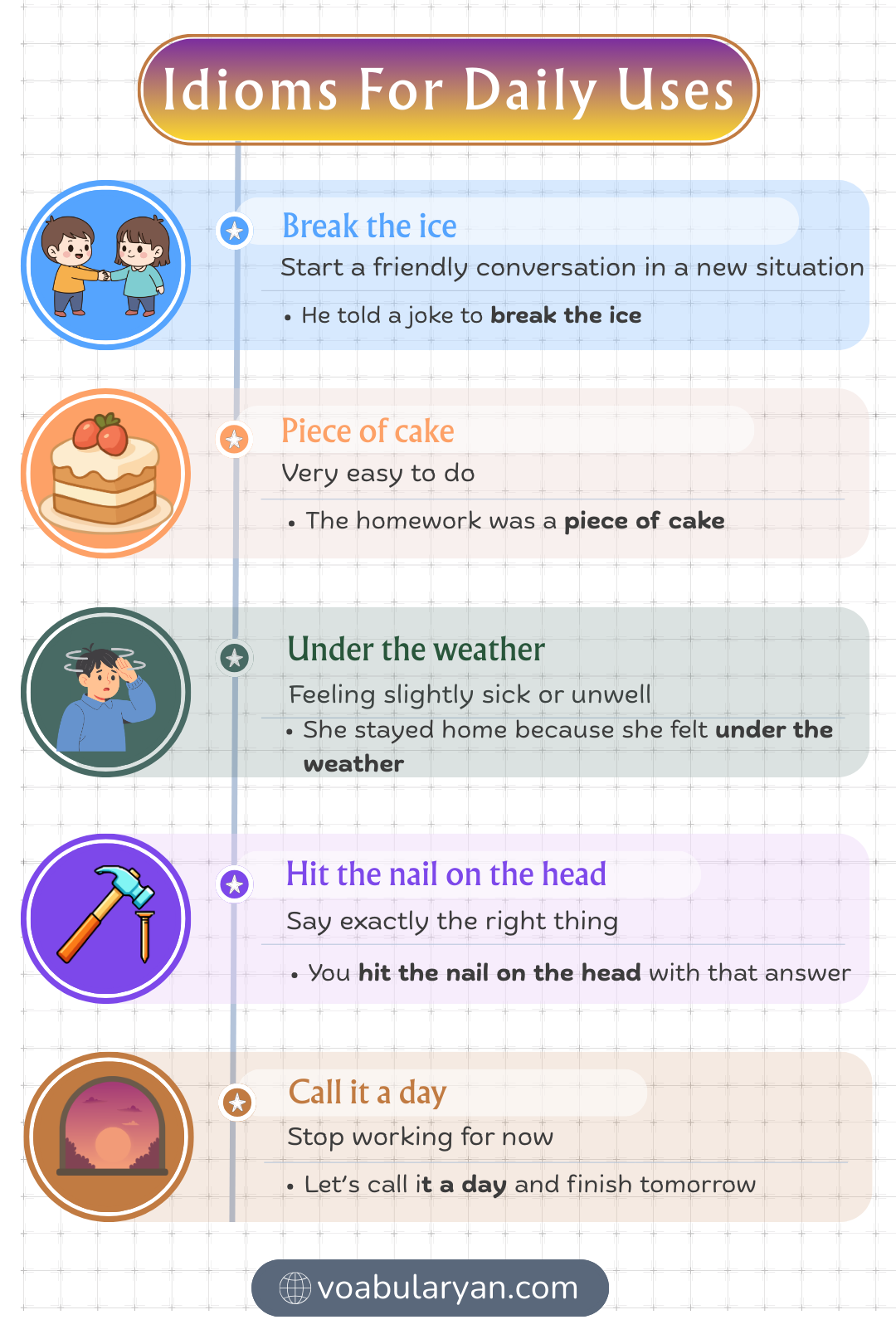
Everyday Idioms For Starting Your Day Right
Bright And Early
Meaning: very early in the morning.
When To Use It: use it when something happens at an early hour.
Collocations: bright and early tomorrow, arrive bright and early
Example Sentences:
- We met bright and early for practice.
- She arrived bright and early at work.
Dialogue:
Liam: I will be there bright and early.
Maya: That early start helps a lot.
Closest Alternatives:
- very early
- early in the morning
Rise And Shine
Meaning: wake up and get ready to start the day.
When To Use It: use it to encourage someone to wake up.
Collocations: say rise and shine cheerfully
Example Sentences:
- Dad said rise and shine at six.
- She whispered rise and shine to her brother.
Dialogue:
Emma: Rise and shine, it is morning.
Noah: I need five more minutes.
Closest Alternatives:
- wake up
- get up
At The Crack Of Dawn
Meaning: very early, just as the sun rises.
When To Use It: use it when describing very early starts.
Collocations: leave at the crack of dawn
Example Sentences:
- They left at the crack of dawn.
- He wakes up at the crack of dawn.
Dialogue:
Olivia: We start at the crack of dawn.
Ethan: That is an early morning.
Closest Alternatives:
- at sunrise
- very early
Wake Up On The Wrong Side Of The Bed
Meaning: start the day feeling upset or annoyed.
When To Use It: use it when someone seems in a bad mood.
Collocations: wake up on the wrong side of the bed today
Example Sentences:
- He must have woken up on the wrong side of the bed.
- She woke up on the wrong side of the bed this morning.
Dialogue:
Grace: Did you wake up on the wrong side of the bed?
Daniel: I feel a bit irritable today.
Closest Alternatives:
- in a bad mood
- grumpy
Get Your Act Together
Meaning: start behaving responsibly and effectively.
When To Use It: use it when urging someone to improve behavior.
Collocations: get your act together quickly
Example Sentences:
- She told him to get his act together.
- I need to get my act together soon.
Dialogue:
Mila: I must get my act together.
Omar: That focus will bring real progress.
Closest Alternatives:
- pull yourself together
- improve your behavior
Idioms For Everyday Routines And Daily Life
Run Around Like A Headless Chicken
Meaning: act in a rushed and confused way.
When To Use It: use it when someone seems busy but disorganized.
Collocations: run around like a headless chicken all morning
Example Sentences:
- He was running around like a headless chicken before the meeting.
- She ran around like a headless chicken looking for her phone.
Dialogue:
Liam: I am running around like a headless chicken.
Maya: Take a breath and make a clear plan.
Closest Alternatives:
- rush about
- panic
Cut It Fine
Meaning: leave very little time before a deadline.
When To Use It: use it when something is almost too late.
Collocations: cut it fine with the train
Example Sentences:
- He cut it fine catching the flight.
- She cut it fine with her project.
Dialogue:
Olivia: I cut it fine today.
Ethan: That close timing is risky.
Closest Alternatives:
- leave it late
- almost miss
When Push Comes To Shove
Meaning: when action becomes necessary in a serious moment.
When To Use It: use it when real effort is finally required.
Collocations: when push comes to shove, he acts
Example Sentences:
- When push comes to shove, she stays calm.
- He works hard when push comes to shove.
Dialogue:
Grace: When push comes to shove, we will decide.
Daniel: That shows true commitment.
Closest Alternatives:
- in the end
- when it matters
Drag Your Feet
Meaning: delay doing something on purpose.
When To Use It: use it when someone avoids starting.
Collocations: drag your feet on a task
Example Sentences:
- He dragged his feet on the report.
- She keeps dragging her feet.
Dialogue:
Mila: Stop dragging your feet.
Omar: I will begin with real effort.
Closest Alternatives:
- delay
- put off
Call It A Day
Meaning: stop working for the day.
When To Use It: use it when ending tasks.
Collocations: call it a day early
Example Sentences:
- They called it a day at five.
- Let us call it a day.
Dialogue:
Emma: Let us call it a day.
Noah: We did enough work.
Closest Alternatives:
- finish up
- stop for now
Get Cracking
Meaning: start doing something quickly.
When To Use It: use it when urging fast action.
Collocations: get cracking on homework
Example Sentences:
- We need to get cracking.
- She told him to get cracking.
Dialogue:
Olivia: Let us get cracking.
Ethan: Time to move with speed.
Closest Alternatives:
- get started
- hurry up
Hit The Ground Running
Meaning: start something with strong energy.
When To Use It: use it when beginning fast and focused.
Collocations: hit the ground running at work
Example Sentences:
- She hit the ground running on her first day.
- He hit the ground running with new ideas.
Dialogue:
Grace: I plan to hit the ground running.
Daniel: That early momentum helps.
Closest Alternatives:
- start fast
- begin strongly
Have A Lie-In
Meaning: sleep longer than usual in the morning.
When To Use It: use it on relaxed days.
Collocations: have a lie-in on Sunday
Example Sentences:
- She had a lie-in today.
- I will have a lie-in tomorrow.
Dialogue:
Ava: I had a lie-in.
Ryan: That extra rest feels good.
Closest Alternatives:
- sleep in
- rest longer
Call The Shots
Meaning: make the main decisions.
When To Use It: use it when someone leads.
Collocations: call the shots at work
Example Sentences:
- She calls the shots here.
- He likes to call the shots.
Dialogue:
Mila: Who calls the shots?
Omar: The manager makes the decisions.
Closest Alternatives:
- be in charge
- lead
Go Through The Motions
Meaning: do something without real interest.
When To Use It: use it when effort feels empty.
Collocations: go through the motions at work
Example Sentences:
- He was going through the motions.
- She went through the motions all day.
Dialogue:
Emma: I am just going through the motions.
Noah: Try to find true purpose.
Closest Alternatives:
- act mechanically
- do it without feeling
In The Groove
Meaning: working smoothly and confidently.
When To Use It: use it when performance feels natural.
Collocations: get in the groove
Example Sentences:
- She is in the groove today.
- He got in the groove quickly.
Dialogue:
Olivia: I feel in the groove.
Ethan: That steady flow helps.
Closest Alternatives:
- in the zone
- working well
Get Stuck In
Meaning: begin something with strong effort.
When To Use It: use it when starting eagerly.
Collocations: get stuck in at work
Example Sentences:
- They got stuck in right away.
- She told him to get stuck in.
Dialogue:
Mila: Time to get stuck in.
Omar: I am ready for real work.
Closest Alternatives:
- dive in
- start eagerly
On Autopilot
Meaning: act without thinking carefully.
When To Use It: use it when routine feels automatic.
Collocations: run on autopilot
Example Sentences:
- He was on autopilot all day.
- She worked on autopilot.
Dialogue:
Emma: I feel on autopilot.
Noah: That daily routine takes over.
Closest Alternatives:
- act automatically
- without thought
Put Your Feet Up
Meaning: rest and relax comfortably.
When To Use It: use it after hard work.
Collocations: put your feet up after work
Example Sentences:
- She put her feet up after dinner.
- He plans to put his feet up tonight.
Dialogue:
Grace: I will put my feet up.
Daniel: You earned that rest.
Closest Alternatives:
- relax
- rest
Knock Off
Meaning: stop working for the day.
When To Use It: use it when ending work.
Collocations: knock off at five
Example Sentences:
- They knocked off early.
- She will knock off soon.
Dialogue:
Ava: Let us knock off.
Ryan: It has been a long day.
Closest Alternatives:
- finish work
- clock out
Kick Back
Meaning: relax in a comfortable way.
When To Use It: use it during free time.
Collocations: kick back and relax
Example Sentences:
- He likes to kick back after work.
- They kicked back on the sofa.
Dialogue:
Emma: Let us kick back tonight.
Noah: A calm evening sounds good.
Closest Alternatives:
- relax
- unwind
Wind Down
Meaning: gradually relax after activity.
When To Use It: use it at the end of busy days.
Collocations: wind down before bed
Example Sentences:
- She wound down before sleep.
- He needs to wind down tonight.
Dialogue:
Grace: I am trying to wind down.
Daniel: Soft music may help you feel calm.
Idioms About Daily Challenges And Overcoming Obstacles
Take The Plunge
Meaning: decide to do something bold or risky.
When To Use It: use it when making a brave decision.
Collocations: take the plunge and start, finally take the plunge
Example Sentences:
- She decided to take the plunge.
- He finally took the plunge and applied.
Dialogue:
Liam: I will take the plunge.
Maya: That shows real courage.
Closest Alternatives:
- take a risk
- make the leap
Jump At The Chance
Meaning: accept an opportunity very eagerly.
When To Use It: use it when someone quickly agrees to a good offer.
Collocations: jump at the chance to travel
Example Sentences:
- She jumped at the chance to join.
- He would jump at the chance again.
Dialogue:
Emma: I would jump at the chance.
Noah: It sounds like a great opportunity.
Closest Alternatives:
- grab the chance
- accept eagerly
Be On A Roll
Meaning: have repeated success in a short time.
When To Use It: use it when someone keeps winning.
Collocations: be on a roll lately
Example Sentences:
- She is on a roll this week.
- He felt on a roll at work.
Dialogue:
Olivia: You are on a roll today.
Ethan: Everything feels in perfect flow.
Closest Alternatives:
- in great form
- doing very well
Give It A Whirl
Meaning: try something new for fun.
When To Use It: use it when testing an activity casually.
Collocations: give it a whirl and see
Example Sentences:
- She decided to give it a whirl.
- He said, let us give it a whirl.
Dialogue:
Grace: Let us give it a whirl.
Daniel: It could be an exciting experience.
Closest Alternatives:
- try it out
- have a go
Give Something Your Best Shot
Meaning: try as hard as possible.
When To Use It: use it before making a strong effort.
Collocations: give it your best shot
Example Sentences:
- She will give it her best shot.
- He promised to give it his best shot.
Dialogue:
Ava: I will give it my best shot.
Ryan: That full effort matters.
Closest Alternatives:
- try your best
- make a strong effort
Square The Circle
Meaning: solve a problem that seems impossible.
When To Use It: use it when facing a difficult task.
Collocations: try to square the circle
Example Sentences:
- He tried to square the circle.
- She hoped to square the circle in time.
Dialogue:
Mila: We must square the circle.
Omar: It is a hard challenge.
Closest Alternatives:
- solve the impossible
- fix a tough problem
Try Your Hand At Something
Meaning: attempt a new skill or activity.
When To Use It: use it when exploring new interests.
Collocations: try your hand at cooking
Example Sentences:
- She tried her hand at painting.
- He wants to try his hand at writing.
Dialogue:
Emma: I will try my hand at baking.
Noah: That sounds like a fun skill.
Closest Alternatives:
- attempt
- have a go
Get The Hang Of Something
Meaning: learn how to do something well.
When To Use It: use it when progress improves skill.
Collocations: get the hang of driving
Example Sentences:
- She got the hang of the game.
- He will get the hang of it soon.
Dialogue:
Ava: I am starting to get the hang of this.
Ryan: Practice builds real confidence.
Closest Alternatives:
- understand
- learn quickly
Keep Someone On Your Toes
Meaning: keep someone alert and ready.
When To Use It: use it when constant attention is needed.
Collocations: keep me on my toes
Example Sentences:
- The job keeps me on my toes.
- She keeps him on his toes.
Dialogue:
Mila: This task keeps me on my toes.
Omar: That sharp focus helps.
Closest Alternatives:
- keep alert
- stay ready
Play Devil’s Advocate
Meaning: argue the opposite side for discussion.
When To Use It: use it when testing ideas fairly.
Collocations: play devil’s advocate in debate
Example Sentences:
- She decided to play devil’s advocate.
- He often plays devil’s advocate in meetings.
Dialogue:
Emma: I will play devil’s advocate.
Noah: That helps us think more deeply.
Closest Alternatives:
- question the idea
- argue the other side
Wishful Thinking
Meaning: believing something good without strong reason.
When To Use It: use it when hope ignores reality.
Collocations: pure wishful thinking
Example Sentences:
- That plan is just wishful thinking.
- He knew it was wishful thinking.
Dialogue:
Olivia: Maybe it will work.
Ethan: That sounds like wishful thinking.
Closest Alternatives:
- false hope
- unrealistic belief
Everyday Idioms For Expression And Communication
Beat Around The Bush
Meaning: avoid saying something directly.
When To Use It: use it when someone delays the main point.
Collocations: stop beating around the bush
Example Sentences:
- Stop beating around the bush and speak.
- She kept beating around the bush.
Dialogue:
Emma: Please do not beat around the bush.
Noah: I will say it in clear words.
Closest Alternatives:
- avoid the point
- speak indirectly
It Goes Without Saying
Meaning: something is obvious and needs no explanation.
When To Use It: use it for clear and accepted facts.
Collocations: it goes without saying that
Example Sentences:
- It goes without saying we must try.
- It goes without saying that honesty matters.
Dialogue:
Olivia: It goes without saying we support you.
Ethan: Your loyal support means a lot.
Closest Alternatives:
- obviously
- clearly
Come Clean
Meaning: admit the truth about something.
When To Use It: use it when confessing a mistake.
Collocations: come clean about the problem
Example Sentences:
- He decided to come clean.
- She finally came clean about it.
Dialogue:
Grace: I will come clean now.
Daniel: That honest confession matters.
Closest Alternatives:
- tell the truth
- admit it
Turn A Blind Eye
Meaning: ignore something wrong on purpose.
When To Use It: use it when choosing not to act.
Collocations: turn a blind eye to mistakes
Example Sentences:
- He turned a blind eye to the rule.
- She turns a blind eye to small faults.
Dialogue:
Ava: They turned a blind eye again.
Ryan: That silent choice was clear.
Closest Alternatives:
- ignore
- overlook
Pull Someone’s Leg
Meaning: tease someone with a playful lie.
When To Use It: use it during light humor.
Collocations: just pulling your leg
Example Sentences:
- I was only pulling your leg.
- She likes to pull his leg.
Dialogue:
Mila: I am just pulling your leg.
Omar: You nearly fooled me with that story.
Closest Alternatives:
- tease
- joke with
Make A Long Story Short
Meaning: explain something briefly and directly.
When To Use It: use it before summarizing details.
Collocations: to make a long story short
Example Sentences:
- To make a long story short, we won.
- She said, make a long story short, we left.
Dialogue:
Emma: To make a long story short, I agreed.
Noah: That clear summary helps.
Closest Alternatives:
- in brief
- in short
Keep Someone In The Loop
Meaning: keep someone informed about updates.
When To Use It: use it when sharing progress or news.
Collocations: keep me in the loop
Example Sentences:
- Please keep me in the loop.
- She kept him in the loop.
Dialogue:
Olivia: Can you keep me in the loop?
Ethan: I will share every update.
Closest Alternatives:
- keep informed
- update regularly
Everyday Business Idioms For The Workplace
By The Book
Meaning: follow rules exactly as written.
When To Use It: use it when someone obeys every rule strictly.
Collocations: do it by the book, handle things by the book
Example Sentences:
- She completed the task by the book.
- He prefers to work by the book.
Dialogue:
Liam: Let us do this by the book.
Maya: That careful approach avoids mistakes.
Closest Alternatives:
- follow the rules
- stick to procedure
Red Tape
Meaning: official rules that slow down progress.
When To Use It: use it when talking about delays in process.
Collocations: deal with red tape, cut through red tape
Example Sentences:
- The project stalled because of red tape.
- She struggled with endless red tape.
Dialogue:
Emma: There is too much red tape.
Noah: These strict rules slow everything down.
Closest Alternatives:
- bureaucracy
- official delays
Get On Board
Meaning: agree to join or support a plan.
When To Use It: use it when seeking cooperation.
Collocations: get on board with the idea
Example Sentences:
- She asked them to get on board.
- He finally got on board with the plan.
Dialogue:
Olivia: Will you get on board?
Ethan: Yes, I support the idea.
Closest Alternatives:
- agree
- join in
Call It A Day
Meaning: stop working for the rest of the day.
When To Use It: use it when ending tasks.
Collocations: call it a day early
Example Sentences:
- They decided to call it a day.
- Let us call it a day now.
Dialogue:
Grace: Shall we call it a day?
Daniel: We finished enough work.
Closest Alternatives:
- finish up
- stop for now
Cut Corners
Meaning: do something quickly but poorly to save time or money.
When To Use It: use it when quality is reduced.
Collocations: cut corners on costs
Example Sentences:
- He cut corners on the project.
- They refused to cut corners.
Dialogue:
Ava: We cannot cut corners.
Ryan: Quality must remain high.
Closest Alternatives:
- do it cheaply
- skip steps
Idioms With “Day” In Common Phrases
Make Someone’s Day
Meaning: cause someone to feel very happy.
When To Use It: use it when an action brings joy.
Collocations: really make someone’s day
Example Sentences:
- That compliment made her day.
- You truly made my day.
Dialogue:
Liam: Your message made my day.
Maya: I am glad it brought real joy.
Closest Alternatives:
- cheer someone up
- brighten someone’s day
Call It A Day
Meaning: stop working or doing something for now.
When To Use It: use it when ending tasks for the day.
Collocations: call it a day early
Example Sentences:
- They decided to call it a day.
- Let us call it a day after this task.
Dialogue:
Emma: Shall we call it a day?
Noah: Yes, we finished enough work.
Closest Alternatives:
- finish up
- stop for now
Make A Day Of It
Meaning: spend the whole day enjoying an activity.
When To Use It: use it when planning extended fun.
Collocations: make a day of it at the beach
Example Sentences:
- They made a day of it at the park.
- Let us make a day of it tomorrow.
Dialogue:
Olivia: We should make a day of it.
Ethan: That sounds like real fun.
Closest Alternatives:
- spend the whole day
- enjoy all day
Save The Day
Meaning: prevent failure or solve a problem.
When To Use It: use it when someone rescues a situation.
Collocations: arrive to save the day
Example Sentences:
- She arrived to save the day.
- His quick idea saved the day.
Dialogue:
Grace: You really saved the day.
Daniel: I am glad I could help with that problem.
Closest Alternatives:
- rescue
- fix the situation
Day In Day Out
Meaning: every day without change.
When To Use It: use it for repeated daily actions.
Collocations: work day in day out
Example Sentences:
- He works day in day out.
- She practices day in day out.
Dialogue:
Ava: I train day in day out.
Ryan: That steady routine builds skill.
Closest Alternatives:
- every day
- constantly
Back In The Day
Meaning: in the past, often with nostalgia.
When To Use It: use it when talking about earlier times.
Collocations: back in the day we played outside
Example Sentences:
- Back in the day, we walked to school.
- Things were different back in the day.
Dialogue:
Mila: Back in the day, life felt simple.
Omar: Those old memories stay strong.
Closest Alternatives:
- in the past
- years ago
Have Seen Better Days
Meaning: look worn or in poor condition.
When To Use It: use it when something looks old or damaged.
Collocations: car has seen better days
Example Sentences:
- That sofa has seen better days.
- His shoes have seen better days.
Dialogue:
Emma: This jacket has seen better days.
Noah: It looks quite worn.
Closest Alternatives:
- look old
- be worn out
Just One Of Those Days
Meaning: a day when many small things go wrong.
When To Use It: use it when nothing seems smooth.
Collocations: it is just one of those days
Example Sentences:
- It is just one of those days.
- She sighed, saying it was one of those days.
Dialogue:
Olivia: It is just one of those days.
Ethan: Tomorrow may feel much better.
Closest Alternatives:
- bad day
- unlucky day
It’s Just Not My Day
Meaning: things are not going well for you.
When To Use It: use it after repeated small failures.
Collocations: guess it is not my day
Example Sentences:
- I missed the bus. It’s just not my day.
- Nothing works. It’s just not my day.
Dialogue:
Grace: It’s just not my day.
Daniel: Do not lose your hope.
Closest Alternatives:
- bad luck today
- unlucky day
Save For A Rainy Day
Meaning: keep money for future needs.
When To Use It: use it when planning for hard times.
Collocations: save money for a rainy day
Example Sentences:
- She saves extra money for a rainy day.
- He keeps some cash for a rainy day.
Dialogue:
Ava: I always save for a rainy day.
Ryan: That careful planning helps later.
Closest Alternatives:
- save for the future
- keep emergency funds
Key Takeaways
Day idioms use the simple idea of a day to express mood, memory, effort, endings, and preparation. The meaning depends on tone and context, since the same phrase can sound cheerful, frustrated, or thoughtful. In conversation or writing, wording often remains stable and follows a fixed order, which keeps the expression natural. When we consider these idioms closely, we see how everyday time words carry figurative meaning that reaches beyond the literal sense of a single day.
FAQs
Q1. What does “break the ice” mean?
It means starting a conversation so the mood feels less awkward. In idioms for daily use, it can be a small joke or a friendly question at a first meeting.
Q2. What does “bite the bullet” mean?
It means doing something hard or unpleasant because it must be done. In idioms for daily use, it can be paying a bill, apologizing, or making a tough call.
Q3. What does “hit the books” mean?
It means beginning serious study. In idioms for daily use, it often comes up before exams, like “I have to hit the books tonight.”
Q4. What does “a piece of cake” mean?
It means something is very easy. In idioms for daily use, it can describe a simple task, like “That quiz was a piece of cake.”
Q5. What does “beat around the bush” mean?
It means avoiding the main point instead of speaking directly. In idioms for daily use, it can describe someone giving long answers without saying yes or no.
Q6. What does “under the weather” mean?
It means feeling a bit sick or weak. In idioms for daily use, it can fit a mild cold, like “I’m under the weather today.”
You May Also Like