
You listen as someone explains an idea, but the meaning slips past you. You say, “I don’t get it,” yet the words barely capture the confusion and quiet uncertainty that settle in that moment. Situations like this happen in everyday conversations.
That is where idioms for not understanding become useful in learning English. These expressions appear when people talk about confusion or a moment when something does not make sense. Some sound light in casual talk, while others carry stronger frustration.
We’ll look at how these phrases work in everyday sentences and short dialogue. You’ll sense when one fits a small misunderstanding and when another reflects deeper confusion during a conversation. Here are the words people use when meaning slips away.
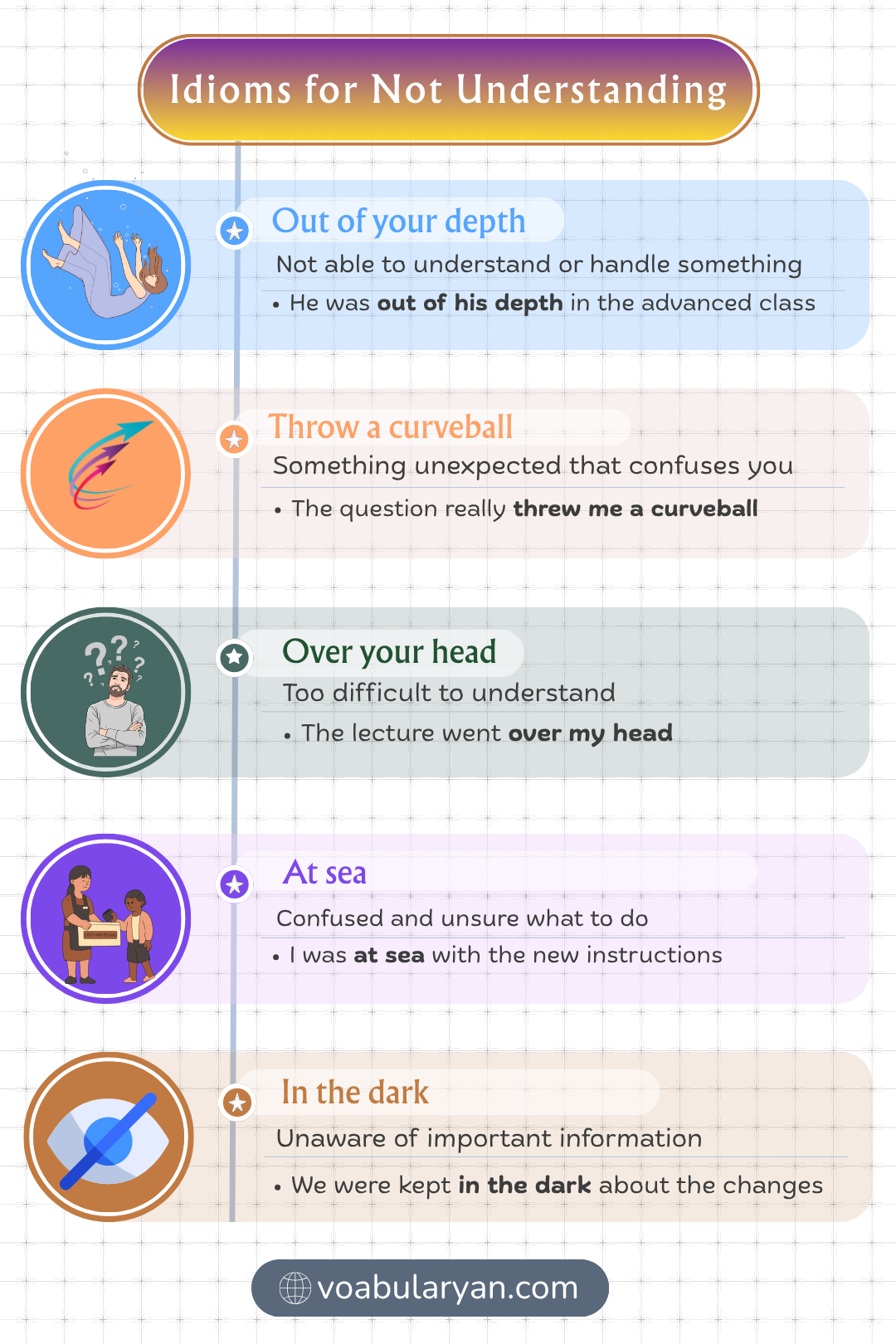
Not Understanding Idioms For Being Confused In General
At Sea
Meaning: Confused and unsure what to do next.
When To Use It: When guidance is missing and a person feels lost.
Collocations: feel at sea, be at sea about, left at sea, at sea without
Example Sentences:
- I felt At Sea when the plan changed without any notice.
- She was At Sea about the new rules and asked for help.
Dialogue:
Hina: Why are you quiet in the meeting today?
Danish: I am At Sea about the new process.
Closest Alternatives:
- confused
- at a loss
In The Dark
Meaning: Not knowing important information that others know.
When To Use It: When someone is not told details and feels unaware.
Collocations: keep someone in the dark, be in the dark about, left in the dark, in the dark on
Example Sentences:
- They kept me In The Dark about the change until the last minute.
- We are still In The Dark about the final decision.
Dialogue:
Sara: Do you know why the meeting was canceled?
Usman: No, I am In The Dark too.
Closest Alternatives:
- unaware
- not informed
In A Fog
Meaning: Unable to think clearly, often from tiredness or stress.
When To Use It: When the mind feels slow and details are hard to grasp.
Collocations: be in a fog, feel in a fog, in a fog all day, in a fog after
Example Sentences:
- I was In A Fog after the night shift and forgot my keys.
- She felt In A Fog and kept rereading the same line.
Dialogue:
Nadia: You look lost, did you sleep at all?
Haris: Hardly, I am In A Fog today.
Closest Alternatives:
- groggy
- not thinking straight
All Greek To Me
Meaning: Completely hard to understand, like a foreign language.
When To Use It: When a topic feels confusing and the meaning is unclear.
Collocations: it’s all Greek to me, sounds all Greek to me, looks all Greek to me, that part is all Greek to me
Example Sentences:
- The legal paper is All Greek To Me, so I asked for help.
- His math explanation was All Greek To Me at first.
Dialogue:
Adeel: Did you understand the instructions for the device?
Rida: No, it is All Greek To Me.
Closest Alternatives:
- makes no sense
- hard to follow
In A Spin
Meaning: Upset and confused, unable to think calmly.
When To Use It: When sudden news makes someone anxious and unsettled.
Collocations: be in a spin, get in a spin, in a spin about, left in a spin
Example Sentences:
- She was In A Spin after losing her passport.
- I got In A Spin when the phone rang late at night.
Dialogue:
Mona: Why are you pacing around the room?
Yasir: I am In A Spin about the result.
Closest Alternatives:
- flustered
- rattled
Not Understanding Idioms For Missing The Point
Miss The Point
Meaning: Fail to understand the main idea being said.
When To Use It: When someone focuses on details and ignores the main message.
Collocations: miss the point completely, miss the point of, miss the point about, don’t miss the point
Example Sentences:
- He Miss The Point and argued about one word, not the idea.
- She Miss The Point because she only heard the joke part.
Dialogue:
Amina: You are upset, but that was not what I meant.
Bilal: Sorry, I Miss The Point and reacted too fast.
Closest Alternatives:
- misunderstand
- get the wrong idea
Off The Mark
Meaning: Not correct, or not close to what is true.
When To Use It: When a guess, comment, or plan is wrong.
Collocations: way off the mark, a bit off the mark, off the mark about, off the mark on
Example Sentences:
- His guess was Off The Mark by a long way.
- That answer is Off The Mark because it ignores the key detail.
Dialogue:
Hina: Do you think the meeting is at three?
Omar: No, that is Off The Mark. It starts at two.
Closest Alternatives:
- incorrect
- wrong
Off Base
Meaning: Not right, or based on a wrong idea.
When To Use It: When someone makes a claim without the right facts.
Collocations: completely off base, off base about, off base on, be off base
Example Sentences:
- He was Off Base when he said the rule changed.
- Her worry was Off Base, since the payment was already sent.
Dialogue:
Noor: I think they are angry with me.
Rayan: You are Off Base. They were just busy today.
Closest Alternatives:
- mistaken
- not accurate
Lost In Translation
Meaning: Not understood well after being moved into another language or form.
When To Use It: When meaning changes or gets unclear after translating or retelling.
Collocations: get lost in translation, lost in translation when, lost in translation during, something is lost in translation
Example Sentences:
- The humor felt Lost In Translation when it was turned into English.
- Her feeling got Lost In Translation in the short text message.
Dialogue:
Sara: Why did he sound rude in that message?
Yasir: It may be Lost In Translation from his first language.
Closest Alternatives:
- misunderstood
- not conveyed
Beat Around The Bush
Meaning: Avoid saying the main thing in a direct way.
When To Use It: When someone talks too long and delays the real point.
Collocations: beat around the bush about, stop beating around the bush, keep beating around the bush, beat around the bush instead of
Example Sentences:
- She Beat Around The Bush and did not answer the question.
- He kept Beat Around The Bush because the truth felt hard.
Dialogue:
Mariam: Are you leaving the job or not?
Sameer: I will not Beat Around The Bush. Yes, I am leaving.
Closest Alternatives:
- avoid the issue
- dodge the question
Not Understanding Idioms For Things That Are Too Hard
Go Over Your Head
Meaning: Be too hard to understand, so the meaning is missed.
When To Use It: When information is too complex for someone at that moment.
Collocations: go over your head, went over my head, go over his head, go over her head
Example Sentences:
- The math talk Go Over Your Head and he stopped asking questions.
- Her joke Go Over Your Head because it needed inside knowledge.
Dialogue:
Hina: Did you understand the new rule he explained?
Omar: No, it Go Over Your Head when he spoke so fast.
Closest Alternatives:
- be too confusing
- not understand
Out Of Your Depth
Meaning: In a situation that is too hard for your skill level.
When To Use It: When someone feels unable to handle a task or role.
Collocations: be out of your depth, feel out of your depth, out of your depth in, out of your depth with
Example Sentences:
- He felt Out Of Your Depth in the advanced class.
- She was Out Of Your Depth during the first week at the new job.
Dialogue:
Noor: Why are you so quiet in the training session?
Rayan: I am Out Of Your Depth and trying to catch up.
Closest Alternatives:
- in over your head
- not ready
A Tough Nut To Crack
Meaning: A difficult problem or person that is hard to understand.
When To Use It: When a task takes time, effort, and careful thought.
Collocations: a tough nut to crack, be a tough nut to crack, prove a tough nut to crack
Example Sentences:
- This puzzle is A Tough Nut To Crack, but I will keep trying.
- The old lock was A Tough Nut To Crack without the right tool.
Dialogue:
Ayesha: Why are you still working on that case?
Saad: It is A Tough Nut To Crack, but the clue is close.
Closest Alternatives:
- difficult problem
- hard case
A Head Scratcher
Meaning: Something confusing that makes people think hard.
When To Use It: When a situation has no easy answer.
Collocations: a real head scratcher, a bit of a head scratcher, it’s a head scratcher, remain a head scratcher
Example Sentences:
- The missing key is A Head Scratcher because nobody moved it.
- Her sudden silence was A Head Scratcher for the whole group.
Dialogue:
Mina: Why did the app stop working only on my phone?
Faisal: That is A Head Scratcher. Let’s check the settings.
Closest Alternatives:
- puzzling
- confusing problem
Throw You For A Loop
Meaning: Surprise you and disrupt your thinking or plan.
When To Use It: When unexpected news makes it hard to react quickly.
Collocations: throw you for a loop, really throw you for a loop, throw me for a loop, thrown for a loop
Example Sentences:
- The sudden question Throw You For A Loop during the interview.
- His apology Throw You For A Loop because nobody expected it.
Dialogue:
Hina: Why did you stop talking in the meeting?
Omar: That comment Throw You For A Loop, so I needed a second.
Closest Alternatives:
- catch you off guard
- shock you
Not Understanding Idioms For Not Knowing The Details
Out Of The Loop
Meaning: Not included in updates, so key details are missing.
When To Use It: When others know what is happening but you were not informed.
Collocations: be out of the loop, out of the loop on, keep someone out of the loop, feel out of the loop
Example Sentences:
- I am Out Of The Loop on the new schedule changes.
- She felt Out Of The Loop because nobody shared the update.
Dialogue:
Hina: Do you know why they moved the meeting time?
Danish: No, I am Out Of The Loop this week.
Closest Alternatives:
- not in the know
- not informed
Not Have A Clue
Meaning: Have no idea about something or how it works.
When To Use It: When someone is completely unsure and lacks information.
Collocations: not have a clue about, not have a clue what, not have a clue how, not have a clue why
Example Sentences:
- I Not Have A Clue how the file disappeared.
- She Not Have A Clue what the message was meant to say.
Dialogue:
Sara: Where did he put the keys this time?
Usman: I Not Have A Clue, sorry.
Closest Alternatives:
- have no idea
- don’t know
Not Ringing A Bell
Meaning: Not sounding familiar, like you do not remember it.
When To Use It: When a name, place, or detail is not recognized.
Collocations: not ringing a bell, is it ringing a bell, not really ringing a bell for me, not ringing any bells
Example Sentences:
- That name is Not Ringing A Bell for me right now.
- The address is Not Ringing A Bell, so I need more details.
Dialogue:
Nadia: Do you remember a teacher named Mr. Qasim?
Haris: No, that is Not Ringing A Bell.
Closest Alternatives:
- doesn’t sound familiar
- can’t recall
Not Understanding Idioms For Losing The Thread While Listening
Lost Track
Meaning: Stop following what is happening or lose sense of time.
When To Use It: When attention slips and the details are no longer remembered.
Collocations: lost track of time, lost track of what, lost track during, completely lost track
Example Sentences:
- I Lost Track of time while waiting and missed the call.
- She Lost Track of the steps and had to start again.
Dialogue:
Nadia: Why did you not reply for two hours?
Omar: Sorry, I Lost Track of time during the meeting.
Closest Alternatives:
- lose count
- forget where you were
Tuned Out
Meaning: Stop listening or paying attention to what is being said.
When To Use It: When a person becomes bored, tired, or distracted during talk.
Collocations: tuned out during, totally tuned out, got tuned out, seemed tuned out
Example Sentences:
- He Tuned Out during the long speech and missed the main point.
- She Tuned Out when the discussion turned into an argument.
Dialogue:
Hina: Did you hear the last instruction?
Bilal: No, I Tuned Out for a moment, sorry.
Closest Alternatives:
- stop listening
- lose focus
Not Understanding Idioms For A Mind Going Blank
Draw A Blank
Meaning: Fail to remember or think of an answer.
When To Use It: When the mind goes empty during a question or task.
Collocations: draw a blank on, draw a blank when, drew a blank, keep drawing a blank
Example Sentences:
- I Draw A Blank when she asked for the name.
- He Draw A Blank on the last question and sat quietly.
Dialogue:
Hina: What is the password hint again?
Danish: I Draw A Blank right now, give me a minute.
Closest Alternatives:
- can’t remember
- forget completely
Brain Freeze
Meaning: A sudden moment when thinking stops, often from shock or cold.
When To Use It: When someone cannot respond quickly due to surprise or confusion.
Collocations: get brain freeze, brain freeze moment, total brain freeze, had brain freeze
Example Sentences:
- I had Brain Freeze when the teacher called my name.
- She got Brain Freeze and forgot her line on stage.
Dialogue:
Sara: Why did you stop talking mid sentence?
Usman: I had Brain Freeze and lost my words.
Closest Alternatives:
- mental block
- blank out
At A Loss
Meaning: Unsure what to do or say, with no answer.
When To Use It: When a situation feels confusing and options are unclear.
Collocations: be at a loss, at a loss for words, at a loss about, feel at a loss
Example Sentences:
- I was At A Loss after hearing the sudden news.
- She felt At A Loss about how to fix the mistake.
Dialogue:
Nadia: What did you say when they blamed you?
Haris: I was At A Loss and stayed silent.
Closest Alternatives:
- confused
- unsure
Scratch Your Head
Meaning: Feel puzzled and try to understand something.
When To Use It: When a problem is confusing and does not make sense yet.
Collocations: scratch your head over, scratch your head about, left scratching your head, make you scratch your head
Example Sentences:
- The strange result made me Scratch Your Head for an hour.
- He Scratch Your Head over the map and took the wrong turn.
Dialogue:
Adeel: Why is the bill higher than last month?
Rida: I am Scratch Your Head too, it looks odd.
Closest Alternatives:
- be puzzled
- wonder what happened
Not Understanding Idioms For Being Out Of Sync With Others
Not On The Same Page
Meaning: Not sharing the same understanding or plan.
When To Use It: When people misunderstand each other about goals, details, or next steps.
Collocations: not on the same page about, not on the same page with, get on the same page, on the same page
Example Sentences:
- We were Not On The Same Page about the meeting time.
- They are Not On The Same Page on what the budget should cover.
Dialogue:
Amina: Why did you bring charts when I asked for photos?
Bilal: Sorry, we were Not On The Same Page about the request.
Closest Alternatives:
- misunderstand each other
- not aligned
In Two Minds
Meaning: Unable to decide because both options seem possible.
When To Use It: When someone feels torn between two choices.
Collocations: be in two minds, in two minds about, in two minds whether, still in two minds
Example Sentences:
- She is In Two Minds about moving to a new city.
- I am In Two Minds whether to accept the offer today.
Dialogue:
Noor: Are you joining the trip or staying home?
Rayan: I am In Two Minds because of my work schedule.
Closest Alternatives:
- undecided
- torn
Out Of Sorts
Meaning: Feeling unwell, upset, or not quite normal.
When To Use It: When mood or health feels off, but not seriously.
Collocations: feel out of sorts, a bit out of sorts, seem out of sorts, been out of sorts
Example Sentences:
- He was Out Of Sorts all day after sleeping badly.
- She felt Out Of Sorts and stayed quiet during lunch.
Dialogue:
Hina: You seem different today, is everything fine?
Bilal: I am Out Of Sorts, just tired and distracted.
Closest Alternatives:
- not yourself
- a bit off
Not Understanding Idioms For Being Distracted Or Not Focused
Lost In Thought
Meaning: Thinking deeply and not paying attention to what is around you.
When To Use It: When someone seems distant because their mind is busy.
Collocations: lost in thought, sit lost in thought, look lost in thought, become lost in thought
Example Sentences:
- He sat Lost In Thought and missed the bus stop.
- She walked Lost In Thought and did not hear her phone ring.
Dialogue:
Hina: You did not answer my question, are you okay?
Danish: Sorry, I was Lost In Thought for a moment.
Closest Alternatives:
- deep in thought
- distracted
Off Your Game
Meaning: Not performing as well as you usually do.
When To Use It: When someone makes more mistakes or seems less sharp than normal.
Collocations: be off your game, feel off your game, a bit off your game, off your game today
Example Sentences:
- I am Off Your Game today and keep missing small details.
- She felt Off Your Game during the match and played quietly.
Dialogue:
Sara: You usually finish fast, what happened today?
Usman: I am Off Your Game because I barely slept.
Closest Alternatives:
- not at your best
- below par
Key Takeaways
Idioms for not understanding describe confusion, missed meaning, and mental overload when ideas do not connect. The tone can range from light and humorous to blunt, depending on the setting and the relationship between speakers. In speech and writing, many idioms keep stable wording and word order, so small changes can weaken the sense. Across the page, examples reflect moments like missing the main idea, feeling out of depth, zoning out, or being unsure, while keeping the focus on meaning not landing in a natural way, and we treat it as a normal part of talk.
FAQs
Q1. What does “it’s all Greek to me” mean when something feels confusing?
In idioms for not understanding, “it’s all Greek to me” means the message feels impossible to understand. It often fits complex writing, fast talk, or unfamiliar words, like a contract, manual, or technical explanation.
Q2. What does “in the dark” mean when someone lacks key information?
In idioms for not understanding, “in the dark” means not being informed about what is happening. It can describe missing details, unclear plans, or withheld news, such as not knowing why a decision was made.
Q3. What does “go over my head” mean in conversations or lessons?
In idioms for not understanding, “go over my head” means the idea is too hard to grasp. It often fits advanced talk, heavy details, or quick explanations, like a lecture, a meeting, or a complex joke.
Q4. What does “can’t make head nor tail of it” mean in plain English?
In idioms for not understanding, “can’t make head nor tail of it” means nothing makes sense at all. It fits mixed messages, messy instructions, or confusing speech, like unclear directions or a poorly explained plan.
Q5. What does “lost in translation” mean beyond language issues?
In idioms for not understanding, “lost in translation” means the meaning did not carry over well. It can be about language, but also tone, humor, or intent, where the message changes and confusion follows.
Q6. What does “scratching my head” mean when someone looks puzzled?
In idioms for not understanding, “scratching my head” means feeling confused and thinking hard about a problem. It often fits questions, rules, or results that do not match expectations, like a strange answer or unclear steps.
You May Also Like
