
Everyday conversations are full of phrases that do not match their literal meaning. Someone might say they are “under the weather” or that they need to “hit the books.” Without knowing these expressions, daily talk can feel confusing or unclear.
Idioms for daily life cover common situations at home, school, work, and with friends. Some sound casual and friendly, while others fit neutral writing or polite speech. These phrases describe routine problems, small successes, feelings, and habits, and their meanings and examples unfold as you continue.
We’ll explore what each phrase means, when it fits naturally, how it works in a sentence, and how it sounds in short dialogue, along with close alternatives you may hear. This helps you sense the tone before using one yourself. Let’s begin.
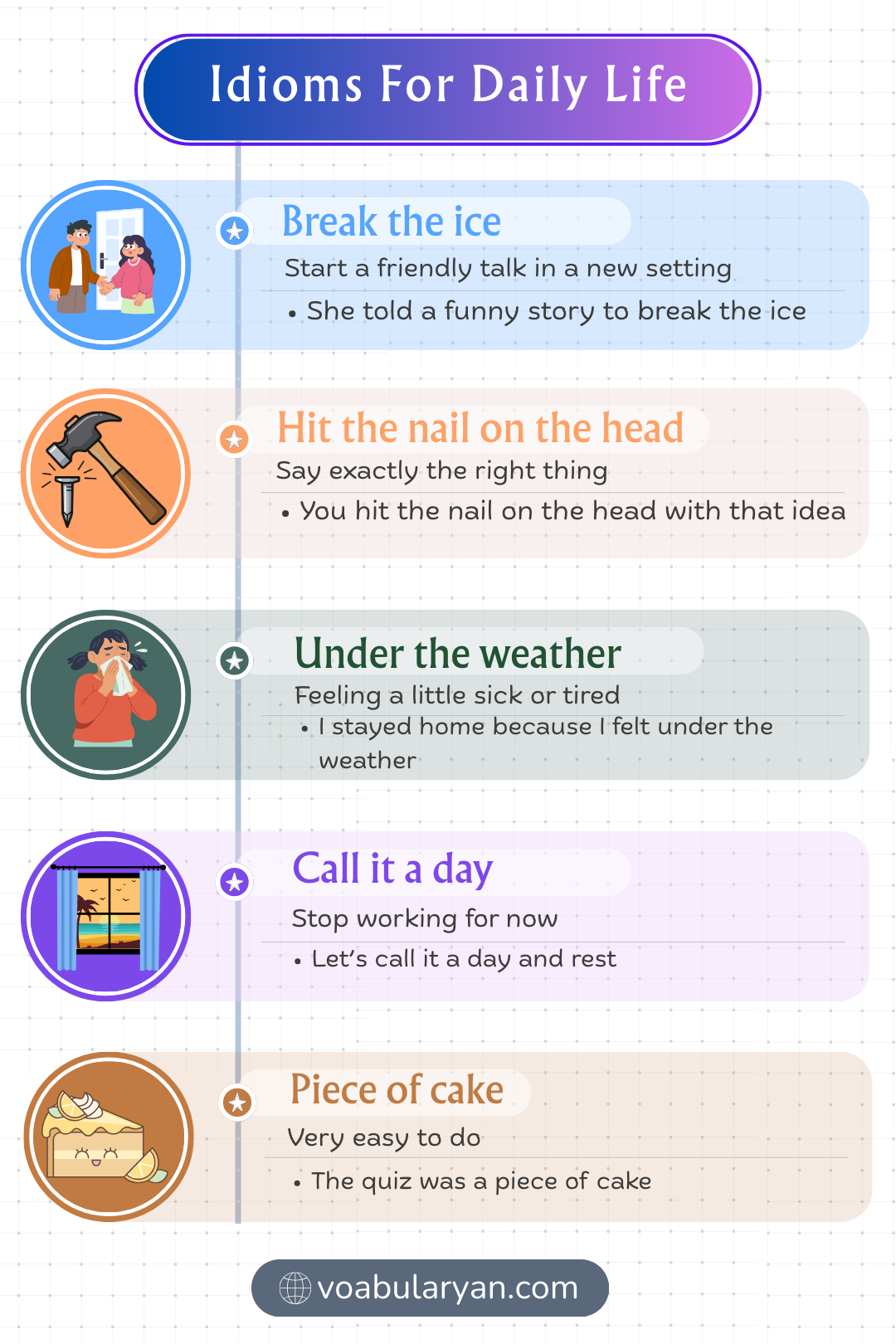
Idioms For Daily Life And Routine Activities
Get The Hang Of It
Meaning: learn how to do something properly.
When To Use It: use it when someone improves with practice.
Collocations: get the hang of it quickly
Example Sentences:
- She finally got the hang of it.
- He is starting to get the hang of it now.
Dialogue:
Liam: I think I got the hang of it.
Maya: That steady practice paid off.
Closest Alternatives:
- figure it out
- learn properly
Call It A Day
Meaning: stop working or stop an activity for now.
When To Use It: use it when ending tasks.
Collocations: call it a day early
Example Sentences:
- They decided to call it a day.
- Let us call it a day after this.
Dialogue:
Emma: Shall we call it a day?
Noah: Yes, we finished enough work.
Closest Alternatives:
- finish up
- stop for now
A Piece Of Cake
Meaning: very easy to do.
When To Use It: use it when something requires little effort.
Collocations: exam was a piece of cake
Example Sentences:
- The test was a piece of cake.
- Fixing it was a piece of cake.
Dialogue:
Olivia: That task was a piece of cake.
Ethan: It felt really simple.
Closest Alternatives:
- very easy
- no problem
Hit The Nail On The Head
Meaning: say or do exactly the right thing.
When To Use It: use it when someone is completely correct.
Collocations: hit the nail on the head with that answer
Example Sentences:
- She hit the nail on the head.
- His comment hit the nail on the head.
Dialogue:
Grace: You hit the nail on the head.
Daniel: That clear point explains everything.
Closest Alternatives:
- be exactly right
- get it right
In The Nick Of Time
Meaning: just before it is too late.
When To Use It: use it when timing is very close.
Collocations: arrive in the nick of time
Example Sentences:
- She arrived in the nick of time.
- He finished in the nick of time.
Dialogue:
Ava: I reached in the nick of time.
Ryan: That close timing was lucky.
Closest Alternatives:
- just in time
- at the last moment
Idioms For Everyday Work And Social Life
By The Book
Meaning: follow rules exactly as written.
When To Use It: use it when actions follow official rules.
Collocations: do it by the book, handle it by the book
Example Sentences:
- He handled the case by the book.
- She prefers to work by the book.
Dialogue:
Liam: Let us do it by the book.
Maya: That keeps everything within the rules.
Closest Alternatives:
- follow the rules
- strictly follow procedure
Get On Board
Meaning: agree to join or support a plan.
When To Use It: use it when asking for cooperation.
Collocations: get on board with the idea
Example Sentences:
- She asked them to get on board.
- He finally got on board with the project.
Dialogue:
Emma: Are you ready to get on board?
Noah: Yes, I fully support it.
Closest Alternatives:
- agree to join
- support the plan
Pull Your Weight
Meaning: do your fair share of work.
When To Use It: use it when teamwork requires equal effort.
Collocations: pull your weight in the team
Example Sentences:
- Everyone must pull their weight.
- She always pulls her weight at work.
Dialogue:
Olivia: We all need to pull our weight.
Ethan: I will do my fair share.
Closest Alternatives:
- do your part
- share responsibility
Speak Of The Devil
Meaning: said when someone appears unexpectedly.
When To Use It: use it when a person arrives after being mentioned.
Collocations: speak of the devil, here he is
Example Sentences:
- Speak of the devil, here she comes.
- We were just talking about you; speak of the devil.
Dialogue:
Grace: Speak of the devil, there he is.
Daniel: What a strange timing.
Closest Alternatives:
- what a coincidence
- there he is
When In Rome
Meaning: follow local customs in a new place.
When To Use It: use it when adapting to different traditions.
Collocations: when in Rome, do as the Romans do
Example Sentences:
- When in Rome, try local food.
- She said, when in Rome, join them.
Dialogue:
Ava: When in Rome, I will follow their way.
Ryan: That shows real respect.
Closest Alternatives:
- adapt to local ways
- follow local customs
Idioms For Overcoming Challenges In Daily Life
Jump The Gun
Meaning: act too early without waiting.
When To Use It: use it when someone starts before the right time.
Collocations: jump the gun on a decision
Example Sentences:
- He jumped the gun and spoke too soon.
- She jumped the gun before hearing the rules.
Dialogue:
Liam: I think I jumped the gun.
Maya: It is better to wait for clear instructions.
Closest Alternatives:
- act too soon
- rush ahead
It’s Raining Cats And Dogs
Meaning: it is raining very heavily.
When To Use It: use it during strong rain.
Collocations: it is raining cats and dogs outside
Example Sentences:
- It’s raining cats and dogs today.
- We stayed inside because it’s raining cats and dogs.
Dialogue:
Ava: It’s raining cats and dogs.
Ryan: We should carry an umbrella.
Closest Alternatives:
- pouring with rain
- raining heavily
Idioms For Expressing Opinions In Daily Conversations
A Penny For Your Thoughts
Meaning: asking someone what they are thinking.
When To Use It: use it when someone looks deep in thought.
Collocations: give a penny for your thoughts, share your thoughts
Example Sentences:
- He looked quiet, so I said, a penny for your thoughts.
- She seemed lost in thought; I asked, a penny for your thoughts.
Dialogue:
Liam: You look deep in thought. A penny for your thoughts?
Maya: I was just considering my plans.
Closest Alternatives:
- what’s on your mind?
- tell me what you’re thinking
Knock On Wood
Meaning: say this when hoping something good continues without bad luck.
When To Use It: use it when trying to prevent bad luck after saying something positive.
Collocations: knock on wood for good luck
Example Sentences:
- I’ve been feeling great, knock on wood.
- Everything is going smoothly, knock on wood.
Dialogue:
Liam: Things are looking good knock on wood.
Maya: Yes, let’s hope it stays that way.
Closest Alternatives:
- hope for the best
- stay lucky
Key Takeaways
Everyday idioms express common actions, sudden events, effort, timing, and even weather through simple, familiar images. The meaning depends on context and tone, since the literal words often point to something quite different. In conversation or writing, these expressions usually keep stable wording and fixed word order, which helps them sound natural. When we consider these phrases closely, we see how ordinary language carries figurative meaning that makes daily communication more vivid and precise.
FAQs
Q1. What does “break the ice” mean?
It means starting a conversation so things feel less awkward. In idioms for daily life, it can be a quick joke or a friendly question when people first meet.
Q2. What does “call it a day” mean?
It means stopping work because enough has been done for now. In idioms for daily life, it can be said after finishing chores or ending a long shift.
Q3. What does “hit the road” mean?
It means leaving and starting a trip. In idioms for daily life, it fits moments like packing up and saying, “Let’s hit the road.”
Q4. What does “under the weather” mean?
It means feeling a little sick or weak. In idioms for daily life, it can be a mild cold, like “I’m under the weather today.”
Q5. What does “once in a blue moon” mean?
It means something happens very rarely. In idioms for daily life, it can describe habits, like seeing an old friend once in a blue moon.
Q6. What does “get the hang of it” mean?
It means learning how to do something after a few tries. In idioms for daily life, it can fit cooking a new dish or learning a game.
You May Also Like