
You step outside into fresh air after a long day indoors and say, “I needed that.” The words are true, yet they barely capture the sense of freedom and renewed energy that open spaces can bring. Time outside often carries a feeling ordinary language struggles to express.
That is where idioms for outdoors become useful in learning English. These expressions appear when people talk about nature, fresh air, and moments away from busy places. Some sound lively and adventurous, while others reflect quiet calm in open surroundings.
We’ll look at how these phrases work in everyday sentences and short dialogue. You’ll sense when one fits a relaxed walk and when another suits a bigger adventure outside. Here are the words people use when life moves beyond four walls.
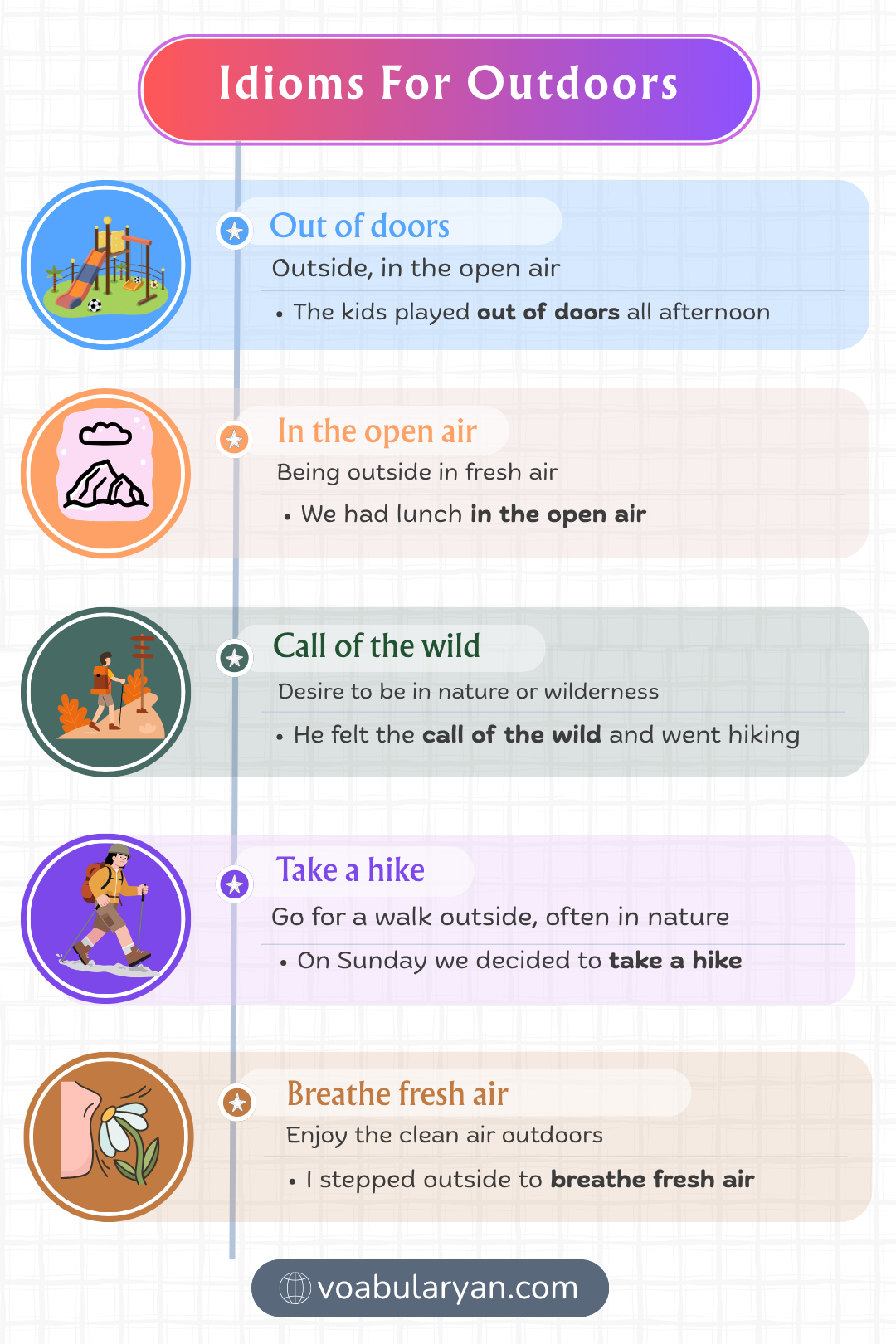
Outdoors Idioms For Trails, Hiking, And Exploring
A Walk In The Park
Meaning: Something very easy to do, with little effort.
When To Use It: When a task feels easy compared with other harder tasks.
Collocations: a walk in the park for, not a walk in the park, make it a walk in the park
Example Sentences:
- The first lesson was A Walk In The Park for the whole class.
- With good notes, the test felt A Walk In The Park.
Dialogue:
Hina: Was the new job interview hard?
Bilal: No, it was A Walk In The Park after my prep.
Closest Alternatives:
- very easy
- a piece of cake
Off The Beaten Path
Meaning: In a place that is not common, busy, or well known.
When To Use It: When talking about areas away from usual routes and crowds.
Collocations: off the beaten path in, off the beaten path near, go off the beaten path
Example Sentences:
- They stayed Off The Beaten Path and found a quiet village.
- The café is Off The Beaten Path, but the food is great.
Dialogue:
Noor: Why did you pick that hotel far from the center?
Rayan: It is Off The Beaten Path, so it feels peaceful.
Closest Alternatives:
- out of the way
- away from the crowds
Hit The Road
Meaning: Leave and begin a trip, often by car.
When To Use It: When it is time to depart and start traveling.
Collocations: hit the road early, hit the road at dawn, ready to hit the road
Example Sentences:
- We should Hit The Road before traffic gets heavy.
- They Hit The Road after breakfast and reached by noon.
Dialogue:
Ayesha: Are you staying one more night?
Saad: No, we will Hit The Road right after lunch.
Closest Alternatives:
- set off
- head out
Take A Hike
Meaning: Go away, often said in an annoyed way.
When To Use It: When someone wants to dismiss a rude comment or unwanted demand.
Collocations: tell someone to take a hike, he can take a hike, they can take a hike
Example Sentences:
- He told the bully to Take A Hike and stopped listening.
- She said Take A Hike when he tried to blame her again.
Dialogue:
Mina: He keeps asking for money after lying to you.
Faisal: He can Take A Hike. I am done with that.
Closest Alternatives:
- go away
- get lost
Get Back On Track
Meaning: Return to the right plan after delays or mistakes.
When To Use It: When progress has slipped and needs to return to normal.
Collocations: get back on track with, get back on track after, get back on track quickly
Example Sentences:
- After the delay, they Get Back On Track and finished the work.
- I will Get Back On Track after a short break this weekend.
Dialogue:
Sana: The schedule has been messy this month.
Omar: Yes, we will Get Back On Track starting Monday.
Closest Alternatives:
- return to plan
- get back to normal
Lose Your Way
Meaning: Get lost, or stop following the right direction in life.
When To Use It: For travel, or for choices that drift from values and goals.
Collocations: lose your way in, lose your way on, lose your way in life
Example Sentences:
- We Lose Your Way in the old streets and asked for help.
- He felt he Lose Your Way after quitting school too soon.
Dialogue:
Nadia: Why does he seem so unsure lately?
Kamil: He thinks he Lose Your Way, but he is finding balance again.
Closest Alternatives:
- get lost
- go astray
Outdoors Idioms For Forest, Trees, And The Wild
Out Of The Woods
Meaning: Past the worst danger, though the situation may not be fully safe.
When To Use It: When a problem is improving and the main risk is over.
Collocations: not out of the woods yet, finally out of the woods, out of the woods now, out of the woods after
Example Sentences:
- The doctor said he is Out Of The Woods, but rest is still needed.
- We are not Out Of The Woods yet, since the final check is tomorrow.
Dialogue:
Hina: Is the project safe now after the fix?
Danish: Almost, but we are not Out Of The Woods yet.
Closest Alternatives:
- past the worst
- in the clear
Bark Up The Wrong Tree
Meaning: Blame the wrong person or follow the wrong idea.
When To Use It: When someone is accusing or searching in the wrong place.
Collocations: bark up the wrong tree about, bark up the wrong tree if, barking up the wrong tree, you’re barking up the wrong tree
Example Sentences:
- If you think I lost it, you are Bark Up The Wrong Tree.
- They were Bark Up The Wrong Tree and questioned the wrong worker.
Dialogue:
Sara: Do you believe he stole the file?
Usman: No, you are Bark Up The Wrong Tree this time.
Closest Alternatives:
- blame the wrong person
- be mistaken
Can’t See The Forest For The Trees
Meaning: Miss the main point by focusing on small details.
When To Use It: When attention stays on minor issues and the big picture is lost.
Collocations: can’t see the forest for the trees, couldn’t see the forest for the trees, stop not seeing the forest for the trees
Example Sentences:
- He Can’t See The Forest For The Trees and keeps fixing tiny errors.
- We Can’t See The Forest For The Trees when we argue over fonts.
Dialogue:
Nadia: Why are we stuck on one small change again?
Haris: We Can’t See The Forest For The Trees right now.
Closest Alternatives:
- miss the big picture
- focus too much on details
Go Out On A Limb
Meaning: Take a risk by saying something before you are sure.
When To Use It: When someone makes a guess or takes responsibility without full proof.
Collocations: go out on a limb and, go out on a limb to say, go out on a limb for, went out on a limb
Example Sentences:
- I will Go Out On A Limb and say the plan will change.
- She Go Out On A Limb for him and spoke to the manager.
Dialogue:
Adeel: Are you sure he will accept the offer?
Rida: Not fully, but I will Go Out On A Limb and say yes.
Closest Alternatives:
- take a chance
- make a bold guess
Shake Like A Leaf
Meaning: Tremble strongly from fear, cold, or nerves.
When To Use It: When someone is visibly shaking because they feel intense emotion.
Collocations: shake like a leaf with fear, shake like a leaf in the cold, started to shake like a leaf, was shaking like a leaf
Example Sentences:
- He began to Shake Like A Leaf before the big speech.
- She was Shake Like A Leaf after hearing the loud crash.
Dialogue:
Mona: Why are your hands shaking so much?
Yasir: I am Shake Like A Leaf after that close call.
Closest Alternatives:
- tremble
- shake with fear
The Apple Doesn’t Fall Far From The Tree
Meaning: A child is similar to a parent in a strong way.
When To Use It: When someone’s behavior or skill matches their parent’s style.
Collocations: the apple doesn’t fall far from the tree, proves the apple doesn’t fall far from the tree
Example Sentences:
- Her daughter sings so well, The Apple Doesn’t Fall Far From The Tree.
- He fixed the car easily, and The Apple Doesn’t Fall Far From The Tree.
Dialogue:
Hassan: Your son speaks so politely, just like you.
Zara: Thanks, The Apple Doesn’t Fall Far From The Tree.
Closest Alternatives:
- like father, like son
- like mother, like daughter
Make Like A Tree And Leave
Meaning: Go away now, often said as a joke or insult.
When To Use It: When someone wants another person to leave a place quickly.
Collocations: make like a tree and leave, told him to make like a tree and leave
Example Sentences:
- He laughed and said, Make Like A Tree And Leave, when the teasing got old.
- She whispered, Make Like A Tree And Leave, after the argument started.
Dialogue:
Mina: He keeps interrupting and it is getting annoying.
Faisal: If he starts again, Make Like A Tree And Leave.
Closest Alternatives:
- go away
- get lost
Outdoors Idioms For Mountains, Hills, And Steep Challenges
Make A Mountain Out Of A Molehill
Meaning: Turn a small problem into something that seems huge.
When To Use It: When someone reacts too strongly to a minor issue.
Collocations: make a mountain out of a molehill about, make a mountain out of a molehill over, don’t make a mountain out of a molehill
Example Sentences:
- She Make A Mountain Out Of A Molehill over a tiny typo.
- He Make A Mountain Out Of A Molehill when the delivery was one day late.
Dialogue:
Amina: Why is he so upset about a small change?
Bilal: He tends to Make A Mountain Out Of A Molehill.
Closest Alternatives:
- overreact
- blow it out of proportion
Move Mountains
Meaning: Do something very hard through great effort and will.
When To Use It: When someone works intensely to reach a big goal.
Collocations: move mountains to, move mountains for, move mountains with, willing to move mountains
Example Sentences:
- She would Move Mountains to help her family stay safe.
- They Move Mountains to finish the project before the deadline.
Dialogue:
Noor: How did you get all that done in one week?
Rayan: We had to Move Mountains and work nonstop.
Closest Alternatives:
- achieve the impossible
- go above and beyond
Uphill Battle
Meaning: A hard struggle that needs a lot of effort to win.
When To Use It: When success is difficult because problems keep coming.
Collocations: an uphill battle, face an uphill battle, fight an uphill battle, uphill battle against
Example Sentences:
- Saving the business was an Uphill Battle after the big loss.
- It felt like an Uphill Battle to change their minds.
Dialogue:
Hina: Why are you still working on that complaint?
Omar: It is an Uphill Battle, but I cannot drop it.
Closest Alternatives:
- tough fight
- hard struggle
Downhill From Here
Meaning: Easier after the hardest part is finished.
When To Use It: When the main challenge is over and the rest feels simpler.
Collocations: it’s downhill from here, should be downhill from here, things are downhill from here
Example Sentences:
- We finished the hardest chapter, so it is Downhill From Here.
- After the first week, the job felt Downhill From Here.
Dialogue:
Sara: Is the rest of the hike still hard?
Faisal: No, it is Downhill From Here, so relax a bit.
Closest Alternatives:
- easier from now on
- the worst is over
Over The Hill
Meaning: Past your best years, often said in a teasing way.
When To Use It: When joking about age or feeling less youthful.
Collocations: be over the hill, feel over the hill, call someone over the hill
Example Sentences:
- He joked that he was Over The Hill after turning forty.
- She felt Over The Hill when she could not keep up.
Dialogue:
Nadia: Why are you complaining about your knees again?
Bilal: Because I am Over The Hill, or so it feels.
Closest Alternatives:
- past your prime
- not as young
Head For The Hills
Meaning: Leave quickly to avoid danger or trouble.
When To Use It: When a situation feels risky and escape is the best choice.
Collocations: head for the hills, time to head for the hills, told them to head for the hills
Example Sentences:
- When the shouting started, they Head For The Hills at once.
- He said it was time to Head For The Hills before things got worse.
Dialogue:
Areeba: This place feels unsafe right now.
Sameer: Then let’s Head For The Hills and go home.
Closest Alternatives:
- run for it
- get out fast
Outdoors Idioms For Rivers, Lakes, And Water Movement
Go With The Flow
Meaning: Accept what happens and adjust without fighting it.
When To Use It: When plans change and a calm, flexible attitude fits best.
Collocations: go with the flow and, go with the flow on, go with the flow for now, just go with the flow
Example Sentences:
- The schedule changed twice, so we chose to Go With The Flow.
- He tried to Go With The Flow and not stress over delays.
Dialogue:
Hina: The trip plan keeps changing, is that bothering you?
Danish: Not really, I will Go With The Flow.
Closest Alternatives:
- take it as it comes
- be flexible
Up The Creek Without A Paddle
Meaning: In serious trouble with no easy way to fix it.
When To Use It: When support is missing and a problem feels hard to escape.
Collocations: up the creek without a paddle, be up the creek without a paddle, left up the creek without a paddle, find yourself up the creek without a paddle
Example Sentences:
- Without the password, we were Up The Creek Without A Paddle.
- He felt Up The Creek Without A Paddle after his ride canceled.
Dialogue:
Sara: What happens if the supplier backs out now?
Usman: Then we are Up The Creek Without A Paddle.
Closest Alternatives:
- in a tight spot
- in serious trouble
In Deep Water
Meaning: In a difficult situation with serious consequences.
When To Use It: When mistakes or trouble have grown and feel hard to manage.
Collocations: be in deep water, get in deep water, in deep water over, find yourself in deep water
Example Sentences:
- He got In Deep Water over the missing money.
- She is In Deep Water after skipping too many classes.
Dialogue:
Nadia: Why is he so worried about that report?
Haris: He is In Deep Water if it is not finished today.
Closest Alternatives:
- in trouble
- in hot water
Test The Waters
Meaning: Try something carefully before fully committing.
When To Use It: When someone wants to check reactions or results first.
Collocations: test the waters with, test the waters before, test the waters by, test the waters on
Example Sentences:
- They Test The Waters with a small sale before a big launch.
- She Test The Waters by asking a few people for feedback.
Dialogue:
Adeel: Why did you only share the idea with two friends?
Rida: I wanted to Test The Waters before telling everyone.
Closest Alternatives:
- try it out
- dip a toe in
Smooth Sailing
Meaning: Easy progress without problems or delays.
When To Use It: When things go well and obstacles are not appearing.
Collocations: smooth sailing from here, it’s smooth sailing, smooth sailing after, expect smooth sailing
Example Sentences:
- After the approval, it was Smooth Sailing to the finish.
- The trip was Smooth Sailing once the weather improved.
Dialogue:
Mona: Do you think the rest of the work will be hard?
Yasir: No, it should be Smooth Sailing now.
Closest Alternatives:
- plain sailing
- trouble-free
A Drop In The Ocean
Meaning: A very small amount compared with what is needed.
When To Use It: When an effort helps a little but cannot solve the whole issue.
Collocations: a drop in the ocean compared to, just a drop in the ocean, a drop in the ocean of, only a drop in the ocean
Example Sentences:
- That donation is A Drop In The Ocean compared to the total cost.
- One extra worker is A Drop In The Ocean for this big job.
Dialogue:
Hiba: Will five minutes of study help before the exam?
Faraz: It is A Drop In The Ocean, but it is still something.
Closest Alternatives:
- barely anything
- a tiny part
Tip Of The Iceberg
Meaning: Only the small visible part of a much bigger problem.
When To Use It: When more issues exist under the surface than people know.
Collocations: the tip of the iceberg, just the tip of the iceberg, only the tip of the iceberg, be the tip of the iceberg
Example Sentences:
- The late delivery was Tip Of The Iceberg for deeper supply issues.
- That complaint is Tip Of The Iceberg in a long list of problems.
Dialogue:
Sara: Is the budget problem only about this one bill?
Usman: No, it is the Tip Of The Iceberg.
Closest Alternatives:
- only the beginning
- a small sign of more
Outdoors Idioms For Weather And The Sky
Come Rain Or Shine
Meaning: No matter what happens, the plan will still go ahead.
When To Use It: When someone promises to act even if conditions are not ideal.
Collocations: come rain or shine, be there come rain or shine, happen come rain or shine
Example Sentences:
- He said he would come Come Rain Or Shine for the ceremony.
- The shop opens at nine Come Rain Or Shine.
Dialogue:
Hina: Are you still going to the match in this weather?
Bilal: Yes, Come Rain Or Shine, I will be there.
Closest Alternatives:
- no matter what
- through thick and thin
Under The Weather
Meaning: Feeling sick and not at full strength.
When To Use It: When someone feels unwell but not badly ill.
Collocations: feel under the weather, a bit under the weather, been under the weather, look under the weather
Example Sentences:
- She felt Under The Weather, so she stayed home to rest.
- I am Under The Weather today and skipped the gym.
Dialogue:
Noor: You seem quiet, are you okay?
Rayan: I am Under The Weather, so I am taking it easy.
Closest Alternatives:
- feeling ill
- not feeling well
Every Cloud Has A Silver Lining
Meaning: Even bad times can have some good part.
When To Use It: When trying to find hope during a difficult event.
Collocations: every cloud has a silver lining, as they say every cloud has a silver lining, remember every cloud has a silver lining
Example Sentences:
- Losing the job hurt, but Every Cloud Has A Silver Lining in the end.
- She said Every Cloud Has A Silver Lining after the plan changed.
Dialogue:
Amina: I missed the trip and I am upset.
Bilal: I know, but Every Cloud Has A Silver Lining somewhere.
Closest Alternatives:
- there is a bright side
- look on the bright side
It Never Rains But It Pours
Meaning: Problems often come all at once, not one by one.
When To Use It: When several bad things happen in a short time.
Collocations: it never rains but it pours, feels like it never rains but it pours, as they say it never rains but it pours
Example Sentences:
- First the car broke down, then the phone died, It Never Rains But It Pours.
- She sighed, It Never Rains But It Pours, after two bills arrived together.
Dialogue:
Sana: How was your morning?
Kashif: Rough. It Never Rains But It Pours today.
Closest Alternatives:
- one thing after another
- when it rains, it pours
Once In A Blue Moon
Meaning: Very rarely, not often at all.
When To Use It: When something happens only on special or uncommon occasions.
Collocations: once in a blue moon, only once in a blue moon, see him once in a blue moon, happen once in a blue moon
Example Sentences:
- We eat out Once In A Blue Moon because we cook at home.
- He visits the town Once In A Blue Moon now.
Dialogue:
Nadia: Do you ever watch that show anymore?
Omar: Only Once In A Blue Moon.
Closest Alternatives:
- hardly ever
- very rarely
On Cloud Nine
Meaning: Extremely happy and excited.
When To Use It: When someone feels joyful after good news or success.
Collocations: be on cloud nine, feel on cloud nine, on cloud nine after, on cloud nine about
Example Sentences:
- She was On Cloud Nine after getting the scholarship.
- He felt On Cloud Nine when his team won the final.
Dialogue:
Hira: Why are you smiling so much today?
Sameer: I am On Cloud Nine after that message.
Closest Alternatives:
- over the moon
- thrilled
Outdoors Idioms For Cold, Ice, And Winter Conditions
On Thin Ice
Meaning: In a risky position, close to getting in trouble.
When To Use It: When one more mistake could lead to a serious consequence.
Collocations: be on thin ice, on thin ice with, skate on thin ice, find yourself on thin ice
Example Sentences:
- He is On Thin Ice after missing two deadlines this month.
- She felt On Thin Ice with her coach after that late arrival.
Dialogue:
Nadia: Do you think the manager will forgive him again?
Haris: Maybe not, he is On Thin Ice and the patience is gone.
Closest Alternatives:
- in a risky spot
- in hot water
Break The Ice
Meaning: Remove tension so people feel more comfortable speaking.
When To Use It: When a meeting feels awkward and someone starts a friendly moment.
Collocations: break the ice with, break the ice by, help break the ice, try to break the ice
Example Sentences:
- She told a short joke to Break The Ice at the start.
- A quick question can Break The Ice in a new group.
Dialogue:
Amina: Everyone looks quiet, and it feels awkward.
Bilal: I will Break The Ice with a friendly intro.
Closest Alternatives:
- get things started
- ease the tension
Snowed Under
Meaning: Extremely busy, with too much work to handle.
When To Use It: When tasks pile up and there is not enough time.
Collocations: be snowed under, snowed under with, feel snowed under, get snowed under
Example Sentences:
- I am Snowed Under with reports and cannot join today.
- She was Snowed Under with exams all week.
Dialogue:
Sara: Can you review my draft tonight?
Usman: I can’t, I’m Snowed Under with urgent work.
Closest Alternatives:
- overloaded
- swamped
Freeze Someone Out
Meaning: Exclude a person by acting cold and distant.
When To Use It: When a group ignores someone and blocks them socially.
Collocations: freeze someone out of, freeze someone out at, try to freeze someone out, feel frozen out
Example Sentences:
- They Freeze Someone Out of the group chat and never reply.
- He felt they Freeze Someone Out at lunch by changing seats.
Dialogue:
Hina: Why does she look upset after class?
Danish: They Freeze Someone Out, and it feels cruel.
Closest Alternatives:
- shut someone out
- give someone the cold shoulder
Outdoors Idioms For Sunlight, Seasons, And Timing
Make Hay While The Sun Shines
Meaning: Take advantage of good conditions while they last.
When To Use It: When a chance is open now, but may not stay open long.
Collocations: make hay while the sun shines and, make hay while the sun shines by, time to make hay while the sun shines
Example Sentences:
- Sales were strong, so they Make Hay While The Sun Shines and expanded.
- She chose to Make Hay While The Sun Shines during her free summer.
Dialogue:
Nadia: Why are you working extra hours this month?
Omar: I want to Make Hay While The Sun Shines and save money.
Closest Alternatives:
- take advantage
- make the most of it
Strike While The Iron Is Hot
Meaning: Act at the best moment before the chance passes.
When To Use It: When timing matters and delay could reduce the chance of success.
Collocations: strike while the iron is hot and, strike while the iron is hot to, strike while the iron is hot before
Example Sentences:
- She Strike While The Iron Is Hot and replied to the offer at once.
- They Strike While The Iron Is Hot after the crowd showed strong interest.
Dialogue:
Hina: The client sounds ready to agree right now.
Bilal: Then Strike While The Iron Is Hot and send the final plan.
Closest Alternatives:
- act fast
- take the chance
In Full Bloom
Meaning: At the best stage, with full growth and beauty.
When To Use It: When something is thriving, especially nature, youth, or success.
Collocations: in full bloom, come into full bloom, gardens in full bloom, at full bloom
Example Sentences:
- The garden was In Full Bloom after the spring rain.
- Her talent was In Full Bloom during the final performance.
Dialogue:
Amina: Why does the park look so colorful today?
Rashid: The flowers are In Full Bloom this week.
Closest Alternatives:
- at its peak
- flourishing
Turn Over A New Leaf
Meaning: Start behaving in a better way than before.
When To Use It: When someone decides to change habits and begin again.
Collocations: turn over a new leaf, turn over a new leaf after, turn over a new leaf and, try to turn over a new leaf
Example Sentences:
- After the warning, he Turn Over A New Leaf and came on time.
- She promised to Turn Over A New Leaf and stop wasting money.
Dialogue:
Noor: Do you think he will change after that mistake?
Rayan: He says he will Turn Over A New Leaf this month.
Closest Alternatives:
- start fresh
- change your ways
Outdoors Idioms For Camping, Fresh Air, And Outdoor Comfort
Rough It
Meaning: Live without comfort, using only basic things.
When To Use It: When someone stays somewhere simple, like camping or a bare room.
Collocations: rough it for a few days, rough it in a tent, rough it without, had to rough it
Example Sentences:
- We had to Rough It during the trip because the hotel was full.
- They Rough It in a tent for two nights near the lake.
Dialogue:
Hina: Was the place comfortable at all?
Danish: Not really, we had to Rough It with very basic gear.
Closest Alternatives:
- live simply
- do without comforts
Home Away From Home
Meaning: A place that feels warm and comfortable like your own home.
When To Use It: When a place makes you feel safe, welcome, and relaxed.
Collocations: a home away from home, feels like a home away from home, make it a home away from home, my home away from home
Example Sentences:
- My aunt’s house is a Home Away From Home when I visit.
- The small guest house felt like a Home Away From Home.
Dialogue:
Sara: Do you like staying at your cousin’s place?
Usman: Yes, it is a Home Away From Home for me.
Closest Alternatives:
- second home
- familiar place
Recharge Your Batteries
Meaning: Rest and regain energy after work or stress.
When To Use It: When someone takes a break to feel strong again.
Collocations: recharge your batteries after, recharge your batteries over the weekend, recharge your batteries with, need to recharge your batteries
Example Sentences:
- I stayed offline to Recharge Your Batteries after the busy week.
- She took a short trip to Recharge Your Batteries and feel better.
Dialogue:
Nadia: Why are you taking a day off tomorrow?
Haris: I need to Recharge Your Batteries and reset my mind.
Closest Alternatives:
- rest up
- regain energy
Pitch In
Meaning: Help by doing a fair share of the work.
When To Use It: When a group task needs extra hands and shared effort.
Collocations: pitch in and, pitch in with, pitch in on, everyone pitch in
Example Sentences:
- Everyone Pitch In to clean up after the event.
- She asked her friends to Pitch In with the move.
Dialogue:
Adeel: The boxes are heavy, and I can’t do it alone.
Rida: Don’t worry, I will Pitch In and carry some too.
Closest Alternatives:
- help out
- lend a hand
Outdoors Idioms With Animal And Nature Comparisons
Like A Fish Out Of Water
Meaning: Feel awkward and uncomfortable in an unfamiliar situation.
When To Use It: When someone is in a place or role that does not suit them.
Collocations: feel like a fish out of water, look like a fish out of water, be like a fish out of water in
Example Sentences:
- He felt Like A Fish Out Of Water at the fancy dinner.
- She was Like A Fish Out Of Water in her first dance class.
Dialogue:
Hina: You seem quiet at this party, are you okay?
Bilal: I feel Like A Fish Out Of Water around strangers.
Closest Alternatives:
- out of place
- uncomfortable
The Early Bird Catches The Worm
Meaning: Starting earlier often leads to better results.
When To Use It: When being early gives an advantage like a deal or a spot.
Collocations: the early bird catches the worm, as they say the early bird catches the worm, remember the early bird catches the worm
Example Sentences:
- She arrived first because The Early Bird Catches The Worm.
- He booked early since The Early Bird Catches The Worm for tickets.
Dialogue:
Noor: Why did you wake up so early for the sale?
Rayan: The Early Bird Catches The Worm, so I wanted the best item.
Closest Alternatives:
- first come, first served
- get there early
A Wild Goose Chase
Meaning: A pointless search that wastes time and effort.
When To Use It: When someone follows a lead that goes nowhere.
Collocations: send someone on a wild goose chase, go on a wild goose chase, a complete wild goose chase
Example Sentences:
- The wrong address sent us on A Wild Goose Chase across town.
- His tip was A Wild Goose Chase, and we found nothing.
Dialogue:
Ayesha: Did you find the shop he mentioned?
Saad: No, it was A Wild Goose Chase and the place does not exist.
Closest Alternatives:
- pointless hunt
- fruitless search
Hold Your Horses
Meaning: Wait and slow down before doing anything.
When To Use It: When someone is rushing and needs to pause for facts.
Collocations: hold your horses and, hold your horses for a second, hold your horses before
Example Sentences:
- Hold Your Horses before you pay, the price may drop tomorrow.
- He said, Hold Your Horses, because the story sounded incomplete.
Dialogue:
Mina: I am going to send the email right now.
Faisal: Hold Your Horses and check the name first.
Closest Alternatives:
- wait a moment
- slow down
Let Sleeping Dogs Lie
Meaning: Do not bring up an old issue that may cause trouble.
When To Use It: When revisiting the past could restart conflict.
Collocations: let sleeping dogs lie, better to let sleeping dogs lie, decided to let sleeping dogs lie
Example Sentences:
- They chose to Let Sleeping Dogs Lie and not reopen the argument.
- I will Let Sleeping Dogs Lie instead of asking about that mistake.
Dialogue:
Nadia: Should I mention his old complaint in the meeting?
Omar: No, Let Sleeping Dogs Lie and focus on today.
Closest Alternatives:
- leave it alone
- don’t stir things up
Outdoors Idioms For Direction, Change, And Getting Unstuck
At A Crossroads
Meaning: Facing an important choice between different paths.
When To Use It: When someone must decide what to do next in life or work.
Collocations: at a crossroads in, at a crossroads with, reach a crossroads, be at a crossroads
Example Sentences:
- She is At A Crossroads and must choose between two jobs.
- We are At A Crossroads after the move and need a new plan.
Dialogue:
Hina: Why do you seem so unsure lately?
Danish: I am At A Crossroads, and the decision feels big.
Closest Alternatives:
- at a turning point
- face a big decision
Change Course
Meaning: Choose a new direction and stop following the old plan.
When To Use It: When something is not working and a new approach is needed.
Collocations: change course and, change course after, change course on, decide to change course
Example Sentences:
- We had to Change Course after the supplier canceled the order.
- He decided to Change Course and study something different.
Dialogue:
Sara: Why are you rewriting the whole plan now?
Usman: Because we need to Change Course before it gets worse.
Closest Alternatives:
- switch direction
- take a new path
Back To Square One
Meaning: Back at the start after losing progress.
When To Use It: When a plan fails and everything must begin again.
Collocations: back to square one again, go back to square one, put us back to square one, ended up back to square one
Example Sentences:
- The wrong file sent us Back To Square One.
- One missing form put the process Back To Square One.
Dialogue:
Nadia: Did the fix solve the problem?
Haris: No, it is Back To Square One after the update.
Closest Alternatives:
- back to the beginning
- start over
In The Same Boat
Meaning: In the same difficult situation as others.
When To Use It: When people share the same problem and face it together.
Collocations: be in the same boat, in the same boat as, we’re in the same boat, all in the same boat
Example Sentences:
- We are In The Same Boat, so we should work together.
- They are In The Same Boat after the flight was canceled.
Dialogue:
Adeel: I feel stressed about the exam tomorrow.
Rida: Same here, we are In The Same Boat.
Closest Alternatives:
- in the same situation
- in it together
Look On The Bright Side
Meaning: Focus on the positive part of a bad situation.
When To Use It: When something goes wrong but hope and gratitude still fit.
Collocations: look on the bright side, try to look on the bright side, look on the bright side of, help someone look on the bright side
Example Sentences:
- Look On The Bright Side, we still have time to fix it.
- She tried to Look On The Bright Side after the delay.
Dialogue:
Mona: The trip is canceled, and I feel upset.
Yasir: I know, but Look On The Bright Side, we can rest today.
Closest Alternatives:
- stay positive
- see the silver lining
Key Takeaways
Idioms for outdoors capture travel, weather, trails, and open air moments in everyday speech. The tone can be playful, bold, or thoughtful, depending on the scene and the relationship between speakers. In speech and writing, many idioms keep stable wording and word order, so small changes can weaken the sense. Across the page, the examples reflect common situations such as leaving quickly, staying committed in bad weather, feeling out of place, or taking a rare chance, with nature based imagery at the center of meaning, and we keep the wording natural.
FAQs
Q1. What does “hit the trail” mean when people talk about going outside?
“Hit the trail” means starting a walk or hike, often with purpose and energy. In idioms for outdoors, it fits mornings, park paths, and trailheads when the trip begins.
Q2. What does “off the beaten path” mean, and is it about travel only?
“Off the beaten path” means away from the usual places that most people choose. In idioms for outdoors, it can mean a quiet track, a hidden spot, or a less common route.
Q3. What does “in the great outdoors” mean in normal conversation?
“In the great outdoors” means being out in nature rather than inside buildings or streets. In idioms for outdoors, it often links with camping, hiking, lakes, and open spaces.
Q4. What does “come rain or shine” mean when plans involve outdoor time?
“Come rain or shine” means something will happen even if the weather changes. In idioms for outdoors, it matches fixed plans like a walk, a run, or a trip that still goes on.
Q5. What is the difference between “take the scenic route” and “take a detour”?
“Take the scenic route” means choosing a longer way for the view, while “take a detour” means going another way to avoid a problem. In idioms for outdoors, both connect to routes and direction.
Q6. What does “a breath of fresh air” mean, and is it always about nature?
“A breath of fresh air” means something feels new, pleasant, or refreshing. In idioms for outdoors, it can be literal outdoor air, or a calming change after stress or routine.
You May Also Like
