
You look at an old school photo and say, “We were so young.” The words are true, but they don’t carry the energy and quiet innocence of those early years. Youth holds bold dreams and quick emotions that plain language struggles to reach.
The right idiom can bring them back. Idioms for youth let you speak about teenage years, early adulthood, and the spirit of freedom with more color. Some sound playful and bright, while others feel soft and reflective.
We’ll walk through each one with real examples and short conversations. You’ll sense which phrase fits a joyful memory and which suits a thoughtful moment about growing older. Here are the words that carry the feeling of being young.
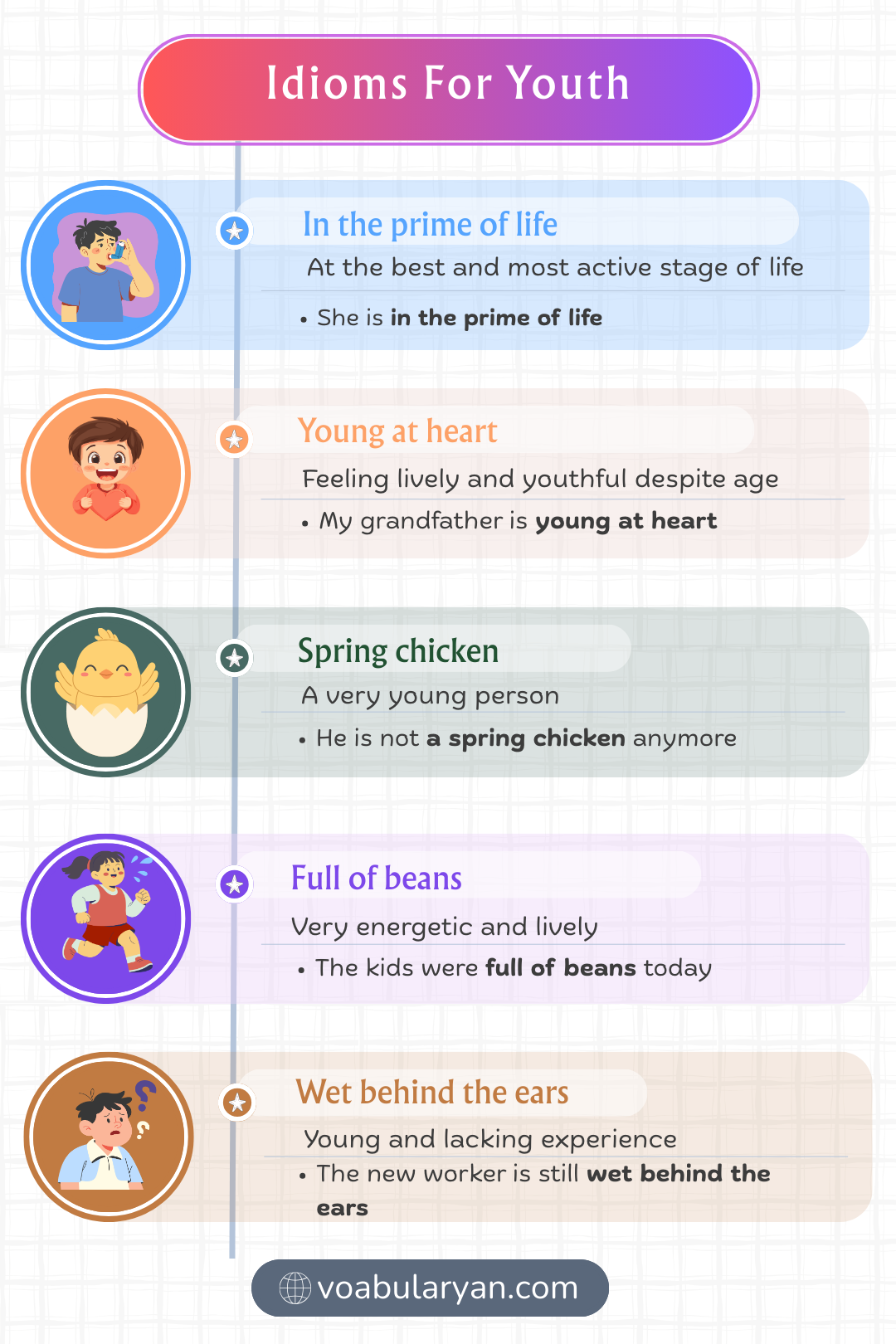
Youth Idioms For Inexperience And Being New
Wet Behind The Ears
Meaning: too new to a situation, with little experience.
When To Use It: say it about someone who is still learning a new role.
Collocations: still wet behind the ears, look wet behind the ears
Example Sentences:
- He is wet behind the ears, but he learns fast.
- She seemed wet behind the ears on her first day.
Dialogue:
Nadia: He looks wet behind the ears.
Faisal: Yes, he lacks experience yet.
Closest Alternatives:
- inexperienced
- green
Born Yesterday
Meaning: not easily fooled, despite what someone thinks.
When To Use It: say it when rejecting a trick or a weak excuse.
Collocations: I was not born yesterday, do you think I was born yesterday
Example Sentences:
- I was not born yesterday, so I checked the facts.
- She was not born yesterday, and she saw the lie.
Dialogue:
Areeba: He thinks I will believe him.
Daniyal: Tell him you were not born yesterday.
Closest Alternatives:
- not naive
- not easily tricked
New Kid On The Block
Meaning: a newcomer in a group, place, or activity.
When To Use It: say it when someone is new and still being noticed.
Collocations: the new kid on the block, feel like the new kid on the block
Example Sentences:
- I felt like the new kid on the block at the club.
- The team hired a new kid on the block last month.
Dialogue:
Mina: I am the new kid on the block here.
Saad: Do not worry, the group is very friendly.
Closest Alternatives:
- newcomer
- new face
Youth Idioms For Young People And Younger Generations
Whipper Snapper
Meaning: an energetic person seen as too bold and inexperienced.
When To Use It: say it about someone new who acts confident around older people.
Collocations: little whipper snapper, rude whipper snapper, cocky whipper snapper
Example Sentences:
- That whipper snapper challenged the coach in front of everyone.
- The boss called him a whipper snapper for talking back.
Dialogue:
Hassan: He called me a whipper snapper in the meeting.
Iqra: He thinks you lack experience, even if you are skilled.
Closest Alternatives:
- upstart
- smart aleck
Young Blood
Meaning: new people who bring fresh energy to a group.
When To Use It: say it when new members change the mood or pace.
Collocations: bring in young blood, hire young blood, need young blood
Example Sentences:
- The club brought in young blood to refresh the team.
- They hired young blood and the office felt more active.
Dialogue:
Amina: The manager wants young blood in the department.
Rayan: Yes, the team needs new energy and ideas.
Closest Alternatives:
- fresh faces
- newcomers
Youth Idioms For Growing Up And Reaching Adulthood
Coming Of Age
Meaning: reaching a point of maturity, often associated with growing up.
When To Use It: say it when someone transitions into adulthood or maturity.
Collocations: coming of age story, coming of age ceremony, coming of age for teenagers
Example Sentences:
- The film tells the Coming Of Age story of a young boy.
- Her Coming Of Age was marked by a special celebration.
Dialogue:
Sara: This movie shows a real Coming Of Age journey.
Ali: It captures the growth of a person well.
Closest Alternatives:
- reaching maturity
- growing up
Salad Days
Meaning: a time in life when someone is young and carefree.
When To Use It: say it when recalling the fun or innocence of youth.
Collocations: in your salad days, the salad days of youth
Example Sentences:
- He often reminisces about the Salad Days of his childhood.
- They enjoyed their Salad Days before responsibilities came.
Dialogue:
Maya: Those were the Salad Days we never forget.
Omar: Yes, carefree and joyful times.
Closest Alternatives:
- youth
- carefree days
Youth Idioms For Staying Youthful In Spirit
Young At Heart
Meaning: feeling youthful and energetic, no matter your age.
When To Use It: say it when someone maintains a lively, positive attitude despite getting older.
Collocations: remain young at heart, feel young at heart, stay young at heart
Example Sentences:
- Even in her 70s, she’s still Young At Heart.
- His energy and enthusiasm show he’s Young At Heart.
Dialogue:
Sana: My grandmother is always Young At Heart.
Tariq: That spirit makes her feel ageless.
Closest Alternatives:
- youthful spirit
- full of life
Spring Chicken
Meaning: someone who is young, often used humorously to refer to someone not as young anymore.
When To Use It: say it when talking about someone who is no longer young but might still act youthful.
Collocations: not a spring chicken, no longer a spring chicken, still a spring chicken
Example Sentences:
- She may not be a Spring Chicken anymore, but she’s still active.
- He’s not a Spring Chicken but still enjoys hiking.
Dialogue:
Mina: I’m not a Spring Chicken anymore, but I can keep up.
Imran: Age is just a number for you!
Closest Alternatives:
- no longer young
- getting older
Youth Idioms For Very Young Kids
Knee-High To A Grasshopper
Meaning: very young, still in early childhood.
When To Use It: say it when talking about someone as a child or remembering them as such.
Collocations: knee-high to a grasshopper once, was knee-high to a grasshopper
Example Sentences:
- He was knee-high to a grasshopper when we first met.
- I remember her knee-high to a grasshopper in the park.
Dialogue:
Sarah: Do you remember him from school?
Tom: Oh yes, he was knee-high to a grasshopper back then.
Closest Alternatives:
- very young
- just a child
Ankle Biter
Meaning: a small child, often used playfully.
When To Use It: say it when referring to small, energetic children.
Collocations: noisy ankle biter, cute little ankle biter
Example Sentences:
- The house was full of ankle biters during the party.
- He’s a real ankle biter, always running around.
Dialogue:
Liam: Who’s that running around?
Jasmine: That’s just the ankle biter from next door.
Closest Alternatives:
- little one
- small child
Little Devil
Meaning: a mischievous child who behaves badly or causes trouble.
When To Use It: say it playfully when talking about a child who is being naughty.
Collocations: little devil at home, that little devil
Example Sentences:
- That little devil broke the vase again.
- She is a little devil when she doesn’t get her way.
Dialogue:
Maya: Why did you do that?
Omar: Oh, it was just the little devil inside me!
Closest Alternatives:
- rascal
- troublemaker
Youth Idioms For Not Being Young Anymore
No Spring Chicken
Meaning: not as young as you once were, often humorously.
When To Use It: say it when referring to someone who is getting older.
Collocations: not a spring chicken anymore, no longer a spring chicken, not a spring chicken for years
Example Sentences:
- I’m No Spring Chicken, but I still enjoy running.
- She’s No Spring Chicken, but her energy is still contagious.
Dialogue:
Nadia: I may be No Spring Chicken, but I’m still active.
Usman: Age doesn’t stop you from being amazing.
Closest Alternatives:
- getting older
- not as young
Past Your Prime
Meaning: no longer at your best or most energetic, typically as you age.
When To Use It: say it when referring to someone or something that is not as youthful or successful as before.
Collocations: past your prime years, past your prime age, feel past your prime
Example Sentences:
- He’s Past His Prime, but still knows how to play.
- She might be Past Her Prime, but her wisdom is valuable.
Dialogue:
Zara: I feel like I’m Past My Prime.
Hassan: You’re not past your best yet, just evolving.
Closest Alternatives:
- no longer at your best
- past your peak
Youth Is Wasted On The Young
Meaning: young people often do not appreciate the value of youth until they grow older.
When To Use It: say it when reflecting on the regrets or missed opportunities of youth.
Collocations: youth is wasted on the young, wish youth wasn’t wasted on the young
Example Sentences:
- Youth Is Wasted On The Young, as they don’t appreciate it.
- I always think, Youth Is Wasted On The Young, when I look back.
Dialogue:
Mina: I didn’t appreciate my energy back then.
Tariq: Youth Is Wasted On The Young, we only realize it later.
Closest Alternatives:
- young and naive
- miss the value of youth
Key Takeaways
This topic brings together idioms that reflect on aging, youth, and the way we perceive time. Meaning depends on tone and situation, so a phrase can sound reflective, humorous, or slightly regretful in different moments. Many idioms keep stable wording and word order, so even small changes can make them sound awkward or unnatural. Across the examples, the language speaks to the feelings of getting older, the loss of youth, and the wisdom that comes with experience, all while fitting seamlessly into everyday conversation and simple writing.
FAQs
Q1. What does “a spring chicken” mean when talking about youth?
It means someone is not young anymore, often said in a light tone. Idioms for youth like this can describe an adult who feels older than before, especially after a tiring day.
Q2. What does “wet behind the ears” mean about a young person?
It means someone is new and lacks experience in a situation. Idioms for youth like this fit first jobs, first games, or first big tasks where learning is still happening.
Q3. What does “green as grass” mean when describing someone young?
It means someone is very inexperienced and easy to mislead. Idioms for youth like this can describe a beginner who believes promises too fast or misses warning signs.
Q4. What does “young at heart” mean, and is it only about age?
It means a person keeps a youthful spirit, even when older. Idioms for youth like this connect to playfulness, curiosity, and energy, such as joining games or laughing easily.
Q5. What does “puppy love” mean in youth and relationships?
It means a young, early romance that feels intense but may not last. Idioms for youth like this fit school crushes, shy notes, and quick feelings that change with time.
Q6. What does “fresh out of school” mean about a young adult?
It means someone has just finished school and is new to work life. Idioms for youth like this fit first interviews, first paychecks, and learning workplace rules.
You May Also Like