
You stand in front of others and begin to talk, hoping your words come out right. Saying “I want to speak” may be true, yet it does not always show the confidence or quiet nervousness behind that moment. Speaking can feel powerful, but also uncertain when many people are listening.
That is where idioms for speaking become useful in learning English. These expressions appear when people share ideas or express strong opinions. Some sound bold and direct, while others carry a softer tone.
We’ll look at how these phrases work in everyday sentences and short dialogue. You’ll sense when one fits a quick comment and when another suits a longer conversation. Here are the words people use when they speak their mind.
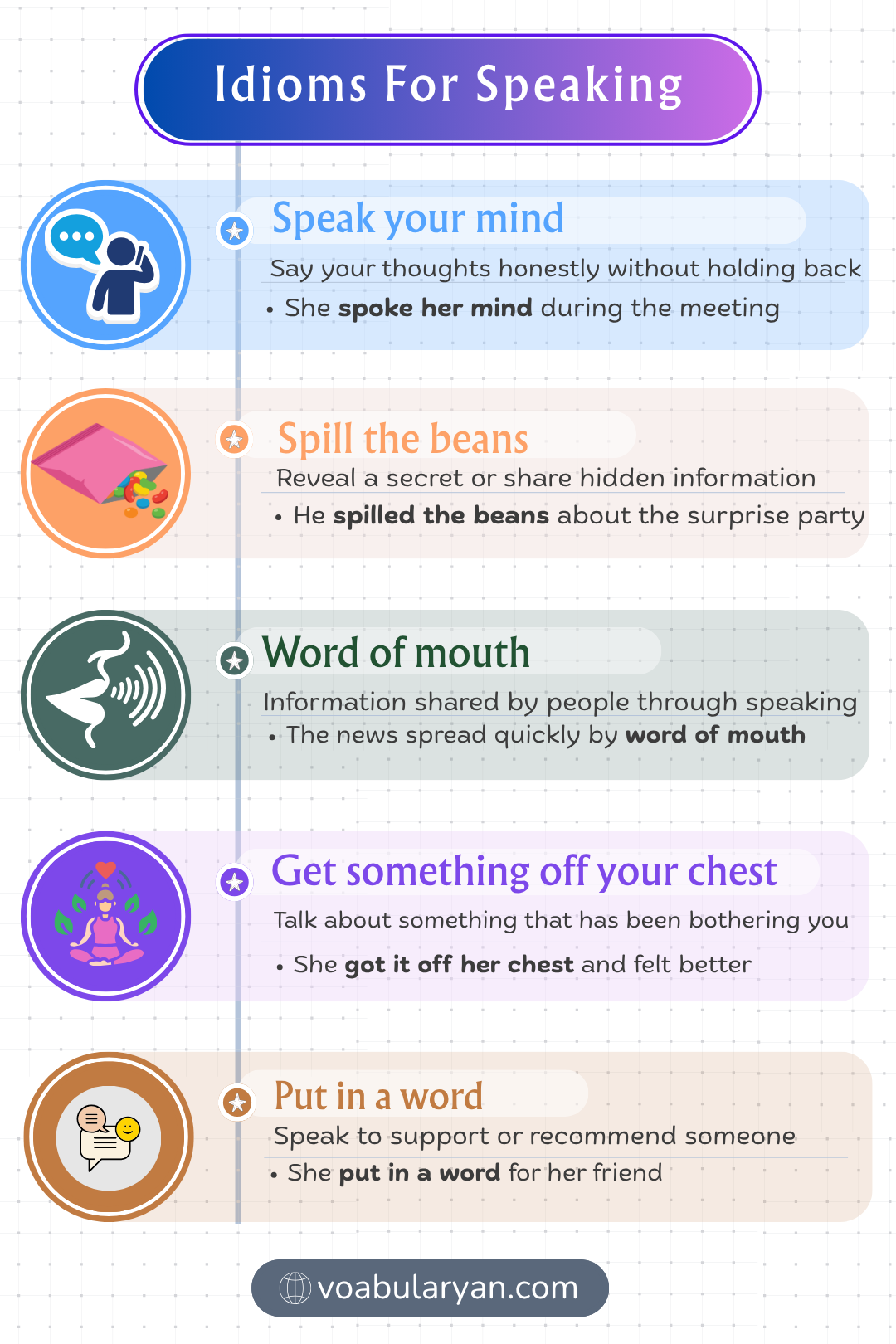
Speaking Idioms For Saying What You Really Think
Speak Your Mind
Meaning: To say your honest opinion without holding it back.
When To Use It: When sharing a view directly, even if it may upset someone.
Collocations: speak your mind about, speak your mind on, speak your mind to, free to speak your mind
Example Sentences:
- She spoke her mind about the plan during the final meeting.
- He spoke his mind and the room went quiet for a moment.
Dialogue:
Mina: Are you okay with the new schedule?
Omar: Not really, so I will speak my mind in the next call.
Closest Alternatives:
- be frank
- say what you think
Speak Your Piece
Meaning: To say what you want to say, then stop.
When To Use It: When someone shares their view once and feels finished.
Collocations: speak your piece and, speak your piece about, speak your piece to, let him speak his piece
Example Sentences:
- She spoke her piece and sat down without adding more.
- He asked to speak his piece before the final vote.
Dialogue:
Aisha: Why did you leave so quickly after you talked?
Daniel: I just wanted to speak my piece and move on.
Closest Alternatives:
- have your say
- say your part
Tell It Like It Is
Meaning: To speak in a direct way without softening the truth.
When To Use It: When someone chooses plain words instead of polite hints.
Collocations: tell it like it is to, tell it like it is about, just tell it like it is, someone who tells it like it is
Example Sentences:
- He told it like it is and pointed out the biggest problem.
- She prefers to tell it like it is rather than give false praise.
Dialogue:
Hassan: Do you think my idea will work?
Lily: I will tell it like it is, it needs more planning.
Closest Alternatives:
- be blunt
- be straight with someone
Call A Spade A Spade
Meaning: To describe something in plain words, even if it sounds harsh.
When To Use It: When naming a problem directly instead of using softer language.
Collocations: call a spade a spade and, call a spade a spade about, call a spade a spade here, let’s call a spade a spade
Example Sentences:
- Let us call a spade a spade, the plan failed because of poor timing.
- She called a spade a spade and named the behavior as rude.
Dialogue:
Noor: Everyone keeps avoiding the main issue.
Evan: Then let’s call a spade a spade and admit the budget is short.
Closest Alternatives:
- be honest
- say it plainly
Get Something Off Your Chest
Meaning: To share a worry or secret to feel relief.
When To Use It: When feelings build up and talking helps reduce the pressure.
Collocations: get it off your chest, get something off your chest about, need to get something off your chest, got it off my chest
Example Sentences:
- She needed to get something off her chest after the argument.
- He got it off his chest and felt calmer right away.
Dialogue:
Rania: You have been quiet all day.
Yusuf: I need to get something off my chest about yesterday’s meeting.
Closest Alternatives:
- confess
- open up
Speaking Idioms For Avoiding The Point
Beat Around The Bush
Meaning: Avoid the main point and talk indirectly.
When To Use It: When someone delays saying something direct, often due to fear or politeness.
Collocations: beat around the bush about, beat around the bush and, stop beating around the bush, keep beating around the bush
Example Sentences:
- He Beat Around The Bush about the price instead of giving a number.
- She kept Beat Around The Bush and never answered the question.
Dialogue:
Amina: Did he accept the offer or not?
Bilal: He Beat Around The Bush and changed the topic again.
Closest Alternatives:
- avoid the point
- not come straight out
Hem And Haw
Meaning: Speak with hesitation and delay a decision.
When To Use It: When someone is unsure and keeps pausing instead of answering.
Collocations: hem and haw about, hem and haw over, hem and haw for, keep hemming and hawing
Example Sentences:
- She Hem And Haw about the invitation and wasted ten minutes.
- He kept Hem And Haw and still did not choose a date.
Dialogue:
Nida: Are you coming with us or staying home?
Haris: I am Hem And Haw because I feel tired.
Closest Alternatives:
- hesitate
- be undecided
Talk In Circles
Meaning: Keep repeating ideas without reaching a point or decision.
When To Use It: When a conversation goes on but never moves forward.
Collocations: talk in circles about, talk in circles and, keep talking in circles, stop talking in circles
Example Sentences:
- We Talk In Circles about the budget and still made no plan.
- They kept Talk In Circles and avoided choosing one option.
Dialogue:
Sana: Did the meeting solve anything today?
Kamran: No, we Talk In Circles and ran out of time.
Closest Alternatives:
- go nowhere
- repeat the same points
Dance Around The Issue
Meaning: Avoid speaking directly about the real problem.
When To Use It: When the topic is sensitive and people speak indirectly.
Collocations: dance around the issue of, dance around the issue and, stop dancing around the issue, keep dancing around the issue
Example Sentences:
- He Dance Around The Issue of money and blamed the schedule instead.
- She kept Dance Around The Issue and never explained what went wrong.
Dialogue:
Mariam: Why are you not telling me the real reason?
Owais: I am sorry, I am Dance Around The Issue too much.
Closest Alternatives:
- avoid the real problem
- sidestep the question
Speaking Idioms For Talking Too Much
Talk A Blue Streak
Meaning: To talk very fast and for a long time.
When To Use It: When someone speaks nonstop, often with excitement or nerves.
Collocations: talk a blue streak about, talk a blue streak when, talk a blue streak all day
Example Sentences:
- He talked a blue streak about his trip the whole drive home.
- She talked a blue streak during the interview and forgot to pause.
Dialogue:
Amina: You seem full of energy today.
Omar: I know, I talked a blue streak and could not stop.
Closest Alternatives:
- talk nonstop
- chatter away
Talk The Hind Legs Off A Donkey
Meaning: To talk so much that it becomes tiring or funny.
When To Use It: When someone talks at length and others cannot get a turn.
Collocations: could talk the hind legs off a donkey, can talk the hind legs off a donkey
Example Sentences:
- My uncle can talk the hind legs off a donkey at any family dinner.
- She talked the hind legs off a donkey while we waited in line.
Dialogue:
Hina: Did you enjoy meeting her parents?
Zain: Yes, but her dad can talk the hind legs off a donkey.
Closest Alternatives:
- talk someone’s ear off
- talk endlessly
Run Off At The Mouth
Meaning: To speak too much, often without thinking.
When To Use It: When someone talks freely and says things they may regret.
Collocations: run off at the mouth about, run off at the mouth to, stop running off at the mouth
Example Sentences:
- He ran off at the mouth and revealed the surprise too soon.
- She runs off at the mouth when she feels nervous in crowds.
Dialogue:
Sara: Why is he upset with you now?
Ethan: I ran off at the mouth and said more than I should.
Closest Alternatives:
- talk carelessly
- speak without thinking
Shoot Your Mouth Off
Meaning: To say something rude or careless without control.
When To Use It: When someone speaks sharply and creates trouble by it.
Collocations: shoot your mouth off about, shoot your mouth off to, shot his mouth off, stop shooting your mouth off
Example Sentences:
- He shot his mouth off in the meeting and offended the client.
- She shot her mouth off online and later apologized.
Dialogue:
Noor: Why did the manager call you in?
Evan: I shot my mouth off and sounded rude.
Closest Alternatives:
- speak out of turn
- blurt things out
Go On And On
Meaning: To continue talking for too long without stopping.
When To Use It: When someone keeps speaking and others lose patience.
Collocations: go on and on about, go on and on for hours, keep going on and on
Example Sentences:
- He went on and on about the problem without offering a fix.
- She went on and on until everyone checked the time.
Dialogue:
Maya: Did the meeting finish on time?
Kamal: No, the speaker went on and on, and people looked bored.
Closest Alternatives:
- ramble
- keep talking
Speaking Idioms For Gossip And Rumors
Spill The Tea
Meaning: Share private gossip or secrets, often in an excited way.
When To Use It: When someone reveals hidden details about people, events, or drama.
Collocations: spill the tea about, spill the tea on, spill the tea with, spill the tea to
Example Sentences:
- She leaned in and Spill The Tea about the surprise engagement.
- At lunch, he Spill The Tea on why the manager resigned.
Dialogue:
Naila: Everyone looks nervous, what happened in the office?
Zoya: I will Spill The Tea later, it is a long story.
Closest Alternatives:
- gossip
- tell secrets
Heard It Through The Grapevine
Meaning: Learned news from informal talk, not from an official source.
When To Use It: When information comes from friends, rumors, or casual conversation.
Collocations: heard it through the grapevine that, heard it through the grapevine about, heard it through the grapevine from, hear it through the grapevine
Example Sentences:
- I Heard It Through The Grapevine that the shop is closing next week.
- She Heard It Through The Grapevine about the promotion before the email.
Dialogue:
Hassan: How did you know they are moving to a new house?
Mina: I Heard It Through The Grapevine from my cousin.
Closest Alternatives:
- heard a rumor
- word got around
Dish The Dirt
Meaning: Reveal unpleasant secrets about someone, often to harm their image.
When To Use It: When people share negative details about another person’s actions.
Collocations: dish the dirt on, dish the dirt about, dish the dirt to, dish the dirt with
Example Sentences:
- He tried to Dish The Dirt on his teammate after the loss.
- She refused to Dish The Dirt about her old boss.
Dialogue:
Rimsha: Why is everyone angry with him today?
Bilal: Someone Dish The Dirt on him during the meeting.
Closest Alternatives:
- expose secrets
- spread rumors
Tongues Are Wagging
Meaning: People are talking a lot, usually with gossip or judgment.
When To Use It: When news spreads and many people discuss it loudly.
Collocations: tongues are wagging about, tongues are wagging over, set tongues wagging, keep tongues wagging
Example Sentences:
- After the surprise wedding, Tongues Are Wagging all over the neighborhood.
- One photo made Tongues Are Wagging about their relationship.
Dialogue:
Ayesha: Why are coworkers whispering near the door?
Omar: Tongues Are Wagging since the new manager arrived.
Closest Alternatives:
- people are talking
- rumors are spreading
Speaking Idioms For Interrupting And Talking Over Others
Cut Someone Off
Meaning: To stop a person before they finish speaking.
When To Use It: When someone interrupts and the other person cannot complete a point.
Collocations: cut someone off mid sentence, cut someone off during, cut someone off before, cut someone off politely
Example Sentences:
- She cut him off before he could explain the mistake.
- The host cut her off when the show time ended.
Dialogue:
Adeel: I tried to answer, but he cut me off.
Mina: That is rude, and it makes talks harder.
Closest Alternatives:
- interrupt
- stop someone mid sentence
Get A Word In Edgewise
Meaning: To manage to speak a little in a busy conversation.
When To Use It: When others talk so much that speaking becomes difficult.
Collocations: can’t get a word in edgewise, barely get a word in edgewise, get a word in edgewise with, trying to get a word in edgewise
Example Sentences:
- I could not get a word in edgewise during the heated debate.
- She tried to get a word in edgewise, but they kept talking.
Dialogue:
Hassan: That meeting was exhausting.
Sara: Same, I could not get a word in edgewise at all.
Closest Alternatives:
- hardly speak
- can’t get a chance to speak
Talk Down To
Meaning: To speak as if the other person is less capable.
When To Use It: When someone uses a disrespectful tone or over simple language.
Collocations: talk down to someone, talk down to me, talk down to her, stop talking down to
Example Sentences:
- He talked down to her and she stopped responding.
- The clerk talked down to me as if I did not understand basics.
Dialogue:
Noor: Why did you leave the discussion early?
Evan: He kept talking down to me, and it felt insulting.
Closest Alternatives:
- patronize
- speak condescendingly
Speaking Idioms For Anger And Confrontation
Give Someone A Piece Of Your Mind
Meaning: Speak angrily and state strong feelings about bad behavior.
When To Use It: When someone has crossed a line and a firm response follows.
Collocations: give him a piece of your mind, give her a piece of your mind, give them a piece of your mind, gave me a piece of his mind
Example Sentences:
- She Give Someone A Piece Of Your Mind after the rude comment in class.
- He decided to Give Someone A Piece Of Your Mind about the broken promise.
Dialogue:
Hana: I told him the truth, and I did not hold back.
Omar: Sounds like you Give Someone A Piece Of Your Mind for sure.
Closest Alternatives:
- tell someone off
- speak your mind
Have A Bone To Pick
Meaning: Have a complaint to discuss about something that felt unfair.
When To Use It: When someone wants to bring up an issue that still bothers them.
Collocations: have a bone to pick with, had a bone to pick with, got a bone to pick with, I have a bone to pick
Example Sentences:
- I Have A Bone To Pick with him about the missing group credit.
- She Have A Bone To Pick with the clerk over the wrong bill.
Dialogue:
Sara: Can we talk about what happened at the meeting?
Bilal: Yes, I Have A Bone To Pick with you about that decision.
Closest Alternatives:
- have a complaint
- take issue with
Give Someone An Earful
Meaning: Speak for a long time in anger about a mistake.
When To Use It: When someone is upset and talks sharply without holding back.
Collocations: give him an earful, give her an earful, gave them an earful, got an earful
Example Sentences:
- The coach Give Someone An Earful after the team ignored the plan.
- She Give Someone An Earful when the package arrived a week late.
Dialogue:
Nadia: Why does he look so quiet after the call?
Rayan: His boss Give Someone An Earful about the late report.
Closest Alternatives:
- scold someone
- give someone a hard time
Speaking Idioms For Saying The Wrong Thing
Put Your Foot In Your Mouth
Meaning: Say something that causes embarrassment or hurts someone’s feelings.
When To Use It: When a comment comes out wrong and creates an awkward moment.
Collocations: put your foot in your mouth and, put your foot in your mouth again, really put your foot in your mouth, put my foot in my mouth
Example Sentences:
- I put my foot in my mouth by asking about her job loss.
- He put his foot in his mouth and everyone went quiet.
Dialogue:
Nadia: I joked about his haircut, and he looked hurt.
Omar: You put your foot in your mouth, so say sorry soon.
Closest Alternatives:
- say the wrong thing
- make an awkward comment
Slip Of The Tongue
Meaning: A small speaking mistake that happens by accident.
When To Use It: When someone says the wrong word or reveals something unintentionally.
Collocations: a slip of the tongue, just a slip of the tongue, sorry slip of the tongue, slip of the tongue moment
Example Sentences:
- She said the wrong name, but it was a slip of the tongue.
- I called it Tuesday, a slip of the tongue, since it was Wednesday.
Dialogue:
Hassan: Did you mean to say the date out loud?
Leah: No, it was a slip of the tongue.
Closest Alternatives:
- verbal mistake
- misspeak
Speak Out Of Turn
Meaning: Say something at an improper time or in the wrong setting.
When To Use It: When a comment breaks a rule of order or respect.
Collocations: speak out of turn in, speak out of turn at, sorry to speak out of turn, spoke out of turn
Example Sentences:
- I spoke out of turn and answered before the leader finished.
- He apologized because he had spoken out of turn in the meeting.
Dialogue:
Ayesha: I corrected her in front of everyone.
Bilal: That might be speaking out of turn, even if you were right.
Closest Alternatives:
- speak at the wrong time
- overstep
Put Words In Someone’s Mouth
Meaning: Say someone believes something they did not actually say.
When To Use It: When a person feels misquoted or their meaning is twisted.
Collocations: put words in my mouth, put words in her mouth, put words in his mouth, stop putting words in someone’s mouth
Example Sentences:
- Do not put words in my mouth; I never blamed you.
- She felt angry when they put words in her mouth on the call.
Dialogue:
Rafael: You said the plan was pointless.
Noor: I did not; you are putting words in my mouth.
Closest Alternatives:
- misquote someone
- twist someone’s meaning
Speaking Idioms For Silence And Holding Back
Bite Your Tongue
Meaning: Stop yourself from speaking, even when you want to.
When To Use It: When speaking could cause trouble, hurt feelings, or make things worse.
Collocations: bite your tongue and, bite your tongue before, bite your tongue when, had to bite my tongue
Example Sentences:
- I had to Bite Your Tongue when he blamed me for his mistake.
- She Bite Your Tongue during the talk and waited until later.
Dialogue:
Hina: Why did you not answer his rude comment?
Danish: I chose to Bite Your Tongue to keep the peace.
Closest Alternatives:
- hold back
- keep quiet
Hold Your Tongue
Meaning: Stay silent and not say what you are thinking.
When To Use It: When it is safer or kinder to avoid speaking right now.
Collocations: hold your tongue and, hold your tongue when, told him to hold his tongue, tried to hold my tongue
Example Sentences:
- He Hold Your Tongue during the argument and listened instead.
- She told me to Hold Your Tongue until the guests left.
Dialogue:
Amina: Should I tell him he is wrong in front of everyone?
Bilal: Better Hold Your Tongue for now and talk later.
Closest Alternatives:
- keep quiet
- say nothing
Mum’s The Word
Meaning: Keep it secret and do not tell anyone.
When To Use It: When information must stay private, like a surprise or plan.
Collocations: mum’s the word, remember mum’s the word, keep it quiet mum’s the word, mum’s the word about
Example Sentences:
- The party is a surprise, so Mum’s The Word until Saturday.
- He nodded and said Mum’s The Word about the new job.
Dialogue:
Sara: Can you promise you will not tell your sister?
Usman: Yes, Mum’s The Word, I will stay silent.
Closest Alternatives:
- keep it under wraps
- don’t tell a soul
Cat Got Your Tongue
Meaning: Unable to speak, often from surprise or nervousness.
When To Use It: When someone suddenly goes silent after a question or shock.
Collocations: what’s the matter cat got your tongue, cat got your tongue or something, look like the cat got your tongue
Example Sentences:
- He just stared, like Cat Got Your Tongue, when the teacher asked him.
- She went Cat Got Your Tongue after the unexpected question.
Dialogue:
Nora: You were talking a lot earlier, now nothing.
Jamal: Yeah, Cat Got Your Tongue when I saw my old coach.
Closest Alternatives:
- speechless
- lost for words
Speaking Idioms For Listening Well
Lend An Ear
Meaning: To listen kindly to someone who wants to talk.
When To Use It: When a person needs attention, comfort, or a patient listener.
Collocations: lend an ear to, lend an ear for, lend a sympathetic ear, always lend an ear
Example Sentences:
- She lent an ear when I felt worried about my test.
- He lends an ear to friends and stays patient.
Dialogue:
Mina: Can I talk for a minute about my day?
Omar: Of course, I can lend an ear.
Closest Alternatives:
- listen
- hear someone out
Be All Ears
Meaning: Ready to listen closely with full attention.
When To Use It: When someone is eager to hear news, ideas, or details.
Collocations: be all ears for, be all ears about, I’m all ears, we’re all ears
Example Sentences:
- Tell me the plan, I’m all ears.
- When she mentioned a surprise, he was all ears and curious.
Dialogue:
Aisha: I have an update about the trip dates.
Daniel: Great, I’m all ears.
Closest Alternatives:
- listening closely
- ready to listen
Key Takeaways
Idioms for speaking includes common lines about sharing opinions, talking too much, interrupting, and choosing the right moment to talk. Context shapes the tone, since some phrases sound confident while others sound rude or careless. Many idioms keep stable wording and word order, so small changes can weaken the meaning. We keep examples broad, because the same phrase can fit a chat, a meeting, or a short note. Overall, the focus stays on honest speech and tone control across different situations.
FAQs
Q1. What do people mean by “speak your mind”?
It means saying what is honestly believed, even if it feels risky. In idioms for speaking, it often fits serious moments where the truth matters more than comfort.
Q2. What does “beat around the bush” mean in a conversation?
It means avoiding the main point and talking in a roundabout way. In idioms for speaking, it often appears when someone feels nervous, polite, or unsure.
Q3. What does “get something off your chest” mean?
It means sharing a worry or truth that has been held inside. In idioms for speaking, it often connects with relief after finally saying what has been bothering someone.
Q4. What does “spill the beans” mean, and is it rude?
It means revealing a secret, often too soon. In idioms for speaking, it can sound playful or serious, depending on whether the secret was harmless or important.
Q5. What does “call a spade a spade” mean in plain talk?
It means speaking in a direct way and naming something as it is. In idioms for speaking, it often fits blunt honesty, especially when others are avoiding the truth.
Q6. What does “talk in circles” mean when someone explains something?
It means talking a lot without reaching a clear point or decision. In idioms for speaking, it often describes confusion, avoidance, or a discussion that goes nowhere.
You May Also Like
