
You remember a teacher who believed in you when you doubted yourself. Saying “She was a great teacher” feels true, yet it barely captures her guidance and lasting impact. Some roles shape us quietly, and plain words often feel too small for that influence.
That is where idioms for teachers come in. These expressions help you speak about respect and steady mentorship in a more natural way. Some sound warm and thankful, while others show deep admiration.
We’ll walk through each one with short examples and everyday conversation. You’ll sense which phrase fits a simple thank you and which suits heartfelt gratitude. Here are the words that honor teachers in a stronger way.
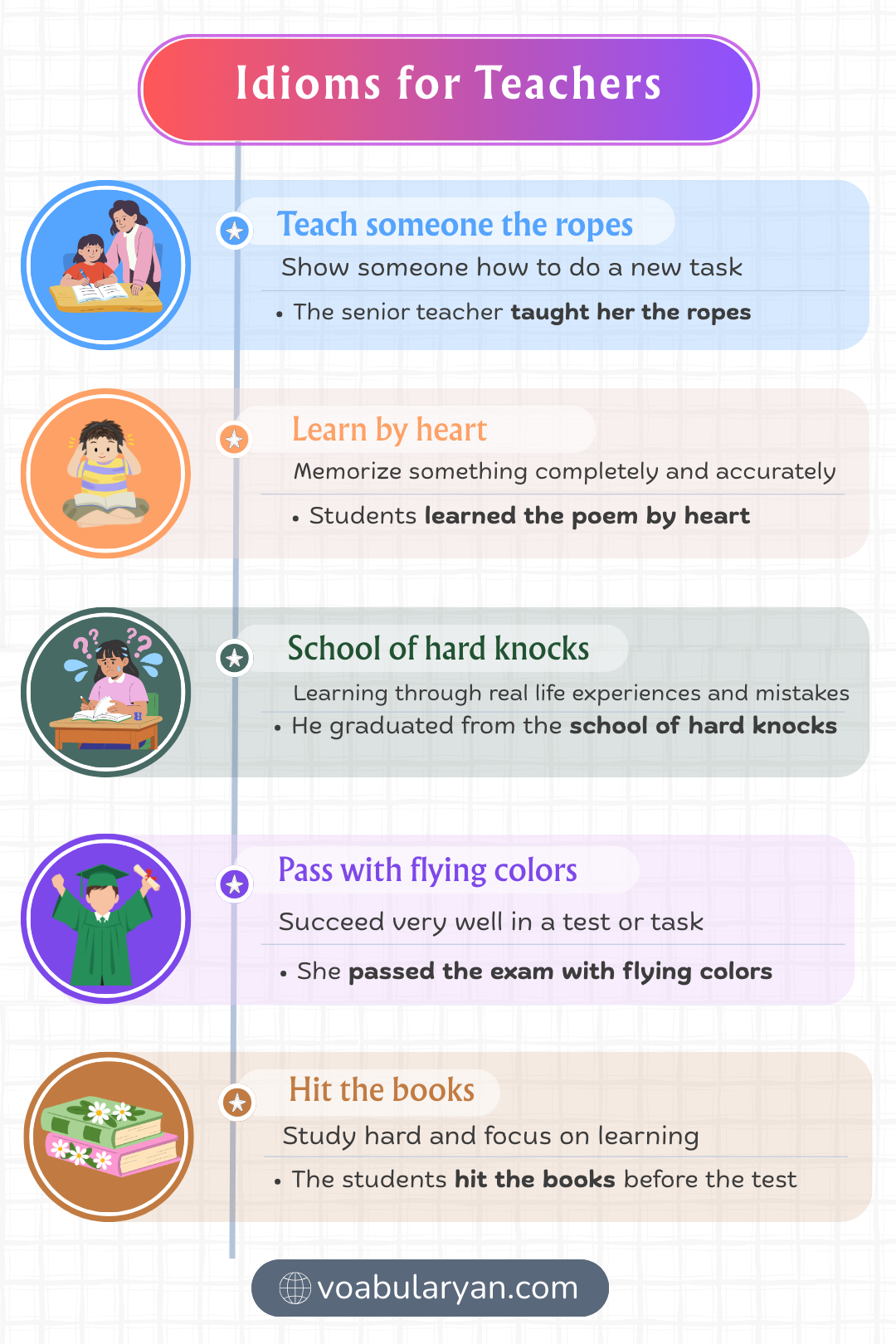
Idioms Teachers Use For Encouraging And Motivating Students
Go The Extra Mile
Meaning: to do more than what is expected.
When To Use It: use it when someone gives extra effort to help or succeed.
Collocations: go the extra mile for a customer, go the extra mile at work, go the extra mile to help
Example Sentences:
- She went the extra mile and fixed the issue before the deadline.
- He goes the extra mile for his team.
Dialogue:
Hira: The client sounded worried.
Sameer: Let us go the extra mile and add extra care.
Closest Alternatives:
- do more than required
- make an extra effort
Pass With Flying Colours
Meaning: to succeed very well, often with high results.
When To Use It: use it when someone does far better than the basic level.
Collocations: pass with flying colours in an exam, pass with flying colours at interview
Example Sentences:
- She passed with flying colours and topped the class.
- He passed with flying colours in the final round.
Dialogue:
Anaya: I was nervous about the test.
Rohan: You passed with flying colours, that is excellent.
Closest Alternatives:
- do very well
- ace it
Burn The Midnight Oil
Meaning: to work late into the night.
When To Use It: use it when someone studies or works past bedtime.
Collocations: burn the midnight oil for exams, burn the midnight oil on a project, burn the midnight oil tonight
Example Sentences:
- He burned the midnight oil to finish the report.
- She burned the midnight oil before the final exam.
Dialogue:
Mehak: You were awake so late yesterday.
Zeeshan: I burned the midnight oil to meet the deadline.
Closest Alternatives:
- stay up late working
- work late
Sink Your Teeth Into
Meaning: to start something eagerly and focus deeply on it.
When To Use It: use it when someone begins a task with strong interest.
Collocations: sink your teeth into a project, sink your teeth into a book, sink your teeth into a new role
Example Sentences:
- She sank her teeth into the new project right away.
- I cannot wait to sink my teeth into this mystery novel.
Dialogue:
Ammar: The assignment looks big.
Sara: Yes, let us sink our teeth into the hard parts first.
Closest Alternatives:
- dive into
- get stuck into
On The Ball
Meaning: alert, prepared, and quick to understand.
When To Use It: use it when someone reacts fast and stays organized.
Collocations: stay on the ball, be on the ball today, keep on the ball at work
Example Sentences:
- She is always on the ball during meetings.
- He stayed on the ball and spotted the mistake early.
Dialogue:
Nimra: How did you notice that so fast.
Talha: I try to stay on the ball and watch the details.
Closest Alternatives:
- sharp
- quick-thinking
Keep Someone On Their Toes
Meaning: to make someone stay alert and ready to react.
When To Use It: use it when a person or situation forces constant attention.
Collocations: keep someone on their toes at work, keep someone on their toes in training, keep someone on their toes with questions
Example Sentences:
- Her questions kept everyone on their toes.
- The fast changes kept him on his toes all week.
Dialogue:
Eman: This job never feels quiet.
Haseeb: True, it keeps us on our toes with constant changes.
Closest Alternatives:
- keep alert
- stay ready
Idioms Teachers Use To Describe Teaching And Learning Situations
Learn The Ropes
Meaning: Learn the basic skills and rules of a new task.
When To Use It: Say it when someone is new and still learning how things work.
Collocations: learn the ropes quickly, learn the ropes at work, help someone learn the ropes
Example Sentences:
- In my first week, I worked to learn the ropes.
- She learned the ropes by watching the team closely.
Dialogue:
Hassan: I am trying to learn the ropes here.
Amina: It takes time to gain confidence.
Closest Alternatives:
- get the hang of it
- learn the basics
Make The Grade
Meaning: Meet the required level or standard.
When To Use It: Say it when judging if something is good enough.
Collocations: make the grade in class, make the grade for the role, make the grade this time
Example Sentences:
- His work did not make the grade this week.
- She studied hard and made the grade.
Dialogue:
Sara: Do you think I will make the grade?
Owais: Your effort looks strong.
Closest Alternatives:
- pass
- meet the standard
Get The Picture
Meaning: Understand the main idea or situation.
When To Use It: Say it when someone finally understands what is happening.
Collocations: get the picture now, get the picture of the problem, help someone get the picture
Example Sentences:
- After the explanation, I got the picture.
- He did not get the picture at first.
Dialogue:
Noor: I think I get the picture now.
Hamid: Good, the idea is simple.
Closest Alternatives:
- understand
- see what it means
Idioms Teachers Use For Classroom Interaction And Engagement
Break The Ice
Meaning: to make people feel more relaxed at the start.
When To Use It: When To Use It: say it when a first meeting feels tense or quiet.
Collocations: break the ice with a joke, break the ice at a party, break the ice in a meeting
Example Sentences:
- The host Break The Ice with a light question for everyone.
- I told a quick story to Break The Ice at dinner.
Dialogue:
Nadia: The room feels quiet, honestly.
Omar: A small joke can Break The Ice fast.
Closest Alternatives:
- start things off
- ease the tension
Two Heads Are Better Than One
Meaning: two people can think better than one person alone.
When To Use It: When To Use It: say it when help makes a problem easier to solve.
Collocations: two heads are better than one for planning, two heads are better than one for solving problems
Example Sentences:
- Let’s solve it together, Two Heads Are Better Than One.
- She asked me to check it because Two Heads Are Better Than One.
Dialogue:
Areeba: I keep missing something in this plan.
Hamza: Let me look too, Two Heads Are Better Than One.
Closest Alternatives:
- think together
- get a second opinion
Cut Some Slack
Meaning: to be less strict and show more patience.
When To Use It: When To Use It: say it when someone deserves understanding after a mistake.
Collocations: cut some slack at work, cut some slack for a friend, cut some slack this time
Example Sentences:
- He made one mistake, so Cut Some Slack and move on.
- After her long week, they Cut Some Slack and stayed calm.
Dialogue:
Bilal: He missed the deadline again.
Sana: Today, Cut Some Slack, he looks worn out.
Closest Alternatives:
- be lenient
- give some leeway
Hold Your Horses
Meaning: to wait and not act too quickly.
When To Use It: When To Use It: say it when someone rushes into a decision or action.
Collocations: hold your horses a second, hold your horses before buying, hold your horses on that plan
Example Sentences:
- Hold Your Horses and read the message before replying.
- Hold Your Horses until we hear the full story.
Dialogue:
Mina: I am ready to send the complaint right now.
Shayan: Hold Your Horses, let’s check the facts first.
Closest Alternatives:
- wait a moment
- slow down
Idioms Teachers Use For Overcoming Challenges And Pressure
In The Hot Seat
Meaning: Being under pressure and facing tough questions or judgment.
When To Use It: Say it when someone must answer for a problem or decision.
Collocations: be in the hot seat, put someone in the hot seat, feel in the hot seat
Example Sentences:
- During the meeting, I was in the hot seat for the mistake.
- She felt in the hot seat when everyone looked at her.
Dialogue:
Maha: I am in the hot seat right now.
Saif: Stay calm and give facts.
Closest Alternatives:
- under pressure
- on the spot
In Over Your Head
Meaning: Facing something too hard to handle alone.
When To Use It: Say it when a task feels beyond skill or experience.
Collocations: be in over your head, get in over your head, feel in over your head
Example Sentences:
- He was in over your head with that role.
- I felt in over your head once the project grew.
Dialogue:
Hiba: I think I am in over your head.
Shayan: That sounds like too much responsibility.
Closest Alternatives:
- out of depth
- overwhelmed
Open A Can Of Worms
Meaning: Start a problem that brings many more problems.
When To Use It: Say it when one action creates messy issues.
Collocations: open a can of worms by asking, open a can of worms in a meeting, do not open a can of worms
Example Sentences:
- That question opened a can of worms for the whole team.
- She opened a can of worms by bringing up old arguments.
Dialogue:
Areej: That topic opened a can of worms.
Faris: Yes, it caused many issues.
Closest Alternatives:
- create trouble
- start a chain of problems
Back To The Drawing Board
Meaning: Start again because the plan did not work.
When To Use It: Say it when a first attempt fails.
Collocations: go back to the drawing board, back to the drawing board on the plan
Example Sentences:
- The test failed, so it is back to the drawing board.
- We went back to the drawing board after the rejection.
Dialogue:
Zainab: It is back to the drawing board.
Umar: Then we need a new plan.
Closest Alternatives:
- start over
- rethink the plan
Fish Out Of Water
Meaning: Feeling uncomfortable in a new place or role.
When To Use It: Say it when someone does not fit in.
Collocations: feel like a fish out of water, look like a fish out of water
Example Sentences:
- I felt like a fish out of water at the new school.
- He looked like a fish out of water at the formal event.
Dialogue:
Sana: I feel like a fish out of water here.
Bilal: New settings can feel strange.
Closest Alternatives:
- feel out of place
- not fit in
Call The Shots
Meaning: Make the important decisions and control actions.
When To Use It: Say it when someone is in charge.
Collocations: call the shots at work, call the shots in the group, let someone call the shots
Example Sentences:
- She calls the shots on final choices.
- He wants to call the shots in every meeting.
Dialogue:
Rida: Who calls the shots today?
Adnan: The manager has the final say.
Closest Alternatives:
- be in charge
- make the decisions
Idioms Teachers Use For Wasting Time Or Delaying Progress
Beat Around The Bush
Meaning: to avoid saying the main point in a direct way.
When To Use It: use it when someone speaks indirectly to delay a clear answer.
Collocations: beat around the bush about money, beat around the bush in a meeting, stop beating around the bush
Example Sentences:
- He kept beat around the bush and never answered the question.
- She beat around the bush before admitting the mistake.
Dialogue:
Sadia: Are you saying yes or no.
Kashif: Sorry, I am beat around the bush because I feel nervous.
Closest Alternatives:
- avoid the point
- speak indirectly
Twiddle Your Thumbs
Meaning: to do nothing while waiting, often from boredom.
When To Use It: use it when someone has no work and is just waiting.
Collocations: twiddle your thumbs all day, sit and twiddle your thumbs, left to twiddle your thumbs
Example Sentences:
- I cannot twiddle your thumbs while the team works.
- He twiddled his thumbs in the lobby for an hour.
Dialogue:
Amina: We are waiting again.
Rafay: Yes, I am just twiddling my thumbs and feeling bored.
Closest Alternatives:
- do nothing
- wait around
Take Your Sweet Time
Meaning: to do something very slowly, without hurry.
When To Use It: use it when someone moves slowly and others feel impatient.
Collocations: take your sweet time getting ready, take your sweet time replying, take your sweet time coming back
Example Sentences:
- He took his sweet time getting dressed.
- The reply came late because they took their sweet time.
Dialogue:
Mariam: The guests are already here.
Zain: He is taking his sweet time in the shower.
Closest Alternatives:
- take a long time
- move slowly
Drag Your Feet
Meaning: to delay doing something, often on purpose.
When To Use It: use it when someone avoids action or refuses to move forward.
Collocations: drag your feet on a decision, drag your feet about paperwork, drag your feet for weeks
Example Sentences:
- They dragged their feet on signing the deal.
- She dragged her feet about the apology.
Dialogue:
Hassan: Why is this still not done.
Noor: They are dragging their feet and wasting time.
Closest Alternatives:
- delay
- stall
Idioms Teachers Use For Communication And Expression
Get The Picture
Meaning: Understand the main idea or situation.
When To Use It: Say it when someone finally understands what is happening.
Collocations: get the picture now, get the picture of the problem, help someone get the picture
Example Sentences:
- After the explanation, I got the picture.
- He did not get the picture at first.
Dialogue:
Noor: I think I get the picture now.
Hamid: Good, the idea is simple.
Closest Alternatives:
- understand
- see what it means
Make A Mountain Out Of A Molehill
Meaning: Treat a small problem as if it is very big.
When To Use It: Say it when someone overreacts to a minor issue.
Collocations: make a mountain out of a molehill over a comment, do not make a mountain out of a molehill
Example Sentences:
- He made a mountain out of a molehill about a small delay.
- She made a mountain out of a molehill after one mistake.
Dialogue:
Aisha: I think I made a mountain out of a molehill.
Hamza: Yes, it was a small issue.
Closest Alternatives:
- overreact
- blow it out of proportion
Put A Square Peg In A Round Hole
Meaning: Force someone or something into the wrong role or place.
When To Use It: Say it when a fit is clearly poor.
Collocations: put a square peg in a round hole at work, feel like a square peg in a round hole
Example Sentences:
- Giving him that role is putting a square peg in a round hole.
- She felt they were putting a square peg in a round hole.
Dialogue:
Sana: This feels like putting a square peg in a round hole.
Bilal: Yes, the match is not right.
Closest Alternatives:
- wrong fit
- mismatch
Barking Up The Wrong Tree
Meaning: Blaming or searching in the wrong direction.
When To Use It: Say it when someone thinks the wrong person caused a problem.
Collocations: barking up the wrong tree about the cause, barking up the wrong tree with that idea
Example Sentences:
- If you blame her, you are barking up the wrong tree.
- They were barking up the wrong tree about who leaked it.
Dialogue:
Maha: I think you are barking up the wrong tree.
Saif: Then my guess is wrong.
Closest Alternatives:
- mistaken
- on the wrong track
Key Takeaways
Idioms for teachers cover classroom routines, effort, patience, and student progress in everyday school talk. Meaning often shifts with tone and situation, so the same phrase can sound warm, firm, or playful depending on context. Many keep stable wording and word order, so small changes can sound unnatural in speech or writing. Examples highlight common school moments without repeating each meaning. We include a wide range so the language fits different teaching situations, from quick reminders to longer notes, while keeping the focus on natural phrasing and accurate intent.
FAQs
Q1. What does “chalk and talk” mean in idioms for the teachers?
It means a traditional class style where the teacher talks and writes on a board. In idioms for the teachers, it points to a lecture style lesson, not group work.
Q2. What does “school of hard knocks” mean in idioms for the teachers?
It means learning through tough life experiences rather than formal lessons. In idioms for the teachers, it often contrasts book learning with lessons gained from real situations.
Q3. What does it mean to “pass with flying colors” in idioms for the teachers?
It means doing very well and succeeding easily, often in a test or exam. In idioms for the teachers, it describes a strong result, not a narrow pass.
Q4. What does “hit the books” mean in idioms for the teachers?
It means studying hard for an exam or task. In idioms for the teachers, it points to focused study time, usually before a big test or deadline.
Q5. What does “go the extra mile” mean in idioms for the teachers?
It means making more effort than is required. In idioms for the teachers, it often describes a teacher doing more to help a class succeed.
Q6. What does “put your thinking cap on” mean in idioms for the teachers?
It means thinking carefully and focusing on a problem. In idioms for the teachers, it is a common classroom phrase for serious thinking before answering.
You May Also Like
