
You stand at the shore, watching waves rise and fall, and say, “The ocean is huge.” The words are true, yet they barely capture its vast depth and restless power. The ocean can feel calm one moment and overwhelming the next.
That is where idioms for the ocean become useful in learning English. These expressions appear when people talk about strong emotion or a sense of endless choice. Some sound peaceful and reflective, while others suggest intensity or uncertainty.
We’ll look at how these phrases work in sentences and short dialogue. You’ll sense when one fits a quiet moment and when another suits a surge of feeling. Here are the words shaped by the image of the ocean.
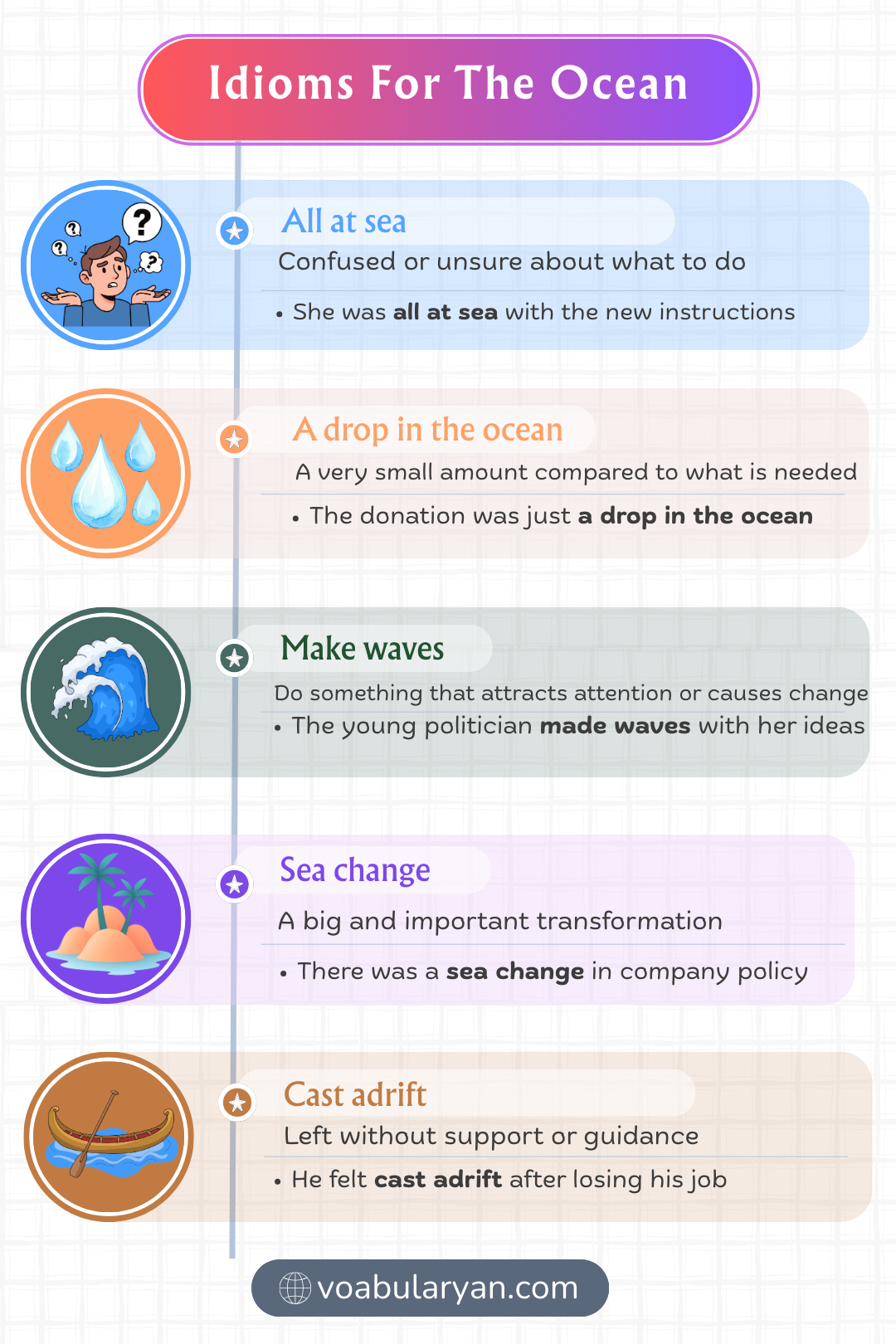
Ocean Idioms for Challenges and Difficulties
Weather the Storm
Meaning: to endure a difficult or challenging situation.
When To Use It: use it when someone faces hardship or adversity and successfully overcomes it.
Collocations: weather the storm of life, weather the storm at work
Example Sentences:
- Despite the financial crisis, the company managed to weather the storm.
- She was able to weather the storm after the unexpected loss.
Dialogue:
Ben: How are you holding up?
Grace: I’m weathering the storm. It’s tough, but I’ll manage.
Closest Alternatives:
- endure hardship
- overcome adversity
Lost at Sea
Meaning: to be in a confusing or uncertain situation with no clear direction.
When To Use It: use it when someone feels disoriented or unable to find a solution.
Collocations: feel lost at sea in life, lost at sea during the project
Example Sentences:
- After the sudden change in plans, I felt completely lost at sea.
- She was lost at sea trying to navigate through the new software.
Dialogue:
Tom: I have no idea what to do next, I feel lost at sea.
Laura: It’s okay, we’ll figure it out together.
Closest Alternatives:
- confused
- unsure
Navigating Troubled Waters
Meaning: to manage or deal with a difficult or delicate situation.
When To Use It: use it when someone is trying to handle a challenging or risky situation.
Collocations: navigating troubled waters at work, navigating troubled waters in a relationship
Example Sentences:
- The manager is navigating troubled waters with the new policy changes.
- They are navigating troubled waters during the merger process.
Dialogue:
James: How’s everything going with the new project?
Sophia: It’s tricky; we’re navigating troubled waters right now.
Closest Alternatives:
- handle difficulties
- deal with challenges
In Deep Water
Meaning: to be in a difficult or dangerous situation that’s hard to get out of.
When To Use It: use it when someone is in a serious or challenging predicament.
Collocations: in deep water with the law, in deep water at work
Example Sentences:
- He found himself in deep water after missing the deadline.
- She realized she was in deep water when the company started losing money.
Dialogue:
John: I think I’m in deep water with this project.
Emily: It’s not too late to fix things, just stay calm.
Closest Alternatives:
- in trouble
- in a difficult situation
Ocean Idioms for Calmness and Peace
Still Waters Run Deep
Meaning: quiet or calm behavior often hides deep or complex feelings.
When To Use It: say it when someone is reserved or calm but has a lot going on beneath the surface.
Collocations: still waters run deep in personality, still waters run deep in a conversation
Example Sentences:
- He’s so quiet, but still waters run deep when you get to know him.
- The calmness of the lake makes me feel that still waters run deep.
Dialogue:
Liam: She’s so calm, but I believe still waters run deep.
Maya: Yes, sometimes people hide their true thoughts.
Closest Alternatives:
- quiet yet powerful
- reserved but thoughtful
Smooth Sailing
Meaning: a situation or process going smoothly with no difficulties.
When To Use It: say it when things are going without any issues or obstacles.
Collocations: smooth sailing ahead, smooth sailing on the project, smooth sailing through the process
Example Sentences:
- The meeting went perfectly. It was smooth sailing.
- Once we got the approvals, it was smooth sailing from there.
Dialogue:
Sara: How did the event go?
Tariq: It was smooth sailing after the preparations.
Closest Alternatives:
- effortless progress
- without a hitch
Calm Before the Storm
Meaning: a peaceful moment before a period of trouble or difficulty.
When To Use It: say it when things seem quiet, but you expect something challenging soon.
Collocations: calm before the storm in a situation, calm before the storm at work
Example Sentences:
- Everything was calm at first, but it was the calm before the storm.
- The quiet moment felt like calm before the storm at the office.
Dialogue:
Mina: It’s been so peaceful today.
Ali: Don’t forget, it could be the calm before the storm.
Closest Alternatives:
- quiet before chaos
- peaceful pause
Ocean Idioms for Exploration and Adventure
Sail Into the Unknown
Meaning: to embark on a journey or challenge without knowing what to expect.
When To Use It: use it when someone is venturing into an uncertain situation or taking a risk.
Collocations: sail into the unknown in life, sail into the unknown with confidence
Example Sentences:
- They decided to sail into the unknown by starting their own business.
- After years of planning, she was ready to sail into the unknown and move abroad.
Dialogue:
Lucas: Are you sure you want to leave your job?
Nina: Yes, I’m ready to sail into the unknown and see where it takes me.
Closest Alternatives:
- take a leap of faith
- embrace uncertainty
Chart Your Own Course
Meaning: to create your own path or direction, especially in life or decisions.
When To Use It: use it when someone decides to make their own decisions or follow a unique path.
Collocations: chart your own course in life, chart your own course in business
Example Sentences:
- She always believed in the idea of charting her own course and not following others.
- Instead of following trends, he chose to chart his own course in the music industry.
Dialogue:
Emma: Why not follow the crowd?
Sophia: I prefer to chart my own course and make my own decisions.
Closest Alternatives:
- make your own way
- forge your own path
Ocean Idioms for Strength and Power
Rock the Boat
Meaning: to cause trouble or disturb a stable situation.
When To Use It: say it when someone is upsetting a peaceful or steady situation.
Collocations: rock the boat at work, rock the boat with a decision, rock the boat in a group
Example Sentences:
- Don’t rock the boat; everything is going smoothly.
- He’s afraid his idea might rock the boat too much.
Dialogue:
Liam: Should we ask for changes?
Maya: Be careful not to rock the boat too soon.
Closest Alternatives:
- cause trouble
- upset the balance
A Sea of Possibilities
Meaning: an abundance of options or opportunities, often wide and endless.
When To Use It: say it when describing many available choices or opportunities.
Collocations: a sea of possibilities ahead, a sea of possibilities in business, explore a sea of possibilities
Example Sentences:
- After graduation, she felt like she had a sea of possibilities.
- With the new project, we’re looking at a sea of possibilities.
Dialogue:
Sophia: So many paths to take, it’s like a sea of possibilities.
Noah: Exactly, we can choose anything we like.
Closest Alternatives:
- endless opportunities
- wide range of choices
Common Ocean Idioms for Everyday Use
A Drop in the Ocean
Meaning: something that is small or insignificant compared to a larger situation.
When To Use It: use it when referring to a small contribution or part of something much bigger.
Collocations: a drop in the ocean compared to, feel like a drop in the ocean
Example Sentences:
- The amount of money donated was just a drop in the ocean compared to the needs.
- His efforts seemed like a drop in the ocean when dealing with such a huge problem.
Dialogue:
Jake: I donated some money, but it feels like a drop in the ocean.
Sarah: Every little bit helps, though.
Closest Alternatives:
- small part
- insignificant
Like a Fish Out of Water
Meaning: to feel uncomfortable or out of place in an unfamiliar situation.
When To Use It: use it when describing someone who feels awkward or out of their element.
Collocations: feel like a fish out of water at a party, like a fish out of water in a new job
Example Sentences:
- He felt like a fish out of water when he joined the new team.
- At the beginning of the event, she was like a fish out of water.
Dialogue:
Rachel: I feel like a fish out of water at this new place.
Tom: It takes time, you’ll get used to it.
Closest Alternatives:
- out of place
- uncomfortable
Water Under the Bridge
Meaning: something from the past that is forgiven or no longer important.
When To Use It: use it when referring to an issue that is now resolved or no longer worth discussing.
Collocations: water under the bridge after an argument, let water under the bridge
Example Sentences:
- The argument we had is now water under the bridge, so let’s move on.
- What happened last year is just water under the bridge now.
Dialogue:
David: I still feel bad about what happened last year.
Jessica: It’s water under the bridge, don’t worry about it.
Closest Alternatives:
- in the past
- forgiven
Make Waves
Meaning: to cause a disturbance or a noticeable effect, often by doing something unexpected.
When To Use It: use it when someone creates a stir or makes a bold impact.
Collocations: make waves in the industry, make waves with a new idea
Example Sentences:
- Her new book is sure to make waves in the literary world.
- The new policy is designed to make waves in the corporate sector.
Dialogue:
Anna: Do you think this idea will be successful?
Max: Absolutely, it’s going to make waves.
Closest Alternatives:
- cause a stir
- create an impact
Ocean Idioms for New Beginnings
Full Steam Ahead
Meaning: to proceed with something quickly and with great energy.
When To Use It: say it when you’re moving forward with full effort or determination.
Collocations: full steam ahead with the project, full steam ahead on the plan, go full steam ahead
Example Sentences:
- We’re ready, so it’s full steam ahead with the new project.
- The team is working full steam ahead to meet the deadline.
Dialogue:
Emma: Are we ready for the launch?
John: Yes, full steam ahead from here!
Closest Alternatives:
- full speed ahead
- go for it
Turning the Tide
Meaning: changing a situation in a significant or positive way.
When To Use It: say it when things are shifting, especially from bad to good.
Collocations: turning the tide of the game, turning the tide with new ideas, turning the tide of a situation
Example Sentences:
- The new policy is turning the tide in the company’s favor.
- The team’s strategy finally turned the tide of the match.
Dialogue:
Liam: How did the project go from failing to succeeding?
Zara: A new approach really turned the tide for us.
Closest Alternatives:
- change the course
- shift the balance
Out of the Blue
Meaning: something happening unexpectedly, without any warning.
When To Use It: say it when something surprises you suddenly, without any prior signs.
Collocations: out of the blue surprise, come out of the blue, out of the blue call
Example Sentences:
- The offer came out of the blue and caught me off guard.
- He showed up out of the blue after months of no contact.
Dialogue:
Sophia: He called out of the blue after years!
Max: It must have been such a surprise.
Closest Alternatives:
- unexpectedly
- out of nowhere
Key Takeaways
This topic brings together idioms related to the ocean, which often symbolize vast possibilities, change, and emotional depth. The meaning of these expressions depends on context, whether describing an overwhelming amount of options, a change in circumstances, or the calming effect of smooth waters. Many of these idioms keep stable wording and fixed order, so small changes can make them sound unnatural. Across the examples, the phrases reflect both calm and stormy moments, fitting naturally into both everyday conversation and simple writing.
FAQs
Q1. What does the idiom “a drop in the ocean” mean?
It means something very small compared to a much larger situation. For example, donating $5 to a big cause is just a drop in the ocean compared to what’s needed.
Q2. What is meant by “sailing close to the wind”?
It means taking a risky action, often in a situation with limited safety. For example, driving without a license can be sailing close to the wind legally.
Q3. What does “in the same boat” mean?
It means being in the same difficult or challenging situation as someone else. For example, when facing a tough project deadline, you might say, “We’re all in the same boat.”
Q4. Why is “rock the boat” used?
It means to cause trouble or disturb a stable situation. For example, suggesting a major change at work might rock the boat with your colleagues.
Q5. What does “smooth sailing” refer to?
It refers to a situation that is going well with no problems. For example, if a meeting goes smoothly without issues, you might say, “It was smooth sailing the whole way.”Q6. How does “dropped like a stone” relate to the ocean?
It means something happening very suddenly and dramatically, often used when something loses value or interest quickly. For example, sales dropped like a stone after the product recall.
You May Also Like
