
You drop your bag at the door after a long day and say, “I’m tired.” The words are honest, yet they barely express the deep exhaustion in your body and the quiet fatigue in your mind. Tiredness can feel heavy, slow, and hard to shake.
That is where idioms for tired become useful in learning English. These expressions appear when people talk about long workdays or sleepless nights. Some sound light and humorous, while others reflect stronger weariness and low energy.
We’ll look at how these phrases work in sentences and short dialogue. You’ll sense when one fits a casual complaint and when another suits real burnout. Here are the words that capture the feeling of being tired.
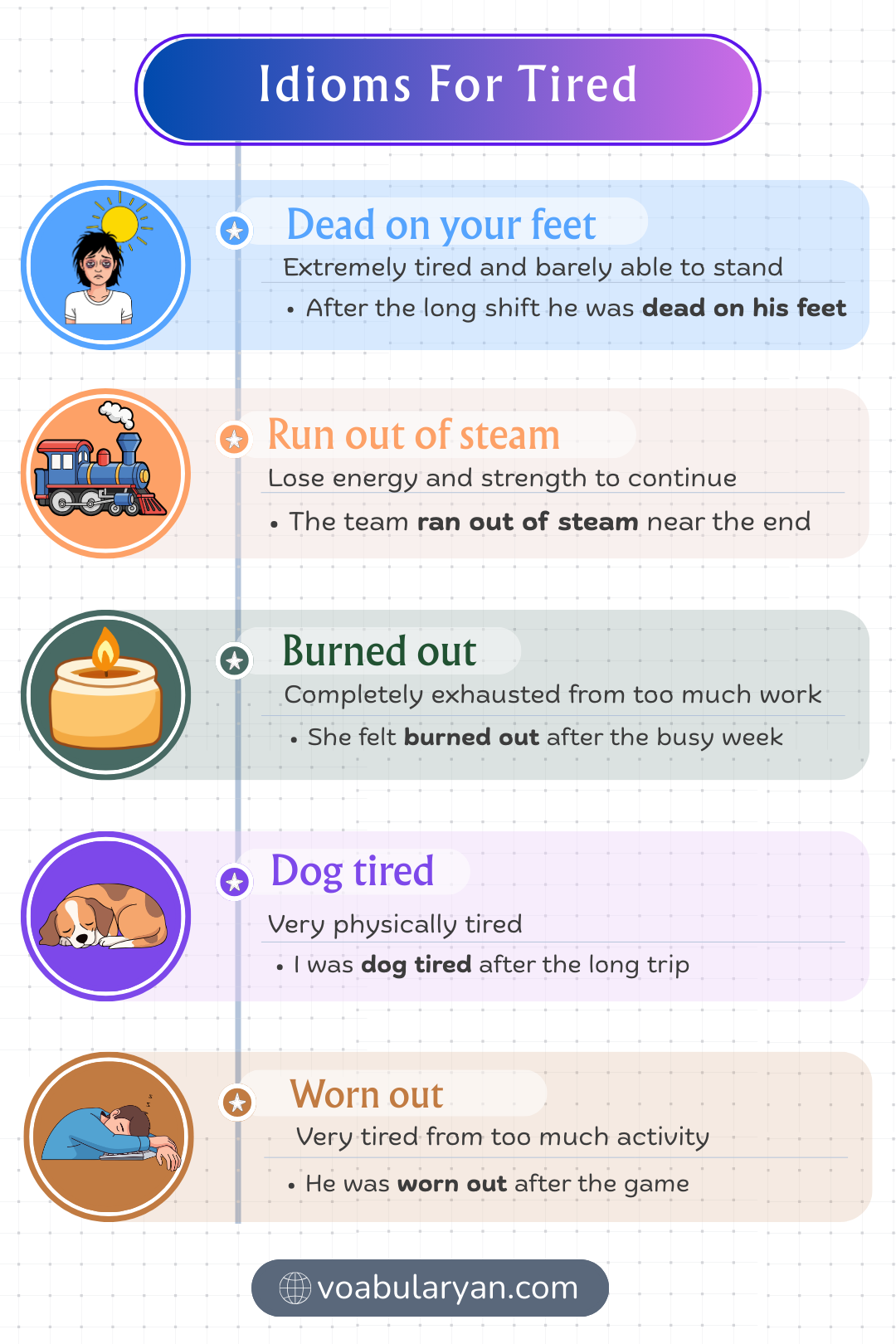
Idioms for Feeling Physically Tired
Run Out of Steam
Meaning: to lose energy or strength.
When To Use It: use it when someone becomes tired after continuous effort.
Collocations: run out of steam during work, run out of steam after a workout
Example Sentences:
- She ran out of steam after the long meeting.
- He ran out of steam halfway through the marathon.
Dialogue:
Anna: I ran out of steam by the end of the project.
Jack: It’s tough when you’re exhausted like that.
Closest Alternatives:
- lose energy
- get tired
Worn Out
Meaning: to feel very tired or exhausted.
When To Use It: use it when someone feels physically drained.
Collocations: feel worn out, completely worn out, worn out from work
Example Sentences:
- After the trip, I was worn out.
- She felt worn out after the long flight.
Dialogue:
Ben: I feel worn out today.
Ella: A good rest should help you recover.
Closest Alternatives:
- exhausted
- drained
Dead on Your Feet
Meaning: to feel extremely tired, almost unable to stand.
When To Use It: use it when someone is physically or mentally exhausted.
Collocations: dead on your feet after work, feel dead on your feet
Example Sentences:
- After the whole day of meetings, he was dead on his feet.
- I was dead on my feet by the time I got home.
Dialogue:
Liam: I’m dead on my feet after today.
Sophie: You need to rest tonight.
Closest Alternatives:
- extremely tired
- completely drained
Bone-Tired
Meaning: to be extremely tired, as if one’s bones are heavy.
When To Use It: use it when someone feels physically exhausted after hard work.
Collocations: bone-tired after work, feel bone-tired after exercise
Example Sentences:
- I’m bone-tired after the hike.
- He was bone-tired from running all day.
Dialogue:
Carlos: I’m bone-tired after that workout.
Mia: I feel the same, we both need a break.
Closest Alternatives:
- very tired
- physically drained
Dog-Tired
Meaning: to be extremely tired, as tired as a dog after a long day.
When To Use It: use it when someone is very tired, usually after hard work.
Collocations: dog-tired after a workout, feel dog-tired from the trip
Example Sentences:
- She felt dog-tired after traveling all night.
- I was dog-tired after cleaning the house.
Dialogue:
Sarah: I’m so dog-tired right now.
James: It looks like you need a good night’s sleep.
Closest Alternatives:
- exhausted
- worn out
Hit the Sack
Meaning: to go to bed and sleep.
When To Use It: use it when someone is ready to go to sleep.
Collocations: hit the sack early, ready to hit the sack
Example Sentences:
- After a long day, I’m going to hit the sack.
- They decided to hit the sack after the party.
Dialogue:
Olivia: I think it’s time to hit the sack.
Tom: I agree, I’m exhausted.
Closest Alternatives:
- go to bed
- sleep
Hit the Wall
Meaning: to reach a point where one has no more energy or motivation.
When To Use It: use it when someone cannot continue because of tiredness or frustration.
Collocations: hit the wall during a workout, hit the wall after hours of work
Example Sentences:
- I hit the wall halfway through the project.
- He hit the wall after running for hours.
Dialogue:
Lily: I’ve totally hit the wall.
Ethan: It’s okay to take a break.
Closest Alternatives:
- reach exhaustion
- run out of energy
Idioms for Mental Fatigue and Exhaustion
Burn Out
Meaning: feeling extremely tired or exhausted from prolonged stress or overwork.
When To Use It: say it when someone has pushed themselves too hard and feels drained.
Collocations: burn out from work, burn out after a project, totally burn out
Example Sentences:
- She burned out after working non-stop for weeks.
- He’s been burning out from all the overtime.
Dialogue:
Ali: I feel like I’m about to burn out.
Sara: You need to take a break before it gets worse.
Closest Alternatives:
- feel exhausted
- run out of energy
Burn the Candle at Both Ends
Meaning: working or staying awake too long, often leading to exhaustion.
When To Use It: say it when someone is overworking themselves or not getting enough rest.
Collocations: burn the candle at both ends for days, burn the candle at both ends at work
Example Sentences:
- He’s been burning the candle at both ends for days.
- She burned the candle at both ends last week, staying up late and working early.
Dialogue:
Maya: I’ve been burning the candle at both ends lately.
Rami: That’s a recipe for fatigue.
Closest Alternatives:
- overwork yourself
- push yourself too hard
Work Yourself to the Bone
Meaning: working extremely hard, often leading to exhaustion.
When To Use It: say it when someone is putting in a lot of effort, often too much.
Collocations: work yourself to the bone on a project, work yourself to the bone during a deadline
Example Sentences:
- She’s been working herself to the bone to finish the assignment.
- He worked himself to the bone last month to meet the targets.
Dialogue:
Zara: I feel like I’m working myself to the bone.
Omar: You need to find a way to rest as well.
Closest Alternatives:
- overwork yourself
- work non-stop
Idioms for Overcoming Fatigue and Taking a Break
Take a Breather
Meaning: to take a short rest or pause.
When To Use It: use it when someone needs a quick break from activity.
Collocations: take a breather after work, take a breather during exercise
Example Sentences:
- Let’s take a breather before continuing the hike.
- She decided to take a breather after the meeting.
Dialogue:
Tom: I need to take a breather.
Sara: Sure, let’s sit for a minute.
Closest Alternatives:
- take a break
- rest for a moment
Recharge Your Batteries
Meaning: to regain energy or strength.
When To Use It: use it when someone takes a break to recover energy.
Collocations: recharge your batteries after work, need to recharge your batteries
Example Sentences:
- He decided to recharge his batteries before the long trip.
- After the weekend, she felt ready to recharge her batteries.
Dialogue:
Ethan: I need a weekend to recharge my batteries.
Olivia: A short break can do wonders for energy.
Closest Alternatives:
- get rest
- recover energy
Take a Load Off
Meaning: to sit down and relax after standing or working for a while.
When To Use It: use it when someone needs to relax after work or activity.
Collocations: take a load off after work, take a load off at home
Example Sentences:
- After the long walk, he finally decided to take a load off.
- She invited me to take a load off and relax.
Dialogue:
Nina: You should take a load off after your run.
Jack: I’m ready to rest for a bit.
Closest Alternatives:
- relax
- rest your feet
Catch Your Breath
Meaning: to stop and rest after physical exertion or excitement.
When To Use It: use it when someone is recovering from physical activity or shock.
Collocations: catch your breath after running, catch your breath before speaking
Example Sentences:
- He stopped to catch his breath after climbing the stairs.
- She needed a moment to catch her breath after the surprise.
Dialogue:
Maya: Give me a second to catch my breath.
Liam: Take your time, I’ll wait for you.
Closest Alternatives:
- rest
- take a break
Idioms for Physical and Emotional Drainage
At the End of Your Rope
Meaning: feeling completely exhausted or unable to handle more stress.
When To Use It: say it when someone can no longer deal with a difficult situation.
Collocations: at the end of your rope with work, at the end of your rope after a long day, feel at the end of your rope
Example Sentences:
- After weeks of nonstop work, he felt at the end of his rope.
- She was at the end of her rope after dealing with constant delays.
Dialogue:
Nina: I’m at the end of my rope with this project.
Tariq: Maybe it’s time to take a break.
Closest Alternatives:
- out of options
- at breaking point
Running on Fumes
Meaning: continuing to work or function even though you’re extremely tired or low on energy.
When To Use It: say it when someone is still going despite feeling physically or mentally drained.
Collocations: running on fumes after a long day, running on fumes during a busy week, barely running on fumes
Example Sentences:
- She was running on fumes after working overtime all week.
- He’s been running on fumes but keeps pushing through.
Dialogue:
Kiran: I’m running on fumes today.
Ahsan: You really need some rest.
Closest Alternatives:
- low on energy
- exhausted but still going
At the End of Your Wits
Meaning: feeling mentally overwhelmed or unable to cope with a situation.
When To Use It: say it when someone is mentally drained and has no solutions left.
Collocations: at the end of your wits with a problem, at the end of your wits after the week, feel at the end of your wits
Example Sentences:
- After dealing with constant changes, I was at the end of my wits.
- She was at the end of her wits trying to find a solution.
Dialogue:
Sarah: I’m really at the end of my wits with this situation.
Ali: That sounds really frustrating.
Closest Alternatives:
- mentally drained
- out of ideas
Idioms for Exhaustion After a Task or Effort
Dragging Your Feet
Meaning: to move slowly or unwillingly, often because of laziness or reluctance.
When To Use It: use it when someone is intentionally or unintentionally delaying or avoiding action.
Collocations: dragging your feet on a task, dragging your feet in the morning
Example Sentences:
- He’s been dragging his feet on finishing the report.
- She kept dragging her feet before going to the gym.
Dialogue:
Liam: Why are you dragging your feet?
Ava: I’m just not feeling motivated today.
Closest Alternatives:
- procrastinate
- delay
Beat to a Pulp
Meaning: to be hurt very badly or to be exhausted from a lot of effort.
When To Use It: use it when someone is physically or mentally worn out.
Collocations: beat to a pulp in a fight, beat to a pulp after working out
Example Sentences:
- After the intense workout, I felt beat to a pulp.
- The boxer was beaten to a pulp in the last round.
Dialogue:
Daniel: I’m beat to a pulp after that run.
Megan: It was an intense workout.
Closest Alternatives:
- completely exhausted
- worn out
Crashed Out
Meaning: to fall asleep very quickly due to exhaustion or to lose consciousness.
When To Use It: use it when someone falls asleep suddenly or from tiredness.
Collocations: crashed out after the party, crashed out on the couch
Example Sentences:
- She crashed out on the sofa after the long trip.
- He crashed out immediately after the meeting ended.
Dialogue:
Chris: I was so tired, I crashed out right away.
Sarah: That’s how I feel after a busy day.
Closest Alternatives:
- fall asleep
- pass out
Key Takeaways
These expressions capture moments when stress, exhaustion, or frustration becomes overwhelming. They highlight situations where someone is physically or mentally at their limit. The meaning varies with tone and context, making the phrases adaptable to both serious and light conversations. Many of these idioms keep stable wording, so altering them can sound unnatural. The language in these idioms reflects real, relatable feelings of being drained or defeated, and they can be used to express both deep stress and lighter forms of tiredness, fitting naturally into daily speech.
FAQs
Q1. What does “burning the candle at both ends” mean?
It means working too hard, usually by staying up late and waking up early, which is one of the idioms for tired. For example, someone working long hours and sacrificing sleep.
Q2. What is the meaning of “running on empty”?
“Running on empty” means feeling exhausted or having no energy left, and it’s a common idiom for tired. For instance, after a long day, someone may feel they are running on empty.
Q3. What does “hitting the wall” mean in the context of tiredness?
It refers to reaching a point of extreme exhaustion or mental fatigue, often used as a idiom for tired. For example, someone might hit the wall during a long workout.
Q4. Is “dead on my feet” the same as being tired?
Yes, “dead on my feet” means being so tired that you can hardly stand, which is often said when someone is extremely fatigued. It is one of the idioms for tired.
Q5. What does “worn out” mean?
“Worn out” means being physically or mentally exhausted from overworking or exertion. It’s a common idiom for tired that describes someone who has been very busy or active.
Q6. When do people say “drained”?
“Drained” means feeling completely exhausted or depleted of energy, and it’s a typical idiom for tired. For example, after a stressful day, someone might say they feel drained.
You May Also Like
