
You step onto a train with your bag in hand and say, “I’m travelling.” The sentence is true, yet it barely captures the sense of adventure and quiet excitement you feel. Travel often brings new places, unfamiliar streets, and moments that stay with you.
That is where idioms for travelling become useful in learning English. These expressions appear when people talk about journeys or long trips from place to place. Some sound light and playful, while others reflect deeper freedom and personal growth.
We’ll look at how these phrases work in sentences and short dialogue. You’ll sense when one fits a short trip and when another suits a life-changing journey. Here are the words that carry the spirit of travel.
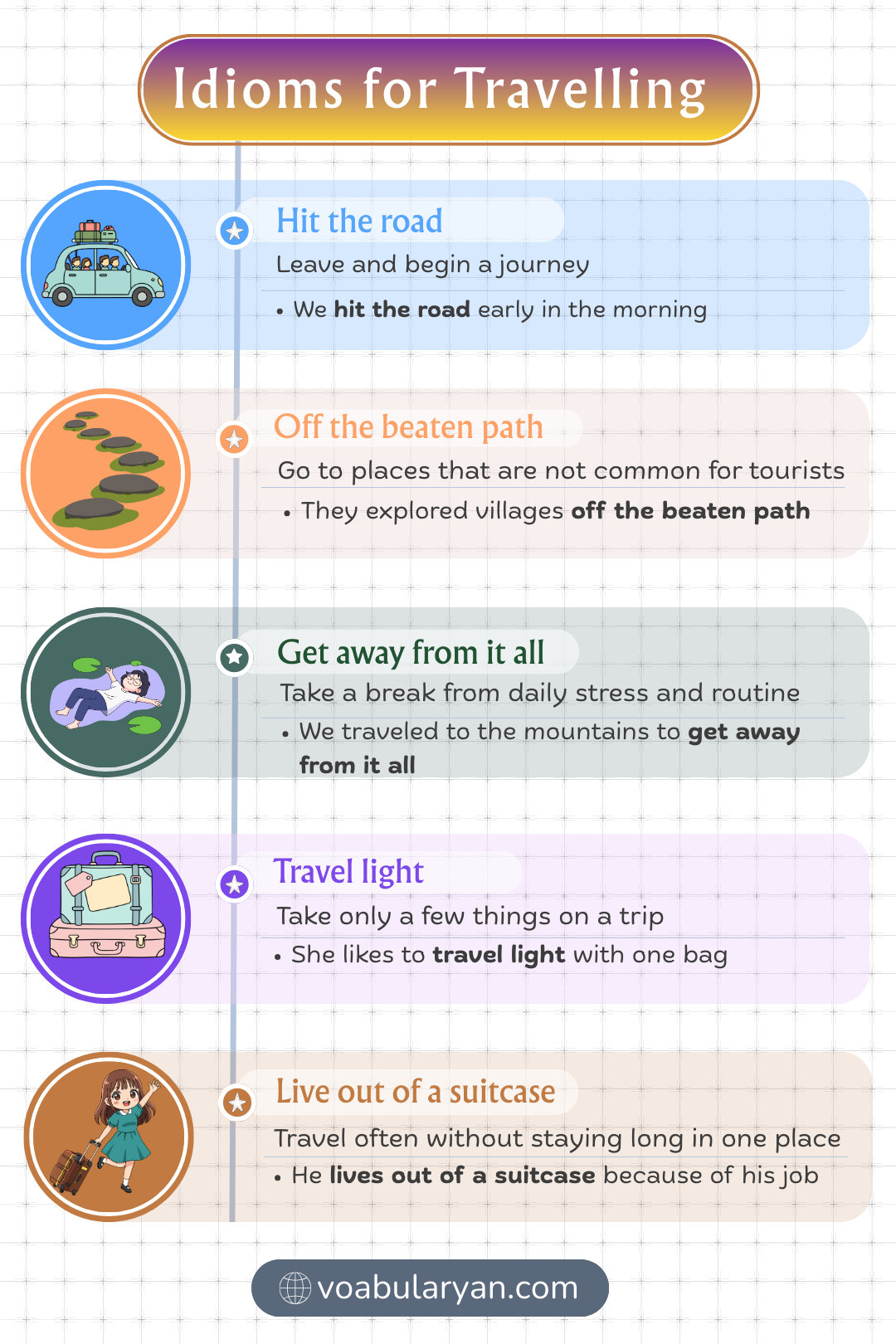
Idioms About The Adventure and Journey of Traveling
Taking The Road Less Traveled
Meaning: choosing an unconventional or less common way.
When To Use It: Say it when someone makes a unique or brave decision, often with uncertain outcomes.
Collocations: take the road less traveled in life, take the road less traveled in career, choose the road less traveled
Example Sentences:
- She decided to take the road less traveled and start her own business.
- He always believes in taking the road less traveled, even when others doubt him.
Dialogue:
Sara: I’m thinking of starting a new venture.
Imran: You’ve always taken the road less traveled and succeeded.
Closest Alternatives:
- forge your own path
- go your own way
Go Off The Beaten Path
Meaning: leave the common or usual route, explore unusual or less known places or ideas.
When To Use It: Say it when someone chooses a unique or unconventional approach.
Collocations: go off the beaten path while traveling, go off the beaten path in life, go off the beaten path for creativity
Example Sentences:
- We decided to go off the beaten path and explore the small towns.
- He loves going off the beaten path and finding hidden gems.
Dialogue:
Maya: Let’s go off the beaten path on our next trip.
David: That will lead us to new experiences.
Closest Alternatives:
- explore new routes
- take the unconventional route
Hit The Road
Meaning: start a journey or leave a place.
When To Use It: Say it when someone begins a trip or leaves for a journey.
Collocations: hit the road for a trip, hit the road with friends, hit the road early in the morning
Example Sentences:
- We’re ready to hit the road and head to the mountains.
- They hit the road at dawn to avoid the traffic.
Dialogue:
Zara: Are you ready to hit the road?
Tariq: Yes, let’s go before the traffic starts.
Closest Alternatives:
- set off
- begin the journey
Take The Scenic Route
Meaning: choose a longer, more enjoyable way rather than the fastest route.
When To Use It: Say it when someone prefers a more relaxed and beautiful journey.
Collocations: take the scenic route on a trip, take the scenic route to work, take the scenic route for enjoyment
Example Sentences:
- We decided to take the scenic route to the beach for the beautiful views.
- Sometimes it’s better to take the scenic route and enjoy the journey.
Dialogue:
Lena: Let’s take the scenic route on our way home.
Ryan: Great idea, I love exploring new places.
Closest Alternatives:
- take the long way
- enjoy the journey
Take The Wheel
Meaning: take control or leadership in a situation.
When To Use It: Say it when someone takes charge or leads a situation.
Collocations: take the wheel of the project, take the wheel and lead, take the wheel in the car
Example Sentences:
- He decided to take the wheel and lead the team.
- She’s been asked to take the wheel for the new campaign.
Dialogue:
Nina: I think it’s time for me to take the wheel.
Leo: Go ahead, you’re ready for the responsibility.
Closest Alternatives:
- take control
- step up
Travel Light
Meaning: travel with only essential items, without excess baggage.
When To Use It: Say it when someone packs minimally for convenience or simplicity.
Collocations: travel light on a vacation, travel light with just essentials, travel light for a short trip
Example Sentences:
- She always travels light with just a backpack.
- He prefers to travel light and avoid carrying heavy luggage.
Dialogue:
Olivia: Do you need anything extra?
Alex: No, I’m just going to travel light.
Closest Alternatives:
- pack light
- travel simply
Pack Light
Meaning: pack only the essentials and avoid extra baggage.
When To Use It: Say it when packing minimally to avoid carrying too much.
Collocations: pack light for a weekend, pack light for a trip, pack light and stay organized
Example Sentences:
- I always try to pack light for quick trips.
- She prefers to pack light so she can move easily.
Dialogue:
Maya: I think we should pack light for this weekend trip.
Sara: Good idea, it’ll be easier to carry.
Closest Alternatives:
- travel light
- carry less
A Journey Of A Thousand Miles Begins With A Single Step
A Bumpy Ride
Meaning: a difficult or rough experience, often with ups and downs.
When To Use It: Say it when someone is facing challenges during an experience.
Collocations: have a bumpy ride through life, have a bumpy ride in business, go through a bumpy ride
Example Sentences:
- Their journey was a bumpy ride with many setbacks.
- The new project has been a bumpy ride so far.
Dialogue:
Sara: This trip has been a bumpy ride.
Imran: Yes, but we’ll make it to the end.
Closest Alternatives:
- rough journey
- challenging experience
Hit A Bump In The Road
Meaning: encounter an unexpected problem or obstacle.
When To Use It: Say it when progress is slowed or interrupted by a challenge.
Collocations: hit a bump in the road during a project, hit a bump in the road with plans, hit a bump in the road at work
Example Sentences:
- We hit a bump in the road when the supplier didn’t deliver.
- The plan was going smoothly until we hit a bump in the road.
Dialogue:
Maya: Everything was going well until we hit a bump in the road.
Caleb: It’s just a minor setback; we’ll solve it.
Closest Alternatives:
- encounter a problem
- face an obstacle
Lost In The Wilderness
Meaning: feeling confused, uncertain, or directionless.
When To Use It: Say it when someone feels lost or without a clear path.
Collocations: feel lost in the wilderness, get lost in the wilderness of choices, wander in the wilderness of doubt
Example Sentences:
- He felt lost in the wilderness after the sudden change.
- She was lost in the wilderness of options and couldn’t decide.
Dialogue:
Nadia: I feel so lost in the wilderness with all these decisions.
Farhan: Sometimes it’s hard to choose the right path.
Closest Alternatives:
- directionless
- unsure
At A Crossroads
Meaning: at a point where a decision must be made, often involving a major change.
When To Use It: Say it when someone faces a difficult choice that will affect their future.
Collocations: be at a crossroads in life, be at a crossroads with decisions, find yourself at a crossroads
Example Sentences:
- She’s at a crossroads in her career and needs to choose a direction.
- He’s at a crossroads and doesn’t know which path to take.
Dialogue:
Sara: I feel like I’m at a crossroads.
Imran: It’s tough, but it’s time to decide what’s best for you.
Closest Alternatives:
- at a turning point
- faced with a choice
Idioms for Reaching Your Destination
Cross The Finish Line
Meaning: complete a task or goal, especially after a long effort.
When To Use It: Say it when someone successfully completes a challenging task.
Collocations: cross the finish line in a race, cross the finish line of a project, cross the finish line after a struggle
Example Sentences:
- After months of hard work, they finally crossed the finish line.
- She couldn’t wait to cross the finish line after the long journey.
Dialogue:
Sarah: We’ve worked so hard; we’re almost at the end.
David: Let’s cross the finish line together!
Closest Alternatives:
- reach the goal
- complete the task
Make It To The Other Side
Meaning: successfully navigate through a difficult situation or challenge.
When To Use It: Say it when someone overcomes difficulties and reaches a safer or better place.
Collocations: make it to the other side of the storm, make it to the other side of the challenge, make it to the other side together
Example Sentences:
- Despite all the setbacks, they made it to the other side of the crisis.
- After weeks of planning, we finally made it to the other side of the project.
Dialogue:
Lena: It’s been hard, but we’ll make it to the other side soon.
John: I believe we’ll come out even stronger.
Closest Alternatives:
- get through
- overcome challenges
Idioms for Escaping and Fleeing
Get Out Of Dodge
Meaning: leave a place quickly, often to escape trouble.
When To Use It: Say it when someone leaves quickly to avoid a difficult or dangerous situation.
Collocations: get out of dodge fast, get out of dodge in a hurry, get out of dodge before things get worse
Example Sentences:
- After the argument, he decided to get out of Dodge before things escalated.
- When the storm hit, we got out of Dodge as fast as we could.
Dialogue:
Amina: It’s getting tense here; maybe it’s time to get out of Dodge.
Hassan: I agree, it’s safer to leave quickly.
Closest Alternatives:
- flee the scene
- escape quickly
Run For The Hills
Meaning: escape quickly from a dangerous or difficult situation.
When To Use It: Say it when someone tries to leave or avoid something troublesome.
Collocations: run for the hills in panic, run for the hills when things get tough, run for the hills in an emergency
Example Sentences:
- When the news broke, people started to run for the hills.
- She had to run for the hills when the alarm went off.
Dialogue:
Sara: It’s getting chaotic here.
Imran: We should run for the hills and stay safe.
Closest Alternatives:
- flee
- take off
Hit The Road Running
Meaning: start working or moving quickly and energetically.
When To Use It: Say it when someone starts a task with energy and speed.
Collocations: hit the road running in the morning, hit the road running for a project, hit the road running with a new plan
Example Sentences:
- He hit the road running and finished the project ahead of schedule.
- She’s always ready to hit the road running on a new idea.
Dialogue:
Maya: Let’s hit the road running and get this done.
Caleb: We’ll need a lot of energy to finish quickly.
Closest Alternatives:
- start strong
- dive in
Escape The Rat Race
Meaning: leave the busy, competitive, and stressful work life.
When To Use It: Say it when someone wants to leave the grind of daily work for a more peaceful life.
Collocations: escape the rat race for good, escape the rat race with a move, escape the rat race to relax
Example Sentences:
- He wanted to escape the rat race and live on a farm.
- After years of stress, she finally decided to escape the rat race.
Dialogue:
Nadia: I’m tired of this hectic lifestyle; I want to escape the rat race.
Farhan: A peaceful life sounds much better.
Closest Alternatives:
- leave the hustle
- step away from the grind
Get Out Of Town
Meaning: leave the area, often to avoid trouble or for a break.
When To Use It: Say it when someone leaves quickly to get away from something undesirable.
Collocations: get out of town for the weekend, get out of town on business, get out of town to relax
Example Sentences:
- After the meeting, he decided to get out of town for a bit.
- We need to get out of town and relax this weekend.
Dialogue:
Sara: It’s too busy here, I think we should get out of town.
Imran: A little peace sounds great.
Closest Alternatives:
- leave the area
- take off
Leave No Stone Unturned
Meaning: make every possible effort to find something or solve a problem.
When To Use It: Say it when you are determined to search or solve something thoroughly.
Collocations: leave no stone unturned in a search, leave no stone unturned for an answer, leave no stone unturned to find the truth
Example Sentences:
- He left no stone unturned in his investigation.
- She left no stone unturned in trying to solve the issue.
Dialogue:
Lena: Have you checked everywhere?
Ryan: Yes, I’ve left no stone unturned in the search.
Closest Alternatives:
- search thoroughly
- do everything possible
Idioms for Starting or Beginning a Journey
On The Move
Meaning: constantly moving or active, not staying in one place for long.
When To Use It: Say it when someone is always busy or traveling.
Collocations: always on the move, be on the move all day, stay on the move
Example Sentences:
- She’s always on the move, juggling work and family.
- He’s been on the move for hours, meeting with clients.
Dialogue:
Amina: I haven’t had a chance to relax, I’ve been on the move all day.
Tariq: It sounds like you’ve had a very busy schedule.
Closest Alternatives:
- constantly busy
- always active
Hit The Ground Running
Meaning: start something with great energy and enthusiasm, especially from the beginning.
When To Use It: Say it when someone begins a task or project with full effort immediately.
Collocations: hit the ground running at work, hit the ground running with a new job, hit the ground running after a break
Example Sentences:
- She hit the ground running with her new project and impressed everyone.
- He always hits the ground running when a new challenge arises.
Dialogue:
Maya: I’m ready to hit the ground running today!
Zain: That’s the energy we need to get ahead.
Closest Alternatives:
- start strong
- dive right in
Idioms for Travel Failures or Delays
Miss The Boat
Meaning: fail to take advantage of an opportunity because you acted too late.
When To Use It: Say it when someone misses a chance because they waited too long or hesitated.
Collocations: miss the boat on an opportunity, miss the boat for a job, miss the boat with the timing
Example Sentences:
- She missed the boat on the job opening because she applied too late.
- By the time we got there, we had missed the boat on the sale.
Dialogue:
Amina: I think we missed the boat on the tickets.
Hassan: It’s unfortunate, but we were too slow.
Closest Alternatives:
- miss the chance
- lose the opportunity
Hit A Roadblock
Meaning: encounter a problem or obstacle that prevents progress.
When To Use It: Say it when something stops or delays forward movement.
Collocations: hit a roadblock in a project, hit a roadblock in negotiations, hit a roadblock during a process
Example Sentences:
- We hit a roadblock when the system crashed.
- The team hit a roadblock and couldn’t finish the task on time.
Dialogue:
Sara: We’ve hit a roadblock in the project.
Imran: Let’s figure out how to move past it.
Closest Alternatives:
- encounter an obstacle
- face a problem
Take A Detour
Meaning: change the planned route or course of action due to an unexpected issue.
When To Use It: Say it when someone has to go a different way than originally planned.
Collocations: take a detour on the way, take a detour for now, take a detour because of traffic
Example Sentences:
- We had to take a detour because of construction on the main road.
- His career took a detour before he found his true passion.
Dialogue:
Nadia: We need to take a detour due to the roadblock.
Farhan: Let’s find the best alternate route.
Closest Alternatives:
- change direction
- reroute
Idioms for Traveling Over Long Distances
Go The Distance
Meaning: persist and continue until the end of a difficult or long task.
When To Use It: Say it when someone is able to keep going and finish something challenging.
Collocations: go the distance in a competition, go the distance with a project, go the distance in a relationship
Example Sentences:
- She proved she could go the distance in the marathon.
- The team went the distance and completed the project on time.
Dialogue:
Nadia: It’s a tough journey, but we can go the distance.
Ali: We’ve made it this far, we can finish strong.
Closest Alternatives:
- endure
- stick with it
Walk A Mile In Someone’s Shoes
Meaning: understand and empathize with someone’s situation before judging.
When To Use It: Say it when encouraging someone to be more compassionate or see things from another perspective.
Collocations: walk a mile in someone’s shoes to understand, walk a mile in someone’s shoes before criticizing
Example Sentences:
- Before judging her, try to walk a mile in someone’s shoes.
- He finally walked a mile in someone’s shoes and understood her struggles.
Dialogue:
Sara: It’s not easy, you should walk a mile in someone’s shoes.
Omar: I see now how tough it must have been.
Closest Alternatives:
- understand their perspective
- show empathy
The Long Haul
Meaning: a long and difficult period of time that requires a lot of effort or patience.
When To Use It: Say it when something will take time and persistence to complete.
Collocations: the long haul of a project, prepare for the long haul, go through the long haul
Example Sentences:
- Building the business will take the long haul, but it will be worth it.
- They knew they were in the long haul for the renovation.
Dialogue:
Amina: This project will require the long haul.
Ali: We must stay focused and keep pushing forward.
Closest Alternatives:
- over time
- the entire journey
Key Takeaways
In life, we all face challenges. Sometimes we hit a roadblock or need to take a detour, but it’s important to stay positive and keep moving forward. Don’t wait too long to take action, or you might miss the boat on great opportunities. Even if things don’t go as planned, it’s how we adjust and keep trying that makes a difference. So, stay flexible and open to new paths, and keep working toward your goals.
FAQs
Q1. What does “hit the road” mean in travel slang?
“Hit the road” means to start a journey or leave for a trip. It’s a casual way to say you’re heading out. For example, “Let’s hit the road, we’re going to the beach!”
Q2. How do you use “off the beaten path”?
This idiom means going somewhere less visited or not well-known. It’s often used to describe an unusual destination. For example, “We took a trip off the beaten path and visited a small village in the mountains.”
Q3. What’s the meaning of “on the move” in travel?
“On the move” refers to being active or constantly traveling. It’s used to describe someone who is always traveling. For example, “She’s always on the move, visiting new countries every month.”
Q4. When should I say “take a detour”?
To “take a detour” means to go off your planned route, often for a short period. For example, “We had to take a detour because of a roadblock.”
Q5. What does “a change of scenery” mean?
“A change of scenery” refers to going to a different place, usually to refresh or relax. For example, “I needed a change of scenery, so I went on a weekend getaway to the mountains.”
Q6. What is “a journey of a thousand miles”?
This idiom refers to a long journey that begins with a single step. It’s often used to motivate someone to start something big, like a trip. For example, “Remember, a journey of a thousand miles starts with a single step.”
You May Also Like
