
You watch two friends argue over a small issue, and someone says, “It’s war.” The phrase sounds dramatic, yet the words barely hold the sudden heat and sharp tension between them. Conflict can flare up fast or simmer beneath the surface. Plain language often feels too light for feelings that cut deep.
The right words can carry that weight. Idioms for war appear when people talk about rivalry or heated arguments. Some feel intense and forceful, while others suggest quiet hostility that lasts over time.
We’ll walk through each one with natural examples and short conversations. You’ll sense when a phrase fits a playful clash and when it suits a serious dispute. Here are the words that carry the weight of conflict.
War Idioms For Hard Choices And Tough Situations
Bite The Bullet
Meaning: face a painful task with courage and accept it.
When To Use It: Say it when someone finally does something hard or unpleasant.
Collocations: bite the bullet and pay, bite the bullet and apologize, bite the bullet and decide
Example Sentences:
- I bit the bullet and told the truth at last.
- She bit the bullet and paid the full cost.
Dialogue:
Amina: I will bite the bullet and speak to him.
Hassan: That takes real courage.
Closest Alternatives:
- face it
- do the hard thing
Uphill Battle
Meaning: a struggle that is very hard to win.
When To Use It: Say it when success needs long effort and many steps.
Collocations: an uphill battle to change minds, an uphill battle for support, face an uphill battle
Example Sentences:
- It is an uphill battle to fix the damage now.
- Winning their trust was an uphill battle.
Dialogue:
Sara: This feels like an uphill battle.
Imran: Yes, it needs steady effort.
Closest Alternatives:
- hard struggle
- tough fight
Fight A Losing Battle
Meaning: keep trying even though failure seems likely.
When To Use It: Say it when effort continues but the outcome looks bad.
Collocations: fight a losing battle against time, fight a losing battle with rules, fight a losing battle to stop it
Example Sentences:
- He is fighting a losing battle against the deadline.
- They were fighting a losing battle to stop the rumors.
Dialogue:
Hira: I feel I am fighting a losing battle.
Usman: The odds look poor right now.
Closest Alternatives:
- struggle in vain
- face likely defeat
In The Line Of Fire
Meaning: in a place where blame or danger is directed.
When To Use It: Say it when someone is a target in a tense situation.
Collocations: be in the line of fire, put someone in the line of fire, caught in the line of fire
Example Sentences:
- The manager was in the line of fire after the mistake.
- She ended up in the line of fire during the argument.
Dialogue:
Nadia: I was in the line of fire for their decision.
Farhan: That is unfair blame.
Closest Alternatives:
- under fire
- the target
Been In The Wars
Meaning: looking worn out, as if through many hard events.
When To Use It: Say it when someone looks tired, messy, or badly treated.
Collocations: look like you have been in the wars, feel like you have been in the wars
Example Sentences:
- He looks like he has been in the wars today.
- After the trip, I felt I had been in the wars.
Dialogue:
Lena: You look like you have been in the wars.
Ryan: It has been a long day.
Closest Alternatives:
- look worn out
- look battered
Battle-Scarred
Meaning: marked by past struggles or hardship.
When To Use It: Say it when experience has left signs, physical or emotional.
Collocations: battle-scarred veteran, battle-scarred team, battle-scarred but strong
Example Sentences:
- The team was battle-scarred but still determined.
- He felt battle-scarred after years of conflict.
Dialogue:
Maya: He seems battle-scarred by what happened.
Caleb: Yes, but he is still strong.
Closest Alternatives:
- hardened by experience
- marked by hardship
War Idioms For Fighting Back And Holding Firm
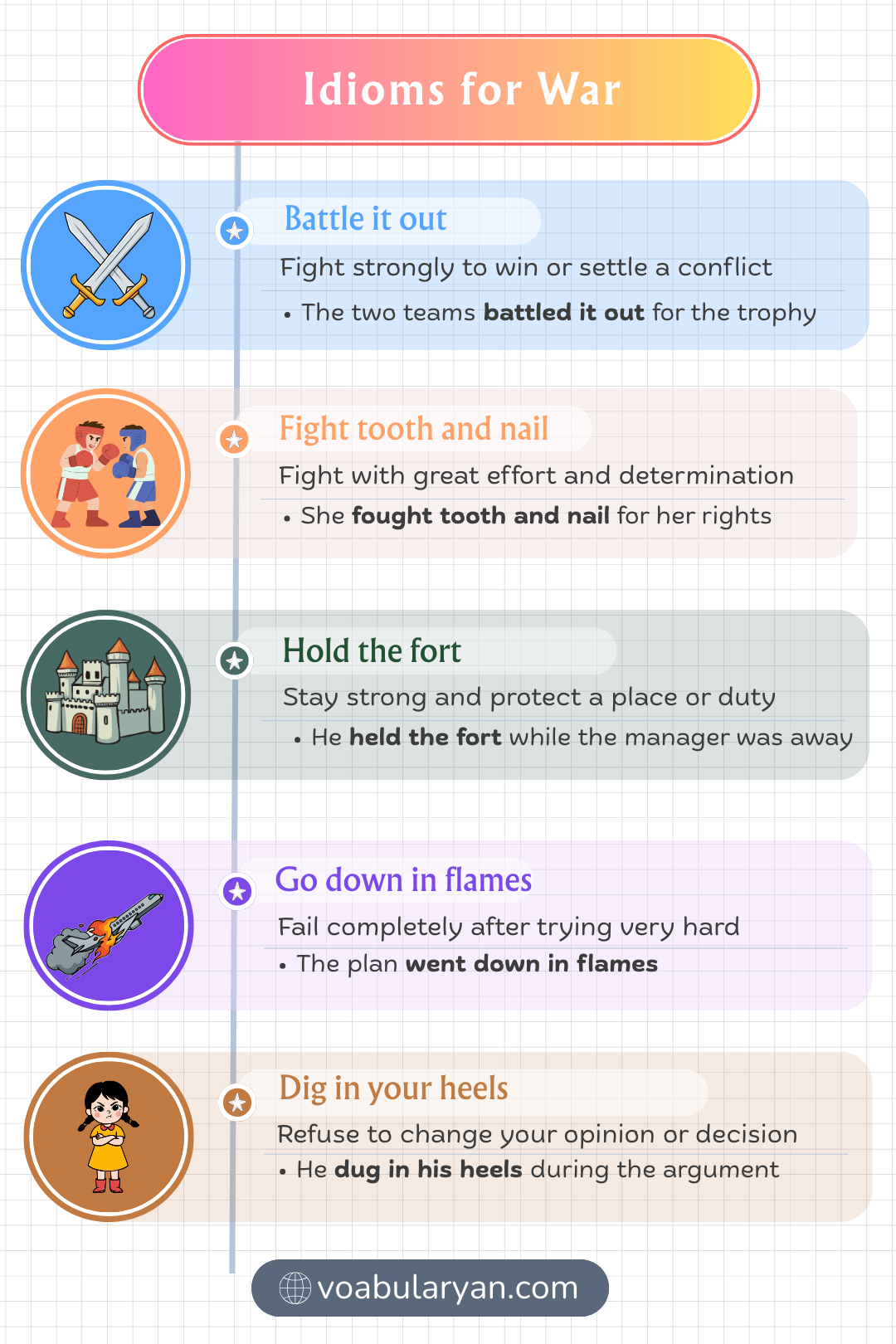
Fight Tooth And Nail
Meaning: fight with maximum effort and refuse to give up.
When To Use It: say it when someone defends a goal with strong determination.
Collocations: fight tooth and nail for a job, fight tooth and nail to win, fight tooth and nail over rights
Example Sentences:
- She Fight Tooth And Nail to keep her place.
- They Fight Tooth And Nail for every point.
Dialogue:
Amina: We will Fight Tooth And Nail for this.
Sameer: That shows real determination.
Closest Alternatives:
- fight hard
- struggle fiercely
Go To The Mat
Meaning: fight strongly for a cause or a person.
When To Use It: say it when someone argues or defends something with full force.
Collocations: go to the mat for a friend, go to the mat over a decision, go to the mat to defend
Example Sentences:
- He Go To The Mat for his teammate.
- She Go To The Mat over the final choice.
Dialogue:
Hira: I will Go To The Mat for my team.
Usman: That is loyal support.
Closest Alternatives:
- stand up for
- defend strongly
Hold Your Ground
Meaning: refuse to change your position under pressure.
When To Use It: say it when someone stays firm during argument or stress.
Collocations: hold your ground in a debate, hold your ground under pressure, hold your ground against criticism
Example Sentences:
- He Hold Your Ground during the meeting.
- She Hold Your Ground even when they pushed back.
Dialogue:
Sana: I will Hold Your Ground on this point.
Bilal: Staying firm takes courage.
Closest Alternatives:
- stand firm
- not back down
Take Up Arms
Meaning: prepare to fight, often in war or strong conflict.
When To Use It: say it when people choose force instead of peace.
Collocations: take up arms against, take up arms to defend, take up arms in revolt
Example Sentences:
- The group decided to Take Up Arms against the invaders.
- They Take Up Arms to protect their land.
Dialogue:
Zoya: They chose to Take Up Arms.
Hamza: The conflict turned violent.
Closest Alternatives:
- go to war
- start fighting
Fight The Good Fight
Meaning: keep working for a fair cause despite difficulty.
When To Use It: say it when effort continues even with setbacks.
Collocations: fight the good fight for justice, fight the good fight against unfairness, keep fighting the good fight
Example Sentences:
- She will Fight The Good Fight for equal treatment.
- They Fight The Good Fight even when progress is slow.
Dialogue:
Mariam: We will Fight The Good Fight.
Bilal: That goal is worth the effort.
Closest Alternatives:
- keep up the struggle
- stand for what is right
Fight Fire With Fire
Meaning: respond to an attack with similar force.
When To Use It: say it when someone answers harshness with harshness.
Collocations: fight fire with fire in an argument, fight fire with fire against rivals
Example Sentences:
- He tried to Fight Fire With Fire during the argument.
- They chose to Fight Fire With Fire after the threat.
Dialogue:
Areeba: He decided to Fight Fire With Fire.
Fahad: That can raise the tension quickly.
Closest Alternatives:
- respond in kind
- hit back
Cross Swords
Meaning: argue or fight with someone.
When To Use It: say it when two sides clash in a dispute.
Collocations: cross swords with a rival, cross swords over money, cross swords in court
Example Sentences:
- They Cross Swords over the final decision.
- She Cross Swords with her boss about the schedule.
Dialogue:
Nida: I Cross Swords with him again today.
Ali: That disagreement keeps returning.
Closest Alternatives:
- clash
- argue fiercely
War Idioms For Strategy And Planning
Choose Your Battles
Meaning: decide which problems deserve time and effort.
When To Use It: Say it when someone avoids small fights to focus on big ones.
Collocations: choose your battles wisely, choose your battles at work, choose your battles with family
Example Sentences:
- She learned to choose your battles during long team projects.
- I had to choose your battles and ignore the small comments.
Dialogue:
Aisha: I try to choose your battles these days.
Hamza: That saves energy for important issues.
Closest Alternatives:
- pick your fights
- focus on priorities
Plan Of Attack
Meaning: a clear plan for how to handle a problem.
When To Use It: Say it when someone prepares steps before action.
Collocations: a plan of attack for the project, plan of attack for exams, agree on a plan of attack
Example Sentences:
- We made a plan of attack before the big task.
- His plan of attack helped the group stay organized.
Dialogue:
Sana: What is our plan of attack?
Bilal: First we set the steps, then we act.
Closest Alternatives:
- action plan
- strategy
Rally The Troops
Meaning: bring people together and raise their spirit.
When To Use It: Say it when a leader encourages a group to work hard.
Collocations: rally the troops before a game, rally the troops after bad news
Example Sentences:
- The coach rallied the troops after the first loss.
- She rallied the troops with a short, strong talk.
Dialogue:
Nora: He rallied the troops when everyone felt low.
Caleb: That gave the group new hope.
Closest Alternatives:
- boost morale
- bring the team together
Draw A Line In The Sand
Meaning: set a firm limit that cannot be crossed.
When To Use It: Say it when someone refuses to accept certain actions.
Collocations: draw a line in the sand over respect, draw a line in the sand on rules
Example Sentences:
- She drew a line in the sand about rude behavior.
- He drew a line in the sand and said no more.
Dialogue:
Mila: I drew a line in the sand today.
Ethan: That boundary shows strength.
Closest Alternatives:
- set a boundary
- take a stand
Keep Your Powder Dry
Meaning: stay ready to act when the right time comes.
When To Use It: Say it when someone saves strength for future trouble.
Collocations: keep your powder dry in uncertain times
Example Sentences:
- He stayed quiet and kept his powder dry.
- She saved her resources and kept her powder dry.
Dialogue:
Zara: I will keep my powder dry for now.
Omar: That means staying prepared.
Closest Alternatives:
- stay ready
- hold back for later
War Idioms For Pressure And Uncertainty
War Of Nerves
Meaning: a tense struggle where each side tries to outlast the other.
When To Use It: say it when pressure and patience matter more than action.
Collocations: a war of nerves between rivals, a war of nerves during talks, turn into a war of nerves
Example Sentences:
- The long silence became a War Of Nerves.
- The standoff turned into a War Of Nerves for both sides.
Dialogue:
Hira: This feels like a War Of Nerves now.
Usman: Yes, everyone is under pressure.
Closest Alternatives:
- battle of wills
- tense standoff
Fog Of War
Meaning: confusion during conflict that hides what is really happening.
When To Use It: say it when facts are unclear in a tense situation.
Collocations: the fog of war lifted, lost in the fog of war, through the fog of war
Example Sentences:
- In the Fog Of War, rumors spread fast.
- The Fog Of War made the choices feel uncertain.
Dialogue:
Sana: The Fog Of War makes everything unclear.
Bilal: Yes, clear facts are hard to get.
Closest Alternatives:
- confusion in conflict
- unclear situation
War Idioms For Starting Or Escalating Conflict
Beat The Drums Of War
Meaning: encourage conflict by calling for fighting and strong action.
When To Use It: Say it when leaders or groups push for conflict and violence.
Collocations: beat the drums of war in speeches, beat the drums of war against rivals, beat the drums of war loudly
Example Sentences:
- Some leaders beat the drums of war during the tense border talks.
- The headline beat the drums of war and raised public fear.
Dialogue:
Nadia: They beat the drums of war with every angry statement.
Farhan: Yes, that kind of talk builds tension fast.
Closest Alternatives:
- call for conflict
- stir up hostility
Go To War
Meaning: begin armed conflict between groups or countries.
When To Use It: Say it when open fighting starts after serious disagreement.
Collocations: go to war over land, go to war with a neighbor, go to war against an enemy
Example Sentences:
- They decided to go to war after talks failed completely.
- The countries went to war over control of the border.
Dialogue:
Aisha: They might go to war if the talks collapse.
Hamza: That would bring great danger to many people.
Closest Alternatives:
- enter conflict
- start fighting
War Idioms For Teamwork And Strength In Unity
Close Ranks
Meaning: unite tightly to protect each other under pressure.
When To Use It: say it when a group supports its members during criticism or threat.
Collocations: close ranks around a leader, close ranks after criticism, close ranks in public
Example Sentences:
- The team Close Ranks after the harsh headlines.
- They Close Ranks around her during the dispute.
Dialogue:
Mina: They Close Ranks when trouble starts.
Hasan: That shows strong loyalty.
Closest Alternatives:
- stand together
- unite
Join Forces
Meaning: work together to reach a shared goal.
When To Use It: say it when separate people or groups cooperate.
Collocations: join forces with a partner, join forces to solve, join forces against a threat
Example Sentences:
- The two clubs Join Forces to run the event.
- They Join Forces to fix the problem quickly.
Dialogue:
Areeba: Let us Join Forces on this task.
Fahad: Together brings more strength.
Closest Alternatives:
- team up
- work together
Band Together
Meaning: unite to help one another against difficulty.
When To Use It: say it when people support each other during hard times.
Collocations: band together as a community, band together to resist, band together for help
Example Sentences:
- Neighbors Band Together after the storm.
- The workers Band Together to demand fair rules.
Dialogue:
Sana: We should Band Together right now.
Bilal: Yes, shared support matters.
Closest Alternatives:
- unite
- stand as one
United We Stand
Meaning: staying together makes a group stronger.
When To Use It: say it when unity is needed to face pressure or conflict.
Collocations: united we stand in hard times, united we stand as a team
Example Sentences:
- In this fight, United We Stand.
- They repeated, United We Stand, before the vote.
Dialogue:
Nida: United We Stand in this situation.
Ali: That unity gives strength.
Closest Alternatives:
- stand together
- stay united
Live To Fight Another Day
Meaning: stop now so you can continue later with more strength.
When To Use It: say it when someone retreats to avoid a bigger loss.
Collocations: live to fight another day after defeat, live to fight another day and return
Example Sentences:
- They pulled back to Live To Fight Another Day.
- He accepted the loss to Live To Fight Another Day.
Dialogue:
Hina: We should Live To Fight Another Day.
Saad: That choice can protect strength.
Closest Alternatives:
- retreat for now
- come back later
War Idioms For Peace And Reconciliation
Bury The Hatchet
Meaning: end a conflict and agree to forgive each other.
When To Use It: Say it when two sides decide to stop arguing.
Collocations: bury the hatchet with a friend, bury the hatchet after years, finally bury the hatchet
Example Sentences:
- They buried the hatchet after a long fight.
- She asked to bury the hatchet and start fresh.
Dialogue:
Amina: Can we bury the hatchet today?
Hassan: Yes, I want peace too.
Closest Alternatives:
- make up
- reconcile
Extend An Olive Branch
Meaning: offer peace or friendship after a disagreement.
When To Use It: Say it when someone takes the first step to fix relations.
Collocations: extend an olive branch to him, extend an olive branch after conflict, extend an olive branch publicly
Example Sentences:
- He extended an olive branch with a calm message.
- She extended an olive branch by inviting them to talk.
Dialogue:
Sadia: I will extend an olive branch.
Bilal: That can open the door to peace.
Closest Alternatives:
- make a peace offer
- reach out
Lay Down Your Arms
Meaning: stop fighting and agree to peace.
When To Use It: Say it when conflict ends and weapons are put away.
Collocations: lay down your arms and surrender, lay down your arms for peace
Example Sentences:
- They agreed to lay down their arms after the ceasefire.
- He urged them to lay down their arms and talk.
Dialogue:
Nadia: They finally laid down their arms.
Farhan: That step can bring relief.
Closest Alternatives:
- stop fighting
- surrender
Make Love Not War
Meaning: choose peace and kindness instead of conflict.
When To Use It: Say it when supporting peace and nonviolence.
Collocations: make love not war message, make love not war slogan
Example Sentences:
- The poster said make love not war in bold letters.
- She repeated make love not war during the peace march.
Dialogue:
Ayesha: I believe in make love not war.
Hamza: That idea calls for peace over violence.
Closest Alternatives:
- choose peace
- promote nonviolence
War Idioms For Surrender And Backing Down
Wave The White Flag
Meaning: show surrender and accept defeat or stop fighting.
When To Use It: say it when someone gives up during a struggle or argument.
Collocations: wave the white flag and quit, wave the white flag in defeat, wave the white flag on the issue
Example Sentences:
- After hours of debate, he Wave The White Flag.
- She finally Wave The White Flag and asked for help.
Dialogue:
Mariam: I will Wave The White Flag on this project.
Bilal: That is a fair choice sometimes.
Closest Alternatives:
- surrender
- give up
Raise The White Flag
Meaning: signal surrender and stop resisting.
When To Use It: say it when someone admits they cannot continue.
Collocations: raise the white flag and surrender, raise the white flag after defeat, raise the white flag in a dispute
Example Sentences:
- He Raise The White Flag after the second round.
- They Raise The White Flag and ended the argument.
Dialogue:
Areeba: I will Raise The White Flag now.
Fahad: That can end the conflict.
Closest Alternatives:
- concede
- back down
War Idioms For Winning And Losing Overall
Win The Battle, Lose The War
Meaning: gain a small success but fail in the bigger goal.
When To Use It: Say it when a short win creates a larger loss later.
Collocations: win the battle, lose the war in politics, win the battle, lose the war at work, win the battle, lose the war overall
Example Sentences:
- He won the battle, lost the war by proving a point and losing trust.
- They won the battle, lost the war after one win hurt the long plan.
Dialogue:
Mina: We won the battle, lost the war with that choice.
Omar: The short win cost the bigger goal.
Closest Alternatives:
- short-term win, long-term loss
- lose the bigger picture
Pyrrhic Victory
Meaning: a win that costs so much it feels like a loss.
When To Use It: Say it when success brings heavy damage or sacrifice.
Collocations: a pyrrhic victory in court, a pyrrhic victory in a fight, turn into a pyrrhic victory
Example Sentences:
- The court win was a pyrrhic victory after huge fees.
- They called it a pyrrhic victory because the damage was severe.
Dialogue:
Aisha: That feels like a pyrrhic victory.
Hamza: Yes, the cost was too high.
Closest Alternatives:
- costly win
- hollow victory
Open Old Wounds
Meaning: bring back painful memories and feelings from the past.
When To Use It: Say it when a topic makes past hurt feel fresh again.
Collocations: open old wounds in a talk, open old wounds between families, open old wounds again
Example Sentences:
- That comment opened old wounds from years ago.
- The meeting opened old wounds and tension rose quickly.
Dialogue:
Sana: This topic opened old wounds for me.
Bilal: I understand, that pain can feel fresh.
Closest Alternatives:
- bring up the past
- revive painful memories
Key Takeaways
This topic brings together common phrases for conflict and pressure in idioms for war, from direct fighting to tense standoffs and surrender. Meaning depends on tone and situation, so a phrase can sound heroic, harsh, or calm in different moments. Many idioms keep stable wording and word order, so changing even one small part can make them sound unnatural. Across the examples, the language reflects real moments such as holding firm, joining together, sudden shock, confusion, and giving up, and it fits both everyday conversation and simple writing.
FAQs
Q1. What does “war of words” mean in everyday English?
It means a public argument with speech or writing, not weapons, in idioms for war. Example: two leaders trade sharp statements in the news for a week.
Q2. What does “call a truce” mean when people are arguing?
It means to stop a fight for a while, in idioms for war. Example: two friends pause the dispute and agree to talk again after dinner.
Q3. What does “battle of wits” mean in normal conversation?
It means a smart contest where each side tries to outthink the other, in idioms for war. Example: two debaters answer each point quickly and sharply.
Q4. What does “war chest” mean when talking about money?
It means a saved fund for a big goal or campaign, in idioms for war. Example: a company keeps extra cash for a major court case or launch.
Q5. What does “on the warpath” mean, and is it very strong?
It means being very angry and ready to confront someone, in idioms for war. Example: a coach storms into the office after a bad call.
Q6. What does “in the trenches” mean outside of a real war?
It means doing the hard work at the busiest level, in idioms for war. Example: staff handle calls, errors, and fixes all day while leaders meet.
You May Also Like
