
You step outside and feel the sudden heat on your skin or the sharp wind against your face. “The weather is bad,” you say, yet the words barely capture the mood of the sky. Rain, sunshine, and storms can change how a day feels, but plain language often sounds too flat for that shift.
The right phrase can hold it. Idioms for weather bring daily talk about bright sunshine and dark clouds to life. Some sound light and playful, while others carry the weight of heavy storms or sudden change.
We’ll walk through each one with real examples and short conversations. You’ll sense which phrase fits a clear morning and which suits a tense, rainy afternoon. Here are the words that match the sky above you.
Weather Idioms For Daily Conversation
A Face Like Thunder
Meaning: Looking very angry, with a dark, harsh expression.
When To Use It: Say it when someone looks upset and ready to argue.
Collocations: a face like thunder all morning, with a face like thunder, had a face like thunder
Example Sentences:
- He walked in with A Face Like Thunder after the meeting.
- She sat there with A Face Like Thunder and said nothing.
Dialogue:
Nadia: He has A Face Like Thunder today.
Farhan: Yes, his anger is obvious.
Closest Alternatives:
- look furious
- scowl
A Fair-Weather Friend
Meaning: A person who stays only when life feels easy.
When To Use It: Say it when support disappears during trouble or stress.
Collocations: a fair-weather friend in hard times, call someone a fair-weather friend
Example Sentences:
- When I needed help, my A Fair-Weather Friend vanished.
- She realized he was A Fair-Weather Friend after the bad news.
Dialogue:
Ayesha: He turned out to be A Fair-Weather Friend.
Usman: That kind of support is weak.
Closest Alternatives:
- unreliable friend
- fair friend only in good times
Be A Breeze
Meaning: Being very easy and not stressful to do.
When To Use It: Say it when a task feels quick and low effort.
Collocations: be a breeze to finish, be a breeze for me, be a breeze compared to
Example Sentences:
- With practice, the exam will Be A Breeze for her.
- After training, the hike was Be A Breeze for him.
Dialogue:
Mina: The last part will Be A Breeze.
Hasan: Good, that sounds easy now.
Closest Alternatives:
- be easy
- be simple
See Which Way The Wind Blows
Meaning: Wait to decide until the situation becomes clearer.
When To Use It: Say it when someone delays a choice to avoid risk.
Collocations: see which way the wind blows before deciding, see which way the wind blows first
Example Sentences:
- They will See Which Way The Wind Blows before making changes.
- I will See Which Way The Wind Blows before I speak.
Dialogue:
Hina: Let us See Which Way The Wind Blows.
Saad: Yes, the mood is still unclear.
Closest Alternatives:
- wait and see
- hold off deciding
Blow Hot And Cold
Meaning: Changing feelings often, sometimes warm, sometimes distant.
When To Use It: Say it when someone acts friendly one day, cold the next.
Collocations: blow hot and cold about a plan, blow hot and cold toward someone
Example Sentences:
- He Blow Hot And Cold about joining our team.
- She keeps Blow Hot And Cold toward me in class.
Dialogue:
Sara: He Blow Hot And Cold with everyone lately.
Owais: That mixed behavior is confusing.
Closest Alternatives:
- be inconsistent
- change moods
A Bolt From The Blue
Meaning: A shocking event that happens with no warning.
When To Use It: Say it when news or events feel sudden and stunning.
Collocations: a bolt from the blue announcement, like a bolt from the blue, came as a bolt from the blue
Example Sentences:
- The message was A Bolt From The Blue for the whole family.
- Her resignation felt A Bolt From The Blue at work.
Dialogue:
Laila: It was A Bolt From The Blue.
Omar: Yes, everyone felt shock.
Closest Alternatives:
- out of the blue
- sudden shock
A Cloud On The Horizon
Meaning: A sign that trouble may happen soon.
When To Use It: Say it when there are early signs of future problems.
Collocations: a cloud on the horizon for business, see a cloud on the horizon, a cloud on the horizon ahead
Example Sentences:
- Rising costs were A Cloud On The Horizon for the project.
- The quiet argument became A Cloud On The Horizon for the group.
Dialogue:
Zoya: I see A Cloud On The Horizon now.
Hamza: Yes, there is growing tension.
Closest Alternatives:
- warning sign
- trouble ahead
Weather Idioms For Rain And Bad Days
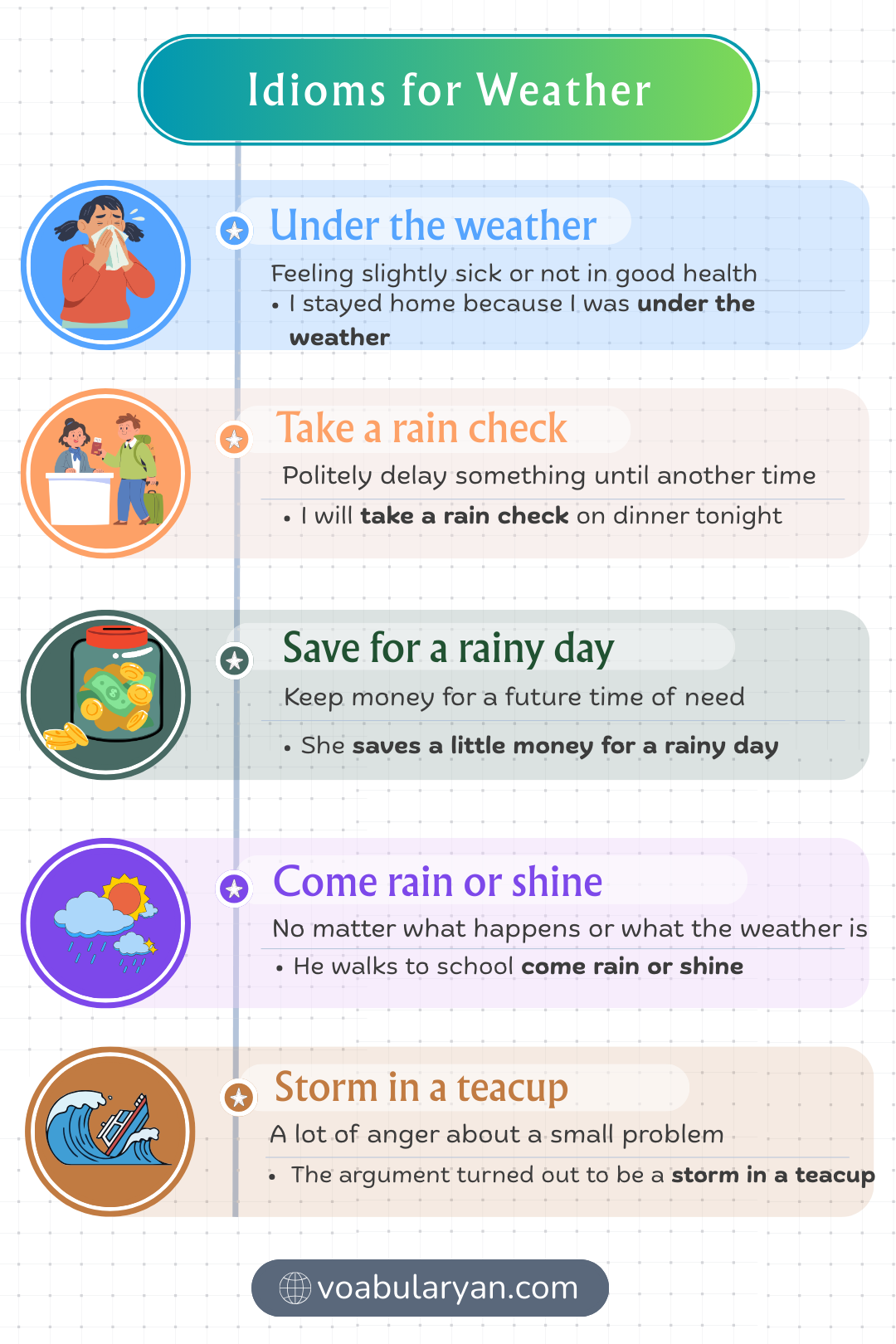
Come Rain Or Shine
Meaning: Something will happen no matter the weather or problems.
When To Use It: Say it when a plan will continue even with trouble.
Collocations: come rain or shine tomorrow, come rain or shine every day, come rain or shine for years
Example Sentences:
- The market opens Come Rain Or Shine every Saturday morning.
- She shows up Come Rain Or Shine for her practice sessions.
Dialogue:
Hira: I will be there Come Rain Or Shine.
Usman: That shows strong commitment.
Closest Alternatives:
- no matter what
- through thick and thin
Save For A Rainy Day
Meaning: Keep money for a time when it is needed.
When To Use It: Say it when talking about planning for future problems.
Collocations: save for a rainy day fund, save for a rainy day each month, saving for a rainy day
Example Sentences:
- He Saved For A Rainy Day instead of buying a new phone.
- She tries to Save For A Rainy Day from every paycheck.
Dialogue:
Amina: I started to Save For A Rainy Day this year.
Sameer: That kind of planning feels wise.
Closest Alternatives:
- put money aside
- build savings
Rain On Someone’s Parade
Meaning: Ruin someone’s happiness by bringing bad news or criticism.
When To Use It: Say it when a negative comment spoils a happy moment.
Collocations: rain on someone’s parade with facts, rain on someone’s parade at a party, don’t rain on my parade
Example Sentences:
- He Rained On Someone’s Parade by pointing out every flaw.
- She did not want to Rain On Someone’s Parade during the celebration.
Dialogue:
Nadia: I do not want to Rain On Someone’s Parade.
Farhan: Then keep the timing gentle.
Closest Alternatives:
- spoil the fun
- dampen the mood
When It Rains, It Pours
Meaning: Bad events often happen at the same time.
When To Use It: Say it when one problem is followed by more.
Collocations: when it rains, it pours these days, when it rains, it pours at work, feels like when it rains, it pours
Example Sentences:
- My phone broke, then my laptop failed, so When It Rains, It Pours.
- Bills arrived together, and When It Rains, It Pours this month.
Dialogue:
Sara: This week proves When It Rains, It Pours.
Bilal: Yes, the problems came in a row.
Closest Alternatives:
- one thing after another
- trouble comes in bunches
Every Cloud Has A Silver Lining
Meaning: Even bad situations can have something good in them.
When To Use It: Say it when finding hope in a hard moment.
Collocations: every cloud has a silver lining somewhere, every cloud has a silver lining in the end
Example Sentences:
- The trip ended early, but Every Cloud Has A Silver Lining.
- He lost the job, yet Every Cloud Has A Silver Lining for him.
Dialogue:
Mina: I keep thinking Every Cloud Has A Silver Lining.
Hasan: That is a hopeful way to see it.
Closest Alternatives:
- there is a bright side
- look on the bright side
Under The Weather
Meaning: Feeling slightly sick and not at full strength.
When To Use It: Say it when someone feels unwell but not seriously.
Collocations: feel under the weather today, a bit under the weather, still under the weather
Example Sentences:
- I am Under The Weather today, so I stayed home.
- She felt Under The Weather and skipped the walk.
Dialogue:
Zara: I am Under The Weather since morning.
Faisal: Rest may bring back your energy.
Closest Alternatives:
- feel unwell
- feel sick
Take A Rain Check
Meaning: Say no now but accept the plan for another time.
When To Use It: Say it when postponing an invitation politely.
Collocations: take a rain check on dinner, take a rain check for next week, can I take a rain check
Example Sentences:
- I will Take A Rain Check on coffee and meet tomorrow.
- She Took A Rain Check because she was busy.
Dialogue:
Hina: Can I Take A Rain Check on tonight?
Omar: Sure, another day works.
Closest Alternatives:
- postpone
- reschedule
Weather Idioms For Heavy Rain
Raining Cats And Dogs
Meaning: Raining very hard, with heavy drops and loud sound.
When To Use It: Say it when rain is strong and outdoor plans get spoiled.
Collocations: raining cats and dogs outside, raining cats and dogs all day, start raining cats and dogs
Example Sentences:
- It was Raining Cats And Dogs during our drive home.
- We stayed inside because it was Raining Cats And Dogs.
Dialogue:
Hira: It is Raining Cats And Dogs right now.
Usman: No wonder the streets look flooded.
Closest Alternatives:
- raining heavily
- pouring
Bucketing Down
Meaning: Raining extremely hard for a short or long time.
When To Use It: Say it when rain is so heavy it feels nonstop.
Collocations: bucketing down outside, bucketing down all morning, start bucketing down
Example Sentences:
- It was Bucketing Down when we left the shop.
- The match stopped because it was Bucketing Down.
Dialogue:
Ayesha: It is Bucketing Down again.
Bilal: Yes, the rain is really heavy.
Closest Alternatives:
- pouring
- raining hard
Coming Down In Sheets
Meaning: Rain falling in thick, steady lines.
When To Use It: Say it when rain looks like a curtain outside.
Collocations: rain coming down in sheets, coming down in sheets all evening
Example Sentences:
- The rain was Coming Down In Sheets across the road.
- It started Coming Down In Sheets near the bridge.
Dialogue:
Sana: It is Coming Down In Sheets now.
Zain: That looks like a solid wall of rain.
Closest Alternatives:
- pouring
- raining heavily
It’s Pelting Down
Meaning: Rain falling fast and hard, sometimes with wind.
When To Use It: Say it when the rain hits strongly and feels sharp.
Collocations: it’s pelting down outside, it’s pelting down with rain
Example Sentences:
- It’s Pelting Down so we cannot walk home.
- We ran inside because It’s Pelting Down.
Dialogue:
Mina: It’s Pelting Down right outside.
Hasan: Let us wait until it gets lighter.
Closest Alternatives:
- pouring
- bucketing down
Weather Idioms For Storms And Hard Times
In The Eye Of The Storm
Meaning: in the middle of trouble, even if it looks calm for a moment.
When To Use It: say it when a person is surrounded by a crisis or conflict.
Collocations: in the eye of the storm during talks, in the eye of the storm at work, in the eye of the storm again
Example Sentences:
- She stayed calm In The Eye Of The Storm during the argument.
- He felt In The Eye Of The Storm as the bad news spread.
Dialogue:
Hira: I am In The Eye Of The Storm at work today.
Usman: That is a lot of pressure at once.
Closest Alternatives:
- in the middle of it
- at the center of trouble
Weather The Storm
Meaning: survive a difficult time and keep going.
When To Use It: say it when someone endures problems without giving up.
Collocations: weather the storm together, weather the storm of criticism, weather the storm and recover
Example Sentences:
- The team Weathered The Storm and finished the project.
- She Weathered The Storm of rumors and stayed steady.
Dialogue:
Amina: We can Weather The Storm if we stay calm.
Sameer: Yes, steady effort matters.
Closest Alternatives:
- get through it
- ride it out
Storm Is Brewing
Meaning: trouble is starting and may grow soon.
When To Use It: say it when signs show conflict or problems coming.
Collocations: a storm is brewing at home, storm is brewing in the office, storm is brewing between them
Example Sentences:
- I sensed a Storm Is Brewing after that cold reply.
- A Storm Is Brewing because the deadline was missed.
Dialogue:
Nadia: A Storm Is Brewing in the group chat.
Farhan: Yes, the tone feels tense.
Closest Alternatives:
- trouble is coming
- tension is building
Calm Before The Storm
Meaning: a quiet time right before trouble begins.
When To Use It: say it when things feel peaceful but problems are expected.
Collocations: the calm before the storm at work, calm before the storm in politics, calm before the storm feeling
Example Sentences:
- The silence felt like the Calm Before The Storm.
- He enjoyed the Calm Before The Storm before exams began.
Dialogue:
Sara: This quiet feels like the Calm Before The Storm.
Bilal: Yes, the rush is coming soon.
Closest Alternatives:
- quiet before trouble
- brief peace
Perfect Storm
Meaning: several bad factors happen together and cause a crisis.
When To Use It: say it when problems combine and make things worse.
Collocations: a perfect storm of delays, a perfect storm of costs, create a perfect storm
Example Sentences:
- Late supplies and staff illness made a Perfect Storm.
- It became a Perfect Storm of stress and missed time.
Dialogue:
Mina: It was a Perfect Storm this week.
Hasan: Too many issues hit at the same time.
Closest Alternatives:
- worst-case mix
- chain of problems
A Storm In A Teacup
Meaning: a big reaction to a small problem.
When To Use It: say it when drama is larger than the issue.
Collocations: a storm in a teacup over nothing, just a storm in a teacup, call it a storm in a teacup
Example Sentences:
- Their argument was a Storm In A Teacup about a seat.
- The complaint felt like a Storm In A Teacup.
Dialogue:
Zara: That was a Storm In A Teacup.
Faisal: Yes, it was a small issue.
Closest Alternatives:
- making a fuss
- much ado about nothing
Throw Caution To The Wind
Meaning: act without care about risk or results.
When To Use It: say it when someone takes a bold chance.
Collocations: throw caution to the wind and travel, throw caution to the wind for love, threw caution to the wind
Example Sentences:
- He Threw Caution To The Wind and quit his job.
- She Threw Caution To The Wind and joined the trip.
Dialogue:
Hina: I Threw Caution To The Wind and signed up.
Omar: That was a bold move.
Closest Alternatives:
- take a risk
- act boldly
Hot As An Oven
Meaning: extremely hot, like a heated oven.
When To Use It: say it when a place feels strongly hot and uncomfortable.
Collocations: hot as an oven in here, hot as an oven outside, feels hot as an oven
Example Sentences:
- The kitchen was Hot As An Oven during cooking.
- It felt Hot As An Oven on the street at noon.
Dialogue:
Ayesha: It is Hot As An Oven in this room.
Usman: Yes, we need more air.
Closest Alternatives:
- boiling hot
- scorching
Weather Idioms For Cold Weather And Winter
Cold As Ice
Meaning: very unfriendly and showing almost no feeling.
When To Use It: say it when someone acts harsh and distant toward others.
Collocations: cold as ice look, cold as ice voice, cold as ice reply
Example Sentences:
- His tone was Cold As Ice during the whole call.
- She stayed Cold As Ice even after the apology.
Dialogue:
Amina: He sounded Cold As Ice when he spoke.
Sameer: Yes, there was no warmth at all.
Closest Alternatives:
- emotionally distant
- unfriendly
In The Dead Of Winter
Meaning: during the harshest and darkest part of the year.
When To Use It: say it when describing a very severe season period.
Collocations: in the dead of winter night, in the dead of winter storms
Example Sentences:
- We moved house in In The Dead Of Winter.
- The power went out In The Dead Of Winter last year.
Dialogue:
Hira: It happened In The Dead Of Winter, so travel was hard.
Usman: That season can bring severe weather.
Closest Alternatives:
- midwinter
- the coldest time
Snowed Under
Meaning: having too much work and not enough time.
When To Use It: say it when tasks pile up and feel hard to manage.
Collocations: snowed under with work, snowed under with emails, snowed under this week
Example Sentences:
- I am Snowed Under with assignments this week.
- She felt Snowed Under after taking on extra shifts.
Dialogue:
Sana: I am Snowed Under right now.
Bilal: That is a lot of work at once.
Closest Alternatives:
- overwhelmed
- swamped
Put Something On Ice
Meaning: delay a plan until a later time.
When To Use It: say it when a decision is paused for now.
Collocations: put the plan on ice, put talks on ice, put the project on ice
Example Sentences:
- They Put Something On Ice until the budget is ready.
- We Put Something On Ice after the schedule changed.
Dialogue:
Mina: We had to Put Something On Ice for a while.
Hasan: That pause can reduce pressure.
Closest Alternatives:
- postpone
- hold off
Walking On Thin Ice
Meaning: being in a risky situation where one mistake brings trouble.
When To Use It: say it when someone must act carefully to avoid consequences.
Collocations: walking on thin ice with the boss, walking on thin ice after a mistake
Example Sentences:
- He is Walking On Thin Ice after missing two deadlines.
- She felt Walking On Thin Ice during that tense meeting.
Dialogue:
Ayesha: I am Walking On Thin Ice at work lately.
Owais: Then every step needs care.
Closest Alternatives:
- in a risky spot
- on shaky ground
Break The Ice
Meaning: start friendly talk to reduce awkward silence.
When To Use It: say it at the start of meetings or new groups.
Collocations: break the ice with a joke, break the ice with small talk
Example Sentences:
- He told a story to Break The Ice.
- A quick question helped Break The Ice at the table.
Dialogue:
Nadia: I tried to Break The Ice with a light question.
Farhan: That made the room feel more relaxed.
Closest Alternatives:
- start a conversation
- ease tension
The Cold Shoulder
Meaning: ignoring someone in an unfriendly way.
When To Use It: say it when a person is treated as unwanted.
Collocations: give the cold shoulder, get the cold shoulder, receive the cold shoulder
Example Sentences:
- She got The Cold Shoulder after the argument.
- He gave me The Cold Shoulder all day.
Dialogue:
Zain: I got The Cold Shoulder at lunch.
Iqra: That kind of silence hurts.
Closest Alternatives:
- be ignored
- be treated badly
Key Takeaways
This topic brings together common phrases that describe changing conditions in the sky and the way people talk about trouble, calm, heat, and surprise through weather images. Meaning depends on tone and situation, so a line can sound serious, playful, or dramatic in different moments. Many idioms keep stable wording and word order, so changing even one small part can make them sound unnatural. Across the examples, the language reflects real moments such as tension building, a short calm, problems stacking up, and extreme heat, and it fits both everyday conversation and simple writing.
FAQs
Q1. What does “under the weather” mean when someone says it in English?
It means feeling a bit ill or not at full strength. In idioms for weather, “under the weather” often fits a short check-in, like “I’m under the weather today.”
Q2. What does “raining cats and dogs” actually mean in everyday talk?
It means raining very hard. In idioms for weather, “raining cats and dogs” is a strong image for heavy rain, not about animals.
Q3. What does “save for a rainy day” mean when people use this phrase?
It means keeping money or supplies for future trouble. In idioms for weather, “save for a rainy day” connects “rainy day” with hard times.
Q4. What does “rain on your parade” mean in conversations and writing?
It means to spoil someone’s joy or plans. In idioms for weather, “rain on your parade” is used when a comment or event ruins a happy moment.
Q5. What does “weather the storm” mean when life gets difficult?
It means to stay steady and get through a hard period. In idioms for weather, “weather the storm” links storms with problems that pass after time.
Q6. What does “every cloud has a silver lining” mean in a tough moment?
It means something good can be found even in a bad situation. In idioms for weather, “every cloud has a silver lining” points to hope after trouble.
You May Also Like
