
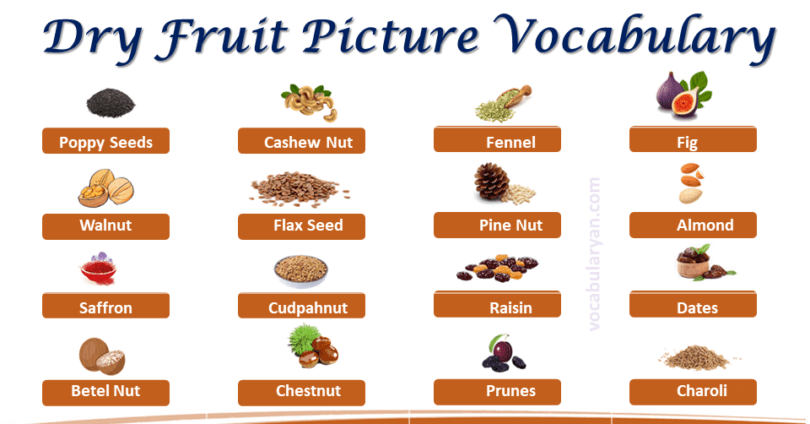
Dry fruits are fruits, nuts, and seeds with the water removed to keep them nutritious and shelf-stable. The four main categories are nuts, dried fruits and berries, edible seeds, and traditional or exotic dry fruits, from almonds to goji berries.
Dry fruits have four main categories: nuts (almond, cashew, walnut, pistachio, hazelnut, pecan, brazil nut, macadamia, peanut, chestnut), dried fruits and berries (raisin, date, fig, apricot, prune, cranberry, mango, blueberry, cherry, pineapple), edible seeds (pine nut, pumpkin, sunflower, chia, flax, sesame, poppy, lotus), and traditional or exotic dry fruits (charoli, betel nut, desiccated coconut, goji berries, mulberries).
Common Dry Fruit Names With Pictures
Each category is defined by what the item is and how it is prepared. Nuts, dried fruits and berries, and edible seeds are the three main everyday categories. The fourth is traditional and exotic dry fruits like charoli, desiccated coconut, and goji berries.
Nut Names in English
Nuts are hard-shelled fruits with an edible kernel inside, eaten raw or roasted as a healthy snack.
Almonds:
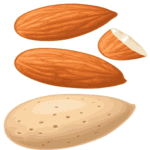
small oval light-brown seeds from the almond tree, with a hard outer shell and a smooth crunchy kernel inside. Almonds are eaten raw, roasted, or soaked overnight and peeled, and California grows about 80% of the global almond supply.
Cashews: kidney-shaped creamy-white nuts from the cashew tree of Brazil, with a mild sweet flavour and rich texture. Cashews are eaten roasted and salted as a snack, ground into cashew butter, and added to Indian curries and Southeast Asian stir-fries for a creamy finish.
Walnuts:
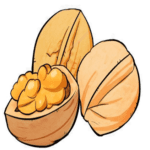
brain-shaped nuts with a wrinkled surface and rich buttery flavour, sold in halves inside a hard shell. Walnuts are eaten raw, baked into brownies and banana bread, and pressed for walnut oil, and they are the highest plant source of omega-3 fatty acids.
Pistachios:
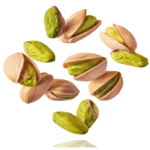
small green nuts inside a partly open beige shell, native to the Middle East and Iran. Pistachios are eaten roasted and salted from the shell, ground into pistachio paste for Italian gelato, and used in Indian sweets like kulfi and burfi.
Hazelnuts: small round nuts (also called filberts) with a hard brown shell and a sweet buttery flavour. Hazelnuts are the base of Italian Nutella spread and Ferrero Rocher chocolates, and Turkey produces about 70% of the world’s hazelnut supply.
Pecans: oval buttery nuts native to the southern United States, with a smooth reddish-brown shell. Pecans are the star of American Southern pecan pie, added to fudge and pralines, and eaten roasted with maple syrup or cinnamon coating.
Brazil Nuts: large triangular nuts from the Amazon rainforest, with a creamy rich flavour and a hard three-sided shell. Brazil nuts are one of the richest food sources of selenium, and just two nuts a day provide the full recommended daily intake of the mineral.
Macadamia Nuts: round white creamy nuts native to Australia, with the hardest shell of any commercial nut. Macadamia nuts have a mild sweet flavor, are used in Hawaiian white-chocolate cookies, and are the most expensive nut in the world by weight.
Peanuts: small oval brown-skinned legumes (technically not nuts) that grow underground in a soft shell. Peanuts are eaten roasted and salted, ground into peanut butter, boiled in Southern American cuisine, and pressed for peanut oil.
Chestnuts:
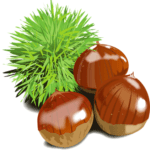
large brown glossy nuts inside a spiky green burr, roasted in winter across Europe. Chestnuts have a starchy sweet flavor closer to a potato than a normal nut, and they are used in stuffing, soups, and traditional Christmas dishes.
Dried Fruits and Berries With Names
Dried fruits and berries are fresh fruits with the water removed to concentrate their flavour and extend shelf life.
Raisins: dried grapes in dark brown, golden, or black varieties, with a sweet chewy texture. Raisins are eaten as a snack straight from the box, added to breakfast cereal, baked into cookies and fruitcake, and mixed into Indian pilaf rice.
Dates:
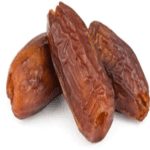
long sticky brown-black dried fruits with a very sweet caramel-like flavour and a stone in the middle. Dates are eaten straight, stuffed with almonds, blended into smoothies, and rolled into energy balls, and Medjool is the largest and most-prized variety.
Dried Figs: small pear-shaped dried fruits with a chewy sweet flesh and tiny crunchy seeds. Dried figs are eaten as a snack, added to cheese boards, baked into fig rolls, and have been cultivated for over 11,000 years in the Mediterranean.
Dried Apricots: bright orange oval dried fruits, sweet-tart in flavor, made by drying fresh apricots. Dried apricots are eaten as a snack, added to Moroccan tagines, and one of the most-used dried fruits in North African and Turkish cuisine.
Prunes:
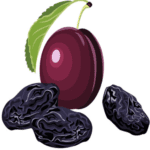
dark purple wrinkled dried plums, chewy and sweet with a slight tang. Prunes are eaten straight, stewed with pork or duck, and known for their high fiber content that supports digestive health.
Dried Cranberries: small tart red berries dried and lightly sweetened, sold under brand names like Craisins. Dried cranberries are added to trail mix, tossed into salads with feta and walnuts, and baked into oat cookies and holiday breads.
Dried Mango: long strips of orange mango flesh with the water removed, chewy and intensely sweet. Dried mango is a popular Filipino snack, added to trail mix, chopped into salsas, and one of the most-loved dried tropical fruits worldwide.
Dried Blueberries: small round dark-blue-purple dried berries, sweet-tart with a chewy texture. Dried blueberries are added to muesli, baked into muffins and pancakes, and prized for their high antioxidant content among dried fruits.
Dried Cherries: small round dried cherries in tart or sweet varieties, deep red or almost black. Dried cherries are added to trail mix, baked into scones, and glazed on top of American cherry pies and Wisconsin cheeses.
Dried Pineapple: yellow chewy rings or chunks of dried pineapple, sweet with a mild tang. Dried pineapple is added to tropical trail mix, mixed into fruit cakes, and used as a topping for oatmeal and yoghurt breakfast bowls.
Edible Seeds With Names
Edible seeds are the small nutrient-dense seeds of grains, flowers, and plants, eaten raw or roasted.
Pine Nuts:
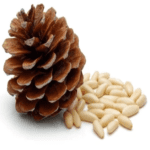
small cream-coloured elongated seeds from pine cones, with a rich buttery flavour. Pine nuts are the essential ingredient in Italian pesto, added to Middle Eastern rice dishes, and toasted on salads and pastas.
Pumpkin Seeds: small flat green seeds (also called pepitas) from inside a pumpkin, roasted and salted as a snack. Pumpkin seeds are added to trail mix, sprinkled on salads and soups, and rich in zinc and magnesium.
Sunflower Seeds: small teardrop-shaped seeds from the sunflower head, with a soft mild flavor. Sunflower seeds are eaten roasted and salted (from the shell in America), added to bread and salads, and pressed for sunflower oil.
Chia Seeds: tiny black or white seeds from the chia plant of Mexico, soaking up liquid to form a gel-like texture. Chia seeds are added to smoothies, made into overnight-oats-style chia puddings, and rich in omega-3 fatty acids.
Flax Seeds:
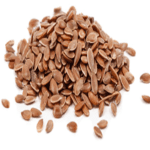
small flat brown or golden seeds (also called linseed), with a mild nutty flavor. Flax seeds are ground into meal for baking, sprinkled on yoghurt and oatmeal, and pressed for flaxseed oil rich in omega-3.
Sesame Seeds: tiny flat seeds in white or black varieties, with a rich nutty flavor when toasted. Sesame seeds top burger buns and sushi rolls, are ground into Middle Eastern tahini paste, and pressed into aromatic sesame oil.
Poppy Seeds:
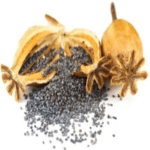
tiny grey-blue seeds with a mild nutty crunch, sourced from the opium poppy plant (with the drug compounds removed). Poppy seeds top bagels and muffins, fill Central European strudels and cakes, and add crunch to Indian potato dishes.
Lotus Seeds (Makhana): puffed white lotus seeds sold roasted and salted, popular in India and East Asia. Lotus seeds (called makhana in India) are eaten as a light healthy snack and used in savoury and sweet dishes like kheer.
Traditional and Exotic Dry Fruits
Traditional and exotic dry fruits are the less-common items from specific cultures and regions worldwide.
Charoli: small round brown seeds from the chironji tree of India, with a soft nutty flavor closer to an almond. Charoli seeds are used in Indian sweets like phirni, kheer, and traditional mithai, and they are one of the priciest ingredients in the Indian dry-fruit trade.
Betel Nut:
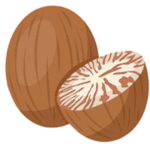
hard round orange-brown seed of the areca palm tree, chewed with betel leaves in South Asia and the Pacific. Betel nut is a traditional stimulant but is a known health risk, and long-term chewing is linked to oral cancer by the World Health Organization.
Desiccated Coconut: dried and finely grated coconut flesh, white and slightly sweet. Desiccated coconut is added to baking (macaroons, coconut cake), stirred into Indian curries and chutneys, and toasted for a nutty flavor on top of yogurt.
Goji Berries: small bright-red dried berries from a shrub native to China, with a mild sweet-tart flavor. Goji berries are eaten as a snack, added to trail mix, brewed into tea, and prized in traditional Chinese medicine for their antioxidant content.
Dried Mulberries: small elongated dried berries in white or dark purple varieties, chewy with a mild honey-like sweetness. Dried mulberries are added to trail mix, sprinkled over yogurt and oatmeal, and rich in vitamin C, iron, and antioxidants.
Dry Fruits That Look Similar
Some dry fruits and their labels look close but describe different items or the same item under two names.
Nut vs Dry Fruit vs Seed
| Term | Meaning |
|---|---|
| Nut | Hard-shelled fruit with an edible kernel (almond, walnut, hazelnut) |
| Dry Fruit | Umbrella term for nuts, dried fruits, and seeds together (Indian English) |
| Seed | Small nutrient-dense reproductive unit of a plant (chia, flax, pumpkin) |
In everyday English (especially in South Asian usage), “dry fruit” is an umbrella term for all three. Botanically, an almond is a seed, a peanut is a legume, and a raisin is a dried berry.
Raisin vs Sultana vs Currant
| Term | Made From |
|---|---|
| Raisin | Dried dark or golden grapes |
| Sultana | Dried seedless golden grape (called Thompson seedless in America) |
| Currant | Dried tiny Zante grape (also called dried currant) |
All three are dried grapes. Raisins are the largest. Sultanas are golden and made from seedless grapes. Currants are the smallest and darkest.
Prune vs Dried Plum
| Term | Verdict |
|---|---|
| Prune | Same as dried plum |
| Dried Plum | Same as prune (marketing rebrand) |
Both name the same fruit. American growers rebranded prunes as “dried plums” in the early 2000s to broaden appeal beyond the digestive-health association.
Peanut vs Groundnut
| Term | Verdict |
|---|---|
| Peanut | American English name |
| Groundnut | British and Indian English name |
Both name the same legume that grows underground rather than on a tree. Botanically, peanuts are not nuts at all: they are legumes like beans and lentils.
FAQs
Q1. What is the difference between dry fruits and nuts?
In everyday English, “dry fruits” is an umbrella term for three types: nuts (almonds, walnuts, cashews), dried fruits (raisins, dates, figs), and edible seeds (chia, sunflower, pumpkin). Nuts come from hard shells and are eaten from the shell. Dried fruits are fresh fruits with the water removed. Seeds are small reproductive units of plants.
Q2. Which dry fruit is best for the brain?
Walnuts and almonds are the two dry fruits most linked with brain health. Walnuts are the highest plant source of omega-3 fatty acids (which support brain cell function), and their shape resembles a brain. Almonds contain vitamin E and magnesium, both connected with memory and cognitive function.
Q3. Which dry fruits are best for skin and hair?
Almonds, walnuts, and dates are the top dry fruits for skin and hair. Almonds provide vitamin E (skin repair) and biotin (hair growth). Walnuts provide omega-3 fatty acids for scalp health. Dates provide iron for hair strength and antioxidants for skin glow.
Q4. What are the healthiest dry fruits to eat daily?
The five healthiest dry fruits to eat daily are almonds (protein and vitamin E), walnuts (omega-3), pistachios (protein), dates (natural energy), and figs (fiber and calcium). A small handful of mixed dry fruits provides balanced nutrition without excess sugar or calories.
Q5. Which dry fruits are highest in protein?
The dry fruits highest in protein per 100 grams are peanuts (25g), almonds (21g), pistachios (20g), cashews (18g), and walnuts (15g). Peanuts are the highest, though they are botanically legumes rather than tree nuts. Vegans and vegetarians rely on these for plant-based protein.
Q6. Are dry fruits and dried fruits the same thing?
Not exactly. In American English, “dried fruits” refers only to fruits dried with the water removed (raisins, dates, figs, prunes). In Indian and British English, “dry fruits” is a broader umbrella term that names dried fruits, nuts, and edible seeds all together.

Leave a Comment