
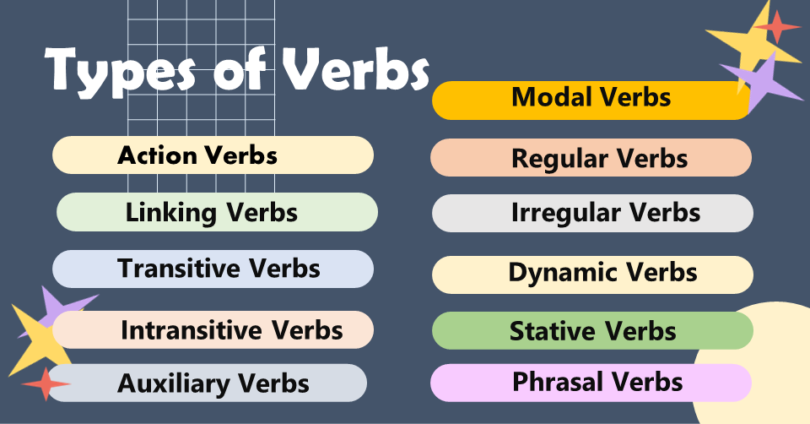
A verb is the word that functions as the head of a verb phrase and expresses an action, occurrence, or state. English groups verbs into several types of verbs, and each type names one feature of a verb rather than a fixed category for the word itself. Fourteen recognized classifications cover the full system: main, auxiliary, modal, action or dynamic, stative, linking, transitive, intransitive, ditransitive, regular, irregular, finite, nonfinite, and phrasal verbs. Each classification uses its own test and its own sentence proof, so identifying a verb means asking the right question about function, meaning, objects, form, and tense. A parts of speech chart places the verb alongside nouns, adjectives, and the rest of the word classes it works with in a sentence.
Grammar sources count verb types differently because they classify different features of the same word, not because grammarians disagree on what a verb is.
Types of Verbs in English With Examples
Grammar books split verbs into different totals because each source classifies a different feature: what the verb does in the sentence, what it means, whether it takes an object, how it forms its past tense, and whether it marks tense on its own. This system counts 14 classifications built across five axes, including ditransitive, finite, and nonfinite verbs that shorter lists skip.
The 14 types of verbs are:
- Main verbs
- Auxiliary verbs
- Modal verbs
- Action or dynamic verbs
- Stative verbs
- Linking verbs
- Transitive verbs
- Intransitive verbs
- Ditransitive verbs
- Regular verbs
- Irregular verbs
- Finite verbs
- Nonfinite verbs
- Phrasal verbs
Five axes organize these classifications, and a single verb receives a label from several axes at once, since each axis measures a separate feature rather than describing the same feature twice:
- Function: whether a verb gives its own meaning or supports another verb.
- Meaning: whether a verb names an event or a state.
- Complement and object pattern: whether a verb links the subject to a description or takes an object.
- Form and finiteness: how a verb forms its past tense and whether it marks tense at all.
- Construction: whether a verb combines with a particle for a new meaning.
One verb receives several of these labels inside the same sentence. Meaning and clause structure decide most labels, and the identification method further on covers the rest.
How Verb Types Work Together
Take the sentence Maya wrote a letter. The verb wrote answers five different questions at once:
- Function: main, because it gives the sentence its central meaning
- Meaning: action or dynamic, because it names an event
- Object pattern: transitive, because it takes the direct object letter
- Form: irregular, because its past form does not use the -ed pattern
- Finiteness: finite, because it marks past tense and agrees with the subject Maya
One word, five labels, five separate axes, and none of them contradicts another.
Now compare Maya has written a letter. Written stays the main verb, but has functions as the auxiliary that marks the perfect aspect. An auxiliary verb never replaces the main verb; it supports it. That difference between giving meaning and supporting another verb defines the next classification.
Main Verbs and Auxiliary Verbs
Function measures whether a verb gives its own meaning or supports another verb inside the same verb phrase.
Main Verbs
A main verb, also called a lexical verb, gives the verb phrase its core meaning. Strip every auxiliary out of a sentence and the verb left standing is the main verb:
- wrote in Maya wrote a letter
- written in Maya has written a letter
- finish in Maya must finish the letter
Auxiliary Verbs
An auxiliary verb, familiar to many students as a helping verb, supports the main verb by marking tense, aspect, voice, or a question. English forms most verb phrases from three primary auxiliaries: be, do, and have.
- is marks the continuous aspect in Maya is writing a letter
- does forms the negative in Maya does not write letters
- has marks the perfect aspect in Maya has written a letter
A dedicated auxiliary verbs lesson works through each primary auxiliary and its full set of forms.
Modal Verbs
A modal verb is a subset of auxiliary verbs, not a separate top-level family. It adds possibility, permission, obligation, or ability to the main verb rather than marking tense on its own. The full set: can, could, may, might, must, shall, should, will, and would.
- must adds obligation in Maya must finish the letter
- could adds possibility in Maya could finish the letter by Friday
Every modal verb functions as one type of auxiliary support, never as an independent family beside it.
Action Verbs and Stative Verbs
Meaning measures whether a verb names an event that happens or a state that continues without change.
Action Verbs
An action verb, called a dynamic verb in precise grammatical terms, names an event: something that happens, changes, or develops over time. Wrote, opened, and gave all function as action verbs because each one names something that took place. Classroom grammar keeps the label action verb for its familiarity, while dynamic verb names the term that contrasts directly with stative verb.
Stative Verbs
A stative verb names a state, a feeling, a relationship, or a sense perception rather than an event. Know, believe, own, and love function as stative verbs in ordinary use. Classification follows meaning rather than a fixed word list, since several verbs shift meaning between action and stative use:
- think names an opinion, a stative use, in I think you are right
- think names a mental process in progress, an action use, in I am thinking about the problem
The continuous form fits only when the verb keeps its action meaning, a distinction that a full present continuous tense lesson covers in more depth.
Linking Verbs and Subject Complements
A linking verb connects the subject to a subject complement: a word or phrase that renames or describes the subject rather than receiving an action. Be, seem, become, appear, feel, look, sound, taste, remain, and grow function as linking verbs whenever they introduce a complement.
- tastes links soup to the complement good in The soup tastes good
- tastes names an action with a direct object in Maya tastes the soup
The label changes because the sentence structure changes, not because the word has two unrelated meanings.
How Verbs Work With Objects
A direct object receives the action of the verb directly. An indirect object receives the direct object and names the person who benefits from the action. Object pattern describes how a verb behaves in one specific clause, never a fixed property of the word.
Transitive Verbs
A transitive verb takes a direct object. Maya opened the door uses opened as a transitive verb, since the door receives the action and answers the question opened what.
Intransitive Verbs
An intransitive verb takes no object. The door opened uses opened as an intransitive verb, since the sentence ends after the subject and the verb. Open functions as both a transitive and an intransitive verb depending on the clause, which is exactly why transitivity describes a use rather than a permanent label on the word.
Ditransitive Verbs
A ditransitive verb takes both a direct object and an indirect object in the same clause. Maya gave Leo a note uses gave as a ditransitive verb:
- Leo is the indirect object who receives the note
- a note is the direct object that Leo receives
Eat rarely functions as a ditransitive verb, since most uses take only a direct object, as in Maya ate the sandwich.
Regular and Irregular Verbs
Form measures how a verb forms its past tense and its past participle.
Regular Verbs
A regular verb adds -ed to the base form to form both the past tense and the past participle, following three spelling patterns:
- live becomes lived
- study becomes studied
- stop becomes stopped, doubling the final consonant after a single vowel
A past simple tense lesson works through the full spelling system with more forms.
Irregular Verbs
An irregular verb forms its past tense and past participle outside the -ed pattern:
- write becomes wrote and written
- go becomes went and gone
- have becomes had once, for both the past tense and the past participle
- get becomes got in every variety of English, and the past participle splits by dialect: American English uses gotten in most senses, as in Maya has gotten better, while British English keeps got as the past participle throughout
Finite and Nonfinite Verbs
Finiteness measures whether a verb marks tense or agreement and completes an independent clause.
Finite Verbs
A finite verb marks tense or subject agreement and completes an independent clause on its own. Wants in She wants to leave is finite because it agrees with the third-person subject she and marks present tense.
Nonfinite Verbs
A nonfinite verb shows no tense and no subject agreement. To leave in She wants to leave functions as a nonfinite infinitive. Nonfinite forms cover three shapes:
- Infinitives such as to leave
- Gerunds such as leaving
- Participles such as left or leaving used inside a longer verb phrase
A finite verb completes the clause while a nonfinite verb depends on it, which is why every complete sentence needs at least one finite verb.
Phrasal Verbs in English
A phrasal verb combines a verb with a particle, a short word such as up, out, or off, to form a meaning that neither word has alone:
- Give up means to stop trying rather than to hand something upward
- Look up means to search a reference source for a fact or a word
- Turn off means to stop a device from running
- Make up means to invent a story, to reconcile after an argument, or to complete a missing amount, and it should never be confused with the noun makeup, the cosmetic product applied to a face
A phrasal verbs with get lesson covers one especially productive verb family in full.
Types of Verbs Comparison Chart
The comparison chart organizes all 14 classifications by axis, type, test, and example, keeping every cell to one short phrase so the chart stays readable on a small screen.
| Axis | Type | Test | Example |
|---|---|---|---|
| Function | Main | Remains after removing every auxiliary | Wrote in Maya wrote a letter |
| Function | Auxiliary | Supports tense, aspect, voice, or a question | Has in Maya has written a letter |
| Function | Modal | Adds possibility, permission, or obligation | Must in Maya must finish the letter |
| Meaning | Action or dynamic | Names an event that happens or changes | Wrote in Maya wrote a letter |
| Meaning | Stative | Names a state, feeling, or relationship | Know in Maya knows the answer |
| Complement | Linking | Connects the subject to a subject complement | Tastes in The soup tastes good |
| Object pattern | Transitive | Takes a direct object | Opened in Maya opened the door |
| Object pattern | Intransitive | Takes no object | Opened in The door opened |
| Object pattern | Ditransitive | Takes a direct and an indirect object | Gave in Maya gave Leo a note |
| Form | Regular | Adds -ed for the past tense and past participle | Opened |
| Form | Irregular | Changes form outside the -ed pattern | Wrote, written |
| Finiteness | Finite | Marks tense or agreement and completes the clause | Wants in She wants to leave |
| Finiteness | Nonfinite | Shows no tense or agreement | To leave in She wants to leave |
| Construction | Phrasal | Combines a verb with a particle for one meaning | Give up |
A full list of verbs A to Z pairs well with this chart for readers who need a running vocabulary bank rather than a classification system.
How to Identify Verb Types
Five steps convert the classifications into a method you run on any sentence:
- Find the complete verb phrase, including every auxiliary attached to the main verb.
- Separate the main verb from the auxiliaries that support it.
- Check whether the verb names an action, a state, or a link to a subject complement.
- Check for a direct object, an indirect object, or no object at all.
- Check the verb’s regularity, its finiteness, and whether it combines with a particle.
Running a sentence through all five checks names every classification the verb qualifies for, rather than forcing it into one box.
Common Mistakes With Verb Types
Four confusions repeat across worksheets and grammar sites, and catching them keeps you from mislabeling a verb you already understand.
Action verb and verb mean the same thing. ❌ Action or dynamic verb is one meaning classification among several, since many verbs function as stative or linking verbs instead. ✅
Modal verbs form a separate family beside auxiliary verbs. ❌ Modal verbs are a subset of auxiliary verbs, so must, can, and should all count as auxiliaries first. ✅
A verb such as open stays permanently transitive or permanently intransitive. ❌ Transitivity describes how a verb behaves in one clause, and the same verb takes a different pattern in each sentence. ✅
Stative verbs never appear in a continuous form. ❌ A stative verb does not take the continuous form while it keeps its stative meaning; several stative verbs shift to an action meaning and take the continuous form. ✅
Verb Types Practice Questions
Test the five-step method against eight sentences before checking your answers.
- Name the main verb and the auxiliary verb in Maya has finished her homework.
- Classify opened as transitive or intransitive in The door opened.
- Is think stative or dynamic in I think you are right? State the reason in one sentence.
- Name the direct object and the indirect object in Maya gave Leo a note.
- Give the past tense and the past participle of go.
- Identify the finite verb and the nonfinite verb in She wants to leave.
- Correct the error in Maya likes to makeup her schedule every Sunday.
- Is must a main verb or an auxiliary verb in Maya must finish the letter?
Answers
- Finished is the main verb and has is the auxiliary verb, since has marks the perfect aspect while finished gives the sentence its meaning.
- Opened functions as an intransitive verb here, since the sentence ends without a direct object.
- Think functions as a stative verb, since it names an opinion rather than an action taking place.
- Leo is the indirect object and a note is the direct object, since Leo receives the note.
- Go becomes went in the past tense and gone in the past participle.
- Wants is finite because it marks present tense and agrees with she, and to leave is nonfinite because it shows no tense.
- The correct verb is make up, since makeup names the cosmetic product rather than the act of organizing a schedule.
- Must functions as an auxiliary verb, since every modal verb belongs to the auxiliary subset rather than giving a sentence its meaning alone.
FAQs
Q1. How many types of verbs are there?
Grammar sources report different totals because each one classifies a different feature of the verb rather than disagreeing on what a verb is. Counting main, auxiliary, modal, meaning-based, object-based, form-based, finiteness-based, and phrasal classifications together produces 14 verb types, a fuller count than lists that skip ditransitive, finite, or nonfinite verbs.
Q2. What are the three main types of verbs?
Classroom grammar narrows the system to three types for beginners: action verbs, linking verbs, and helping verbs. The complete grammatical system extends far beyond that trio, adding object pattern, form, and finiteness as separate classification axes with their own rules.
Q3. What is the difference between transitive and intransitive verbs?
A transitive verb takes a direct object, while an intransitive verb takes none. Maya opened the door is transitive, and The door opened is intransitive, even though both sentences use the same verb. Several verbs switch between the two patterns depending on the clause built around them.
Q4. What is the difference between regular and irregular verbs?
A regular verb adds -ed to form its past tense and past participle, following predictable spelling rules such as stop becoming stopped. An irregular verb changes form outside that pattern, as go becomes went and gone rather than goed.
Q5. What is the difference between finite and nonfinite verbs?
A finite verb marks tense or subject agreement and completes an independent clause by itself. A nonfinite verb, including infinitives, gerunds, and participles, shows no tense and cannot stand alone as a clause’s only verb, as to leave depends on wants in She wants to leave.
You May Also Like

Leave a Comment