
You close your laptop, pack a small bag, and say, “I’m going on vacation.” The sentence is true, yet it barely carries the sense of escape and deep relief you feel. A break from routine often brings excitement and calm at the same time. Plain language can sound too ordinary for moments that feel special.
That is where idioms for vacation become useful in learning English. These expressions appear when people talk about travel or time away from work. Some sound light and playful, while others reflect quiet relaxation and renewed energy.
We’ll look at how these phrases work in sentences and short dialogue, and how they connect with natural word pairings. You’ll sense when one fits a quick weekend trip and when another suits a long holiday. Here are the words that carry the feeling of getting away.
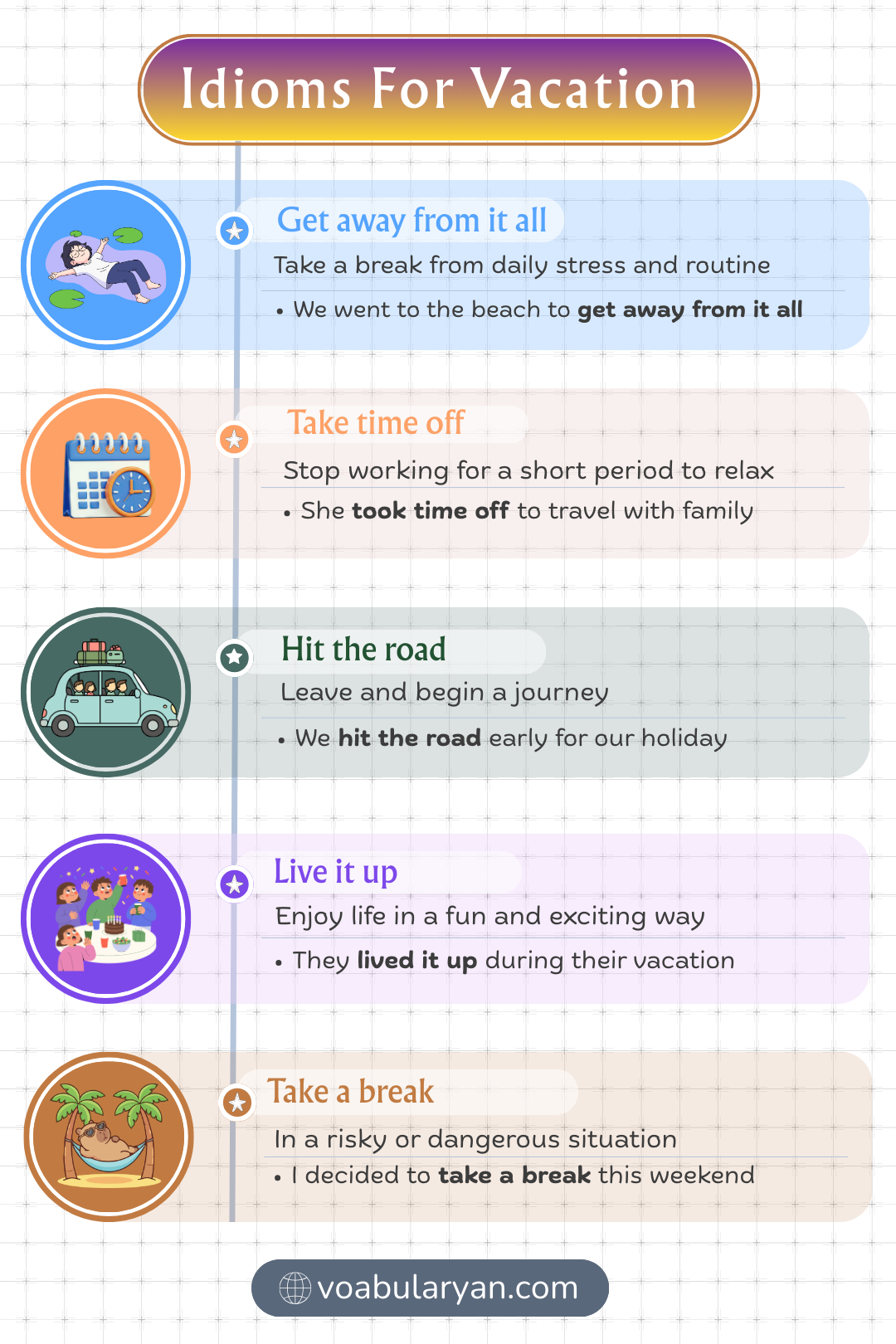
Vacation Idioms For Planning And Packing
Live Out Of A Suitcase
Meaning: stay in many places and keep belongings in luggage.
When To Use It: Say it when frequent travel makes home life feel temporary.
Collocations: live out of a suitcase for months, live out of a suitcase on tours, live out of a suitcase for work
Example Sentences:
- During the job trip, I lived out of a suitcase for weeks.
- She lived out of a suitcase while moving between cities.
Dialogue:
Amina: I have been living out of a suitcase lately.
Hassan: That constant travel sounds tiring.
Closest Alternatives:
- live on the road
- be constantly traveling
Travel Light
Meaning: take few belongings when going somewhere.
When To Use It: Say it when packing small and keeping things easy.
Collocations: travel light for a weekend, travel light with one bag, travel light on trips
Example Sentences:
- We decided to travel light with one small bag.
- She always travels light to avoid heavy luggage.
Dialogue:
Sara: I will travel light this time.
Imran: That makes the trip feel more easy.
Closest Alternatives:
- pack lightly
- bring little
Clear The Decks
Meaning: remove other tasks to focus on one important job.
When To Use It: Say it when someone frees time for a main priority.
Collocations: clear the decks for a deadline, clear the decks for a launch, clear the decks before starting
Example Sentences:
- I cleared the decks to finish the report today.
- They cleared the decks and focused on the big project.
Dialogue:
Hira: We should clear the decks before we begin.
Usman: Yes, then we can focus with full attention.
Closest Alternatives:
- free up time
- remove distractions
Go The Extra Mile
Meaning: do more effort than what is expected.
When To Use It: Say it when someone works beyond the basic duty.
Collocations: go the extra mile for customers, go the extra mile at work, go the extra mile to help
Example Sentences:
- She went the extra mile to help the new student.
- He went the extra mile and fixed the problem quickly.
Dialogue:
Nadia: She always goes the extra mile.
Farhan: That kind of effort stands out.
Closest Alternatives:
- do more than required
- put in extra effort
In The Driver’s Seat
Meaning: in control of a situation or decision.
When To Use It: Say it when someone has power to choose what happens.
Collocations: be in the driver’s seat now, put someone in the driver’s seat, stay in the driver’s seat
Example Sentences:
- After the deal, she was in the driver’s seat.
- He is in the driver’s seat for the final choice.
Dialogue:
Lena: Are we in the driver’s seat now?
Ryan: Yes, we control the next step.
Closest Alternatives:
- in control
- calling the shots
Back On Track
Meaning: returning to the right path after problems.
When To Use It: Say it when progress starts again after delays.
Collocations: get back on track, put it back on track, back on track again
Example Sentences:
- The project is back on track after the meeting.
- He got back on track after a hard week.
Dialogue:
Maya: Are we back on track now?
Caleb: Yes, the plan is moving forward again.
Closest Alternatives:
- back to normal
- moving forward again
Full Steam Ahead
Meaning: move forward with full speed and energy.
When To Use It: Say it when a plan continues strongly with no pause.
Collocations: full steam ahead on the project, go full steam ahead, push full steam ahead
Example Sentences:
- After approval, we went full steam ahead.
- They moved full steam ahead to finish on time.
Dialogue:
Sadia: Now it is full steam ahead.
Bilal: Great, let us keep the momentum.
Closest Alternatives:
- move forward fast
- go all out
Vacation Idioms For Leaving And Getting There
Hit The Road
Meaning: leave and start a trip.
When To Use It: say it when it is time to depart.
Collocations: hit the road early, hit the road at dawn, ready to hit the road
Example Sentences:
- We should Hit The Road before traffic gets heavy.
- She Hit The Road right after breakfast.
Dialogue:
Mina: Are we leaving now?
Hasan: Yes, let us Hit The Road.
Closest Alternatives:
- set off
- head out
Make Tracks
Meaning: leave quickly and move away fast.
When To Use It: say it when someone needs to go soon.
Collocations: make tracks home, make tracks before it gets late, better make tracks
Example Sentences:
- It is late, so I should Make Tracks.
- They Make Tracks when the rain started.
Dialogue:
Hina: Should we stay longer?
Saad: No, we should Make Tracks.
Closest Alternatives:
- leave quickly
- head out fast
Make A Pit Stop
Meaning: stop briefly during a trip to rest or get something.
When To Use It: say it when the stop is short and practical.
Collocations: make a pit stop for gas, make a pit stop at a café, make a quick pit stop
Example Sentences:
- We will Make A Pit Stop for water and snacks.
- He Make A Pit Stop to fill the tank.
Dialogue:
Areeba: Are we stopping anywhere?
Fahad: Yes, we will Make A Pit Stop soon.
Closest Alternatives:
- stop briefly
- take a short break
Catch A Red-Eye
Meaning: take a late-night flight, often arriving early.
When To Use It: say it when traveling overnight by plane.
Collocations: catch a red-eye to New York, catch a red-eye tonight, take the red-eye
Example Sentences:
- She will Catch A Red-Eye to reach home by morning.
- I Catch A Red-Eye when tickets are cheaper.
Dialogue:
Sana: When are you flying out?
Bilal: I will Catch A Red-Eye tonight.
Closest Alternatives:
- take an overnight flight
- fly late
Set Sail
Meaning: begin a trip by boat or ship.
When To Use It: say it when a ship leaves the harbor.
Collocations: set sail at sunrise, set sail for an island, ready to set sail
Example Sentences:
- The crew will Set Sail at dawn.
- They Set Sail for the next port.
Dialogue:
Zoya: Are they leaving now?
Hamza: Yes, they will Set Sail soon.
Closest Alternatives:
- depart by ship
- head out to sea
Vacation Idioms For Budget Travel
On A Shoestring
Meaning: with very little money and a tight budget.
When To Use It: Say it when plans must stay cheap because funds are limited.
Collocations: travel on a shoestring, live on a shoestring, on a shoestring budget
Example Sentences:
- They traveled on a shoestring and stayed in small rooms.
- She ran the event on a shoestring and kept costs low.
Dialogue:
Amina: We are doing this on a shoestring.
Hassan: Then every cost needs care.
Closest Alternatives:
- on a tight budget
- with little money
Bite The Bullet
Meaning: face a painful task with courage and accept it.
When To Use It: Say it when someone finally does something hard or unpleasant.
Collocations: bite the bullet and pay, bite the bullet and apologize, bite the bullet and decide
Example Sentences:
- I bit the bullet and told the truth at last.
- She bit the bullet and paid the full cost.
Dialogue:
Sara: I will bite the bullet and call them.
Imran: That takes real courage.
Closest Alternatives:
- face it
- do the hard thing
Vacation Idioms For Sightseeing And Exploring
Take The Scenic Route
Meaning: choose a longer way to enjoy views and sights.
When To Use It: say it when travel is slower but more enjoyable.
Collocations: take the scenic route home, take the scenic route through hills, take the scenic route along the coast
Example Sentences:
- We Take The Scenic Route to see the mountains.
- She Take The Scenic Route and arrived later than planned.
Dialogue:
Mina: Why are we not using the highway?
Hasan: Let us Take The Scenic Route today.
Closest Alternatives:
- go the long way
- take a prettier way
Off The Beaten Path
Meaning: away from common places that most people visit.
When To Use It: say it when a place feels quiet and not crowded.
Collocations: a cafe off the beaten path, off the beaten path travel, stay off the beaten path
Example Sentences:
- We found a village Off The Beaten Path.
- The trail is Off The Beaten Path and very calm.
Dialogue:
Hina: Is it crowded there?
Saad: No, it is Off The Beaten Path.
Closest Alternatives:
- hidden place
- away from crowds
Road Less Traveled
Meaning: an uncommon choice that few people make.
When To Use It: say it when someone chooses a different direction in life.
Collocations: choose the road less traveled, take the road less traveled
Example Sentences:
- She took the Road Less Traveled and started her own shop.
- He chose the Road Less Traveled instead of a safe job.
Dialogue:
Areeba: Why did he change fields?
Fahad: He took the Road Less Traveled.
Closest Alternatives:
- unusual choice
- different path
Leave No Stone Unturned
Meaning: search everywhere and miss nothing.
When To Use It: say it when effort is complete and thorough.
Collocations: leave no stone unturned in the search, leave no stone unturned to find, leave no stone unturned during the hunt
Example Sentences:
- We will Leave No Stone Unturned to find the missing file.
- They Leave No Stone Unturned during the investigation.
Dialogue:
Sana: Are we done looking?
Bilal: Not yet, we will Leave No Stone Unturned.
Closest Alternatives:
- search everywhere
- look thoroughly
Blaze A Trail
Meaning: lead the way into something new or bold.
When To Use It: say it when someone starts a new path for others.
Collocations: blaze a trail in science, blaze a trail for others, blaze a trail with new ideas
Example Sentences:
- She Blaze A Trail in her field at a young age.
- They Blaze A Trail with a fresh style of music.
Dialogue:
Zoya: She really Blaze A Trail here.
Hamza: Yes, she created a new path.
Closest Alternatives:
- pioneer
- lead the way
Far And Wide
Meaning: across many places and over a large area.
When To Use It: say it when searching or traveling in many locations.
Collocations: search far and wide, travel far and wide, known far and wide
Example Sentences:
- They searched Far And Wide for the missing dog.
- He traveled Far And Wide to learn new skills.
Dialogue:
Mina: Did you look everywhere?
Hasan: Yes, I searched Far And Wide.
Closest Alternatives:
- everywhere
- across many places
Vacation Idioms For Beach And Sun
Catch Some Rays
Meaning: spend time in sunlight for warmth and relaxation.
When To Use It: Say it when someone goes outside to enjoy the sun.
Collocations: catch some rays at the beach, catch some rays by the pool, go catch some rays
Example Sentences:
- We went to the park to catch some rays.
- She sat on the balcony to catch some rays.
Dialogue:
Amina: Let us catch some rays this afternoon.
Hassan: Yes, the sun feels warm today.
Closest Alternatives:
- sunbathe
- get some sun
Get Your Feet Wet
Meaning: gain first experience by trying something new in a small way.
When To Use It: Say it when someone starts learning a new task gently.
Collocations: get your feet wet in a new job, get your feet wet with a small project, get your feet wet in a skill
Example Sentences:
- He got his feet wet by helping with a small task.
- She got her feet wet in the role during the first week.
Dialogue:
Sara: I just want to get my feet wet first.
Imran: Starting small builds confidence.
Closest Alternatives:
- start out
- try it for the first time
Vacation Idioms For Rest And Unplugging
Get Away From It All
Meaning: leave daily stress behind for a short time.
When To Use It: say it when someone wants a break from routine.
Collocations: get away from it all for a weekend, get away from it all on holiday, just get away from it all
Example Sentences:
- We want to Get Away From It All this weekend.
- She booked a cabin to Get Away From It All.
Dialogue:
Hina: I need to Get Away From It All.
Saad: A quiet trip can bring peace.
Closest Alternatives:
- take a break
- escape for a while
Kick Back And Relax
Meaning: rest comfortably and stop worrying for a while.
When To Use It: say it when it is time to rest after work.
Collocations: kick back and relax at home, kick back and relax tonight, kick back and relax with friends
Example Sentences:
- After dinner, we Kick Back And Relax.
- He plans to Kick Back And Relax on Sunday.
Dialogue:
Mina: What are you doing tonight?
Hasan: I will Kick Back And Relax.
Closest Alternatives:
- unwind
- take it easy
Recharge Your Batteries
Meaning: regain energy after being tired.
When To Use It: say it when rest helps someone feel strong again.
Collocations: recharge your batteries over the weekend, recharge your batteries after work, recharge your batteries with sleep
Example Sentences:
- She took a day off to Recharge Your Batteries.
- A long sleep helped him Recharge Your Batteries.
Dialogue:
Areeba: I feel drained.
Fahad: Go home and Recharge Your Batteries.
Closest Alternatives:
- rest up
- recover energy
Take A Breather
Meaning: pause briefly to rest and recover.
When To Use It: say it when someone needs a short break.
Collocations: take a breather after work, take a breather for a minute, take a breather before continuing
Example Sentences:
- I need to Take A Breather before the next task.
- She Take A Breather after climbing the stairs.
Dialogue:
Sana: Let me Take A Breather.
Bilal: Sure, take a short break.
Closest Alternatives:
- take a break
- pause
Off The Grid
Meaning: away from normal contact and daily noise.
When To Use It: say it when someone disconnects and stays hard to reach.
Collocations: go off the grid for a week, live off the grid, stay off the grid
Example Sentences:
- He went Off The Grid for a few days.
- She stayed Off The Grid to rest her mind.
Dialogue:
Zoya: Where has he been lately?
Hamza: He went Off The Grid.
Closest Alternatives:
- unreachable
- away from contact
Call It A Night
Meaning: stop what you are doing and go to sleep.
When To Use It: say it when it is late and you want to end.
Collocations: call it a night early, call it a night and head home, ready to call it a night
Example Sentences:
- It is getting late, so let us Call It A Night.
- After the movie, we Call It A Night.
Dialogue:
Mina: Should we keep working?
Hasan: No, let us Call It A Night.
Closest Alternatives:
- go to bed
- wrap it up
Vacation Idioms For Spontaneous Adventures
Itchy Feet
Meaning: strong urge to travel or change places soon.
When To Use It: Say it when staying still feels hard and movement feels necessary.
Collocations: get itchy feet, have itchy feet again, itchy feet before a trip
Example Sentences:
- After months at home, I got itchy feet.
- She has itchy feet and wants a new city.
Dialogue:
Amina: I have itchy feet these days.
Hassan: That travel urge can be strong.
Closest Alternatives:
- feel restless
- want to travel
Wanderlust
Meaning: a strong desire to travel and explore new places.
When To Use It: Say it when someone loves journeys and new sights.
Collocations: feel wanderlust, wanderlust hits, full of wanderlust
Example Sentences:
- His wanderlust grew after watching travel films.
- Her wanderlust pushed her to plan a long trip.
Dialogue:
Sara: I feel real wanderlust right now.
Imran: New places can bring fresh energy.
Closest Alternatives:
- love of travel
- strong travel desire
Off To A Flying Start
Meaning: beginning very well with quick early success.
When To Use It: Say it when progress is strong from the first moment.
Collocations: off to a flying start in a new job, off to a flying start this season
Example Sentences:
- The team was off to a flying start in the first match.
- She was off to a flying start with her new project.
Dialogue:
Hira: We are off to a flying start.
Usman: Yes, the early results are great.
Closest Alternatives:
- start strong
- begin well
Hit The Ground Running
Meaning: start a new task with speed and strong action.
When To Use It: Say it when someone begins work fully prepared.
Collocations: hit the ground running on day one, hit the ground running at a new job
Example Sentences:
- He hit the ground running on his first day.
- She hit the ground running and finished the plan fast.
Dialogue:
Nadia: I need to hit the ground running Monday.
Farhan: Being prepared will help.
Closest Alternatives:
- start quickly
- jump right in
Throw Caution To The Wind
Meaning: take a risk and stop being careful.
When To Use It: Say it when someone acts boldly without fear.
Collocations: throw caution to the wind and go, throw caution to the wind for once
Example Sentences:
- He threw caution to the wind and booked the trip.
- She threw caution to the wind and spoke her mind.
Dialogue:
Lena: I threw caution to the wind yesterday.
Ryan: That was a bold move.
Closest Alternatives:
- take a risk
- be fearless
On A Roll
Meaning: having repeated success without stopping.
When To Use It: Say it when wins keep coming one after another.
Collocations: be on a roll today, on a roll at work, on a roll lately
Example Sentences:
- She is on a roll and keeps scoring well.
- The team was on a roll for three games.
Dialogue:
Maya: I am on a roll this week.
Caleb: Keep that momentum going.
Closest Alternatives:
- doing great
- in a winning streak
The World Is Your Oyster
Meaning: many choices are open and success is possible.
When To Use It: Say it when someone has freedom to choose a path.
Collocations: the world is your oyster now, the world is your oyster after graduation
Example Sentences:
- With that skill, the world is your oyster.
- After the offer, the world is your oyster.
Dialogue:
Sadia: With this chance, the world is your oyster.
Bilal: It feels like open possibility.
Closest Alternatives:
- many options
- open opportunities
Get Out Of Your System
Meaning: do something once so the urge goes away.
When To Use It: Say it when a desire needs release to feel calm again.
Collocations: get it out of your system, get anger out of your system, get the urge out of your system
Example Sentences:
- He ran hard to get it out of his system.
- She talked it through to get it out of her system.
Dialogue:
Aisha: I needed to get it out of my system.
Hamza: That can bring real relief.
Closest Alternatives:
- let it out
- clear the urge
Vacation Idioms For Setbacks And Course Changes
Go Off The Rails
Meaning: lose control and start going badly.
When To Use It: say it when plans or behavior suddenly become chaotic.
Collocations: go off the rails quickly, go off the rails after stress, project went off the rails
Example Sentences:
- The meeting Go Off The Rails after the first argument.
- His plan Go Off The Rails when money ran out.
Dialogue:
Hina: Everything Go Off The Rails so fast.
Saad: The tension kept rising.
Closest Alternatives:
- get out of hand
- fall apart
Take It In Stride
Meaning: handle a problem calmly without getting upset.
When To Use It: say it when someone stays steady after bad news.
Collocations: take it in stride after criticism, take it in stride and move on, take it in stride with a smile
Example Sentences:
- She Take It In Stride and kept working.
- He Take It In Stride when the plan changed.
Dialogue:
Mina: He stayed calm after the mistake.
Hasan: Yes, he Take It In Stride.
Closest Alternatives:
- stay calm
- shrug it off
No Place Like Home
Meaning: home feels best and most comforting.
When To Use It: say it when returning home after travel or stress.
Collocations: there is no place like home, feel there is no place like home
Example Sentences:
- After the trip, No Place Like Home felt true.
- She smiled and said, No Place Like Home.
Dialogue:
Areeba: This bed feels perfect again.
Fahad: No Place Like Home.
Closest Alternatives:
- home is best
- nothing beats home
Home Away From Home
Meaning: a place that feels as comfortable as home.
When To Use It: say it about a place you know well and enjoy.
Collocations: a hotel that is a home away from home, feel like a home away from home, make it a home away from home
Example Sentences:
- Her aunt’s house is a Home Away From Home.
- The small café became my Home Away From Home.
Dialogue:
Sana: I love this place.
Bilal: It feels like a Home Away From Home.
Closest Alternatives:
- second home
- comfortable place
Key Takeaways
This topic brings together common phrases for travel breaks and downtime in idioms for vacations, from leaving routine behind to slowing down and feeling at home in a new place. Meaning depends on tone and situation, so a line can sound upbeat, relaxed, or practical in different moments. Many idioms keep stable wording and word order, so changing even one small part can make them sound unnatural. Across the examples, the language reflects real moments such as setting off, taking short stops, exploring quiet places, resting to regain energy, and ending the day, and it fits both everyday conversation and simple writing.
FAQs
Q1. What does “hit the road” mean in travel talk?
Idioms for vacations like “hit the road” mean starting a trip and leaving for a journey. For example, a family may pack the car and leave early to reach a beach town.
Q2. What does “get away from it all” mean when planning time off?
Idioms for vacations like “get away from it all” mean escaping daily stress for a calmer place. For example, someone may choose a quiet village or a lakeside cabin for peace.
Q3. What does “recharge your batteries” mean after a busy month?
Idioms for vacations like “recharge your batteries” mean getting energy back after feeling tired. For example, a short mountain trip with rest and fresh air can feel renewing.
Q4. What does “take the scenic route” mean on a road trip?
Idioms for vacations like “take the scenic route” mean choosing a prettier way instead of the fastest one. For example, drivers may pick a coastal road to see views.
Q5. What does “travel light” mean, and what kind of trip fits it?
Idioms for vacations like “travel light” mean packing very little and carrying fewer bags. For example, a weekend city trip may need only a small backpack and basics.
Q6. What does “off the beaten path” mean when picking a vacation place?
Idioms for vacations like “off the beaten path” mean a place that is not crowded or widely known. For example, a small town with local food can feel quieter than big resorts.
You May Also Like
