
Your friend shares the news about a new job, and you reply, “Congratulations.” The word is polite, yet it may not carry the full pride, relief, or excitement you feel for them. Big moments often deserve language that sounds warmer and more personal. In everyday English, people reach for richer phrases to match genuine joy and shared success.
That is where idioms for congratulations become useful in speech and writing. These expressions appear when someone earns a promotion, wins a prize, or reaches a long-awaited goal. Some sound playful and upbeat, while others feel sincere and heartfelt. Their meanings and natural examples reveal how tone shifts with the occasion.
We’ll look at what these phrases mean, how they fit into real sentences, and how they sound in short dialogue. As you read, you’ll sense which one matches a formal message and which suits a cheerful chat. By the end, you can respond to success with words that feel genuine and fitting. Now let’s move through them.
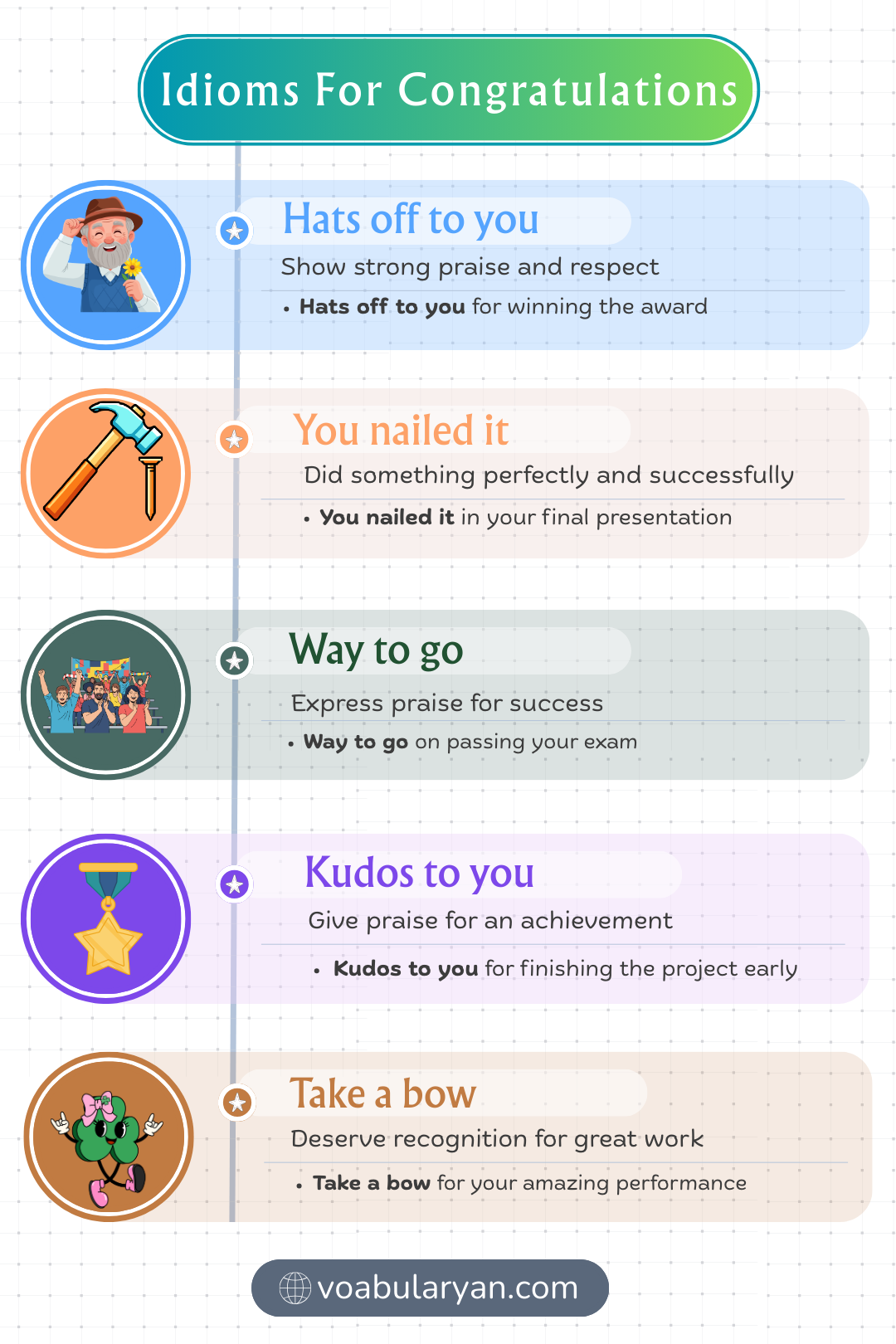
Congratulatory Idioms For General Praise
Kudos
Meaning: praise for an achievement.
When To Use It: use it when recognizing success.
Collocations: kudos to the team
Example Sentences:
- Kudos to you for that idea.
- She gave him kudos for his effort.
Dialogue:
Emma: Kudos on the presentation.
Noah: Your clear effort showed.
Closest Alternatives:
- praise
- credit
Hats Off
Meaning: show respect or admiration for success.
When To Use It: use it when honoring achievement.
Collocations: hats off to her courage
Example Sentences:
- Hats off to the winner.
- Hats off for your bravery.
Dialogue:
Olivia: Hats off to you.
Ethan: That strong performance impressed me.
Closest Alternatives:
- respect
- applause
You Nailed It
Meaning: you did something perfectly.
When To Use It: use it when performance feels exact.
Collocations: you nailed it completely
Example Sentences:
- You nailed it in the interview.
- She told him, you nailed it.
Dialogue:
Mila: You nailed it on stage.
Omar: That confident delivery stood out.
Closest Alternatives:
- did it perfectly
- got it right
Idioms For Celebrating Achievements
You’re On Fire
Meaning: performing extremely well right now.
When To Use It: use it during repeated success.
Collocations: you’re on fire today
Example Sentences:
- Wow, you’re on fire today.
- Everyone said, you’re on fire lately.
Dialogue:
Emma: You’re on fire this week.
Noah: Everything feels in strong form.
Closest Alternatives:
- doing great
- in top form
Break A Leg
Meaning: wish someone good luck before performance.
When To Use It: use it before shows or big events.
Collocations: say break a leg before stage
Example Sentences:
- She told him to break a leg.
- They shouted, break a leg, backstage.
Dialogue:
Olivia: Break a leg tonight.
Ethan: I hope the show goes well.
Closest Alternatives:
- good luck
- do your best
Knock It Out Of The Park
Meaning: achieve great success in something.
When To Use It: use it after impressive results.
Collocations: knock it out of the park in presentation
Example Sentences:
- She knocked it out of the park.
- He really knocked it out of the park.
Dialogue:
Grace: You knocked it out of the park.
Daniel: The strong performance made it clear.
Closest Alternatives:
- do brilliantly
- exceed expectations
Idioms For Formal Congratulations
Three Cheers For You
Meaning: a strong public expression of praise.
When To Use It: use it when celebrating someone’s success.
Collocations: three cheers for you at the event
Example Sentences:
- The crowd shouted, three cheers for you.
- We raised our voices with three cheers for you.
Dialogue:
Liam: Three cheers for you!
Maya: That joyful celebration feels great.
Closest Alternatives:
- loud applause
- cheer for someone
Cheers To You
Meaning: a friendly way to praise or thank someone.
When To Use It: use it when offering appreciation.
Collocations: cheers to you for your help
Example Sentences:
- Cheers to you for the support.
- She said, cheers to you, warmly.
Dialogue:
Emma: Cheers to you for today.
Noah: Your kind effort mattered.
Closest Alternatives:
- thank you
- well done
Give A Thumbs Up
Meaning: show approval or agreement.
When To Use It: use it to signal something is good.
Collocations: give a thumbs up to the idea
Example Sentences:
- He gave a thumbs up to the plan.
- She gave a thumbs up after tasting it.
Dialogue:
Olivia: I give a thumbs up.
Ethan: That clear approval helps.
Closest Alternatives:
- approve
- agree
High Five
Meaning: celebrate success by slapping hands together.
When To Use It: use it after a shared achievement.
Collocations: give a high five
Example Sentences:
- They shared a high five after winning.
- She gave him a high five.
Dialogue:
Grace: Let us have a high five.
Daniel: That shared success feels good.
Closest Alternatives:
- celebrate together
- hand slap
Raise A Glass
Meaning: lift a drink to honor someone or something.
When To Use It: use it during a toast or celebration.
Collocations: raise a glass to success
Example Sentences:
- They raised a glass to the team.
- Let us raise a glass tonight.
Dialogue:
Olivia: Let us raise a glass.
Ethan: To shared success and joy.
Closest Alternatives:
- make a toast
- celebrate
Key Takeaways
Praise and encouragement idioms express approval, success, good luck, and deserved reward through simple yet vivid wording. The meaning often depends on tone, since the same phrase can sound playful, sincere, or formal in different situations. In conversation or short writing, these expressions carry emotional weight beyond their literal sense. Many keep stable wording and fixed word order, which helps maintain clarity. When we look closely at these phrases, we notice how everyday language conveys genuine appreciation and confidence without long explanation.
FAQs
Q1. What does “kudos to you” mean?
It means giving someone praise for doing something well. In idioms for congratulations, it fits a win, a good grade, or a finished project, like “Kudos to you for your hard work.”
Q2. What does “hats off to you” mean?
It means showing real respect for someone’s effort or success. In idioms for congratulations, it can follow a tough task, like “Hats off to you for staying calm.”
Q3. What does “you knocked it out of the park” mean?
It means someone did extremely well, not just okay. In idioms for congratulations, it can be a speech or a performance, like “You knocked it out of the park today.”
Q4. What does “way to go” mean?
It means a quick, friendly praise for success. In idioms for congratulations, it often follows good news, like “Way to go on passing the interview.”
Q5. What does “a pat on the back” mean?
It means a small sign of praise or approval. In idioms for congratulations, it can be for effort too, like “He deserves a pat on the back.”
Q6. What does “you nailed it” mean?
It means someone did something very well or perfectly. In idioms for congratulations, it can be a test or presentation, like “You nailed it in class.”
You May Also Like