
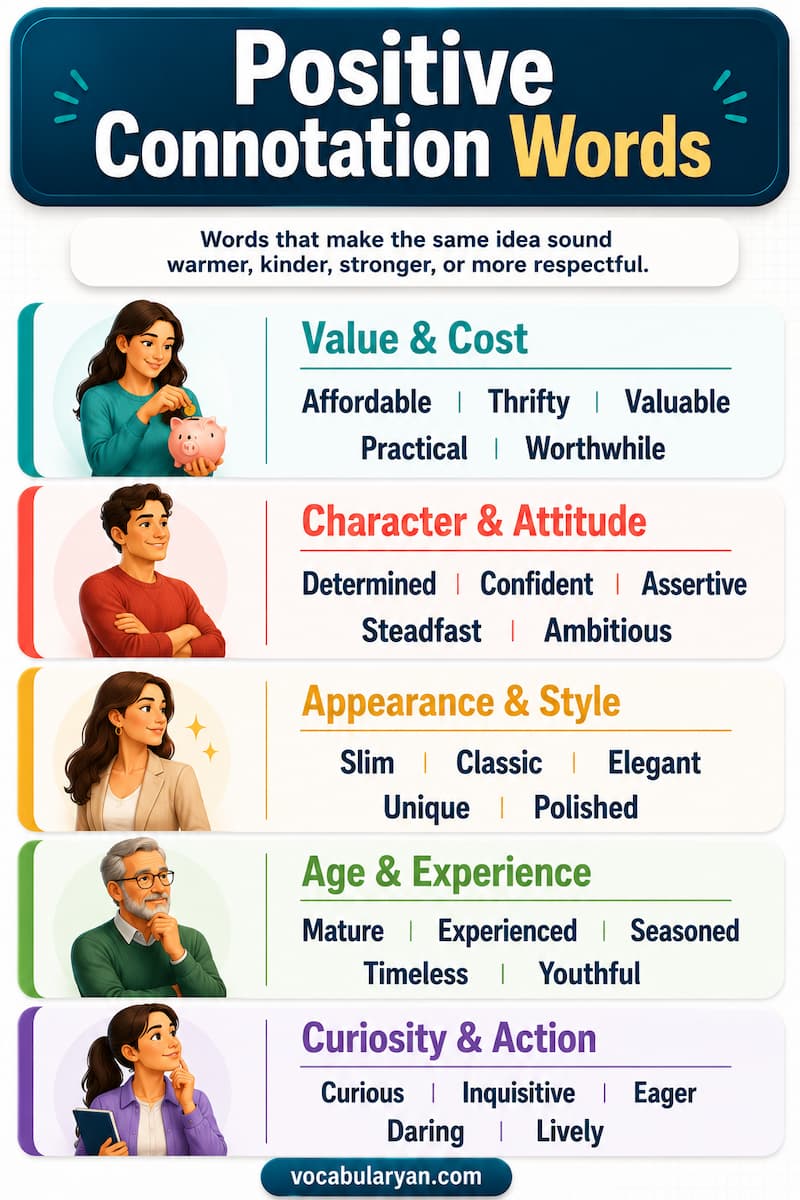
Every word carries two layers of meaning. The first is denotation, the literal dictionary definition. The second is connotation, the emotional charge that surrounds the word once it lands. Cheap and inexpensive share a denotation (low cost), but cheap carries a whiff of poor quality while inexpensive stays neutral. Determined and stubborn both name persistence, but one earns admiration and the other earns a quiet grimace. Connotation is what makes word choice matter. The positive connotation words below are grouped by where they show up most: describing a person, a place, a situation, work and ambition, appearance, and emotion. Each one is shown beside its negative or neutral equivalent so you see the full range at once and choose deliberately.
What Is Positive Connotation?
Connotation is the emotional association a word carries beyond its dictionary definition.
| Term | Meaning |
|---|---|
| Denotation | The literal, dictionary meaning of a word |
| Connotation | The emotional feeling or association the word evokes |
| Positive connotation | A word that evokes a good, warm, or admirable feeling |
| Negative connotation | A word that evokes a bad, cold, or unfavorable feeling |
| Neutral connotation | A word that states a fact without emotional charge |
Three words can share a denotation but carry entirely different emotional weight:
| Neutral | Positive connotation | Negative connotation |
|---|---|---|
| Smell | Aroma | Stench |
| Thin | Slender | Scrawny |
| Old | Vintage | Decrepit |
| Cheap | Inexpensive | Stingy |
| Talkative | Articulate | Chatty |
Positive Connotation Words for Describing a Person
Word choice when describing someone sets the entire tone of how that person is received. These positive words reframe qualities that negative synonyms would undercut.
| Quality | Positive connotation | Negative connotation |
|---|---|---|
| Confident | Self-assured | Arrogant |
| Persistent | Determined | Stubborn |
| Curious | Inquisitive | Nosy |
| Talkative | Articulate | Chatty |
| Quiet | Thoughtful | Withdrawn |
| Cautious | Careful | Timid |
| Bold | Courageous | Reckless |
| Ambitious | Driven | Pushy |
| Selective | Discerning | Picky |
| Energetic | Spirited | Hyperactive |
| Emotional | Passionate | Volatile |
| Frugal | Thrifty | Stingy |
| Unconventional | Original | Eccentric |
| Direct | Frank | Blunt |
| Proud | Dignified | Conceited |
Positive Connotation Words for Describing a Place
A single word shifts how a place feels in a reader’s or listener’s mind.
| Quality | Positive connotation | Negative connotation |
|---|---|---|
| Old | Historic | Run-down |
| Small | Cozy | Cramped |
| Busy | Vibrant | Chaotic |
| Quiet | Peaceful | Dead |
| Crowded | Lively | Packed |
| Large | Spacious | Empty |
| Isolated | Secluded | Remote |
| Cheap | Affordable | Shabby |
| Simple | Rustic | Plain |
| Different | Unique | Odd |
Positive Connotation Words for Describing a Situation
When framing a situation, the word you choose controls whether readers see opportunity or failure.
- Challenging (not impossible): demanding the best of what you have.
- “A challenging brief that produced the team’s strongest work.”
- Unexpected (not shocking): arriving without warning but not necessarily unwelcome.
- “An unexpected turn that opened a door nobody had planned for.”
- Evolving (not unstable): changing in a direction that allows adaptation.
- “An evolving situation that rewarded flexibility.”
- Ambitious (not unrealistic): aiming above the comfortable middle.
- “An ambitious target that focused the whole team.”
- Complex (not complicated): demanding careful attention rather than being simply broken.
- “A complex negotiation that took skill to navigate.”
- Unconventional (not strange): departing from the expected in a purposeful way.
- “An unconventional approach that produced a better result than the standard one.”
- Formative (not difficult): shaping character and capability through the experience.
- “A formative year that changed how she approached every problem after it.”
- Brisk (not cold): sharply fresh and invigorating.
- “A brisk morning that made everyone more alert.”
Positive Connotation Words for Work and Ambition
In professional and academic writing, positive connotation shifts how effort, judgment, and character read.
| Neutral or negative word | Positive connotation swap |
|---|---|
| Stubborn | Tenacious |
| Obsessive | Dedicated |
| Slow | Methodical |
| Blunt | Direct |
| Demanding | Exacting |
| Quiet | Reflective |
| Unpredictable | Innovative |
| Aggressive | Assertive |
| Controlling | Organized |
| Nervous | Conscientious |
| Risk-taking | Entrepreneurial |
| Preachy | Principled |
Each swap names the same quality but shifts where the emotional weight lands. A tenacious colleague is admired; an obsessive one is watched. A methodical worker is trusted; a slow one is doubted.
Positive Connotation Words for Appearance
Describing how someone looks is where connotation shapes perception most directly.
| Quality | Positive connotation | Negative connotation |
|---|---|---|
| Thin | Slender | Scrawny |
| Heavy | Full-figured | Overweight |
| Short | Petite | Stumpy |
| Tall | Statuesque | Lanky |
| Young-looking | Youthful | Immature-looking |
| Older | Distinguished | Weathered |
| Unusual face | Striking | Odd-looking |
| Pale | Fair | Washed-out |
| Tanned | Sun-kissed | Leathery |
| Muscular | Athletic | Bulky |
The positive connotation word in each pair names the same physical fact but frames it as a quality worth noticing rather than a flaw.
Positive Connotation Words for Emotions and Personality
These words reframe emotional qualities that negative synonyms make sound like problems.
- Passionate (not intense): driven by genuine, deep feeling.
- “She was passionate about the outcome in a way that moved the whole team.”
- Sensitive (not thin-skinned): attuned to the feelings of others and the world.
- “His sensitive reading of the situation prevented a much larger problem.”
- Lively (not loud): full of natural energy and engaged presence.
- “Her lively contribution changed the tone of the meeting.”
- Imaginative (not unrealistic): generating possibilities others can’t yet see.
- “His imaginative proposal was the one that eventually won the contract.”
- Candid (not blunt): honest and direct in a way that respects the other person.
- “Her candid assessment was exactly what the team needed.”
- Spontaneous (not impulsive): acting freely from genuine feeling.
- “His spontaneous invitation turned an ordinary evening into a memorable one.”
- Independent (not loner): comfortable in one’s own company and judgment.
- “Her independent approach produced a solution no one else had considered.”
- Assertive (not aggressive): expressing needs and views with confidence, not force.
- “He was assertive without being overbearing, which made the negotiation work.”
Positive Connotation Words in Literature and Writing
Writers use connotation deliberately to shape how readers feel about characters, settings, and events.
Shakespeare’s Juliet is compared to the sun, not a lamp. The word sun carries connotations of warmth, life, and transcendence that lamp would entirely miss. When Atticus Finch is described as having “quiet confidence,” the word quiet softens what might otherwise read as arrogance. The connotation of quiet in that context is steadiness and self-possession, not withdrawal.
Three techniques worth knowing:
- Upgrade neutral words: “walked” becomes “strode” (confident) or “wandered” (peaceful).
- Avoid unintended connotation: “cheap hotel” vs “budget hotel” say the same thing in a review but produce different emotional responses in the reader.
- Use positive connotation to frame criticism gently: “She was direct” softens “She was blunt.” “He was methodical” softens “He was slow.” The fact stays the same; the charge changes.
Positive vs Negative Connotation: Side-by-Side
The clearest way to internalize connotation is to see the full spectrum for one concept at a time.
| Concept | Positive | Neutral | Negative |
|---|---|---|---|
| Smell | Aroma, fragrance | Smell, scent | Stench, odor |
| Old age | Wise, distinguished | Elderly, aged | Decrepit, ancient |
| Persistence | Determined, tenacious | Persistent | Stubborn, obstinate |
| Spending little | Thrifty, frugal | Inexpensive | Cheap, stingy |
| Asking questions | Curious, inquisitive | Questioning | Nosy, intrusive |
| Thin | Slender, lean | Thin, slim | Scrawny, gaunt |
| Young | Youthful, vibrant | Young | Immature, naive |
| Talking a lot | Eloquent, expressive | Talkative | Chatty, long-winded |
| Taking risks | Adventurous, bold | Risk-taking | Reckless, foolish |
| Being quiet | Reflective, thoughtful | Quiet | Withdrawn, cold |
Reading this table vertically shows how connotation shapes perception: the same underlying quality reads entirely differently depending on which word you choose.
Positive Connotation Words A to Z
One positive connotation word for each letter, with the neutral or negative word it replaces.
| Letter | Positive word | Replaces |
|---|---|---|
| A | Adventurous | Reckless |
| B | Bold | Pushy |
| C | Candid | Blunt |
| D | Determined | Stubborn |
| E | Eloquent | Talkative |
| F | Frugal | Stingy |
| G | Genuine | Naive |
| H | Historic | Old |
| I | Inquisitive | Nosy |
| J | Judicious | Slow to decide |
| K | Kindhearted | Soft |
| L | Lively | Loud |
| M | Methodical | Slow |
| N | Noble | Prideful |
| O | Original | Eccentric |
| P | Passionate | Intense |
| Q | Quiet-confident | Reserved |
| R | Resourceful | Makeshift |
| S | Slender | Scrawny |
| T | Tenacious | Obsessive |
| U | Unconventional | Strange |
| V | Vintage | Old |
| W | Worldly | Opinionated |
| X | (e)Xacting | Demanding |
| Y | Youthful | Immature |
| Z | Zealous | Obsessive |
FAQs
Positive connotation words carry a warm or admirable emotional charge beyond their literal meaning. Determined, thrifty, inquisitive, slender, vibrant, and candid are all positive connotation words because they frame a quality favorably. Each has a negative equivalent (stubborn, stingy, nosy, scrawny, loud, blunt) that describes the same thing less generously.
Denotation is the literal dictionary definition of a word. Connotation is the emotional feeling or association the word carries. Cheap and inexpensive share the same denotation (low cost) but different connotations: cheap implies poor quality while inexpensive stays neutral. Writers use connotation deliberately to guide how readers feel, not just what they know.
They frame facts favorably without distorting them. A “determined negotiator” and a “stubborn negotiator” describe the same behavior but produce opposite impressions. Choosing the positive connotation word does not change what is true; it changes how the reader receives it. In professional writing, CVs, reviews, recommendations, and profiles, this distinction carries real weight.
Self-assured (not arrogant), determined (not stubborn), inquisitive (not nosy), discerning (not picky), spirited (not hyper), thrifty (not stingy), and candid (not blunt) all describe the same human qualities with a positive charge. Each reframes the quality as a strength rather than a flaw.
Ask what impression you want to leave. If your goal is to build warmth, trust, or admiration, reach for the positive connotation word. If your goal is factual objectivity, use the neutral one. In persuasive writing, journalism, job applications, and personal descriptions, positive connotation words do silent persuasive work without misrepresenting the facts.
Yes. “Cheap” has a negative connotation in “a cheap hotel” but a neutral or positive one in “that’s a cheap solution to an expensive problem.” Context shapes how connotation lands, which is why awareness of your audience and situation is as important as word choice itself. A word that flatters in one context can inadvertently insult in another.