
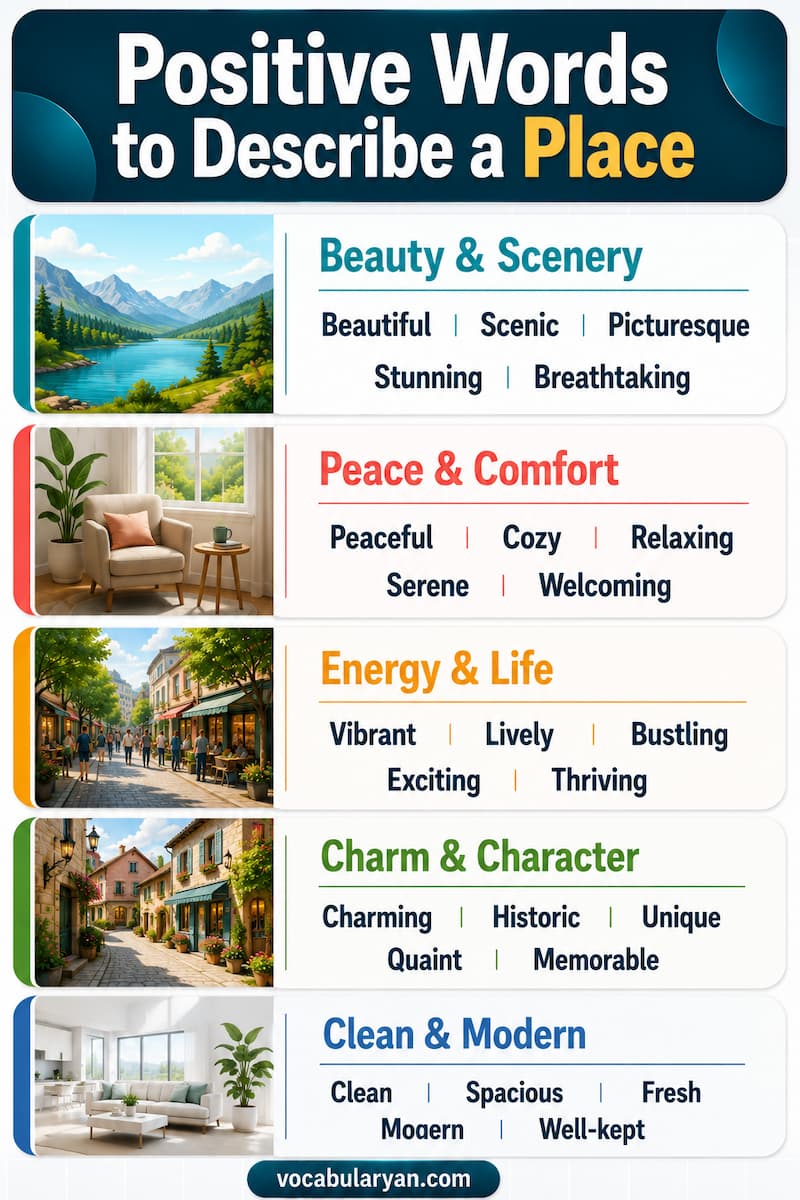
“Nice” and “beautiful” run dry fast. When you want to describe a place, a beach, a city, a quiet village, a room you love, the word that sticks names what the place actually feels like to be in. The words below are grouped by the kind of place they suit, from scenic and peaceful to lively and grand, so you reach the right one for a travel post, a story, an essay, or a review. Each word comes with a meaning and an example sentence to borrow. Name the exact quality, and your description will put the reader right there.
Positive Words to Describe a Place at a Glance
Short on time? Grab a word for the quality you mean, then read the fuller groups below.
| If the place is… | Try these words |
|---|---|
| Beautiful | Scenic, picturesque, breathtaking, stunning |
| Peaceful | Tranquil, serene, restful, idyllic |
| Lively | Vibrant, bustling, dynamic, buzzing |
| Welcoming | Cozy, homely, inviting, warm |
| Well-kept | Clean, pristine, immaculate, tidy |
| Grand | Majestic, magnificent, imposing, splendid |
Beautiful and Scenic Words to Describe a Place
Beauty is the first thing most people want to capture about a place. These words name what pleases the eye.
- Scenic: offering beautiful natural views.
- “We drove the scenic road along the coast.”
- Picturesque: as charming as a painting or postcard.
- “The picturesque village looked unreal in the morning light.”
- Breathtaking: so beautiful it stops you short.
- “The view from the summit was breathtaking.”
- Stunning: strikingly, impressively beautiful.
- “The sunset over the lake was stunning.”
- Gorgeous: rich and lovely to look at.
- “They stayed in a gorgeous old farmhouse.”
- Lush: full of healthy, green growth.
- “A lush valley spread out below the trail.”
- Pristine: pure, clean, and untouched.
- “The pristine beach had not a single footprint.”
- Verdant: green and thick with vegetation.
- “Spring left the hills verdant and fresh.”
- Sublime: beautiful in a way that fills you with awe.
- “The canyon at dawn was simply sublime.”
- Panoramic: opening onto a wide, sweeping view.
- “The café had a panoramic view of the bay.”
Peaceful and Calm Words to Describe a Place
Some places lower your shoulders the moment you arrive. These words name that stillness.
- Tranquil: deeply calm and quiet.
- “A tranquil garden sat behind the temple.”
- Serene: bright, peaceful, and untroubled.
- “The serene lake mirrored the whole sky.”
- Restful: easing strain and inviting rest.
- “The cabin was restful after a long week.”
- Idyllic: perfectly peaceful and lovely.
- “They found an idyllic spot by the river.”
- Secluded: tucked away from noise and crowds.
- “A secluded cove waited past the headland.”
- Soothing: gentle and calming to the senses.
- “The soothing sound of waves filled the room.”
- Quiet: free of noise and bustle.
- “The library was quiet and warm.”
- Sheltered: protected, safe, and snug.
- “The sheltered bay stayed calm in the storm.”
- Mellow: relaxed and unhurried in feel.
- “The old town had a mellow, easy pace.”
- Unspoiled: pure and free of damage or crowds.
- “The coast there is still unspoiled.”
Lively and Vibrant Words to Describe a Place
Other places hum with energy. These words name a spot that is full of life.
- Vibrant: full of life, color, and movement.
- “The market was vibrant with sound and color.”
- Bustling: busy with happy, lively activity.
- “The bustling square never seemed to empty.”
- Dynamic: energetic and always in motion.
- “The district has a young, dynamic feel.”
- Buzzing: alive with chatter and excitement.
- “The whole street was buzzing on opening night.”
- Cosmopolitan: worldly, diverse, and sophisticated.
- “The city felt genuinely cosmopolitan.”
- Energetic: charged with activity and drive.
- “The festival left the town energetic for days.”
- Trendy: fashionable and current.
- “A trendy café had opened on the corner.”
- Colorful: bright, varied, and full of character.
- “The colorful old quarter drew painters all summer.”
- Spirited: full of warmth and lively character.
- “It was a spirited little harbor town.”
- Thriving: growing, busy, and full of success.
- “The thriving port stayed open past midnight.”
Cozy and Welcoming Words to Describe a Place
A place can hold you like a good chair. These words name comfort and warmth.
- Cozy: snug, warm, and comforting.
- Homely: comfortable and full of homey warmth.
- Inviting: appealing and easy to settle into.
- Warm: friendly and comforting in feel.
- Snug: small, soft, and sheltering.
- Charming: delightful in a warm, personal way.
- Welcoming: open and easy to walk into.
- Comfortable: relaxed and free of strain.
- Intimate: small, close, and personal.
- Quaint: charmingly old-fashioned and sweet.
Clean and Well-Kept Words to Describe a Place
Care shows. These words name a place that is looked after.
- Clean: free of dirt and clutter.
- Spruce: trim, smart, and well-kept.
- Immaculate: flawlessly clean and tidy.
- Tidy: neat and in good order.
- Spotless: without a mark or speck.
- Polished: smooth, bright, and well-finished.
- Manicured: trimmed and cared for to the detail.
- Orderly: arranged and calm, free of chaos.
- Fresh: clean, airy, and full of life.
- Well-kept: maintained with real care.
Grand and Impressive Words to Describe a Place
Some places make you stop and look up. These words name scale and splendor.
- Majestic: grand, dignified, and awe-inspiring.
- Magnificent: strikingly grand and impressive.
- Imposing: large and commanding in presence.
- Splendid: brilliant, rich, and impressive.
- Stately: dignified and grand in style.
- Opulent: luxurious and richly furnished.
- Spectacular: dramatic and impressive to see.
- Regal: splendid in a royal, lofty way.
- Lavish: rich, generous, and finely made.
- Towering: rising high and dominating the view.
Phrases to Describe a Place (for Travel Writing and IELTS)
For an essay, a review, or a speaking exam, a full phrase carries more than a single word. Borrow any of these and adapt them.
- “It’s a hidden gem most tourists never find.”
- “The view from the top is worth every step.”
- “The whole town has a relaxed, easygoing pace.”
- “It feels like stepping into a postcard.”
- “There’s a real sense of history in every street.”
- “The place has a charm you don’t see anymore.”
- “It’s the kind of spot you never want to leave.”
- “Every corner offers something new to look at.”
A good phrase names one real detail. Instead of “it was a nice place,” try “the harbor glowed orange at sunset.” The specific image is what makes a place come alive on the page.
Beautiful and Rare Words to Describe a Place
When the common words feel too plain, reach for these rarer ones. Each names a special quality of a place.
| Word | Meaning |
|---|---|
| Bucolic | Pleasantly rural and pastoral |
| Halcyon | Calm, peaceful, and happy |
| Arcadian | Rustic, unspoiled, and idyllic |
| Sylvan | Wooded, leafy, and full of trees |
| Resplendent | Brilliantly bright and lovely |
| Salubrious | Healthy, fresh, and pleasant |
| Elysian | Blissful and perfectly peaceful |
| Verdurous | Rich and green with growth |
| Pastoral | Peaceful in a gentle, countryside way |
| Atmospheric | Full of a distinctive, evocative mood |
| Enchanting | Charming enough to feel magical |
| Crystalline | Bright, sparkling, and spotless |
How to Describe a Place Well: Show, Don’t Just Name
The strongest description names one quality, then proves it with a detail you can picture. A specific image beats a stack of adjectives.
- ❌ “The town was nice, pretty, and charming.”. Three labels, no picture.
- ✅ “The town was charming. Window boxes spilled red flowers onto cobbled streets.”. One word, one image, and you can see it.
See the difference. The first piles on words that blur together. The second names one quality and shows it in a detail, so the reader believes it. Do the same with any word here. Pair peaceful with the sound that proves it. Pair grand with the thing that towers. Try it now: pick one word that fits your place, and add the smallest true detail behind it. That habit turns a flat description into one the reader can walk into.
Positive Words to Describe a Place A to Z
Most lists give A to Z with no meanings. This one gives a word and a meaning for each letter, so you scan and choose at once.
| Letter | Word | Meaning |
|---|---|---|
| A | Airy | Open, light, and well-ventilated |
| B | Breathtaking | So beautiful it stops you short |
| C | Charming | Delightful in a warm, personal way |
| D | Dreamy | Soft, lovely, and far from stress |
| E | Enchanting | Charming enough to feel magical |
| F | Fresh | Clean, airy, and full of life |
| G | Gorgeous | Rich and lovely to look at |
| H | Homely | Comfortable and full of warmth |
| I | Idyllic | Picture-perfect and serene |
| J | Jovial | Cheerful and full of good spirit |
| K | Kaleidoscopic | Bright and richly varied in color |
| L | Lush | Full of healthy, green growth |
| M | Majestic | Grand, dignified, and awe-inspiring |
| N | Natural | Pure and shaped by nature |
| O | Opulent | Luxurious and richly furnished |
| P | Picturesque | As charming as a painting |
| Q | Quaint | Charmingly old-fashioned |
| R | Restful | Easing strain and inviting rest |
| S | Serene | Bright, peaceful, and untroubled |
| T | Tranquil | Deeply calm and quiet |
| U | Unspoiled | Pure and free of damage |
| V | Vibrant | Full of life and color |
| W | Welcoming | Open and easy to walk into |
| X | (e)Xquisite | Finely and beautifully made |
| Y | Youthful | Bright, fresh, and full of energy |
| Z | Zen | Calm, balanced, and uncluttered |
FAQs
The best words name the look and feel of the place: scenic, peaceful, vibrant, charming, and majestic. A specific word always beats a vague one. “The village was picturesque” paints a far clearer picture than “the village was nice,” because it shows what the place was actually like.
Use scenic, picturesque, breathtaking, stunning, and gorgeous. These point to a place that pleases the eye. To make any of them land, tie the word to a real sight: “The breathtaking valley dropped away beneath a ring of snow-capped peaks.”
Use tranquil, serene, restful, idyllic, and secluded. These name a place that calms you the moment you arrive. Pair the word with a sound or detail, like “a serene lake without a ripple,” and the calm becomes real for the reader.
Use vibrant, bustling, dynamic, buzzing, and thriving. These capture a place full of energy and movement. “The bustling market hummed with vendors and music” says far more than “the market was busy.”
Try bucolic, halcyon, sylvan, resplendent, and elysian. These rarer words feel fresh when the common ones start to repeat. Use them where they fit the place naturally, and pair them with a real detail so they don’t sound forced.
Name one quality and prove it with a detail the reader can picture. Instead of “it was a beautiful place,” try “the harbor glowed orange at sunset.” A single true image makes a place come alive far better than a row of adjectives.