
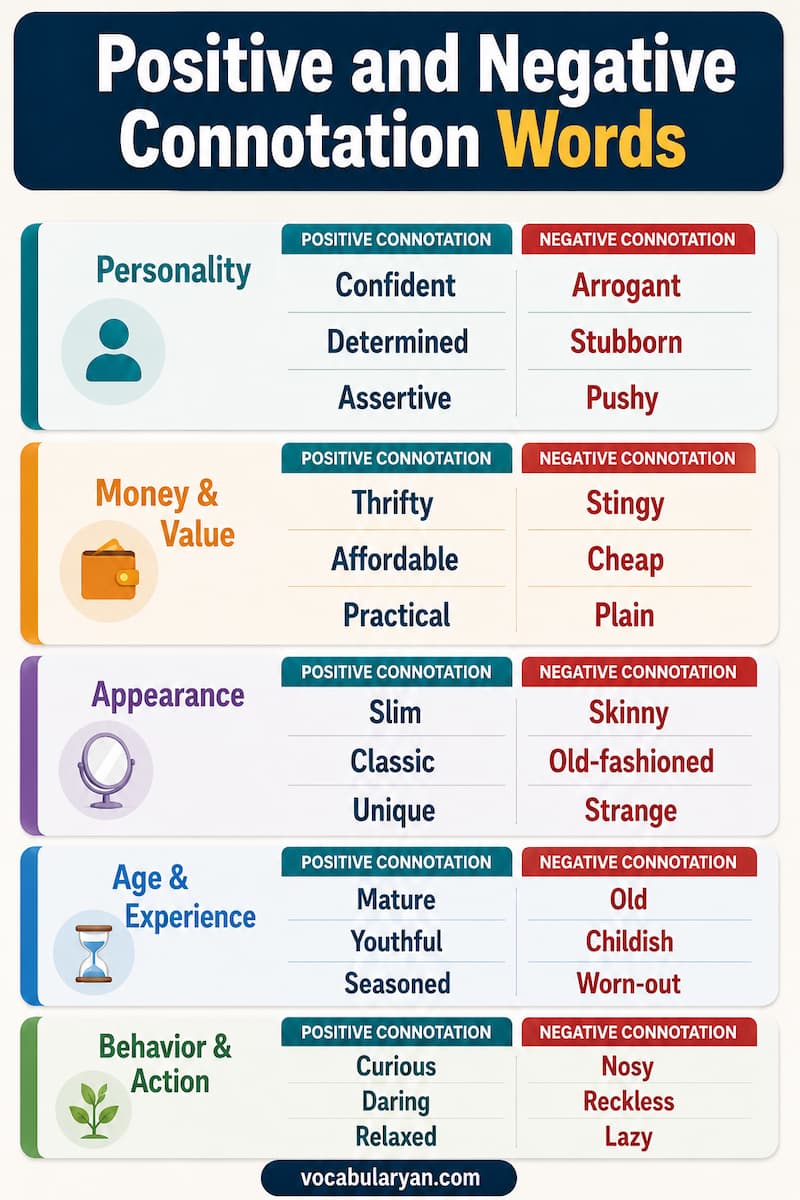
The word curious describes someone who wants to understand the world. The word nosy describes someone who pries into what is not their business. Both name the same underlying quality: interest in what others are doing. The difference is entirely connotation, the emotional charge a word carries beyond its literal meaning. Connotation is what makes word choice the most powerful decision in writing. The tables below cover more than 150 word pairs and trios organized by topic, each showing the full spectrum from positive through neutral to negative, so you see the whole range and choose exactly the charge you want.
Connotation vs Denotation: The Core Distinction
Before choosing between positive and negative, understand what connotation actually is.
Denotation is the literal, dictionary definition of a word. Connotation is the emotional association the word carries in addition to that definition.
| Word | Denotation (literal meaning) | Connotation |
|---|---|---|
| Aroma | A smell | Positive: pleasant, inviting |
| Smell | A smell | Neutral: no charge either way |
| Stench | A smell | Negative: unpleasant, offensive |
Three words. One denotation. Three different impressions. Every word pair in this article works the same way.
Positive and Negative Connotation Words for People
How you describe a person reveals your attitude toward them. These pairs show how connotation shapes character.
| Neutral | Positive connotation | Negative connotation |
|---|---|---|
| Persistent | Determined | Stubborn |
| Curious | Inquisitive | Nosy |
| Confident | Self-assured | Arrogant |
| Talkative | Articulate | Chatty |
| Quiet | Reflective | Withdrawn |
| Careful | Cautious | Timid |
| Energetic | Spirited | Hyperactive |
| Frugal | Thrifty | Stingy |
| Unconventional | Original | Eccentric |
| Proud | Dignified | Conceited |
| Direct | Frank | Blunt |
| Emotional | Passionate | Volatile |
| Ambitious | Driven | Pushy |
| Selective | Discerning | Picky |
| Bold | Courageous | Reckless |
| Young-acting | Youthful | Childish |
| Strong-willed | Tenacious | Pig-headed |
| Private | Reserved | Secretive |
| Casual | Relaxed | Careless |
| Tidy | Meticulous | Obsessive |
Positive and Negative Connotation Words for the Senses
Sensory words carry some of the strongest connotations in the language. The right one can make a reader smell, taste, or hear a scene.
| Neutral | Positive connotation | Negative connotation |
|---|---|---|
| Smell | Aroma, fragrance | Stench, odor |
| Sound | Melody, harmony | Noise, racket |
| Light | Glow, radiance | Glare, blaze |
| Touch | Soft, silky | Rough, scratchy |
| Taste | Savory, rich | Bland, bitter |
| Old food | Aged, mature | Rancid, stale |
| Strong drink | Bold, robust | Harsh, sharp |
| Sweet food | Delicate, honeyed | Cloying, saccharine |
| Texture | Velvety, smooth | Slimy, greasy |
| Temperature | Crisp, bracing | Frigid, freezing |
Positive and Negative Connotation Words for Size and Appearance
Physical description shifts dramatically depending on whether you choose positive or negative connotation.
| Neutral | Positive connotation | Negative connotation |
|---|---|---|
| Thin | Slender, lean | Scrawny, gaunt |
| Large | Full-figured, substantial | Overweight, bulky |
| Short | Petite, compact | Stumpy, squat |
| Tall | Statuesque, willowy | Lanky, gangly |
| Old | Distinguished, wise | Decrepit, ancient |
| Used | Vintage, classic | Worn, tatty |
| Small building | Cozy, intimate | Cramped, poky |
| Large building | Spacious, grand | Empty, cavernous |
| Pale | Fair, porcelain | Washed-out, sallow |
| Tanned | Sun-kissed, bronzed | Weathered, leathery |
Positive and Negative Connotation Words for Money and Value
Financial and material descriptions are some of the most connotation-sensitive in everyday writing.
| Neutral | Positive connotation | Negative connotation |
|---|---|---|
| Low cost | Affordable, economical | Cheap, cut-rate |
| High cost | Premium, exclusive | Overpriced, extravagant |
| Saving money | Thrifty, prudent | Stingy, miserly |
| Spending freely | Generous, lavish | Wasteful, reckless |
| Old item | Antique, vintage | Junk, decrepit |
| Unbranded | Artisanal, independent | Generic, off-brand |
| Basic | Understated, refined | Plain, bare |
| Simple food | Wholesome, honest | Plain, bland |
| Expensive meal | Exquisite, fine dining | Extravagant, overpriced |
| Low wages | Entry-level, starter | Underpaid, poverty wages |
Positive and Negative Connotation Words for Places
A single word decides whether a place sounds appealing or unappealing without changing any physical fact.
| Neutral | Positive connotation | Negative connotation |
|---|---|---|
| Small | Cozy, intimate | Cramped, poky |
| Busy | Vibrant, lively | Chaotic, frantic |
| Quiet | Peaceful, serene | Dead, dull |
| Old | Historic, storied | Run-down, dilapidated |
| Isolated | Secluded, private | Remote, cut-off |
| Crowded | Buzzing, energetic | Packed, overrun |
| Dark | Atmospheric, moody | Dingy, gloomy |
| Bright | Sunny, airy | Glaring, harsh |
| Unfamiliar | Exotic, distinctive | Strange, odd |
| Changed | Revitalized, renewed | Gentrified, altered |
Positive and Negative Connotation Words for Speech and Ideas
How someone talks or thinks reads entirely differently depending on which word you choose.
| Neutral | Positive connotation | Negative connotation |
|---|---|---|
| Talkative | Eloquent, expressive | Chatty, long-winded |
| Quiet | Thoughtful, measured | Silent, cold |
| Opinionated | Principled, committed | Preachy, dogmatic |
| Repetitive | Thorough, consistent | Tedious, redundant |
| Brief | Concise, sharp | Curt, abrupt |
| Unconventional idea | Innovative, original | Outlandish, strange |
| Simple idea | Elegant, distilled | Obvious, simplistic |
| Unproven idea | Visionary, forward-thinking | Speculative, ungrounded |
| Old idea | Timeless, classic | Outdated, obsolete |
| Complex idea | Sophisticated, nuanced | Complicated, dense |
Positive and Negative Connotation Words for Actions and Behavior
The same action reads as admirable or reprehensible depending on the connotation of the word you use.
| Neutral | Positive connotation | Negative connotation |
|---|---|---|
| Persist | Persevere, press on | Nag, badger |
| Look at | Observe, appreciate | Stare, gawk |
| Eat | Savor, enjoy | Gorge, devour |
| Walk slowly | Stroll, wander | Plod, trudge |
| Walk fast | Stride, march | Rush, barrel |
| Ask questions | Inquire, explore | Interrogate, pry |
| Spend time | Invest, dedicate | Waste, linger |
| Change plans | Adapt, pivot | Backtrack, flip-flop |
| Talk about oneself | Share, open up | Boast, brag |
| Follow rules | Principled, disciplined | Rigid, rule-bound |
The Same Sentence: Three Connotation Levels
The most direct way to feel the difference is to read the same sentence three ways.
Topic: describing a coworker’s persistence
- ✅ Positive: “She was determined to find a solution, and her persistence paid off.”
- Neutral: “She kept working on the problem until it was resolved.”
- ❌ Negative: “She was stubborn and refused to drop it even when everyone else had moved on.”
Topic: describing a house’s size
- ✅ Positive: “The cozy cottage had everything they needed within arm’s reach.”
- Neutral: “The small house had two rooms.”
- ❌ Negative: “The cramped, poky flat barely fit a bed and a chair.”
Topic: describing someone’s spending habits
- ✅ Positive: “She was thrifty, knowing exactly where every pound went.”
- Neutral: “She spent very little money.”
- ❌ Negative: “She was stingy, unwilling to spend on anything, even necessities.”
All three sentences in each group describe the same underlying fact. Connotation is the only thing changing.
Practice: Choose the Right Connotation
For each situation, decide which word fits the impression you want to make.
| Situation | Word A | Word B | Which fits? |
|---|---|---|---|
| Writing a glowing CV | Dedicated | Obsessive | Dedicated |
| Describing a negative character in a story | Strong-willed | Pig-headed | Pig-headed |
| A real-estate listing for a small flat | Intimate | Cramped | Intimate |
| A critical review of an expensive restaurant | Extravagant | Premium | Extravagant |
| Praising a friend who speaks their mind | Candid | Blunt | Candid |
| A horror novel describing an old house | Ancient | Historic | Ancient |
| A job reference for a careful worker | Meticulous | Fussy | Meticulous |
| A news article covering a noisy protest | Spirited | Rowdy | Spirited (or Rowdy, depending on stance) |
How Context Shifts Connotation
A word that carries positive connotation in one context flips in another. Connotation is not fixed: it depends on who is reading, who is speaking, and what the surrounding words say.
- Cheap is negative in “a cheap coat that fell apart in a week” but neutral or positive in “a cheap and cheerful local café.”
- Wild is positive in “a wild, joyful celebration” but negative in “the wild accusations had no basis in fact.”
- Simple reads as praise in “a simple, elegant solution” but as dismissal in “a simple mistake that should never have happened.”
- Old reads with warmth in “an old friend I hadn’t seen in years” but with coldness in “the old heating system broke again.”
Context is the final arbiter. The word plus the sentence plus the audience produces the connotation, not the word alone.
Positive and Negative Connotation Words A to Z
One three-column connotation set per letter for quick reference.
| Letter | Positive | Neutral | Negative |
|---|---|---|---|
| A | Adventurous | Risk-taking | Reckless |
| B | Bold | Direct | Blunt |
| C | Candid | Honest | Blunt |
| D | Determined | Persistent | Stubborn |
| E | Economical | Cheap | Stingy |
| F | Fragrant | Scented | Pungent |
| G | Generous | Giving | Wasteful |
| H | Historic | Old | Run-down |
| I | Inquisitive | Curious | Nosy |
| J | Joyful | Happy | Giddy |
| K | Kindhearted | Caring | Soft |
| L | Lively | Active | Loud |
| M | Mature | Older | Decrepit |
| N | Noble | Proud | Arrogant |
| O | Original | Unusual | Eccentric |
| P | Passionate | Emotional | Volatile |
| Q | Quiet-confident | Reserved | Withdrawn |
| R | Relaxed | Casual | Careless |
| S | Slender | Thin | Scrawny |
| T | Thrifty | Frugal | Stingy |
| U | Unconventional | Different | Weird |
| V | Vibrant | Busy | Chaotic |
| W | Worldly | Experienced | Cynical |
| X | (e)Xacting | Demanding | Fussy |
| Y | Youthful | Young | Immature |
| Z | Zealous | Enthusiastic | Obsessive |
FAQs
Positive connotation words carry a warm, admirable, or favorable emotional charge beyond their literal meaning: determined, thrifty, slender, aroma. Negative connotation words carry an unfavorable or cold charge: stubborn, stingy, scrawny, stench. Neutral words state the same fact without emotional color: persistent, economical, thin, smell. Three words, one meaning, three different impressions.
Denotation is the literal dictionary definition. Connotation is the emotional feeling a word evokes. Cheap and inexpensive share a denotation (low cost) but different connotations: cheap implies poor quality, inexpensive stays neutral. Choosing between them is not about accuracy but about impression.
Ask what feeling the word produces in the reader, not what it literally means. Does it frame the subject favorably or unfavorably? Determined frames persistence as a strength. Stubborn frames the same persistence as a flaw. If the word makes the subject look better than the neutral version, it’s positive. If it makes them look worse, it’s negative.
They shape how readers feel about characters, settings, and situations without adding any extra information. A character described as determined reads as admirable. The same character described as stubborn reads as difficult. The fact does not change: only the word does. Every professional writer, from novelists to journalists to copywriters, uses connotation deliberately to guide that response.
Yes, and context decides. Wild is positive in “a wild, joyful evening” and negative in “wild, unfounded claims.” Cheap is negative in “a cheap, poorly made bag” and close to neutral in “a cheap and cheerful street market.” Simple is admiring in “a simple, elegant solution” and dismissive in “a simple error.” The word alone does not fix the connotation: the sentence and the audience shape it.
Take a neutral sentence and rewrite it twice: once with all positive connotation words and once with all negative ones, keeping the core facts identical. Try: “The room was small” → “The intimate room was perfectly proportioned” vs “The cramped room barely held two people.” Reading the three versions side by side makes the power of connotation immediate and unforgettable.