
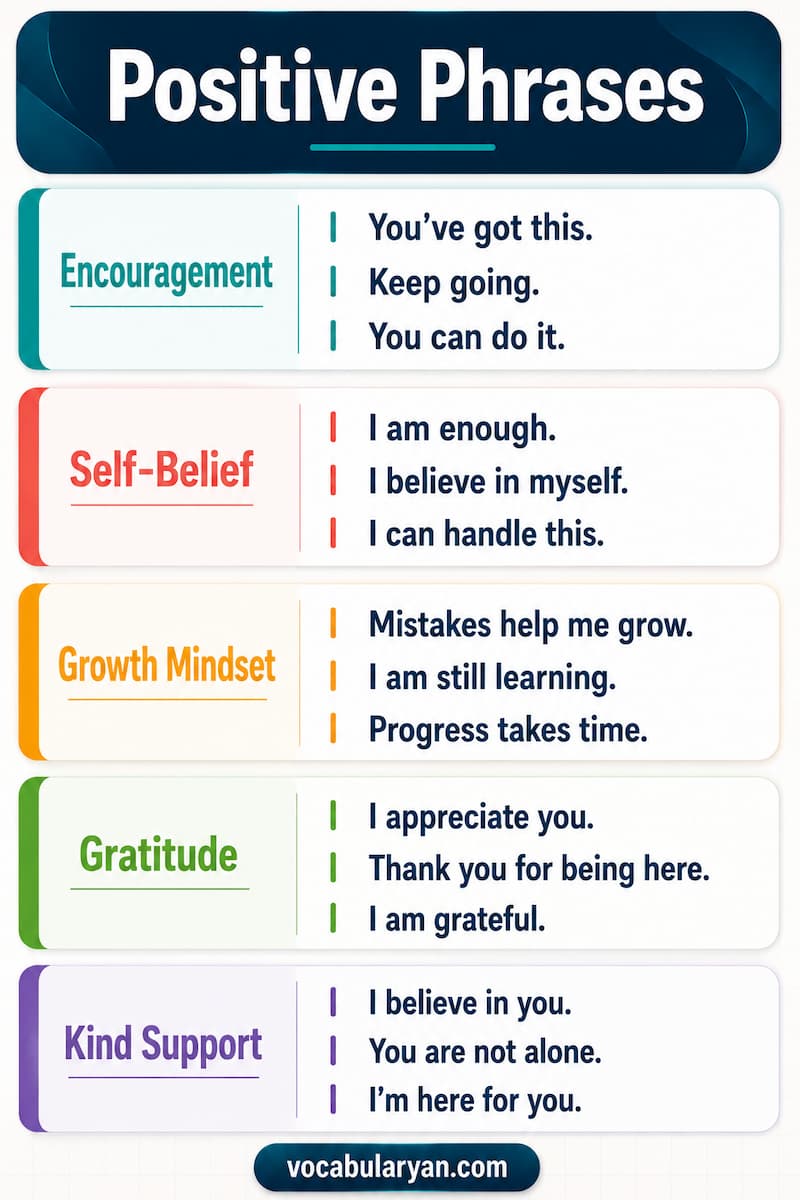
A well-chosen phrase at the right moment does more than a long speech. “I believe in you” before a hard day. “That meant a lot” after a kind act. “You’re not alone in this” when someone is struggling. Positive phrases are the everyday expressions that shift a conversation, lift a mood, or remind someone of their worth. The phrases below are grouped by what they do, so you find the right one for the moment, whether you’re encouraging someone, expressing gratitude, offering comfort, celebrating a win, or simply starting the day well. Each phrase carries a meaning and a context note so you know exactly when it lands best.
Positive Phrases at a Glance
Short on time? Match the moment to the right column, then read the fuller groups below.
| When you want to… | Reach for |
|---|---|
| Encourage someone | You’ve got this, I believe in you |
| Show appreciation | Thank you for being you, that meant a lot |
| Offer comfort | You’re not alone, I’m right here |
| Celebrate a win | I’m so proud of you, look how far you’ve come |
| Brighten someone’s day | You make a difference, the world is better with you |
| Build your own mindset | I can do this, today is a fresh start |
Positive Phrases to Encourage Someone
Use these when someone needs a push, not a rescue. These phrases give the person credit for their own strength.
- “You’ve got this.” A short, confident expression of belief in someone’s ability. Best before a test, interview, or hard conversation.
- “I believe in you.” Deeper than “good luck.” It names trust in the person, not just the outcome.
- “Keep going. You’re closer than you think.” Moves the person forward without dismissing how far they’ve already come.
- “One step at a time.” Reduces a large challenge to the next manageable action.
- “You’re stronger than you know.” Names a quality the person has but may not be feeling in the moment.
- “I’ve seen what you’re capable of, and this won’t beat you.” Personal and specific, the most powerful kind.
- “Don’t give up right before the breakthrough.” Reframes the hard stretch as a sign of nearness, not failure.
- “You’ve handled harder than this.” Grounds encouragement in real evidence from the person’s own life.
- “Progress, not perfection.” Releases the pressure of an impossible standard and redirects to what actually builds results.
- “Whatever happens, I’m in your corner.” Separates the support from the outcome, making it unconditional.
Positive Phrases to Show Appreciation
These phrases name what someone did or who someone is. The more specific, the stronger they land.
- “Thank you for being you.” Names the person’s worth, not just the act. Best when the whole relationship deserves naming.
- “That meant a lot.” Honest and short. Names the effect without overstating it.
- “I don’t say it enough, but I’m grateful for you.” Acknowledges a gap and fills it with warmth.
- “You didn’t have to do that, and it made all the difference.” The unsolicited kindness is the highest kind worth naming.
- “I notice the effort you put in, even when no one else does.” One of the most powerful forms of appreciation.
- “Your presence makes this better.” About being, not doing. Suits a colleague, a friend, or a partner.
- “You make the people around you better.” Names the ripple of someone’s goodness.
- “I’m lucky to know you.” Warm, genuine, and often unsaid until too late.
- “What you do matters, even when it doesn’t feel like it.” Bridges the gap between effort and visible impact.
- “Thank you for showing up.” Names the most underrated form of generosity: being present.
Positive Phrases to Offer Comfort
These land best when someone is hurting, overwhelmed, or afraid. Say the phrase and then stop. Let it breathe.
- “You’re not alone in this.” The single most reassuring thing most people can hear in a hard moment.
- “I’m right here.” Three words that say everything about presence and reliability.
- “It’s okay to not be okay.” Releases the pressure to perform recovery before it arrives.
- “You don’t have to have this figured out right now.” Names permission to be in the middle of something.
- “Take all the time you need.” Removes urgency from a moment that deserves space.
- “Your feelings make sense.” Validates without diagnosing. Meets the person where they are.
- “This is hard, and you’re doing it anyway.” Names both the difficulty and the courage, without minimizing either.
- “I’m not going anywhere.” Commits the relationship for the long stretch.
- “What do you need right now?” The most useful question in a hard moment.
- “You’ve survived every hard day so far. This one too.” Grounds comfort in the person’s actual history.
Positive Phrases to Celebrate a Win
Celebrate with specificity. These phrases name what happened rather than floating above it.
- “I’m so proud of you.” The three words that matter most when someone has worked hard for a result.
- “Look how far you’ve come.” Reorients to the distance covered, not just the destination reached.
- “You earned this.” Names the connection between effort and outcome.
- “This is the result of everything you put in.” More specific than “well done” and twice as meaningful.
- “I knew you could do it.” A quiet, confident celebration from someone who believed all along.
- “Take a moment to feel this.” Gives permission to stay with the win rather than rushing past it.
- “This is worth celebrating.” Names the win as genuinely significant, not something to downplay.
- “You should be proud of yourself.” Redirects the pride to the person’s own self-regard.
- “What you did took courage and now it shows.” Links the result to the bravery that produced it.
- “This is just the beginning.” Celebrates the win while pointing to the larger potential still ahead.
Positive Phrases to Brighten Someone’s Day
These need no occasion. They work on a random Tuesday as well as at a milestone.
- “You make a difference.” True of almost every person and said to almost none.
- “The world is better with you in it.” Says something that belongs in more conversations.
- “You bring something no one else does.” Names the irreplaceability of the person.
- “I thought of you and it made me smile.” Names a real moment rather than a greeting-card sentiment.
- “You’re doing better than you think.” The phrase most people need to hear on most Tuesdays.
- “I’m glad you’re here.” About presence. Costs nothing and often lands hard.
- “You’ve been on my mind in the best way.” Warm and specific about the kind of thought.
- “Seeing you made today better.” A brief, genuine note that stays with people.
- “You have no idea how much your kindness means.” Opens a door to gratitude that rarely gets opened.
- “Just wanted to say I appreciate you.” No occasion needed. No reason other than it’s true.
Positive Phrases to Build Your Own Mindset
These are phrases to say to yourself, as affirmations, pre-day mantras, or mid-day resets.
- “Today is a fresh start.” Each morning deserves this frame, regardless of yesterday.
- “I can do difficult things.” Short, true, and covers almost any situation.
- “I am where I need to be.” Reduces the pressure of comparison and accepts the present.
- “Progress is progress, however small.” Keeps momentum when speed is absent.
- “I don’t have to be perfect to move forward.” Removes the most common reason people stall.
- “I’m getting better at this.” Names growth without needing a grade.
- “What I do today matters.” Connects small actions to larger meaning.
- “I’m allowed to rest and still deserve good things.” Addresses the guilt that attaches to stillness.
- “I am enough.” The foundational phrase. Worth repeating past the point where it feels forced.
- “This feeling is temporary.” The most practically useful thing to remember in a hard moment.
Positive Phrases for Specific Situations
Some moments need a phrase that fits precisely. These are grouped by situation.
| Situation | Phrase that fits |
|---|---|
| Before a job interview | “You’re walking in prepared. Trust what you know.” |
| After a hard week | “You made it. That matters more than you think.” |
| When a friend is grieving | “There are no right words. I’m just here.” |
| When a child is nervous | “Nervous means you care. Caring is a strength.” |
| When someone quits something hard | “You showed up longer than most people would.” |
| Congratulating a new parent | “You’re already doing it. Love like yours is enough.” |
| Praising a colleague | “The way you handled that made us all look better.” |
| Comforting after a failure | “This didn’t go as planned. That’s not the end of the story.” |
How to Make a Positive Phrase Land
Any phrase works better when it names something real. Two versions of the same thought, one vague and one specific, show the whole difference.
- ❌ “You’re doing great! You’re so strong. Everything will be fine.”. Three phrases, nothing specific.
- ✅ “You’ve been showing up every day for two months through something most people would have quit. That’s strength.”. One phrase, one true thing, full weight.
The rule is short and practical: name one real, specific thing you’ve actually seen, and then stop. The specific observation is what turns a phrase from pleasantry into something the other person carries.
Positive Phrases A to Z
One phrase per letter, with a short note on when it fits best.
| Letter | Phrase | When it fits |
|---|---|---|
| A | All the way in your corner | When full commitment is the message |
| B | Believe in yourself, I already do | When someone doubts what you don’t |
| C | Come as you are | When someone needs permission to stop performing |
| D | Don’t underestimate what you’ve already done | When progress is overlooked |
| E | Every step counts | When the pace feels too slow |
| F | Fresh starts are always available | After a setback |
| G | Good things are coming | When patience is what’s needed |
| H | Hard doesn’t mean wrong | When the effort is real and the result unclear |
| I | I’m here, no matter what | When presence is everything |
| J | Just showing up is enough today | When capacity is low |
| K | Keep going, quietly and steadily | When the work is invisible but continuing |
| L | Look at what you’ve built | When progress goes unacknowledged |
| M | More than enough, exactly as you are | The foundational reassurance |
| N | Nothing about this is wasted | When effort seems to lead nowhere |
| O | One day at a time is still movement | When the long view is overwhelming |
| P | Progress is always worth celebrating | When the win feels too small |
| Q | Quiet courage still counts | When someone endures without showing it |
| R | Rest is part of the work | When someone needs permission to pause |
| S | Small steps still move you forward | When progress feels too slow |
| T | The best is still ahead | When hope needs a direction |
| U | Unstoppable when you decide to be | Before a big move |
| V | Value what you bring, others do | When someone underestimates their impact |
| W | What you feel is valid | When someone questions their own emotions |
| X | (e)Xactly right where you need to be | When life feels off-track |
| Y | You matter more than you know | The simplest and truest thing |
| Z | Zero pressure, just breathe | When calm is what someone needs most |
FAQs
Positive phrases are short, everyday expressions that encourage, comfort, appreciate, or celebrate. Unlike idioms, which are fixed figurative expressions, positive phrases are direct statements you say to someone or to yourself. “I believe in you,” “you’re not alone,” and “I’m proud of you” are positive phrases because they carry real warmth in natural, usable form.
“You’ve got this,” “I believe in you,” “you’re stronger than you know,” and “you’ve handled harder than this” are among the most effective. The strongest encouragement names something specific and true about the person rather than making a general promise about the future.
“Today is a fresh start,” “I can do difficult things,” “progress is progress however small,” and “I am enough” make strong daily affirmations. The most effective self-phrases are short, present-tense, and genuinely believable. A phrase you can actually hold onto under pressure works better than a sweeping claim you can’t quite trust.
“You’re not alone in this,” “I’m right here,” “it’s okay to not be okay,” and “your feelings make sense” land best when someone is hurting. Say the phrase, then stop. The most common mistake when comforting someone is filling the silence that the phrase opened. Let it breathe.
Name one specific, real thing you’ve actually seen. “You’re doing great” floats above the moment. “You’ve been showing up every single day for two months, and that takes real courage” names what you actually observed. Specificity is what turns a phrase from pleasantry into something the person carries with them.
“Progress, not perfection,” “today is a fresh start,” “I can do this,” and “one step at a time” all work as daily mantras. Short, true, and present-tense phrases hold up best under real pressure. A phrase you can repeat in ten seconds and actually believe is worth more than a longer one you can’t.