
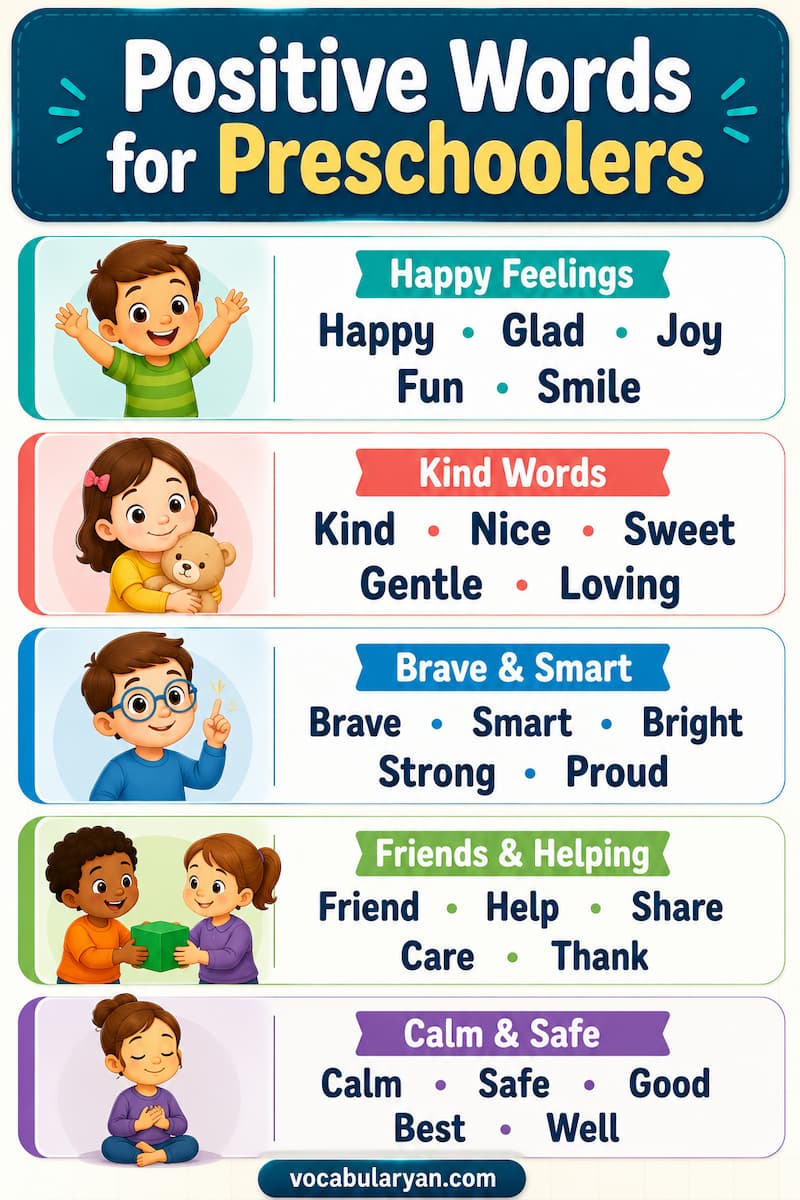
At three, four, and five years old, a child’s brain is wiring itself at full speed. The words a parent or teacher repeats in those years don’t just encourage, they become part of how the child sees themselves. A four-year-old who hears “brave” when she tries something hard begins to reach for that word when she faces the next hard thing. The words below are grouped by what they name, from kindness and bravery to effort and wonder, at a level a preschooler can hear and start to carry. Each word comes with a meaning that an adult understands and a short example that lands right for a young child. Say the word and say what you saw. That combination is what makes it stay.
Positive Words for Preschoolers at a Glance
Short on time? Grab a word for the moment you’re in, then read the fuller groups below.
| When you want to name… | Try these words |
|---|---|
| Who they are | Kind, brave, gentle, funny, loving |
| Their effort | Trying, working, practicing, not giving up |
| Their heart | Caring, warm, giving, helpful, friendly |
| Their mind | Curious, creative, imaginative, clever |
| Their worth | Loved, special, enough, valued, seen |
| Progress | Growing, learning, getting better, improving |
Words That Name a Preschooler’s Best Qualities
These are the one-word names for what a young child already is. Say them often, and say what you saw.
- Kind: caring and gentle toward others.
- “You were so kind when you gave him a turn.”
- Brave: doing something even when it felt a bit scary.
- “That was brave, trying the new slide for the first time.”
- Gentle: soft and careful with people, animals, and fragile things.
- “You were so gentle with the baby rabbit.”
- Loving: full of warm, open care for people around them.
- “You are such a loving child. That hug said everything.”
- Funny: making others laugh in a sweet, joyful way.
- “Your silly face made everyone laugh. You are so funny.”
- Curious: wanting to know how everything works.
- “You asked such a curious question. That’s how scientists think.”
- Creative: making up new ideas, pictures, and stories.
- “That drawing is so creative. I’ve never seen a purple dog before.”
- Helpful: noticing when someone needs a hand and giving it.
- “You were so helpful carrying those books.”
- Friendly: warm and open with new people.
- “I love how friendly you are. You waved to every person.”
- Caring: noticing how others feel and doing something about it.
- “You noticed she was sad. That’s what caring looks like.”
Words That Name a Preschooler’s Effort
At this age, naming the effort matters more than naming the outcome. These words tell a child that trying is the whole point.
- Trying: making a real attempt, which is all that’s needed.
- “I love that you kept trying, even when it was hard.”
- Practicing: doing something again and again to get better at it.
- “All that practicing is how you got so good at it.”
- Working: putting real effort into a task.
- “Look at you working so hard on that tower.”
- Not giving up: staying with it past the first hard moment.
- “You didn’t give up. That’s the most important thing.”
- Focused: staying with a task and seeing it through.
- “You stayed focused on that puzzle the whole time.”
- Persistent: trying again after something doesn’t work.
- “You tried it a different way. That’s persistent.”
- Careful: taking their time and paying attention.
- “You were so careful with the paint. Good thinking.”
- Energetic: bringing real enthusiasm and drive.
- “You brought so much energetic effort to the whole morning.”
Words That Tell a Preschooler They Are Loved and Enough
These are the words that land deepest. A preschooler who hears these often builds a foundation nothing can easily shake.
- Loved: held in deep, steady, unconditional care.
- “You are loved today, tomorrow, and always.”
- Enough: already whole, worthy, and complete as they are.
- “You are enough exactly as you are right now.”
- Special: carrying something no one else in the world has.
- “There is no one else in the whole world exactly like you.”
- Valued: genuinely important to everyone around them.
- “You are so valued in this family.”
- Seen: fully noticed and known by the people who love them.
- “I see you. I know how hard that was.”
- Safe: held and protected in this moment.
- “You are safe. I’m right here.”
- Proud: making those who love them glow with warmth.
- “I am so proud of you, not just for what you did, but for who you are.”
- Wonderful: filling life with genuine joy and warmth.
- “You are wonderful. This house is brighter because you’re in it.”
Words That Name a Preschooler’s Growing Mind
Young children are natural scientists and artists. These words name their thinking and imagination.
- Clever: quick to notice and figure things out.
- Imaginative: building whole worlds in their mind.
- Thoughtful: pausing before acting, which takes real effort at this age.
- Observant: noticing the small details others walk past.
- Inquisitive: full of genuine questions about how everything works.
- Inventive: coming up with a brand new way to do something.
- Wonder-filled: looking at the world with wide, open eyes.
- Quick-thinking: finding a solution before the adults do.
- Bright: full of light, energy, and smart ideas.
Specific Things to Say Instead of “Good Job”
“Good job” is warm but vague. A preschooler learns more when the word names what they did. These pairs show the difference.
| Instead of this… | Try this instead |
|---|---|
| “Good job!” | “You did it! You kept trying until it worked.” |
| “You’re so smart!” | “You figured that out by trying different ways.” |
| “Good sharing!” | “You waited for your turn. That was really kind.” |
| “You’re so brave!” | “I saw you try something new even when you weren’t sure. That’s brave.” |
| “I’m proud of you.” | “You worked hard on that. You should feel proud of yourself.” |
| “Great drawing!” | “You used so many colors. What’s happening in this picture?” |
| “Well done!” | “You didn’t give up on that puzzle. I noticed.” |
| “You’re amazing!” | “The way you helped him without being asked, that was amazing.” |
The difference is specific versus general. Specific words tell the child what you saw, which shows them you were watching. That alone is one of the most powerful things a caring adult can offer a young child.
Short Phrases to Say Every Morning
A warm morning sets a whole day. These take under ten seconds and mean everything.
- “I love you and I’m glad you’re here.”
- “Today is going to be a great day.”
- “You can come to me with anything.”
- “I’m so happy you’re my child.”
- “Whatever happens today, I’ve got you.”
- “You make this family brighter.”
- “I’m proud of you just for being you.”
- “Let’s have a good day together.”
Positive Words for Preschoolers A to Z
Short, warm, at the right level for a classroom display or a morning card.
| Letter | Word | Meaning for little ones |
|---|---|---|
| A | Amazing | Something that fills everyone with wonder |
| B | Brave | Doing it even when you feel a little scared |
| C | Curious | Always wanting to know more |
| D | Determined | Not stopping until you figure it out |
| E | Enough | Already perfect exactly as you are |
| F | Friendly | Warm and open with everyone |
| G | Gentle | Careful and soft with people and animals |
| H | Helpful | Noticing what someone needs and doing it |
| I | Imaginative | Full of ideas no one else thought of |
| J | Joyful | Carrying real happiness that shows |
| K | Kind | Warm and caring toward others |
| L | Loved | Held in steady, forever care |
| M | Mindful | Noticing what’s happening right now |
| N | Nice | Warm and friendly in every moment |
| O | Original | One of a kind in your own special way |
| P | Playful | Full of fun and happy laughter |
| Q | Quick | Fast to learn and notice things |
| R | Resilient | Getting back up after a fall |
| S | Special | There is no one else exactly like you |
| T | Trying | Making the attempt, which is everything |
| U | Unique | Different in the very best way |
| V | Valued | Genuinely important to everyone around you |
| W | Warm | Full of friendly, caring energy |
| X | (e)Xcited | Full of happy energy about something new |
| Y | You | The best version of exactly who you are |
| Z | Zestful | Full of lively, happy energy for the day |
FAQs
Kind, brave, curious, loving, gentle, and trying are among the most powerful for this age. Words land best when they’re short, specific, and tied to what the child just did. Instead of “good job,” try “you shared without being asked, that was kind.” The specific word names what you saw, and preschoolers are lifted by being seen.
Name the action, not just the outcome. Research from Carol Dweck and early childhood organizations consistently shows that process praise (“you kept trying even when it was hard”) builds more resilience than outcome praise (“you’re so smart”). A preschooler who hears their effort named begins to believe that effort is what matters, which serves them for life.
Name what you see first, then steady them. “I know that’s hard” validates the feeling. “You’re still trying” names the strength. “I’m right here” provides the anchor. Avoid dismissing the struggle (“it’s fine”). A preschooler whose hard moment is named and held learns that struggle is normal, not a sign that something is wrong with them.
Words at this age shape neural pathways linked to self-worth, motivation, and emotional regulation. Bright Horizons notes that the preschool years are when the brain is especially responsive to positive language from trusted adults. Words heard repeatedly at this age become part of a child’s inner voice, the one they draw on when the adult is no longer in the room.
Short, present-tense, first-person lines work best: “I am loved,” “I am brave enough,” “I can try,” and “mistakes help me learn.” Keep them true and short enough for a young child to repeat. One or two lines said each morning are worth more than a long list said once.
Capable, enough, special, loved, and seen are the most foundational. Pair any of them with something real: “You are capable, you figured out that button all by yourself.” Confidence at this age grows from being seen accurately, not from being told they’re perfect. A child who hears specific, honest warmth from trusted adults builds a self-image that carries them forward.