
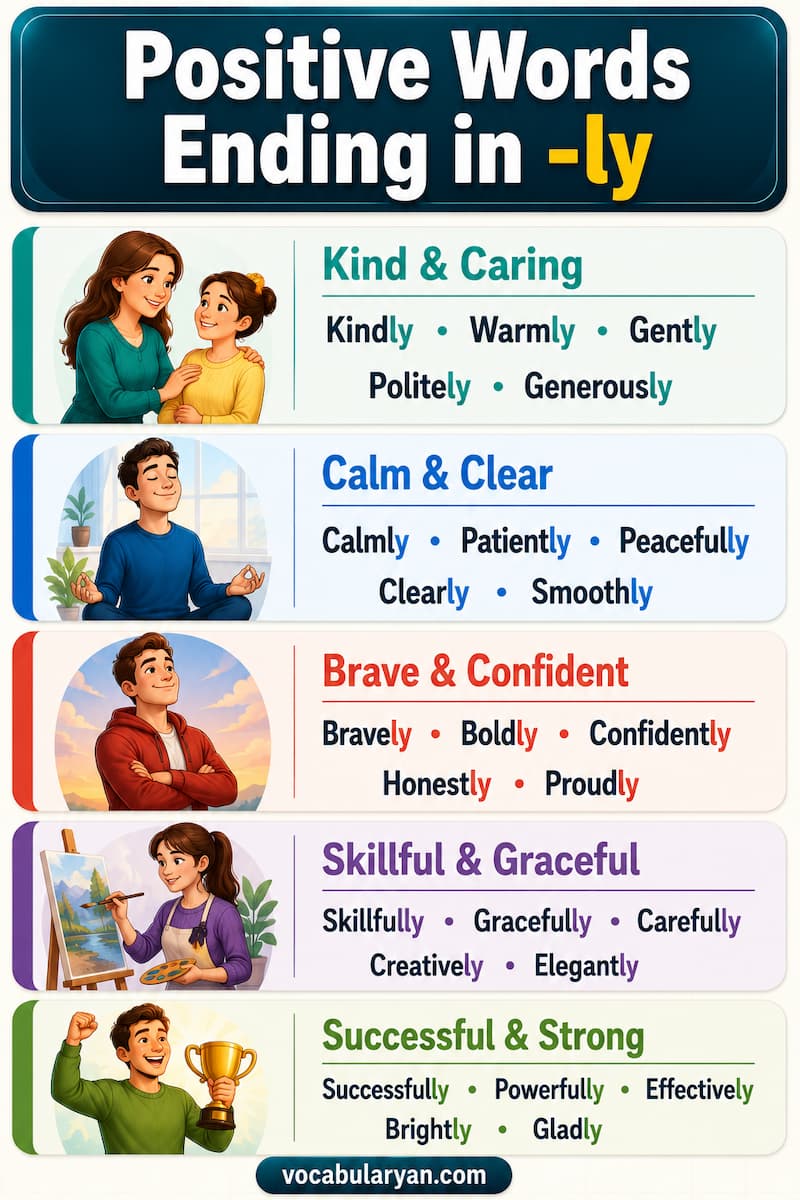
The suffix -ly is the most productive in English, and it works in two entirely different ways. Add it to a noun and you get an adjective: friend becomes friendly, love becomes lovely, scholar becomes scholarly. Add it to an adjective and you get an adverb: joyful becomes joyfully, warm becomes warmly, graceful becomes gracefully. Both types end in -ly and both carry real positive charge, but they behave differently in a sentence and need different treatment. The words below are organized by type first, then by meaning cluster within each type, so you always know not just what a word means but how to use it correctly.
The Two Types of Positive -ly Words
Before choosing a word, identify which type it belongs to. The type determines where it sits in a sentence.
| Type | How it forms | What it describes | Where it goes |
|---|---|---|---|
| Adjective | Noun + ly | A noun or pronoun | Before a noun or after a linking verb |
| Adverb | Adjective + ly | A verb, adjective, or another adverb | After the verb, before an adjective |
- “She gave a friendly smile.” (Adjective: friend + ly, describes the noun smile.)
- “She smiled warmly.” (Adverb: warm + ly, describes the verb smiled.)
Both end in -ly. Only the type tells you how to use them.
Positive -ly Adjectives: Warmth and Character
These adjectives come from nouns naming people or relationships. They describe the kind of person someone is or the quality of how they behave.
- Friendly: warm and open in manner toward others.
- “His friendly approach put everyone at ease from the start.”
- Lovely: beautiful, charming, and pleasing in every way.
- “What a lovely afternoon to sit by the water.”
- Lively: full of energy, animation, and bright spirits.
- “The lively conversation kept the table going long after dinner.”
- Kindly: naturally warm and benevolent in nature.
- “She spoke in a kindly tone that made the child relax.”
- Stately: impressively dignified and commanding in bearing.
- “A stately oak stood at the center of the courtyard.”
- Comely: pleasant and attractive in appearance.
- “The comely design of the room made it feel both grand and warm.”
- Mannerly: consistently polite and well-behaved.
- “He was mannerly in every situation, from formal dinners to the schoolyard.”
- Goodly: impressively large, fine, or generous.
- “She left a goodly portion of her time to mentoring newer colleagues.”
- Neighborly: warm, helpful, and cooperative as a neighbor.
- “Their neighborly generosity showed in every small and unasked act.”
- Sprightly: full of life and quick, cheerful energy.
- “The sprightly toddler darted between the chairs without pause.”
Positive -ly Adjectives: Virtue and Nobility
These adjectives name admirable qualities and moral character in a person.
- Saintly: having the purity and goodness of a deeply virtuous person.
- “Her saintly patience through the long difficulty inspired everyone.”
- Godly: deeply moral, devout, and guided by strong principles.
- “He was known for his godly conduct in every dealing.”
- Scholarly: showing deep learning and intellectual commitment.
- “Her scholarly approach brought rigour to every question.”
- Kingly: having the dignity and generosity of a true leader.
- “He made a kingly gesture by crediting everyone on the team.”
- Queenly: carrying the grace and dignity of royalty.
- “She arrived with a queenly composure that silenced the room.”
- Sisterly: warm and supportive in the way a close sister would be.
- “Her sisterly care for the younger students set the tone for the whole group.”
- Brotherly: warm and loyal in the way of a close brother.
- “He offered brotherly support through every stage of the recovery.”
- Motherly: warm, nurturing, and protective in a maternal way.
- “Her motherly instinct to protect the group was felt by everyone.”
- Fatherly: steady, warm, and guiding in a paternal way.
- “His fatherly advice came at exactly the right moment.”
- Womanly: having the grace, warmth, and maturity of a woman.
- “She carried herself with a womanly dignity beyond her years.”
Positive -ly Adjectives: Time and Order
These adjectives describe timing, regularity, and well-organized quality.
- Timely: arriving at exactly the right moment.
- “The timely intervention prevented a much larger problem.”
- Orderly: arranged neatly and functioning well.
- “An orderly handover made the transition genuinely smooth.”
- Earthly: belonging to the physical world, often in contrast to what’s fleeting.
- “The simple earthly pleasures, bread, sunlight, and company, meant the most to him.”
- Heavenly: divinely beautiful or perfectly delightful.
- “The heavenly scent of the garden carried all the way to the gate.”
- Worldly: experienced, sophisticated, and knowledgeable about life.
- “Her worldly wisdom came from decades of genuine engagement.”
- Leisurely: unhurried, calm, and pleasantly relaxed in pace.
- “A leisurely walk along the cliff path was exactly what the week needed.”
Positive -ly Adjectives: Energy and Warmth
These adjectives name vivid, sensory, or expressive qualities.
- Vibrantly: full of vivid, living color and bright energy.
- Cuddly: warm, soft, and inviting close affection.
- Bubbly: cheerful, sparkling, and naturally full of good feeling.
- Sparkly: bright, shining, and catching the light with life.
- Curly: natural and full of spirited, soft movement.
Positive -ly Adverbs: Joy and Happiness
These adverbs describe how someone does something when they’re happy, warm, or celebrating. They follow the verb or open the sentence.
- Joyfully: in a way that expresses deep happiness.
- “She accepted the award joyfully, her voice breaking with gratitude.”
- Happily: in a genuinely contented and pleased way.
- “He happily gave his last hour of the day to the mentoring call.”
- Cheerfully: in a bright, upbeat, and positive way.
- “She answered cheerfully even when the question was difficult.”
- Gleefully: with open, energetic, child-like delight.
- “They gleefully announced the result to the whole office.”
- Playfully: in a lighthearted and fun-filled way.
- “He playfully challenged her claim, and the room broke into laughter.”
- Warmly: in a friendly and affectionate way.
- “The whole team was welcomed warmly on the first day.”
- Brightly: in a vivid, cheerful, and glowing way.
- “She smiled brightly and the tension in the room eased.”
- Delightfully: in a way that brings genuine pleasure to others.
- “The event was delightfully organized from start to finish.”
Positive -ly Adverbs: Courage and Confidence
These adverbs describe how someone acts when they’re brave, assured, or determined.
- Boldly: in a confident and decisive way, without hesitation.
- “She boldly raised the issue that no one else had mentioned.”
- Bravely: with real courage, especially when it costs something.
- “He bravely admitted the mistake before anyone had to point it out.”
- Confidently: with assured belief in one’s own ability.
- “She presented confidently and held the room from the first line.”
- Courageously: with moral or physical bravery in the face of difficulty.
- “They courageously held their position under sustained pressure.”
- Decisively: with clear, firm, committed action.
- “She acted decisively and the situation turned in an hour.”
- Resolutely: with firm and unwavering purpose.
- “He resolutely kept his principles when the pressure mounted.”
- Fearlessly: without holding back, entirely without hesitation.
- “She fearlessly took on the assignment everyone else had declined.”
- Powerfully: with commanding strength and real effect.
- “He spoke powerfully and the audience leaned forward.”
Positive -ly Adverbs: Kindness and Care
These adverbs describe how someone acts when they’re caring, generous, or warm toward others.
- Attentively: in a way that shows full, focused care.
- “She listened attentively to every concern before responding.”
- Generously: giving freely and without keeping score.
- “He generously offered his time to anyone who asked.”
- Lovingly: with deep, open affection.
- “She had lovingly preserved every letter from the years apart.”
- Tenderly: with gentleness and care for another’s feelings.
- “He tenderly helped her over the rough stretch of path.”
- Graciously: with warm, dignified courtesy.
- “She graciously thanked every contributor by name.”
- Thoughtfully: with genuine consideration for others.
- “The gift was thoughtfully chosen down to the last detail.”
- Compassionately: with real feeling for another’s difficulty.
- “She listened compassionately and asked no unnecessary questions.”
- Affectionately: in a way that shows open and genuine warmth.
- “He greeted everyone affectionately, whether it was their first day or their last.”
Positive -ly Adverbs: Wisdom and Excellence
These adverbs describe how someone acts when they’re performing with skill, intelligence, or integrity.
- Brilliantly: with outstanding intelligence or skill.
- “She performed brilliantly under conditions that would have rattled most.”
- Skillfully: with developed and precise ability.
- “He skillfully steered the negotiation to a result that satisfied everyone.”
- Wisely: with sound and well-considered judgment.
- “She wisely chose silence where others would have spoken.”
- Masterfully: with command and excellence in execution.
- “The conductor masterfully drew the best from every section.”
- Honestly: with full truthfulness and no deception.
- “He honestly acknowledged what hadn’t worked before proposing a fix.”
- Faithfully: with steady, loyal, and reliable commitment.
- “She faithfully delivered what she promised, every time.”
- Mindfully: with full, deliberate attention to what matters.
- “He mindfully paused before every significant decision.”
- Carefully: with precise and deliberate attention to every detail.
- “The report was carefully structured, with no section wasted.”
Positive -ly Adverbs: Gratitude and Positivity
These adverbs describe how someone responds when they’re thankful, optimistic, or appreciative.
- Thankfully: in a way that expresses real gratitude.
- “Thankfully, the last revision turned out to be the best one.”
- Gratefully: with a deep and open sense of appreciation.
- “She accepted gratefully, without making anyone feel the size of the favor.”
- Positively: in an optimistic and constructive way.
- “He responded positively to the criticism and improved within the week.”
- Hopefully: with warm expectation for what’s to come.
- “She looked hopefully toward the next chapter.”
- Peacefully: in a calm, undisturbed, and settled way.
- “He settled peacefully into the new rhythm of the days.”
- Serenely: with a steady, tranquil, and unruffled calm.
- “She waited serenely while everything around her rushed.”
How -ly Adjectives Differ from -ly Adverbs: Quick Test
When you’re unsure which type a -ly word is, apply one of two tests.
The adjective test: place the word before a noun. If it makes sense, it’s an adjective.
- “A friendly person” ✅. Friendly is an adjective.
- “A warmly person” ❌. Warmly is not an adjective.
The adverb test: replace the word with “in a ___ way.” If it makes sense, it’s an adverb.
- “She smiled warmly” = “She smiled in a warm way” ✅. Warmly is an adverb.
- “A lovely day” = “A day in a love way” ❌. Lovely is not an adverb.
Most -ly adjectives cannot take -ly again (you don’t say “friendlily”), while most -ly adverbs already carry the -ly as their final form.
Positive -ly Words A to Z
One positive -ly word per letter, labeled by type, with a short meaning.
| Letter | Word | Type | Meaning |
|---|---|---|---|
| A | Admirably | Adverb | In a way that earns genuine admiration |
| B | Boldly | Adverb | With confidence and decisive action |
| C | Cheerfully | Adverb | In a bright and upbeat way |
| D | Delightfully | Adverb | In a way that brings real pleasure |
| E | Earnestly | Adverb | With sincere and deep seriousness |
| F | Friendly | Adjective | Warm and open toward others |
| G | Graciously | Adverb | With warm, dignified courtesy |
| H | Happily | Adverb | In a genuinely contented way |
| I | Impressively | Adverb | In a way that commands admiration |
| J | Joyfully | Adverb | With deep, expressed happiness |
| K | Kindly | Adverb/Adj | In a warm and caring way |
| L | Lovely | Adjective | Beautiful and pleasing in every way |
| M | Masterfully | Adverb | With commanding skill and excellence |
| N | Nobly | Adverb | With high moral purpose and dignity |
| O | Openly | Adverb | In a candid and welcoming way |
| P | Peacefully | Adverb | In a calm and settled way |
| Q | Quietly | Adverb | In a still and composed way |
| R | Resolutely | Adverb | With firm and unwavering purpose |
| S | Saintly | Adjective | Having the goodness of a virtuous person |
| T | Thoughtfully | Adverb | With genuine care and consideration |
| U | Uprightly | Adverb | With honest, principled conduct |
| V | Valiantly | Adverb | With great courage and determination |
| W | Warmly | Adverb | In a friendly and affectionate way |
| X | (e)Xaltedly | Adverb | With elevated joy and pride |
| Y | Yearningly | Adverb | With warm and hopeful longing |
| Z | Zealously | Adverb | With eager, passionate energy |
FAQs
Positive -ly words split into two types. Adjectives (lovely, friendly, lively, scholarly, saintly) come from noun + ly and describe nouns. Adverbs (joyfully, warmly, boldly, kindly, gratefully) come from adjective + ly and describe verbs. Both end in -ly but work differently in a sentence.
An -ly adjective describes a noun: “a friendly person,” “a lovely day.” An -ly adverb describes a verb or another adjective: “she smiled warmly,” “he spoke boldly.” Most -ly adjectives are formed by adding -ly to a noun (friend → friendly). Most -ly adverbs are formed by adding -ly to an adjective (warm → warmly).
Friendly, lovely, lively, kindly, saintly, scholarly, motherly, fatherly, brotherly, sisterly, heavenly, earthly, timely, orderly, neighborly, and sprightly are among the most used. Each comes from a noun, and each describes what kind of thing or person something is.
Joyfully, happily, warmly, kindly, boldly, graciously, lovingly, thankfully, brilliantly, mindfully, and peacefully are among the most used. Each describes how an action is performed and answers the question “how?”
Add -ly to the adjective. If the adjective ends in -l, just add -ly: beautiful → beautifully. If it ends in -y, change y to i then add -ly: happy → happily. If it ends in -le preceded by a consonant, drop the e and add -y: gentle → gently. Most adjectives follow the straight adjective + ly rule: warm → warmly, bold → boldly, graceful → gracefully.
A small number of -ly words function as both. Kindly is the most common: “a kindly person” (adjective) and “she spoke kindly” (adverb). Leisurely is another: “a leisurely walk” (adjective) and “she walked leisurely” (adverb). For most -ly words, though, the part of speech is fixed, and the type determines the function.