
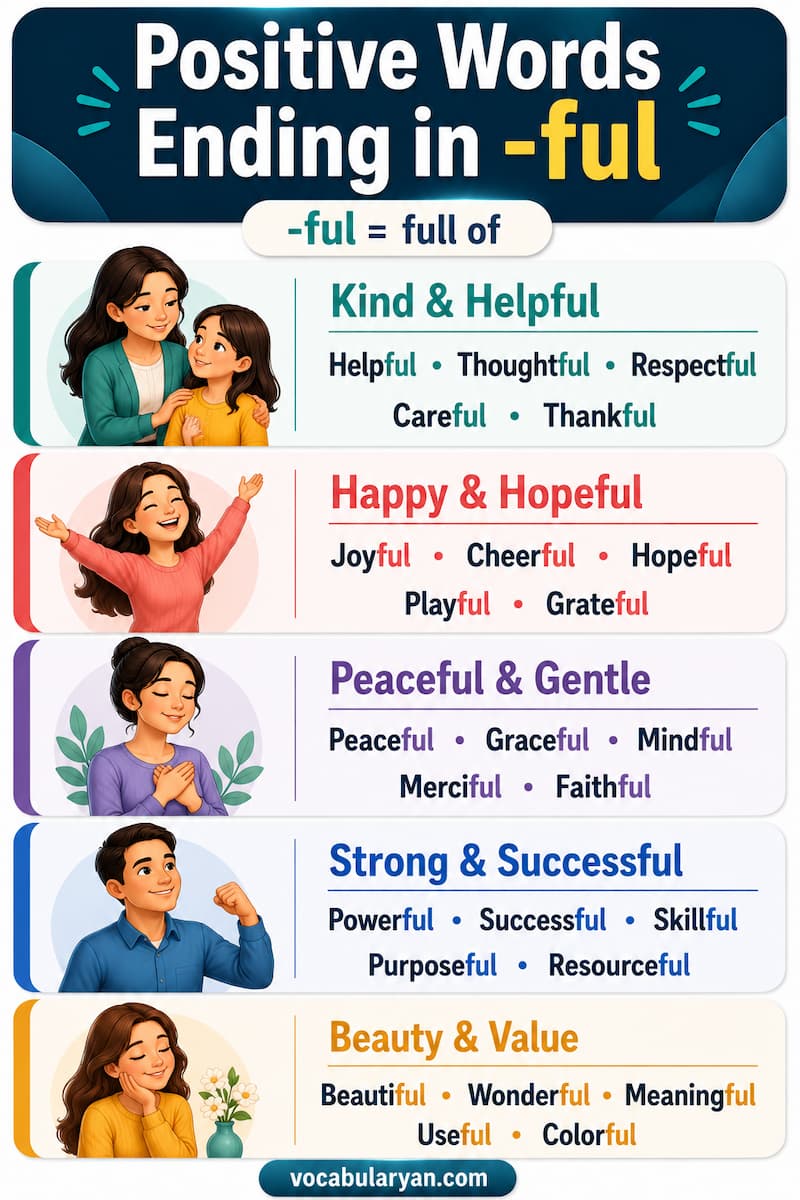
The suffix -ful turns a noun into an adjective that means “full of” whatever that noun holds. Joy becomes joyful. Grace becomes graceful. Wonder becomes wonderful. The pattern is one of the most productive in English, and the words it builds tend to carry real warmth. The positive -ful words below are grouped by what they name, from feelings and moods to character traits to beauty and capability, so you find the right one for a sentence, a caption, a story, or a compliment. Each word carries a meaning and a natural example.
What Does the Suffix -ful Mean?
The suffix -ful comes from Old English and means full of or having the qualities of. Add it to a noun and you get an adjective:
| Root noun | + ful | Meaning |
|---|---|---|
| Joy | Joyful | Full of joy |
| Grace | Graceful | Full of grace |
| Hope | Hopeful | Full of hope |
| Wonder | Wonderful | Full of wonder |
| Peace | Peaceful | Full of peace |
That one suffix accounts for hundreds of English adjectives. The positive ones cluster naturally around feelings, character, beauty, and capability, and each group below covers one of those clusters.
Positive -ful Words for Feelings and Moods
These words name how someone feels or the mood a place carries.
- Joyful: full of deep, genuine happiness.
- “She had a joyful laugh that filled the whole room.”
- Cheerful: bright and visibly happy in mood.
- “He arrived cheerful and ready for the day.”
- Blissful: wrapped in complete and peaceful happiness.
- “They spent a blissful week by the coast.”
- Hopeful: full of warm expectation for what’s ahead.
- “She felt hopeful for the first time in months.”
- Grateful: full of genuine thankfulness.
- “I’m so grateful for everything you did.”
- Peaceful: calm, free of conflict or disturbance.
- “The garden was peaceful in the early morning.”
- Restful: easing tiredness and inviting calm.
- “A restful weekend left her ready for the week.”
- Playful: full of fun, lightness, and good humor.
- “His playful jokes made even the longest meeting bearable.”
- Gleeful: bright with open, energetic delight.
- “The children gave a gleeful shout when it started to snow.”
- Mirthful: full of warm, shared laughter and good feeling.
- “A mirthful gathering that carried on long past midnight.”
- Wishful: holding a warm, hopeful desire.
- “She gave a wishful smile at the thought of returning.”
- Zestful: full of lively energy and enthusiasm.
- “His zestful approach to the project lifted everyone.”
Positive -ful Words for Character and Virtue
These words name the admirable qualities in a person.
- Faithful: true and steady in loyalty and commitment.
- “She remained faithful to the people and values she loved.”
- Thoughtful: considering others carefully and with genuine care.
- “That was such a thoughtful gift. You know her well.”
- Mindful: fully present and attentive to the moment.
- “A mindful approach to the task meant nothing was rushed.”
- Graceful: moving or behaving with ease and dignity.
- “She handled the difficult question with graceful confidence.”
- Truthful: honest and free of deception.
- “He gave a truthful answer when an easier one was available.”
- Dutiful: conscientious and reliable in meeting responsibilities.
- “His dutiful approach to every task earned real respect.”
- Merciful: showing kindness when harshness was possible.
- “A merciful decision gave everyone a second chance.”
- Tactful: careful and diplomatic in how feelings are handled.
- “She delivered the feedback in a tactful and kind way.”
- Trustful: open and ready to extend trust to others.
- “Children are naturally trustful and generous in spirit.”
- Purposeful: moving with strong direction and real intention.
- “Each purposeful step brought her closer to the goal.”
- Soulful: deep and full of genuine feeling.
- “He gave a soulful performance that stayed with the audience.”
- Respectful: showing regard and consideration for others.
- “She was respectful to everyone, regardless of their role.”
Positive -ful Words for Beauty and Wonder
These words name what is striking, lovely, or inspiring to encounter.
- Beautiful: deeply pleasing to the senses and the heart.
- “The view from the ridge was beautiful at dawn.”
- Wonderful: filling you with warm admiration and surprise.
- “What a wonderful evening that was.”
- Colorful: richly varied and bright with vivid hues.
- “The colorful market stretched the full length of the square.”
- Tasteful: showing elegant, well-judged aesthetic sense.
- “The tasteful decor was calm and well-chosen.”
- Bountiful: generous and rich in abundance.
- “The bountiful harvest filled every shelf in the barn.”
- Artful: showing skill and creativity in construction.
- “An artful arrangement of light and shadow defined the photograph.”
- Tuneful: melodic and pleasing to hear.
- “A tuneful melody drifted through the open window.”
- Flavorful: richly full of distinct and pleasing taste.
- “The flavorful sauce built slowly through the whole dish.”
- Eventful: rich with interesting and memorable occurrences.
- “It was an eventful journey from the first hour.”
Positive -ful Words for Strength and Capability
These words name power, skill, and effective capability.
- Powerful: full of strength, force, or influence.
- “The powerful engine pulled the whole train with ease.”
- Skillful: highly developed in a craft or ability.
- “Her skillful handling of the negotiation impressed the room.”
- Masterful: commanding a skill or situation at the highest level.
- “A masterful performance that left the audience silent.”
- Forceful: strong and full of energy in action or speech.
- “He made a forceful case that nobody could dismiss.”
- Resourceful: finding effective solutions with whatever is available.
- “She was resourceful enough to solve the problem with what was there.”
- Impactful: producing a strong and meaningful effect.
- “The campaign had an impactful message that stayed with people.”
- Insightful: showing deep and accurate understanding.
- “Her insightful analysis changed the direction of the project.”
- Meaningful: carrying real value and significance.
- “The conversation was short but genuinely meaningful.”
- Successful: achieving a desired goal or result.
- “A successful launch after months of preparation.”
- Fruitful: producing real and valuable results.
- “The collaboration proved fruitful within weeks.”
- Gainful: producing benefit or profit.
- “Gainful work that also carried real purpose.”
- Healthful: promoting good health and wellbeing.
- “A healthful routine of sleep, movement, and good food.”
Positive -ful Words for Connection and Warmth
These words name the warmth between people and the qualities that bind them.
- Thankful: openly expressing thanks for what others give.
- Pitiful: moved to compassion by another’s difficulty.
- Frolicful: playfully full of energy and good fun.
- Wistful: gently longing, in a warm and tender way.
- Praiseful: quick and open in giving genuine praise.
- Fanciful: full of warm imagination and playful ideas.
- Heartful: sincerely warm and full of deep feeling.
- Songful: naturally lyrical and full of joyful expression.
- Wakeful: alert and attentive to those around you.
- Reposeful: calm and restfully gentle in nature.
Rare and Beautiful Positive -ful Words
When the common ones feel too worn, these rarer -ful words carry a fresh charge.
| Word | Meaning |
|---|---|
| Mirthful | Full of laughter and good cheer |
| Blithe-ful | Carefree and full of joy |
| Praiseful | Full of genuine praise and appreciation |
| Heartful | Full of sincere, deep feeling |
| Wakeful | Alert, attentive, and fully alive to the moment |
| Reposeful | Calm and restfully peaceful |
| Eventful | Rich with memorable happenings |
| Graceful | Elegant and full of quiet dignity |
| Tuneful | Melodious and pleasant to hear |
| Songful | Naturally musical and lyrical |
How the -ful Suffix Works: Form a New Word in Seconds
Understanding the pattern lets you build and recognize -ful words on the spot.
The rule: noun + -ful = adjective meaning “full of ___”
- Hope → Hopeful (full of hope)
- Color → Colorful (full of color)
- Tact → Tactful (full of tact)
- Meaning → Meaningful (full of meaning)
- Insight → Insightful (full of insight)
Spelling note: when the root noun ends in -y, change the y to i before adding -ful.
- Beauty → Beautiful (not beautyful)
- Bounty → Bountiful (not bountyful)
Adverb form: add -ly to get the adverb:
- Joyful → Joyfully
- Peaceful → Peacefully
- Graceful → Gracefully
Positive -ful Words A to Z
One positive -ful word for each letter, with a short meaning.
| Letter | Word | Meaning |
|---|---|---|
| A | Artful | Showing skill and creative flair |
| B | Beautiful | Deeply pleasing to senses and heart |
| C | Cheerful | Bright and visibly happy |
| D | Dutiful | Reliable and conscientious |
| E | Eventful | Rich with memorable occurrences |
| F | Faithful | True and steady in loyalty |
| G | Graceful | Moving with ease and dignity |
| H | Hopeful | Full of warm expectation |
| I | Insightful | Showing deep, accurate understanding |
| J | Joyful | Full of genuine happiness |
| K | Kind-ful | Warm and full of care |
| L | Lightful | Bright and full of warm radiance |
| M | Mindful | Fully present and attentive |
| N | Nourish-ful | Rich with nourishing goodness |
| O | Overjoyed-ful | Brimming with delight |
| P | Peaceful | Calm and free of disturbance |
| Q | Quietful | Calm and gently full of peace |
| R | Restful | Easing strain and inviting calm |
| S | Skillful | Highly developed in ability |
| T | Thoughtful | Considering others with genuine care |
| U | Upbeat-ful | Bright and forward-looking in mood |
| V | Vibrant-ful | Richly full of life and color |
| W | Wonderful | Filling you with warm admiration |
| X | (e)Xtraordinary-ful | Full of exceptional quality |
| Y | Yearning-ful | Full of warm, reaching hope |
| Z | Zestful | Full of lively, enthusiastic energy |
FAQs
Positive -ful words include wonderful, beautiful, grateful, joyful, peaceful, hopeful, cheerful, blissful, graceful, and mindful. The suffix -ful means “full of,” so each word names a quality in its fullest form. They group naturally into feelings, character traits, beauty, and capability.
The suffix -ful comes from Old English and means “full of” or “having the qualities of.” Adding it to a noun creates an adjective: joy becomes joyful (full of joy), grace becomes graceful (full of grace), and hope becomes hopeful (full of hope). It’s one of the most productive suffixes in English.
Wonderful, beautiful, grateful, and mindful are among the most widely used positive -ful words in everyday English. Wonderful and beautiful top frequency lists across both spoken and written use, while grateful and mindful have grown significantly in recent years with the rise of wellbeing and self-development vocabulary.
For formal or literary writing, graceful, masterful, insightful, and purposeful carry the most weight. For emotional warmth, blissful, soulful, and heartful land deeply. For admirable character, faithful, dutiful, and truthful name qualities with real moral resonance.
Add -ful to a noun: hope + ful = hopeful. If the noun ends in -y, change the y to i first: beauty + ful = beautiful, bounty + ful = bountiful. To form the adverb, add -ly to the adjective: graceful → gracefully, joyful → joyfully.
The suffix -ful means “full of”: hopeful = full of hope. The suffix -less means “without”: hopeless = without hope. They produce opposite adjectives from the same root, and many positive -ful words have a negative -less counterpart: joyful/joyless, graceful/graceless, faithful/faithless.