
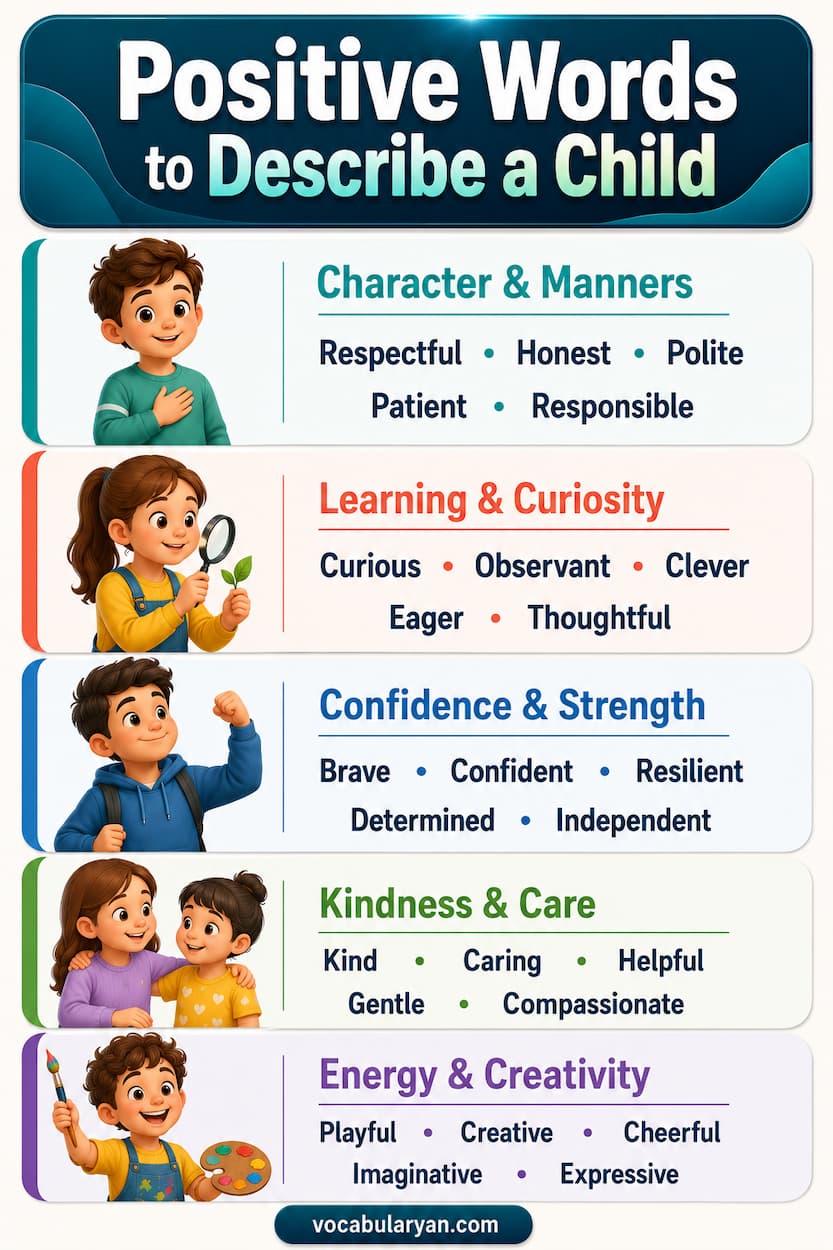
The words we use for a child become the words they use for themselves. Choosing the right ones, the specific, true ones, builds a child’s confidence far more than a quick “good job.” The words below are grouped by what you want to praise, character, behavior, effort, creativity, social skills, so a parent or teacher can find the right one for a report card, a note home, or a quiet word of encouragement. Each word comes with a meaning, and the main groups add an example you can borrow. Pick the ones that fit the child, and your words will help shape who they become.
Positive Words to Describe a Child at a Glance
Short on time? Grab a word for the quality you want to praise, then read the fuller groups below.
| If you want to praise their… | Try these words |
|---|---|
| Character | Kind, honest, caring, fair |
| Behavior | Polite, well-behaved, responsible, cooperative |
| Effort | Hardworking, diligent, persistent, eager |
| Imagination | Creative, curious, inventive, imaginative |
| Friendships | Friendly, sociable, welcoming, inclusive |
| Inner strength | Resilient, brave, confident, patient |
Positive Words for a Child’s Character
Character is who a child is at heart. These words praise the good in them.
- Kind: warm and good to other people.
- “You were so kind to share your lunch today.”
- Honest: tells the truth, even when it’s hard.
- “Thank you for being honest about what happened.”
- Caring: notices and cares how others feel.
- “You’re caring. You always check on your friends.”
- Fair: treats everyone equally and plays fair.
- “You were fair when you shared out the turns.”
- Respectful: treats people and rules with respect.
- “You’re respectful. You listened so well today.”
- Thoughtful: thinks of others before acting.
- “That was thoughtful, saving a seat for your friend.”
- Gentle: soft and careful with others.
- “You’re so gentle with the little ones.”
- Generous: happy to share what they have.
- “You’re generous. You gave your friend the bigger piece.”
- Loyal: stands by their friends.
- “You’re loyal. You stood up for your friend today.”
- Truthful: speaks the truth and keeps their word.
- “You’re truthful, and people trust you for it.”
- Considerate: mindful of how others feel.
- “It was considerate of you to wait your turn.”
- Good-natured: easy, warm, and pleasant.
- “You have such a good-natured way with everyone.”
Positive Words for a Child’s Behavior
These words praise how a child acts at home and in class. They work well in report cards and notes home.
- Well-behaved: acts properly and follows the rules.
- “She is well-behaved and a pleasure to teach.”
- Polite: uses kind manners with everyone.
- “He is polite and always says please and thank you.”
- Cooperative: works well with others.
- “She is cooperative and shares happily in group work.”
- Responsible: takes care of their jobs and things.
- “He is responsible and looks after his own work.”
- Attentive: listens carefully and stays engaged.
- “She is attentive and follows instructions closely.”
- Calm: stays settled and steady.
- “He stays calm even when things get busy.”
- Mannerly: shows good manners naturally.
- “She is mannerly and kind to her classmates.”
- Disciplined: keeps to good habits on their own.
- “He is disciplined about finishing what he starts.”
- Helpful: ready to lend a hand.
- “She is helpful and the first to tidy up.”
- Obedient: listens and does what is asked.
- “He is obedient and respectful of the rules.”
- Settled: calm and focused in the classroom.
- “She has been settled and happy this term.”
- Self-controlled: manages their feelings well.
- “He is self-controlled, even when he’s frustrated.”
Positive Words for a Hardworking Child (Effort And Learning)
The best praise names effort, because effort is something a child can keep doing. These words celebrate how hard a child tries.
- Hardworking: puts in real effort.
- “You’re hardworking. You kept going until it was done.”
- Diligent: works with steady care.
- “She is diligent and checks her work carefully.”
- Determined: keeps trying through difficulty.
- “You’re determined. You didn’t give up on that puzzle.”
- Persistent: sticks with a hard task.
- “He is persistent and works through every challenge.”
- Motivated: keen to learn and do well.
- “She is motivated and always ready to begin.”
- Eager: excited to take part and learn.
- “You’re eager to try new things, and it shows.”
- Conscientious: careful and serious about the work.
- “He is conscientious about every task he is given.”
- Dedicated: gives full effort to learning.
- “She is dedicated and proud of her progress.”
- Studious: enjoys learning and study.
- “He is studious and asks thoughtful questions.”
- Focused: keeps attention on the task.
- “You stayed focused the whole way through.”
- Improving: making clear, steady progress.
- “She is improving every single week.”
- Hard-trying: gives their honest best.
- “You’re a hard-trying learner, and it pays off.”
Positive Words for a Creative And Curious Child
Some children see the world in their own bright way. These words praise imagination and wonder.
- Creative: full of fresh, original ideas.
- Curious: loves to explore and ask why.
- Imaginative: makes up rich, inventive play.
- Inventive: finds clever, new ways to do things.
- Artistic: gifted at art and making.
- Inquisitive: asks questions and seeks answers.
- Original: thinks in their own special way.
- Expressive: shares ideas and feelings openly.
- Resourceful: finds a way with what they have.
- Observant: notices the small details.
- Playful: full of fun and invention.
- Bright: quick to learn and full of life.
Positive Words for a Child’s Social Skills
These words praise how a child gets along with others, the qualities that build good friendships.
- Friendly: warm and easy to get along with.
- Sociable: enjoys being with other children.
- Outgoing: confident and happy to meet people.
- Welcoming: makes others feel included.
- Inclusive: makes sure no one is left out.
- Encouraging: cheers others on.
- Sharing: happy to share with friends.
- Agreeable: easy and pleasant to be around.
- Well-liked: popular and warmly received.
- Approachable: easy for others to come to.
- Team-spirited: works happily as part of a group.
- Fair-minded: treats other children justly.
Positive Words for a Child’s Emotional Strengths
These words praise a child’s inner strength, the feelings and courage that help them grow.
- Resilient: bounces back after a setback.
- “You’re resilient. You tried again after it went wrong.”
- Brave: faces new things even when nervous.
- “You were brave to stand up and speak today.”
- Confident: believes in what they can do.
- “You’re confident, and it helps you try hard things.”
- Patient: waits calmly and keeps trying.
- “You showed real patience finishing that build.”
- Cheerful: brings a happy, bright mood.
- “Your cheerful smile lifts the whole room.”
- Optimistic: looks on the bright side.
- “You’re optimistic, even on a tricky day.”
- Self-aware: understands their own feelings.
- “You’re self-aware. You knew you needed a break.”
- Empathetic: feels for how others feel.
- “You’re empathetic. You comforted your friend so kindly.”
- Secure: settled and steady in themselves.
- “You seem secure and happy in yourself.”
- Courageous: meets fear and tries anyway.
- “That took courage, and you did it.”
- Hopeful: expects good things to come.
- “You stay hopeful, and that helps you keep going.”
- Easygoing: relaxed and happy to go with the flow.
- “You’re easygoing and a joy to be around.”
Positive Words to Describe a Toddler
Little ones have their own bright sparks. These words fit the youngest children.
- Affectionate: loving and full of hugs.
- Energetic: full of bounce and go.
- Giggly: quick to laugh and smile.
- Cuddly: warm and loving to hold.
- Spirited: lively and full of character.
- Sweet: gentle and endearing.
- Adventurous: eager to explore everything.
- Animated: lively and full of expression.
- Joyful: bubbling with happiness.
- Wide-eyed: full of wonder at the world.
Positive Words to Describe a Teenager
Teenagers are growing into who they will be. These words celebrate their developing strengths.
- Independent: thinks and acts for themselves.
- Mature: thoughtful and steady beyond their years.
- Ambitious: sets goals and works toward them.
- Self-reliant: handles things on their own.
- Principled: holds firm to their values.
- Driven: pushes hard toward what matters to them.
- Capable: ready and able to take things on.
- Open-minded: listens to new ideas.
- Idealistic: cares deeply about a better world.
- Level-headed: stays calm and sensible.
- Reflective: thinks deeply about things.
- Self-motivated: gets going without being pushed.
Positive Words for a Report Card (With Comment Examples)
Report cards stick with a child, so the words matter. Lead with a real strength, name it clearly, and tie it to something the child did. Here are ready comment openers you can adapt:
- “______ is a conscientious learner who takes real pride in her work.”
- “______ is polite, cooperative, and a positive presence in the classroom.”
- “______ shows wonderful curiosity and asks thoughtful questions.”
- “______ is resilient and keeps trying, even with challenging tasks.”
- “______ is kind and inclusive, and his classmates value his friendship.”
- “______ has made steady progress and should be proud of her effort.”
To raise a concern kindly, name a strength first, then frame the next step as a goal: “______ is a creative writer. With a little more focus on neat handwriting, her work will shine even more.”
How to Turn a Negative Into a Positive Word
Every tricky trait has a warmer way to name it. Reframing does not hide the truth; it points to the strength underneath, and it changes how a child hears it.
| Instead of saying… | Try… |
|---|---|
| Bossy | A natural leader |
| Stubborn | Determined |
| Loud | Lively and full of energy |
| Talkative | Sociable and expressive |
| Nosy | Curious and observant |
| Slow | Careful and thorough |
| Shy | Thoughtful and observant |
| Fussy | Has high standards |
| Hyper | Energetic and enthusiastic |
| Demanding | Knows what they want |
The reframe is not about pretending. A child who hears “you’re so determined” instead of “you’re so stubborn” learns to see the same trait as a strength worth keeping.
How to Praise a Child the Right Way: Be Specific
The strongest praise names exactly what the child did, and it praises effort over fixed talent. A specific word teaches a child what to keep doing.
- ❌ “You’re so smart.” — Praises a label the child can’t control.
- ✅ “You worked really hard on that, and it paid off.” — Praises effort, which they can repeat.
See the difference. The first praises a fixed trait, and a child can start to fear losing it. The second praises the effort, which a child can choose again tomorrow. Do the same with any word from this page. Pair kind with the moment they shared. Pair brave with the thing they tried. Try it now: think of one child, pick one word, and tie it to something real they did. That habit turns empty praise into the kind that helps a child grow.
Positive Words to Describe a Child A to Z
Most lists give A to Z with no meanings. This one gives a clear word and a meaning for each letter, so you can scan and choose at once.
| Letter | Word | Meaning |
|---|---|---|
| A | Affectionate | Warm and loving |
| B | Brave | Tries even when nervous |
| C | Curious | Loves to explore and ask |
| D | Diligent | Works with steady care |
| E | Eager | Keen to learn and join in |
| F | Friendly | Warm and easy to know |
| G | Generous | Happy to share |
| H | Helpful | Ready to lend a hand |
| I | Imaginative | Full of inventive ideas |
| J | Joyful | Full of happiness |
| K | Kind | Good to other people |
| L | Lively | Full of energy and fun |
| M | Mannerly | Shows good manners |
| N | Nurturing | Caring toward others |
| O | Observant | Notices small details |
| P | Polite | Uses kind manners |
| Q | Quick-witted | Sharp and fast to learn |
| R | Resilient | Bounces back from setbacks |
| S | Sociable | Enjoys being with others |
| T | Thoughtful | Thinks of others |
| U | Unique | Wonderfully their own self |
| V | Vibrant | Full of life and color |
| W | Well-behaved | Acts properly and kindly |
| X | (e)Xpressive | Shares ideas openly |
| Y | Youthful | Bright and full of wonder |
| Z | Zealous | Full of eager energy |
FAQs
The best words are specific and name real strengths: kind, curious, hardworking, brave, and creative. A specific word teaches a child what to keep doing, while a vague “good job” fades fast. Tie the word to something real: “You were so kind to share today.”
Use conscientious, cooperative, curious, resilient, and inclusive. Lead with a genuine strength, name it clearly, and tie it to something the child did. To raise a concern kindly, name a strength first, then frame the next step as a goal the child can work toward.
Praise effort rather than fixed talent. Saying “you worked so hard” helps more than “you’re so smart,” because effort is something a child can choose to repeat. Praising a fixed trait can make a child afraid to try hard things in case they fail and lose the label.
Reframe it toward the strength underneath. A “bossy” child can be called a natural leader, a “stubborn” one determined, and a “talkative” one sociable and expressive. Reframing is honest, it names the same trait in a way that helps the child see it as something worth growing.
Use affectionate, energetic, curious, sweet, and joyful. Toddlers show their character through play and feeling, so the warmest words name their energy and wonder. Tying a word to a moment, “you were so curious about the bugs today,” makes the praise feel real.