
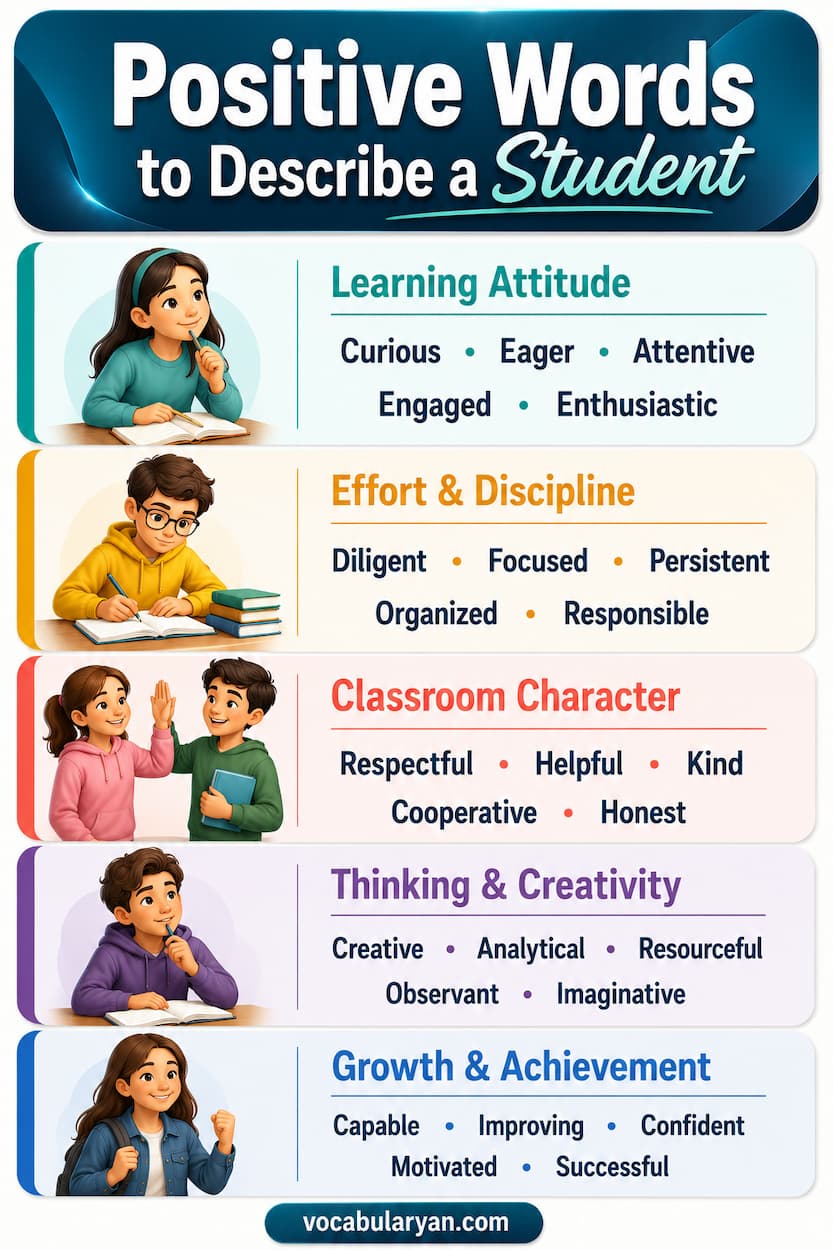
Report card season comes around fast, and the right word can do a lot for a student who reads it. The words below are built for teachers: grouped by what you assess, academic ability, work habits, attitude, participation, behavior, so you can find the exact one for a report card, a progress note, or a recommendation letter. Each word comes with a meaning, and the main groups add a ready comment sentence you can adapt. Lead with a real strength, name it clearly, and your words will mean something to the student and the family.
Positive Words to Describe a Student at a Glance
Short on time? Grab a word for the area you’re assessing, then read the fuller groups below.
| If you’re describing their… | Try these words |
|---|---|
| Academic ability | Capable, analytical, knowledgeable, proficient |
| Work habits | Diligent, organized, thorough, conscientious |
| Attitude | Motivated, eager, curious, positive |
| Participation | Engaged, active, attentive, inquisitive |
| Behavior | Respectful, mature, cooperative, responsible |
| Teamwork | Collaborative, supportive, inclusive, helpful |
Positive Words for a Student’s Academic Ability
These words describe how a student thinks and performs in their schoolwork.
- Capable: able to handle the work at their level.
- “Sam is a capable learner who takes on every task with confidence.”
- Analytical: breaks problems down and reasons them out.
- “She is analytical and works through problems step by step.”
- Knowledgeable: knows a great deal about the subject.
- “He is knowledgeable and brings real depth to discussions.”
- Perceptive: sees the deeper point quickly.
- “She is perceptive and notices what others miss.”
- Gifted: shows a natural talent for the subject.
- “He is a gifted writer with a strong, clear voice.”
- Proficient: skilled and competent in the work.
- “She is proficient across all the core skills for her year.”
- Sharp: quick and clear in thinking.
- “He is sharp and grasps new ideas almost at once.”
- Insightful: offers thoughtful, deeper observations.
- “She asks insightful questions that move the lesson forward.”
- Competent: handles all the required tasks well.
- “He is a competent learner, ready for the next level.”
- Quick-thinking: responds fast and accurately.
- “She is quick-thinking and confident in class.”
- Logical: reasons in a clear, ordered way.
- “He is logical and explains his thinking clearly.”
- Accomplished: has achieved strong results.
- “She is an accomplished student with consistently high work.”
Positive Words for a Student’s Work Habits
These words describe how a student approaches and manages their work, the heart of most report cards.
- Diligent: works with steady, careful effort.
- “He is diligent and gives full attention to every task.”
- Organized: keeps work and time in good order.
- “She is organized and always prepared for class.”
- Thorough: completes work fully and carefully.
- “He is thorough and checks his work before handing it in.”
- Conscientious: takes real care to do things right.
- “She is conscientious and proud of the work she produces.”
- Meticulous: pays close attention to every detail.
- “He is meticulous, and his work is always neat and accurate.”
- Dedicated: gives full commitment to learning.
- “She is dedicated and never settles for half effort.”
- Productive: gets a good amount of quality work done.
- “He is productive and uses class time well.”
- Reliable: can be counted on to do the work.
- “She is reliable and always meets her deadlines.”
- Prepared: comes to class ready to learn.
- “He is prepared and brings everything he needs.”
- Efficient: works well without wasting time.
- “She is efficient and manages her workload calmly.”
- Focused: keeps attention on the task at hand.
- “He stays focused even during longer activities.”
- Self-disciplined: keeps to good habits on his own.
- “She is self-disciplined and works well independently.”
Positive Words for a Student’s Attitude to Learning
These words describe how a student feels about school and learning. A strong attitude often matters as much as ability.
- Motivated: keen to learn and do well.
- Eager: excited to take part and try.
- Enthusiastic: brings real energy to lessons.
- Curious: loves to explore and ask why.
- Positive: keeps a bright, can-do outlook.
- Keen: sharp and willing to get involved.
- Determined: keeps trying through difficulty.
- Persistent: sticks with a hard task.
- Open-minded: welcomes new ideas and feedback.
- Willing: happy to take on what is asked.
- Self-motivated: gets going without being pushed.
- Resilient: bounces back after a setback.
Positive Words for Class Participation
These words describe how a student takes part in lessons and discussions.
- Engaged: fully involved in the lesson.
- Active: takes a lively part in class.
- Attentive: listens closely and stays on task.
- Involved: joins in willingly and often.
- Responsive: answers and reacts thoughtfully.
- Inquisitive: asks good, searching questions.
- Contributing: adds real value to discussions.
- Confident: speaks up and shares ideas.
- Forthcoming: offers ideas without being asked.
- Interested: shows genuine interest in the topic.
- Expressive: shares thoughts clearly and openly.
- Spirited: brings energy to group activities.
Positive Words for a Student’s Behavior And Character
These words describe how a student conducts themselves in the classroom.
- Respectful: treats teachers and peers with respect.
- “He is respectful and a positive presence in class.”
- Mature: thoughtful and steady beyond his years.
- “She is mature and handles responsibility well.”
- Cooperative: works well with teacher and classmates.
- “He is cooperative and follows instructions readily.”
- Responsible: takes care of his work and conduct.
- “She is responsible and manages her own learning.”
- Honest: truthful and trustworthy.
- “He is honest and owns up when something goes wrong.”
- Kind: warm and good to those around him.
- “She is kind and looks out for her classmates.”
- Considerate: mindful of others in the room.
- “He is considerate and respects the learning space.”
- Trustworthy: relied on to do the right thing.
- “She is trustworthy and often given extra responsibility.”
- Polite: courteous to everyone.
- “He is polite and a pleasure to teach.”
- Well-mannered: shows good manners naturally.
- “She is well-mannered and respectful at all times.”
- Calm: settled and steady in class.
- “He stays calm and composed during assessments.”
- Dependable: a steady, reliable member of the class.
- “She is dependable and a role model for her peers.”
Positive Words for Group Work And Social Skills
These words describe how a student works and gets along with others.
- Collaborative: works well as part of a team.
- Supportive: helps and encourages classmates.
- Friendly: warm and easy to work with.
- Inclusive: makes sure no one is left out.
- Helpful: ready to assist others.
- Encouraging: cheers classmates on.
- Team-spirited: pulls his weight in a group.
- Agreeable: easy and pleasant to work with.
- Sociable: gets along well with everyone.
- Fair: treats group members equally.
- Welcoming: makes new students feel at home.
- Well-liked: respected and valued by peers.
Positive Words for Communication Skills
These words describe how well a student speaks, listens, and writes.
- Articulate: expresses ideas clearly and well.
- Fluent: speaks or writes smoothly and easily.
- Persuasive: makes a convincing case.
- Coherent: organizes ideas in a clear order.
- Well-spoken: speaks clearly and with care.
- Concise: gets the point across without waste.
- Eloquent: speaks and writes with real skill.
- Receptive: takes in and acts on feedback.
- Clear: easy to understand in speech and writing.
- Convincing: argues a point effectively.
- Good listener: hears others out with care.
- Thoughtful: chooses words with real care.
Positive Words for a Struggling Student (Framed Positively)
Every student has strengths worth naming, even when grades are low. These words describe effort and growth honestly, without focusing on the shortfall.
- Improving: making clear, steady gains.
- “He is improving and should be proud of his progress.”
- Developing: building skills steadily over time.
- “She is developing well and growing in confidence.”
- Progressing: moving forward at her own pace.
- “He is progressing, and his effort is starting to show.”
- Persevering: keeps trying through real difficulty.
- “She is persevering and does not give up easily.”
- Earnest: tries hard with honest intent.
- “He is earnest and genuinely wants to do well.”
- Coachable: takes guidance and acts on it.
- “She is coachable and applies feedback well.”
- Growing: gaining ground term by term.
- “He is growing in both skill and confidence.”
- Hardworking: gives honest effort despite challenges.
- “She is hardworking, even when the work is tough.”
- Showing promise: signs of real potential ahead.
- “He is showing promise and building strong habits.”
- Engaged with support: works well with the right help.
- “She thrives when given a little extra support.”
- Making strides: clear movement in the right direction.
- “He is making strides in his reading this term.”
- Building confidence: steadily believing in himself more.
- “She is building confidence and trying harder things.”
Report Card Comments: Ready Examples by Grade Level
Strong comments lead with a real strength, name it clearly, and end on encouragement. Adapt these openers to the student in front of you.
- Early years: “______ is a curious and cheerful learner who loves to explore new ideas.”
- Elementary: “______ is a conscientious student who takes real pride in her work.”
- Middle school: “______ participates thoughtfully and brings a positive attitude to every lesson.”
- High school: “______ is a capable, self-motivated student who consistently produces quality work.”
To raise a concern kindly, name a strength first and frame the next step as a goal: “______ is a creative thinker. With more consistent attention to deadlines, his work will reach its full potential.”
Positive Words for a Student Recommendation Letter
A recommendation letter calls for stronger, standout words. These fit a reference for college, a scholarship, or a job.
- Exceptional: far above the usual standard.
- Outstanding: clearly one of the very best.
- Exemplary: a model others should follow.
- Remarkable: impressive in a memorable way.
- Distinguished: stands out among her peers.
- Invaluable: a truly valued member of the class.
- Standout: noticeably better than the rest.
- Commendable: deserving of real praise.
- Admirable: worthy of deep respect.
- First-rate: of the highest quality.
- Promising: full of strong future potential.
- Driven: pushes hard toward ambitious goals.
How to Write a Student Comment That Helps: Strength First
The best comment names a real strength, backs it with evidence, and frames any concern as a next step. A specific comment teaches the student exactly what to keep doing.
- ❌ “Good student. Needs to work harder.” — Vague, and the student learns nothing.
- ✅ “Maya is a thoughtful contributor in discussions. With steadier effort on written work, her grades will match her ideas.” — Now it helps.
See the difference. The first gives a label and a vague push. The second names a real strength, then turns the concern into a clear, doable goal. Do the same with any word from this page. Pair diligent with the work habit you saw. Pair engaged with the discussion she lifted. Try it now: think of one student, pick one word, and tie it to something real they did. That habit turns a forgettable comment into one that actually moves a student forward.
Positive Words to Describe a Student A to Z
Most lists give A to Z with no meanings. This one gives a clear word and a meaning for each letter, so you can scan and choose at once.
| Letter | Word | Meaning |
|---|---|---|
| A | Attentive | Listens closely and stays on task |
| B | Bright | Quick to learn and full of life |
| C | Conscientious | Careful to do things right |
| D | Diligent | Works with steady effort |
| E | Engaged | Fully involved in learning |
| F | Focused | Keeps attention on the task |
| G | Gifted | Naturally talented |
| H | Hardworking | Gives honest, steady effort |
| I | Inquisitive | Asks searching questions |
| J | Judicious | Makes sensible choices |
| K | Knowledgeable | Knows the subject well |
| L | Logical | Reasons clearly and in order |
| M | Motivated | Keen to learn and do well |
| N | Neat | Tidy and careful in work |
| O | Organized | Keeps work in good order |
| P | Proficient | Skilled and competent |
| Q | Quick-thinking | Responds fast and well |
| R | Respectful | Treats others with respect |
| S | Studious | Enjoys learning and study |
| T | Thorough | Completes work fully |
| U | Understanding | Grasps ideas and others well |
| V | Versatile | Good across many tasks |
| W | Well-behaved | Acts properly in class |
| X | (e)Xemplary | A model for others |
| Y | Yearning to learn | Hungry for new knowledge |
| Z | Zealous | Full of eager energy |
FAQs
The best words are specific to what you’re assessing: diligent and conscientious for work habits, engaged and inquisitive for participation, capable and analytical for ability. A specific word backed by evidence, “She is diligent and checks her work carefully,” helps far more than a vague “good student.”
Use conscientious, cooperative, motivated, engaged, and respectful. Lead with a genuine strength, name it clearly, and tie it to something the student did. To raise a concern kindly, name a strength first, then frame the next step as a goal the student can work toward.
Name effort and growth honestly: improving, developing, persevering, willing, and responsive. Every student has real strengths worth naming, even when grades are low. “He is persevering and does not give up easily” is honest and encouraging at the same time.
Use stronger, standout words: exceptional, outstanding, exemplary, remarkable, and invaluable. A recommendation calls for confident language, but back each word with evidence. “She is exceptional, the strongest writer in her year” carries more weight than the adjective alone.
Lead with a real strength, back it with evidence, and frame any concern as a clear next step. Avoid vague labels like “good” or “needs to try harder.” A specific comment, “Maya contributes thoughtfully; with steadier written work, her grades will match her ideas,” tells the student exactly what to keep doing and what to build.