
Many English words begin with a part that changes meaning before the root word. In prefixes, forms like un-, re-, pre-, dis-, and mis- express negation, time, direction, repetition, and change. That is why many learners look for a list of prefixes when vocabulary feels harder than it should.
For example, re- in replay means again, un- in unsafe means not, and pre- in preview means before. I use these word parts when explaining English vocabulary because they connect spelling, meaning, and usage naturally.
This article covers common prefixes, meanings, and examples from everyday English, school, and reading vocabulary. By the end, you will know how prefixes work and recognize them faster in the words you read and learn.
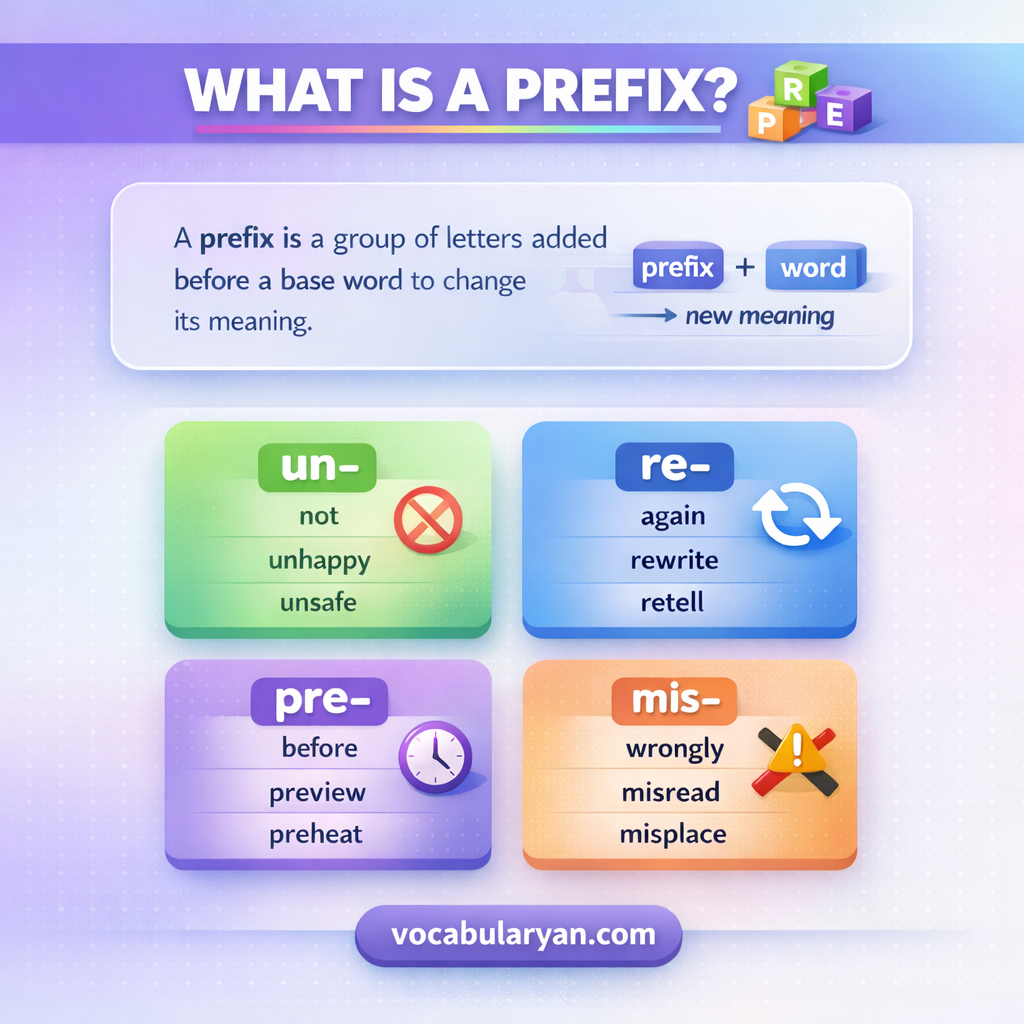
What is a Prefix In English?
Prefixes in English are word parts placed before a base word or root to change its meaning. They usually do not change the word class, but they can express ideas such as negation, repetition, opposition, time, size, number, or place. For example, un in unhappy gives a negative meaning, re in rewrite expresses doing something again, and pre in preview indicates something that happens before another event. A prefix joins the base word as one unit, so the meaning changes from the beginning of the word rather than functioning as a separate word.
List Of Prefixes In English from A to Z
- A-: not, without — asymmetrical, atypical
- Ab-: away from — abnormal, abduct
- Ad-: toward — advance, adapt
- After-: later — aftermath, afterlife
- Ambi-: both — ambidextrous, ambiguous
- Amphi-: both sides — amphibian, amphitheater
- An-: not — anarchy, anaerobic
- Ana-: again, back — analyze, anatomy
- Ante-: before — antebellum, antecedent
- Anti-: against — antibiotic, antifreeze
- Apo-: away from — apogee, apostle
- Arch-: chief — archenemy, archbishop
- Auto-: self — autograph, autobiography
- Be-: around, make — befriend, belittle
- Bi-: two — bicycle, bilingual
- Biblio-: book — bibliography, bibliophile
- Bio-: life — biology, biography
- Circum-: around — circumference, circumnavigate
- Cis-: on this side — cisatlantic
- Co-: together — cooperate, coexist
- Col-: together — collect, collaborate
- Com-: together — combine, communicate
- Con-: with — connect, construct
- Contra-: against — contradict, contraband
- Counter-: against — counterattack, counterbalance
- De-: down, reverse — deactivate, descend
- Demi-: half — demigod, demilune
- Dia-: through — diameter, diagnose
- Dis-: not — disagree, disappear
- Dys-: bad — dysfunction, dyslexia
- E-: out — emit, eject
- Eco-: environment — ecology, ecosystem
- Em-: cause to be — empower, embed
- En-: make — enable, enlarge
- Endo-: within — endoscope, endocrine
- Epi-: upon — epicenter, epidemic
- Eu-: good — euphoria, euphemism
- Ex-: out — export, exclude
- Exo-: outside — exoskeleton
- Extra-: beyond — extraordinary
- Fore-: before — forecast, foretell
- Hemi-: half — hemisphere
- Hetero-: different — heterogeneous
- Homo-: same — homogeneous
- Hydro-: water — hydrology
- Hyper-: over — hyperactive
- Hypo-: under — hypodermic
- Il-: not — illegal
- Im-: not — impossible
- In-: not — incomplete
- Infra-: below — infrastructure
- Inter-: between — international
- Intra-: within — intracellular
- Ir-: not — irregular
- Iso-: equal — isometric
- Juxta-: near — juxtapose
- Macro-: large — macroeconomics
- Mal-: bad — malfunction
- Maxi-: large — maxiskirt
- Mega-: very large — megastore
- Meta-: beyond — metaphor
- Micro-: small — microscope
- Mid-: middle — midday
- Milli-: thousandth — milligram
- Mini-: small — minibus
- Mis-: wrong — misplace
- Mono-: one — monologue
- Multi-: many — multilingual
- Neo-: new — neoclassical
- Non-: not — nonprofit
- Omni-: all — omniscient
- Out-: beyond — outperform
- Over-: too much — overreact
- Pan-: all — pandemic
- Para-: beside — parallel
- Peri-: around — perimeter
- Poly-: many — polygon
- Post-: after — postgraduate
- Pre-: before — preview
- Pro-: forward — promote
- Proto-: first — prototype
- Pseudo-: false — pseudonym
- Quadri-: four — quadrilateral
- Quasi-: almost — quasi-legal
- Re-: again — rewrite
- Retro-: backward — retroactive
- Semi-: half — semicircle
- Sub-: under — submarine
- Super-: above — superhuman
- Supra-: above — supranational
- Sym-: together — sympathy
- Syn-: together — synchronize
- Tele-: far — telephone
- Trans-: across — transport
- Tri-: three — triangle
- Ultra-: beyond — ultraviolet
- Un-: not — unfair
- Under-: beneath — underestimate
- Uni-: one — unicycle
- Vice-: in place of — vice-president
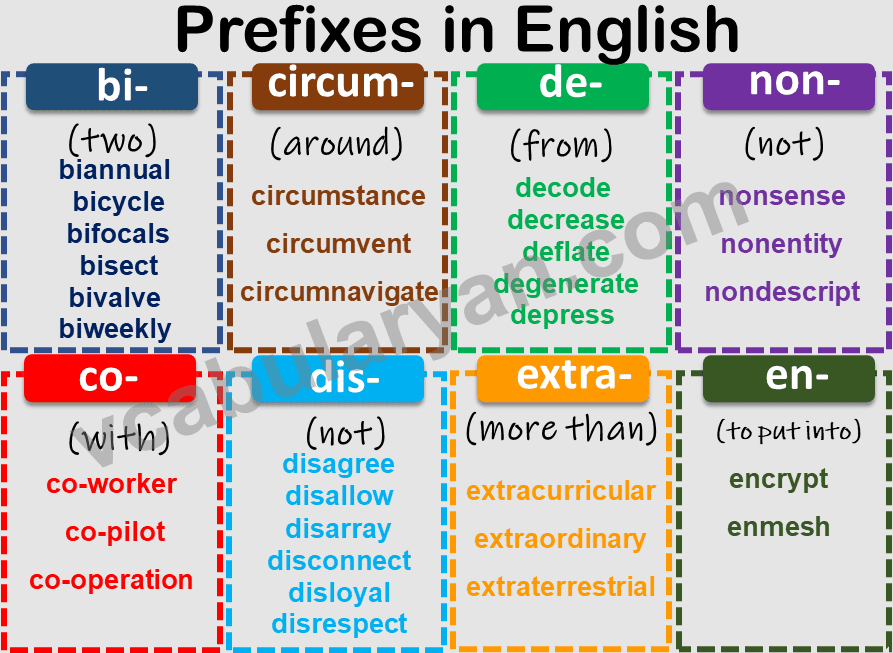
Negative Prefixes
Negative prefixes change the meaning of a word by adding the idea of absence, opposition, or error. These prefixes appear in many everyday vocabulary words and are often the first group learners encounter when studying prefixes in English.
Common negative prefixes include un-, non-, dis-, mis-, mal-, in-, im-, il-, ir-, anti-, counter-, contra-, pseudo-, dys-, a-, an-.
Examples:
- Un-: unhappy, unfair, unknown
- Non-: nonstop, nonfiction, nonverbal
- Dis-: disagree, disconnect, disapprove
- Mis-: misunderstand, misplace, misread
- Mal-: malfunction, malpractice
- In- / Im- / Il- / Ir-: inactive, impossible, illegal, irregular
- Anti-: antiwar, antisocial
- Counter-: counterattack, counterargument
- Pseudo-: pseudoscience, pseudonym
- Dys-: dysfunction, dyslexia
- A- / An-: amoral, anhydrous
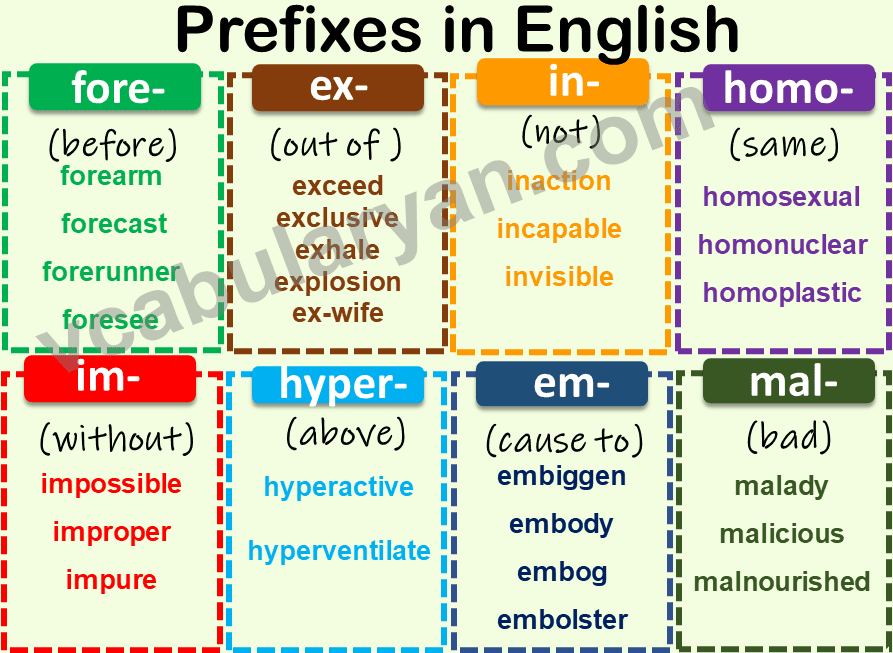
Many negative prefixes follow spelling patterns. For example, in- becomes im- before words starting with “p” or “m” (impossible, immature) and il- before words beginning with “l” (illegal).
Time Prefixes
Time prefixes help describe order, repetition, or sequence. These prefixes often appear in academic vocabulary and everyday communication when discussing events that happen earlier, later, or again.
Common time prefixes include pre-, post-, re-, retro-, ante-, fore-, after-, proto-, neo-, ana-.
Examples:
- Pre-: preview, preheat, prehistoric
- Post-: postwar, postgraduate, postscript
- Re-: rewrite, rebuild, reconsider
- Retro-: retroactive, retrospective
- Ante-: antenatal, antecedent
- Fore-: foresee, foretell, forewarn
- After-: afterlife, aftershock
- Proto-: prototype, protozoa
- Neo-: neoclassical, neonate
- Ana-: analysis, anagram
The prefix re- is especially common in English vocabulary because it indicates repetition or returning to an earlier state.
Place Prefixes
Place prefixes describe position or location. These prefixes help speakers describe spatial relationships and appear frequently in scientific, academic, and everyday vocabulary.
Common place prefixes include sub-, super-, supra-, infra-, inter-, intra-, endo-, exo-, epi-, para-, peri-, circum-, juxta-, extra-, under-.
Examples:
- Sub-: submarine, subzero
- Super-: superstructure, supermarket
- Supra-: supranational
- Infra-: infrastructure, infrared
- Inter-: international, interact
- Intra-: intranet, intravenous
- Endo-: endoscope, endocrine
- Exo-: exoskeleton, exoplanet
- Para-: paranormal, paralegal
- Peri-: perimeter, periscope
- Circum-: circumnavigate, circumference
- Juxta-: juxtapose
- Extra-: extraordinary, extracurricular
- Under-: undersea, underground
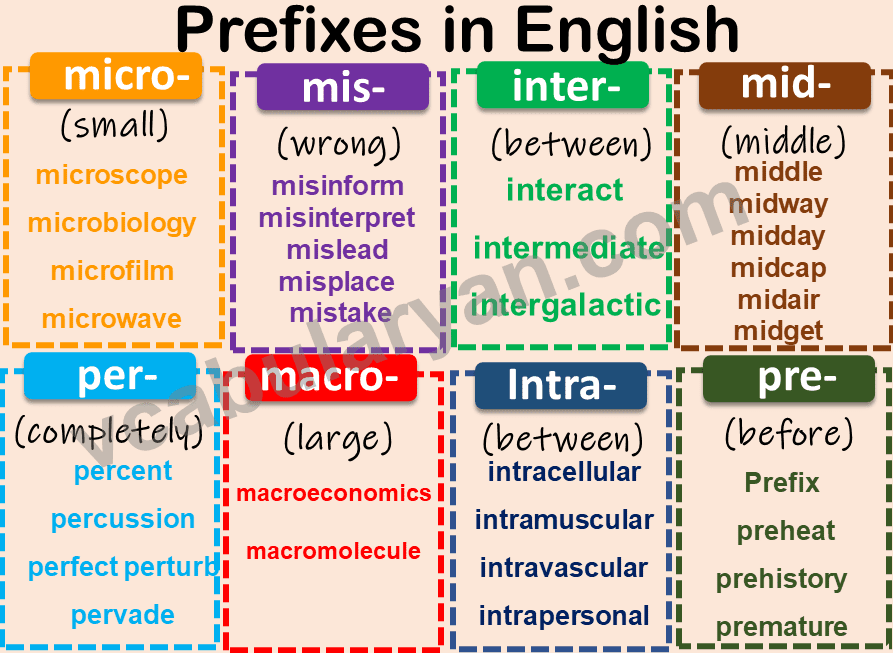
Prefixes that describe place help learners understand complex vocabulary by breaking words into meaningful parts.
Direction Prefixes
Direction prefixes express movement or orientation. They indicate motion toward, away from, across, or beyond something.
Common direction prefixes include ab-, ad-, apo-, de-, dia-, ex-, e-, out-, over-, trans-.
Examples:
- Ab-: abduct, abnormal
- Ad-: advance, adhere
- Apo-: apology, apogee
- De-: descend, deform
- Dia-: diagonal, diameter
- Ex-: export, exhale
- Out-: outperform, outgrow
- Over-: overflow, overtake
- Trans-: transport, translate
These prefixes help form many academic vocabulary words, especially in science and technical writing.
Number Prefixes
Number prefixes express quantity or amount. Many of these prefixes come from Greek and Latin and appear widely in mathematics, science, and general vocabulary.
Common number prefixes include uni-, bi-, tri-, quadri-, mono-, poly-, multi-, omni-, pan-, hemi-, demi-, milli-, ambi-, amphi-.
Examples:
- Uni-: uniform, unilateral
- Bi-: bicycle, bilingual
- Tri-: triangle, tricycle
- Quadri-: quadrilateral
- Mono-: monologue, monochrome
- Poly-: polygon, polyglot
- Multi-: multicultural, multitask
- Omni-: omniscient, omnivore
- Pan-: pandemic, panorama
- Hemi-: hemisphere
- Demi-: demigod
- Milli-: millimeter
Number prefixes are very productive in English vocabulary, especially in scientific terminology.
Size Prefixes
Size prefixes describe scale or magnitude. These prefixes help speakers compare objects or describe measurements.
Common size prefixes include macro-, micro-, mini-, maxi-, mega-.
Examples:
- Macro-: macroeconomics
- Micro-: microscope, microorganism
- Mini-: miniskirt, minibus
- Maxi-: maximum, maxillofacial
- Mega-: megastore, megabyte
These prefixes are widely used in modern technical vocabulary, especially in computing and science.
Degree Prefixes
Degree prefixes describe intensity, rank, or level. They help express whether something is extreme, partial, or above or below a normal level.
Common degree prefixes include hyper-, hypo-, ultra-, semi-, quasi-, arch-, eu-.
Examples:
- Hyper-: hyperactive, hypertension
- Hypo-: hypothermia, hypothetical
- Ultra-: ultrafast, ultraviolet
- Semi-: semicircle, semicolon
- Quasi-: quasiscientific
- Arch-: archenemy
- Eu-: euphoric, euphoria
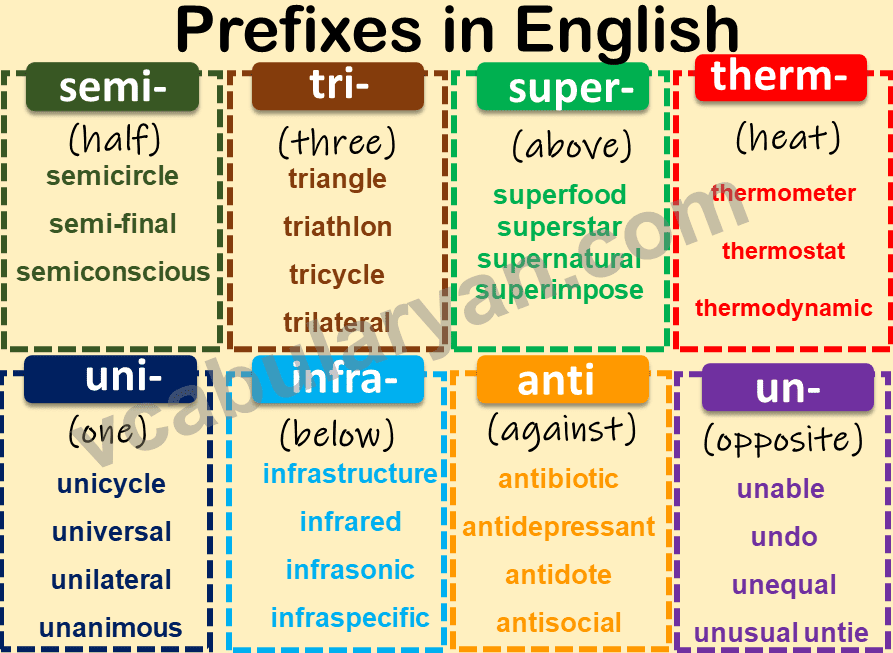
These prefixes appear frequently in academic vocabulary and scientific writing.
Relation Prefixes
Relation prefixes describe relationships such as sameness, difference, cooperation, or substitution.
Common relation prefixes include auto-, co-, col-, com-, con-, hetero-, homo-, iso-, meta-, pro-, sym-, syn-, vice-, cis-.
Examples:
- Auto-: autobiography, autopilot
- Co-: cooperate, coexist
- Com- / Con-: combine, connect
- Hetero-: heterogeneous
- Homo-: homogeneous
- Iso-: isotope, isometric
- Meta-: metaphysics, metadata
- Pro-: promote, proactive
- Syn- / Sym-: synchronize, symmetry
- Vice-: vice president
- Cis-: cisatlantic
These prefixes help learners recognize relationships between ideas and concepts.
Change Prefixes
Change prefixes indicate transformation, removal, or reversal. They are especially useful in academic writing and technical vocabulary.
Common change prefixes include de-, dis-, re-, en-, em-.
Examples:
- De-: defrost, deactivate
- Dis-: disconnect, disassemble
- Re-: rebuild, reconsider
- En-: enable, enlarge
- Em-: empower, embolden
Understanding these prefixes helps learners decode unfamiliar vocabulary.
Science Prefixes
Some prefixes are common in scientific and technical vocabulary. Many of these come from Greek and Latin roots used in academic terminology.
Common science prefixes include bio-, hydro-, eco-, biblio-.
Examples:
- Bio-: biology, biotechnology
- Hydro-: hydroelectric, hydrology
- Eco-: ecosystem, ecology
- Biblio-: bibliography
These prefixes appear frequently in academic fields such as biology, environmental science, and literature.
How To Use Prefixes In English
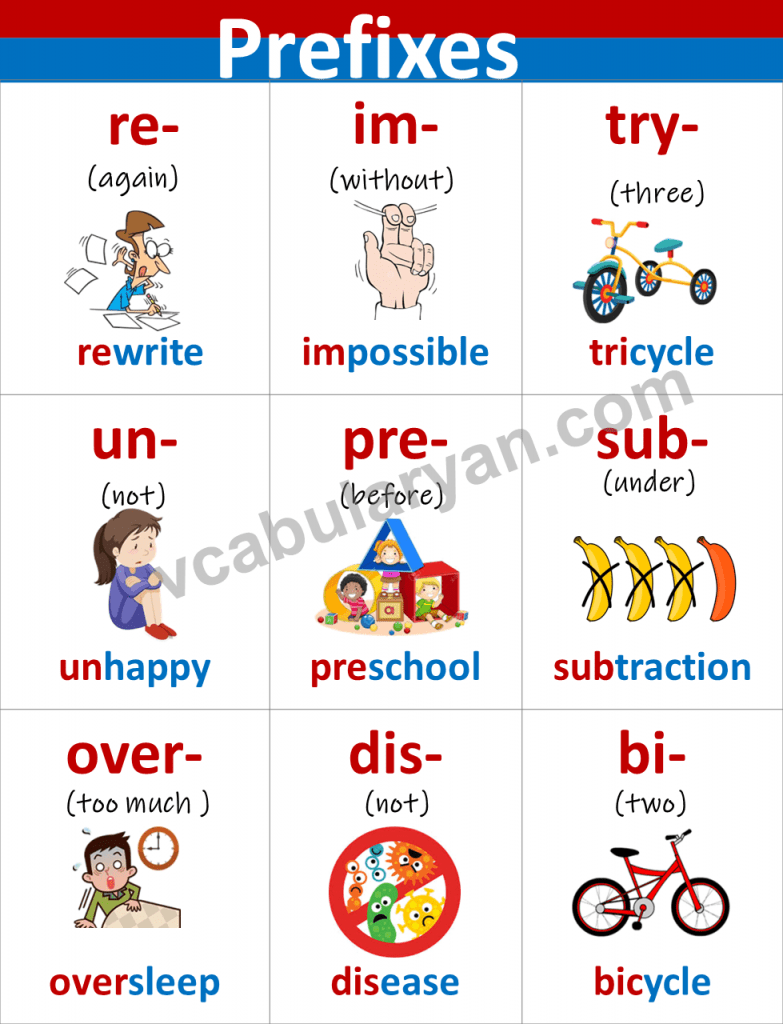
Use prefixes by adding them to the beginning of a base word to change its meaning. The prefix adds one idea, such as not, again, before, too much, or under, while the main part of the word keeps the core meaning. For example, happy becomes unhappy, write becomes rewrite, and paid becomes prepaid. You use the right prefix when you want to express a specific meaning that fits the word. Not every prefix can go with every word, so the combination must be a standard English form. The meaning of the whole word comes from both the prefix and the base word working together.
FAQs
Q1. What is a prefix in English?
A prefix is a small word part added to the beginning of another word to change its meaning. When un is added to happy it becomes unhappy, and when re is added to write it becomes rewrite.
Q2. What are some common prefixes used in English words?
Common prefixes include un in unhappy and unfair, re in rewrite and return, pre in preview and prepare, dis in dislike and disagree, mis in misread and mistake, and sub in submarine and subsoil.
Q3. What are examples of prefixes that show numbers or quantity?
Number-related prefixes appear in words like mon in monopoly, bi in bicycle, tri in triangle, quad in quadrant, and multi in multicolored.
Q4. What words are formed with the prefix “un”?
Words with un include unhappy, unfair, unable, untidy, unclear, uneven, unusual, unknown, unkind, and unsafe.
Q5. What words use the prefix “re”?
Words with re include rewrite, replay, rebuild, reopen, redo, return, replace, remind, restart, and review.
Q6. What does the prefix intra mean?
The prefix intra means within or inside a single group, place, or thing. So intranet means a network used within one organization, and intracellular means inside a cell.
Q7. What does the prefix un mean?
The prefix un usually means not or the opposite of. It changes a word like happy into unhappy and fair into unfair.
You May Also Like
