
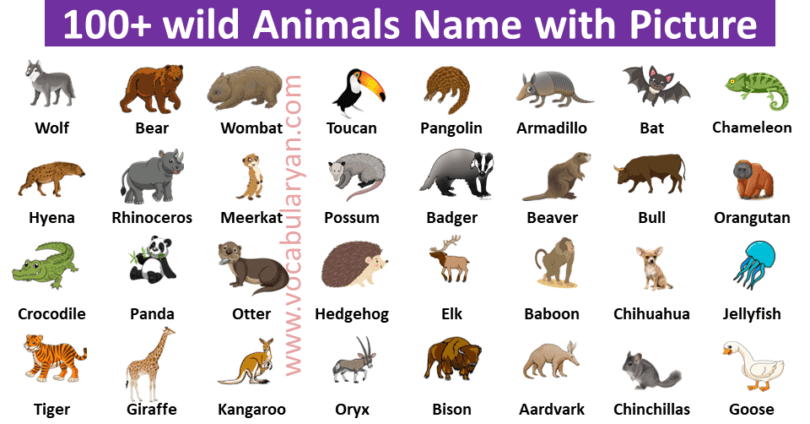
Wild animals are the species that survive in nature without human care, from the lions of Africa to the polar bears of the Arctic. English wild animal names have 18 main categories by animal family and habitat.
English wild animal names have 18 main categories: big cats, small wild cats, wild wolves and coyotes, wild foxes, bears, great apes, monkeys, large African mammals, safari grazers, wild deer, marsupials, rodents, other small mammals, birds of prey, colorful wild birds, wild reptiles, arctic animals, and desert animals.
Common Wild Animal Names With Pictures
Each category is defined by animal family and habitat. Big cats, wild canines, and bears are three of the most-recognized wild predator families. The other 15 are small wild cats, foxes, great apes, monkeys, large African mammals, safari grazers, wild deer, marsupials, rodents, other small mammals, birds of prey, colorful wild birds, wild reptiles, arctic animals, and desert animals.
Big Cat Names in English
Big cats are the largest wild cat species, the top predators of African, Asian, and American ecosystems.
Lion
powerful tawny wild cat with a golden coat, and adult males sporting a shaggy dark mane around the neck. Lions are found across African savannas, hunt in family prides of 10-30 members, and are the only cats that hunt cooperatively as a team, called “the king of the jungle.”
Tiger
largest wild cat in the world, with orange fur, black vertical stripes, and a white belly. Tigers are found across India, Southeast Asia, and Russia, hunt alone at night, and no two tigers have the same stripe pattern, as unique to each animal as human fingerprints.
Leopard
muscular wild cat with a golden coat and dark rosette-shaped spots, and a long spotted tail. Leopards are found across Africa and southern Asia, drag their kills up into trees to eat away from other predators, and are the most adaptable of all the big cats.
Cheetah
slim, long-legged wild cat with a golden coat and solid black spots, and black tear lines running from each eye. Cheetahs are the fastest land animal on Earth, reaching 110 km/h in three seconds, and are found across African savannas and small parts of Iran.
Jaguar
stocky powerful wild cat with a golden or black coat and large dark rosette spots (larger than a leopard’s). Jaguars are found across Central and South America, especially the Amazon rainforest, and have the strongest bite of any big cat, powerful enough to crack turtle shells.
Puma (Cougar or Mountain Lion)
tawny wild cat with no spots as an adult, and a long thick tail with a black tip. Pumas are found across North and South America, from Canada to Patagonia, and have the widest range of any land mammal in the Americas.
Snow Leopard
pale grey wild cat with black rosette spots and a thick long fluffy tail, adapted to cold mountain climates. Snow leopards are found in the high mountains of Central Asia, including the Himalayas and Tibetan Plateau, and their tail is nearly as long as their body for balance on cliffs.
Small Wild Cat Names in English
Small wild cats are the shy, medium-sized wild cats found across every continent except Australia and Antarctica.
Bobcat
medium wild cat with a spotted tan-brown coat, tufted ears, and a distinctive short “bobbed” tail. Bobcats are found across North America from Canada to Mexico, hunt rabbits and small deer, and are twice the size of a house cat despite the short tail.
Lynx
medium wild cat with a spotted grey coat, long ear tufts, huge fluffy paws, and a short tail. Lynx are found across the cold forests of Canada, northern Europe, and Russia, hunt snowshoe hares as their main prey, and use their huge paws like snowshoes.
Caracal
slim wild cat with a reddish-tan coat and distinctive long black tufts on the tips of its ears. Caracals are found across Africa, the Middle East, and India, jump over 3 meters straight up to catch birds mid-flight, and get their name from the Turkish word for “black ear.”
Serval
tall long-legged wild cat with a golden coat, black spots and stripes, and huge upright ears. Servals are found across sub-Saharan Africa, have the longest legs relative to body size of any cat, and can pinpoint rodents underground by ear alone before pouncing.
Ocelot
small wild cat with a striking gold coat and dark chain-like rosettes, called a “mini leopard.” Ocelots are found from Texas down to Argentina, hunt at night in Central and South American rainforests, and were once popular exotic pets (which is now illegal).
Wild Wolf and Coyote Names in English
Wolves, coyotes, jackals, and their wild-dog relatives are the pack-hunting canines of Africa, Europe, Asia, and the Americas.
Wolf
large wild dog with a thick grey, black, brown, or white coat, and a long bushy tail. Wolves are found across North America, Europe, and Asia, hunt in family packs of 6-12 called wolf packs, and are the ancestors of every dog breed on Earth.
Coyote
medium tan-grey wild dog similar to a small wolf, with a pointed muzzle and a bushy black-tipped tail. Coyotes are found across North America, hunt in pairs or small family teams, and thrive from Alaska to Panama, adapting quickly to farm and city life.
Jackal
small tawny-brown wild dog with pointed ears and a black-tipped bushy tail, resembling a small coyote. Jackals are found across Africa, the Middle East, and India, hunt in pairs or scavenge in small numbers, and are famous for their eerie howling calls at dusk.
African Wild Dog
medium wild dog with a patchy coat of black, brown, yellow, and white, and huge rounded ears. African wild dogs are found across sub-Saharan Africa, hunt in packs of 10-40, and have the highest hunting success rate of any predator on Earth (about 80%).
Wild Fox Names in English
Foxes are small pointed-faced wild canines with bushy tails, adapted to almost every habitat from Arctic snow to Sahara sand.
Red Fox
small wild dog with a bright orange-red coat, white belly, black legs, and a long white-tipped bushy tail. Red foxes are found across North America, Europe, and Asia, and are the most widespread wild carnivore on Earth, adapted to farm, forest, and city life.
Arctic Fox
small white-coated wild dog with a rounded face, small ears, and a fluffy white tail. Arctic foxes are found across the Arctic tundra of North America, Europe, and Russia, change from white winter fur to brown summer fur, and survive temperatures down to -50°C.
Fennec Fox
tiny cream-coated wild dog with enormous bat-like ears (the largest ears relative to body size of any canine). Fennec foxes are found in the North African Sahara desert, use their huge ears to release body heat and detect prey underground, and are the smallest wild dog on Earth.
Bear Names in English
Bears are the largest wild land carnivores, with heavy bodies, thick fur, and powerful claws.
Grizzly Bear
huge brown bear with a distinctive shoulder hump of muscle, and long curved claws for digging. Grizzly bears are found across northwestern North America and Alaska, catch salmon leaping upstream in autumn, and stand up to 3 meters tall on their hind legs to warn other bears.
Polar Bear
massive white-furred bear with black skin, adapted to the frozen Arctic. Polar bears are found across the Arctic ice pack, hunt seals at ice breathing holes, swim distances of over 100 kilometers, and are the largest land carnivore on Earth.
Black Bear
medium black-coated bear with a brown muzzle and short curved claws for climbing. Black bears are found across North America, eat mostly plants and berries, climb trees to nap and escape danger, and can smell food from 3 kilometers away.
Giant Panda
large distinctive black-and-white bear with round ears and a white face marked with black eye patches. Giant pandas are found only in the bamboo forests of central China, eat 12-38 kilograms of bamboo daily, and are the national symbol of China and mascot of world conservation.
Great Ape Names in English
Great apes are the largest tailless primates on Earth, our closest evolutionary cousins with human-like hands and problem-solving intelligence.
Gorilla
largest primate on Earth, with a muscular black-furred body, human-like hands, and a distinctive silverback in adult males. Gorillas are found in the rainforests of central Africa, form family troops led by a silverback, and share 98% of their DNA with humans.
Chimpanzee
medium ape with black hair, expressive face, and long arms for swinging through trees. Chimpanzees are found across the forests of central and western Africa, use tools (rocks, sticks) to crack nuts and fish termites, and are the closest living relative of humans, sharing 99% of our DNA.
Orangutan
large red-haired ape with long powerful arms, from the rainforests of Borneo and Sumatra. Orangutans spend nearly all their time in trees, build a new leaf nest to sleep in every night, and are the largest tree-dwelling animal on Earth. The name means “person of the forest” in Malay.
Wild Monkey Names in English
Monkeys are the tail-bearing smaller primates of Africa, Asia, and the Americas, known for their agility and social intelligence.
Baboon
medium ground-dwelling monkey with a dog-like snout, long tail, and colorful hindquarters. Baboons are found across sub-Saharan Africa and the Arabian Peninsula, travel in troops of 20-200, and are the largest and most terrestrial of the Old World monkeys.
Macaque
medium monkey family with brown or grey fur and pink faces, from Asia and North Africa. Macaques are the most widespread monkey after humans, and famous species are the snow-bathing Japanese macaques and the Barbary macaques of Gibraltar (the only wild monkeys in Europe).
Lemur
small primate with a pointed fox-like face, a long striped tail, and huge orange eyes for night vision. Lemurs are found only on the African island of Madagascar, come in over 100 different species, and are the most endangered primate family on Earth.
Large African Mammal Names in English
Large African mammals are the elephant family and its rhino and hippo cousins, the largest land animals of Africa and Asia.
Elephant
massive grey herbivore with a long muscular trunk, two ivory tusks, and huge fan-shaped ears. Elephants are the largest land animal, found in Africa and Asia, remember individual humans for decades, and mourn their dead in family funerals.
Rhinoceros
huge grey armored herbivore with one or two horns on the nose, and thick folded skin. Rhinos are found in Africa (white and black species) and Asia (Indian, Javan, Sumatran), have poor eyesight but excellent hearing and smell, and are heavily poached for their horns, making all five species endangered.
Hippopotamus
massive barrel-shaped grey semi-aquatic mammal with a huge head, tiny ears, and enormous jaws with tusk-like teeth. Hippos are found in the rivers and lakes of sub-Saharan Africa, spend the day submerged in water, and are one of the most dangerous animals in Africa, killing more humans than lions.
Safari Grazing Animal Names in English
Safari grazing animals are the classic giraffes, zebras, and wild ox of the African plains and beyond.
Giraffe
tallest land animal with an extremely long neck, long spindly legs, and a yellow-and-brown patterned coat. Giraffes are found across sub-Saharan African savannas, reach 6 meters tall, use their 45-cm blue-black tongue to strip leaves from thorny acacia trees, and sleep only 30 minutes a day.
Zebra
African horse-like animal covered in unique black-and-white vertical stripes. Zebras are found across the grasslands of eastern and southern Africa, graze in mixed herds with wildebeest for protection, and every zebra’s stripe pattern is unique, like human fingerprints.
Cape Buffalo
large muscular African wild ox with black hide, curved fused horns forming a “helmet” on the head, and huge shoulders. Cape buffalo are found across African savannas and forests, form herds of hundreds, and are one of the Big Five safari animals, known for defending themselves fiercely against lions.
Bison
huge shaggy-coated wild ox with a massive head and a raised shoulder hump, from the plains of North America and Europe. American bison are found in Yellowstone and Great Plains parks, once numbered 60 million before near-extinction, and are the largest land animal in North America.
Wildebeest
medium horse-shaped African antelope with dark brown-grey fur, curved horns, and a shaggy mane. Wildebeest are found across the Serengeti-Mara ecosystem of Kenya and Tanzania, migrate 1,500 kilometers every year in herds of 1.5 million, and cross crocodile-filled rivers in one of nature’s most dramatic events.
Wild Deer Names in English
Wild deer are the antler-bearing forest herbivores of North America, Europe, Asia, and beyond.
Deer
medium graceful herbivore with brown or reddish coat, large dark eyes, and males with branched antlers shed every winter. Deer are found across every continent except Antarctica and Australia, browse in woodland forests and open meadows, and can leap 3 meters high over fences.
Elk (Wapiti)
large deer species with a tan-brown body, dark shaggy neck mane, and huge branched antlers up to 1.2 meters wide. Elk are found across the mountains and forests of western North America and eastern Asia, are second only to moose in size among deer, and their bugling call echoes across autumn valleys during mating season.
Moose
largest deer species on Earth, standing 2 meters tall at the shoulder, with a huge palmate rack of antlers and a long dangling flap of skin under the throat called a “bell.” Moose are found across the forests of North America, Scandinavia, and Russia, swim for hours across cold lakes, and weigh up to 700 kilograms.
Wild Marsupial Names in English
Wild marsupials are the pouched mammals of Australia and the Americas, carrying their young in a belly pouch.
Kangaroo
large hopping marsupial with powerful hind legs, a long thick tail, and a pouch for carrying its joey. Kangaroos are found only in Australia, hop at 70 km/h, use their tail as a fifth leg for balance, and are the national symbol of Australia.
Koala
small tree-dwelling marsupial with round fluffy grey ears, a black leather nose, and long claws for climbing. Koalas are found in the eucalyptus forests of eastern Australia, sleep 18-22 hours a day, and eat only eucalyptus leaves, a diet no other mammal can digest.
Wombat
stocky burrowing marsupial with short legs, round rump, and thick brown fur, resembling a small bear. Wombats are found in eastern Australia, dig underground burrows up to 30 meters long, and produce cube-shaped droppings, the only animal on Earth that does so.
Opossum
medium tree-dwelling marsupial with grey fur, a long pink hairless tail, and a pointed white face. Opossums are the only marsupial in North America, “play dead” when threatened (falling limp for hours), and are immune to most snake venom.
Wild Rodent Names in English
Wild rodents are the largest mammal family, with over 2,000 species, all sharing constantly-growing front teeth for gnawing.
Squirrel
small furry rodent with big dark eyes, a bushy tail, and quick agile movements. Squirrels are found in forests and cities worldwide, bury nuts and acorns for winter (and forget where 25% of them are, planting new trees), and can rotate their hind feet 180 degrees to climb down head-first.
Chipmunk
tiny striped rodent with a bushy tail and cheek pouches for carrying food. Chipmunks are found across North America and northern Asia, store nuts and seeds in their cheek pouches (up to 8 acorns at once), and hibernate in underground burrows through winter.
Beaver
large brown rodent with buck teeth, a flat paddle-shaped tail, and webbed hind feet. Beavers are found in North America and Europe, cut down trees with their teeth to build dams and lodges in streams, and are called “nature’s engineers” for reshaping the landscape.
Porcupine
medium rodent covered in sharp defensive quills up to 30 cm long, some able to detach and lodge in attackers. Porcupines are found across the Americas, Africa, and Asia, climb trees to eat bark and shoots, and their name comes from the Latin for “quill pig.”
Kangaroo Rat
tiny hopping desert rodent with long hind legs, a long tufted tail, and huge dark eyes. Kangaroo rats are found across the deserts of the southwestern United States and Mexico, never drink water (their bodies extract water from dry seeds), and hop like a miniature kangaroo.
Other Small Wild Mammal Names
Other small wild mammals are the raccoons, hedgehogs, badgers, and mongoose relatives of forests, gardens, and burrows worldwide.
Raccoon
medium furry mammal with a black bandit mask across the eyes, a ringed bushy tail, and dexterous human-like hands. Raccoons are found across North America, wash their food in water before eating, open latches and jars with their nimble paws, and thrive in cities as well as forests.
Hedgehog
small round mammal covered in short spines, with a pointed snout and small dark eyes. Hedgehogs are found across Europe, Asia, and Africa, roll into a tight prickly ball for defense, and eat garden slugs and insects, making them a beloved garden guest in Britain.
Badger
stocky ground-digging mammal with black-and-white striped face, short legs, and powerful claws. Badgers are found across Europe, Asia, and North America, dig extensive underground burrows called setts (some used for 100 years), and are the national animal of Wisconsin.
Birds of Prey Names in English
Birds of prey are the eagles, owls, hawks, and vultures at the top of the wild bird food chain, with hooked beaks and sharp talons.
Eagle
large powerful bird of prey with a hooked beak, sharp talons, and excellent long-distance vision. Eagles are found on every continent except Antarctica, spot prey from 3 kilometers away, and are the national symbol of the United States (Bald Eagle), Mexico (Golden Eagle), and many other countries.
Owl
medium night-hunting bird with huge forward-facing eyes, a hooked beak, and silent wing feathers. Owls are found worldwide, rotate their heads 270 degrees to see behind them, hunt in complete silence thanks to feathered wing edges, and swallow their prey whole.
Vulture
large scavenging bird of prey with broad wings, a bald head (to stay hygienic when feeding on carcasses), and excellent eyesight. Vultures are found across Africa, Asia, Europe, and the Americas, glide for hours on rising warm air currents, and are nature’s cleanup crew, preventing disease spread.
Falcon
medium bird of prey with pointed swept-back wings, a short hooked beak, and incredibly fast flight. The peregrine falcon is the fastest animal on Earth, diving at 390 km/h to catch prey mid-air, and falcons are found on every continent except Antarctica.
Colorful Wild Bird Names in English
Colorful wild birds are the tropical peacocks, toucans, flamingos, and woodpeckers of the rainforests and wetlands, prized for their bright plumage.
Peacock
male peafowl with a bright blue body and a massive spread of iridescent green-and-blue tail feathers marked with eye-shaped spots. Peacocks are native to India and Sri Lanka, fan out their tail feathers in a dazzling display to attract females, and are the national bird of India.
Toucan
medium colorful tropical bird with an enormous banana-shaped beak (longer than the head) in bright orange, yellow, or red. Toucans are found in Central and South American rainforests, eat fruit from tree branches too thin for other birds, and are famous mascots of tropical cereal and coffee brands.
Flamingo
tall long-legged pink wading bird with a curved beak and a long S-shaped neck. Flamingos are found across the Americas, Africa, Asia, and southern Europe, get their pink color from eating shrimp and algae, and stand on one leg to conserve body heat in cold water.
Woodpecker
medium tree-climbing bird with a strong chisel-like beak and stiff tail feathers used as a prop against the trunk. Woodpeckers are found on every continent except Australia and Antarctica, tap on tree trunks 8,000-12,000 times per day to find insects, and their skulls are specially cushioned to protect their brains.
Wild Reptile Names in English
Wild reptiles are the cold-blooded predators of forests, rivers, and swamps, from crocodiles to king cobras.
Crocodile
large predatory reptile with armored skin, a V-shaped snout, and huge jaws with visible teeth. Crocodiles are found in fresh and salt water across Africa, Asia, Australia, and the Americas, ambush prey at the water’s edge, and are one of the oldest surviving animal families on Earth (200 million years).
Alligator
large predatory reptile similar to a crocodile but with a U-shaped snout and hidden teeth. Alligators are found in fresh water across the southeastern United States and eastern China, made a full recovery from near-extinction in the 1960s, and are the state reptile of Florida.
King Cobra
world’s longest venomous snake, reaching up to 5.5 meters, with a hooded head and a growling hiss like a small dog. King cobras are found in the forests of India and Southeast Asia, eat other snakes as their main diet, and are the national reptile of India.
Python
large non-venomous constrictor snake with beautifully patterned skin, from Africa, Asia, and Australia. Reticulated pythons reach 6 meters, kill prey by squeezing rather than venom, and swallow prey whole, including deer.
Komodo Dragon
world’s largest lizard, reaching 3 meters long and 70 kilograms, found only on Indonesia’s Komodo Islands. Komodo dragons hunt deer and wild pigs, have venom in their bite, and can smell rotting meat from 4 kilometers away.
Arctic Wild Animal Names in English
Arctic wild animals are the species adapted to the frozen tundra and Arctic ice pack of the far north.
Walrus
massive marine mammal with tough grey wrinkled skin, long ivory tusks, and a bristly mustache of whiskers. Walruses are found on Arctic pack ice and coastal areas, use their tusks to pull themselves onto the ice, and males weigh over 1,500 kilograms (larger than a car).
Reindeer
medium deer with brown fur, huge branched antlers on both males and females, and wide cloven hooves for walking on snow. Reindeer are found across the Arctic tundra of Scandinavia, Russia, and North America (where they are also called caribou), migrate 5,000 kilometers annually, and are the only deer domesticated by humans.
Snowy Owl
large white owl with black flecks (in females and juveniles), huge yellow eyes, and thick feathered legs. Snowy owls are found across the Arctic tundra of North America, Europe, and Asia, hunt during the daytime (unusual for owls), and are the national bird of Quebec, Canada.
Narwhal
medium Arctic whale with a mottled grey-and-white body, and males with a long spiral tusk (a tooth) reaching 3 meters. Narwhals are found in the Arctic waters of Canada, Greenland, and Russia, dive to 1,500 meters hunting for fish and squid, and are called “the unicorn of the sea.”
Musk Ox
huge shaggy-coated ox with massive curved horns fused across the forehead, and long silky underwool called qiviut. Musk oxen are found across the Arctic tundra of Canada, Alaska, and Greenland, form defensive circles with horns facing outward to protect calves from wolves, and their qiviut is 8 times warmer than sheep’s wool.
Desert Wild Animal Names in English
Desert wild animals are the species adapted to extreme heat, cold nights, and scarce water in deserts worldwide.
Camel
large humped mammal with long legs, thick eyelashes, and wide padded feet for walking on sand. Camels are found across the deserts of the Middle East, North Africa, and Central Asia, store fat (not water) in their humps, and survive weeks without drinking.
Meerkat
small stand-up ground squirrel of the mongoose family, with a slim body, dark eye patches, and a long thin tail. Meerkats are found in the deserts of southern Africa, stand upright to watch for predators (one meerkat serves as lookout), and are famous from the Lion King character Timon.
Sand Cat
small pale sandy-colored wild cat with wide flat ears, a broad head, and thickly furred paws to insulate against hot sand. Sand cats are found across the Sahara, Arabian, and Central Asian deserts, hunt at night, and are the only cat truly adapted to desert conditions with no need to drink water.
Roadrunner
fast ground-dwelling bird from the cuckoo family, with a slim body, long tail, and shaggy crest. Roadrunners are found across the deserts of the southwestern United States and Mexico, hit speeds of 32 km/h chasing lizards and rattlesnakes, and are the state bird of New Mexico.
Wild Animals That Look Similar
Some wild animal names cause confusion for English learners.
Wild vs Domestic Animals
| Type | Meaning |
|---|---|
| Wild Animal | Animal that survives in nature without human care (lion, tiger, deer) |
| Domestic Animal | Animal bred and raised by humans as a pet, farm animal, or working animal (dog, cat, cow, horse) |
Wild animals hunt or graze for their own food; domestic animals are fed by humans. Some species have both wild and domestic populations (like horses, camels, and cats).
Lion vs Tiger vs Leopard vs Cheetah vs Jaguar
| Big Cat | Coat | Where Found |
|---|---|---|
| Lion | Solid golden coat (mane in males) | African savanna |
| Tiger | Orange with black vertical stripes | Asia (India, SE Asia, Russia) |
| Leopard | Golden with black rosette spots | Africa and southern Asia |
| Cheetah | Golden with solid black spots and tear lines | Africa, small parts of Iran |
| Jaguar | Golden or black with larger rosettes | Central and South America |
Lions are the only big cats that hunt as a family team. Tigers are the largest. Cheetahs are the fastest. Jaguars have the strongest bite.
Wolf vs Coyote vs Jackal
| Canine | Size | Where Found |
|---|---|---|
| Wolf | Largest (50 kg) | North America, Europe, Asia |
| Coyote | Medium (15 kg) | North and Central America |
| Jackal | Smallest (10 kg) | Africa, Middle East, India |
All three are wild dogs. Wolves are largest and hunt in packs. Coyotes are medium and hunt in pairs. Jackals are smallest and scavenge in small numbers.
Fox Types
| Fox | Coat | Where Found |
|---|---|---|
| Red Fox | Bright orange-red | Northern Hemisphere, worldwide |
| Arctic Fox | White (winter) or brown (summer) | Arctic tundra |
| Fennec Fox | Cream, tiny with huge ears | Sahara Desert |
Red foxes are the most widespread. Arctic foxes change color with the season. Fennec foxes are the smallest wild dog on Earth.
Carnivore vs Herbivore vs Omnivore
| Diet | Meaning |
|---|---|
| Carnivore | Eats meat (lion, tiger, wolf, eagle) |
| Herbivore | Eats plants (elephant, giraffe, deer, panda) |
| Omnivore | Eats both meat and plants (bear, raccoon, chimpanzee) |
Carnivores hunt or scavenge. Herbivores graze on grass or browse on leaves. Omnivores eat whatever is available.
FAQs
Q1. What is the difference between wild and domestic animals?
Wild animals survive in nature without human care, hunting or grazing for their own food (lion, tiger, deer, elephant). Domestic animals are bred and raised by humans as pets, farm animals, or working animals (dog, cat, cow, horse, chicken). Wild animals are dangerous around humans; domestic animals are safe.
Q2. What are the Big Five wild animals of Africa?
The Big Five wild animals of Africa are lion, leopard, African elephant, Cape buffalo, and rhinoceros. The name was given by 19th-century safari hunters for the five most dangerous animals to hunt on foot. Today the Big Five are the most-sought-after animals to spot on modern photographic safaris.
Q3. What is the difference between a leopard, cheetah, and jaguar?
A cheetah is slim and fast with black tear lines from the eyes and solid black spots, found in Africa. A leopard is muscular with rosette-shaped spots and drags kills into trees, found in Africa and Asia. A jaguar is stockier with larger darker rosettes and the strongest bite of any big cat, found in the Americas.
Q4. What is the smartest wild animal?
Chimpanzees are among the smartest wild animals, known for using tools (rocks, sticks, spears), solving complex puzzles, and communicating with over 60 signals. Other very intelligent wild animals are dolphins, elephants (which mourn their dead and remember friends for decades), and crows (which use tools and recognize human faces).
Q5. What is the fastest wild animal?
The peregrine falcon is the fastest animal on Earth at 390 km/h in a hunting dive. On land, the cheetah is the fastest at 110 km/h, but only for short bursts of 20-30 seconds. In water, the sailfish is the fastest at 110 km/h. All three use their speed to catch fast-moving prey.
Q6. What are the most endangered wild animals?
The most critically endangered wild animals are the Amur leopard (fewer than 100 in the wild), the Javan rhinoceros (fewer than 80), the vaquita porpoise (fewer than 20), the black rhino, the Sumatran orangutan, the gorilla, and the tiger. Habitat loss and poaching are the two biggest threats.

Leave a Comment