
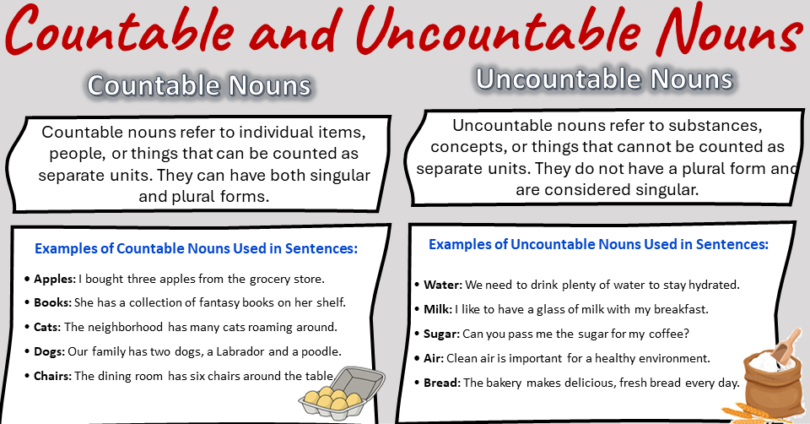
A countable noun names an individual item that can be counted as a separate unit and takes a plural form. An uncountable noun names a substance, a concept, or a mass that cannot be divided into separate units and has no plural form. This distinction decides which articles, quantifiers, and verb forms a noun takes, and several nouns shift between the two categories depending on what they mean in a sentence. A 12 types of nouns lesson places both categories inside the full noun classification system.
What Makes a Noun Countable or Uncountable
A noun counts as countable when it names something you can divide into separate, numbered units: one apple, two apples. A noun counts as uncountable when it names a substance, a quality, or a mass with no natural way to divide it into units: water, honesty, furniture.
- Countable nouns: take a number and a plural form.
- Uncountable nouns: have no plural form and take a singular verb.
Several nouns, such as chicken and paper, shift between countable and uncountable depending on what they mean in the sentence. The quantifier a noun pairs with, such as many or much, confirms which category applies.
Countable Nouns
A countable noun takes a singular or a plural form and pairs with a, an, a number, or a quantifier like many or a few.
- Maya bought three apples.
- The classroom has twenty students.
- Maya owns two cars.
A countable noun takes a plural verb when used in its plural form: The apples are fresh.
Uncountable Nouns
An uncountable noun has no plural form and pairs with some, much, or a little instead of a or an.
- Maya needs some advice.
- The furniture in this room is new.
- Water covers most of the planet.
An uncountable noun always takes a singular verb, even when it names something that feels plural in meaning: The information was helpful, not the informations were helpful.
Nouns That Are Both Countable and Uncountable
Several nouns shift between countable and uncountable depending on what they mean in a sentence.
- Chicken: Maya ate chicken for dinner (uncountable, the meat in general) versus Maya raises three chickens (countable, the individual animals).
- Paper: Maya bought more paper for the printer (uncountable, the material) versus Maya signed three papers (countable, individual documents).
- Time: Time is precious (uncountable, the general concept) versus Maya visited Paris three times (countable, individual instances).
- Wine: Maya enjoys wine with dinner (uncountable, the drink in general) versus The restaurant serves three wines by the glass (countable, specific types).
- Fish: Maya eats fish twice a week (uncountable, the food) versus Maya caught three fish at the lake (countable, using an irregular plural that matches the singular form).
- Light: The room needs more light (uncountable, illumination in general) versus Maya turned off three lights (countable, individual lamps).
Context, not the word itself, decides which category applies in a given sentence.
Quantifiers for Countable and Uncountable Nouns
The quantifier a noun pairs with confirms which category it belongs to.
| Noun Type | Quantifiers |
|---|---|
| Countable only | Many, few, a few, several, a number of |
| Uncountable only | Much, little, a little, a great deal of |
| Both | Some, any, a lot of, plenty of, most |
Many pairs with countable nouns, while much pairs with uncountable nouns: Maya has many books versus Maya has much patience. Few and a little follow the same pattern: Maya owns few books versus Maya has a little patience.
Turning an Uncountable Noun Into a Countable Phrase
A unit phrase converts an uncountable noun into a countable expression by naming a specific quantity or container.
- A piece of advice
- A loaf of bread
- A bar of chocolate
- A cup of coffee
- A bottle of wine
- A grain of rice
- A sheet of paper
- A bolt of lightning
- Maya gave me a piece of advice.
- We bought two loaves of bread.
The unit phrase itself takes the plural form, not the uncountable noun inside it: two pieces of advice, not two advices.
Full List of Countable and Uncountable Nouns
The table groups nouns by category, with no word repeated across or within either list.
| Category | Nouns |
|---|---|
| Countable | Apple, book, car, chair, student, hat, pencil, computer, cup, dog, table, window, bottle, phone, key |
| Uncountable | Water, milk, sugar, flour, coffee, rice, information, advice, money, furniture, music, weather, homework, luggage, traffic |
Countable and Uncountable Nouns Comparison Chart
The comparison chart organizes each category by test and example, keeping every cell to one short phrase so the chart stays readable on a small screen.
| Category | Test | Example |
|---|---|---|
| Countable | Takes a number and a plural form | Apples in Maya bought three apples |
| Uncountable | Has no plural form, takes a singular verb | Advice in Maya needs some advice |
| Dual-nature | Shifts meaning between countable and uncountable use | Chicken in Maya ate chicken, or Maya raises three chickens |
| Unit phrase | Converts an uncountable noun into a countable expression | A piece of advice |
How to Identify Countable and Uncountable Nouns
Five steps convert the rules into a method you run on any sentence:
- Check whether the noun can be counted as separate units.
- Check whether it takes a plural form.
- Check whether it shifts meaning between countable and uncountable use.
- Check which quantifier fits: many/few or much/little.
- Check whether a unit phrase is needed to count it.
Common Mistakes With Countable and Uncountable Nouns
Four confusions repeat across worksheets and grammar sites, and catching them keeps you from mislabeling a noun you already understand.
Maya received some good informations. ❌ Maya received some good information, since information has no plural form. ✅
Maya has much books to read. ❌ Maya has many books to read, since many pairs with countable nouns while much pairs with uncountable nouns. ✅
The furnitures in this room are new. ❌ The furniture in this room is new, since furniture has no plural form and takes a singular verb. ✅
Maya has a little books on her shelf. ❌ Maya has a few books on her shelf, since a few pairs with countable nouns while a little pairs with uncountable nouns. ✅
Maya gave me two advices. ❌ Maya gave me two pieces of advice, since advice itself has no plural form and the unit phrase shows the plural instead. ✅
Countable and Uncountable Nouns Practice Questions
Test the five-step method against nine questions before checking your answers.
- Classify apple and give its plural form.
- Classify furniture and state whether it has a plural form.
- Correct the error in Maya received some good informations.
- Correct the error in Maya has much books to read.
- Is chicken countable or uncountable in Maya ate chicken for dinner?
- Is chicken countable or uncountable in Maya raises three chickens?
- Form a unit phrase to count advice.
- Correct the error in Maya has a little books on her shelf.
- Correct the error in Maya gave me two advices.
Answers
- Apple functions as a countable noun, with the plural form apples.
- Furniture functions as an uncountable noun, with no plural form.
- The correct sentence is Maya received some good information, since information has no plural form.
- The correct sentence is Maya has many books to read, since many pairs with countable nouns.
- Chicken functions as an uncountable noun here, since it names the meat in general.
- Chicken functions as a countable noun here, since chickens names the individual animals.
- A piece of advice converts advice into a countable expression.
- The correct sentence is Maya has a few books on her shelf, since a few pairs with countable nouns while a little pairs with uncountable nouns.
- The correct sentence is Maya gave me two pieces of advice, since advice has no plural form and the unit phrase shows the plural instead.
FAQs
Q1 What are examples of countable and uncountable nouns?
Countable nouns include apple, book, and student, each taking a plural form. Uncountable nouns include water, advice, and furniture, each with no plural form and a singular verb, as in The furniture is new.
Q2. What is the difference between “much” and “many”?
Many pairs with countable nouns, as in Maya has many books. Much pairs with uncountable nouns instead, as in Maya has much patience. Using much with a countable noun, or many with an uncountable one, is a common error.
Q3. Can a noun be both countable and uncountable?
Yes. Several nouns shift meaning depending on use, including chicken, paper, time, wine, and fish. Maya ate chicken for dinner treats the word as uncountable, while Maya raises three chickens treats it as countable.
Q4. How do you make an uncountable noun countable?
A unit phrase names a specific quantity or container, converting the uncountable noun into a countable expression, as in a piece of advice or a loaf of bread. The unit phrase itself takes the plural form: two pieces of advice.
Q5. Is “information” countable or uncountable?
Information is uncountable in English, even though its equivalent is countable in some other languages. It takes no plural form and pairs with much or some rather than many or a, as in Maya needs some information, not some informations.