
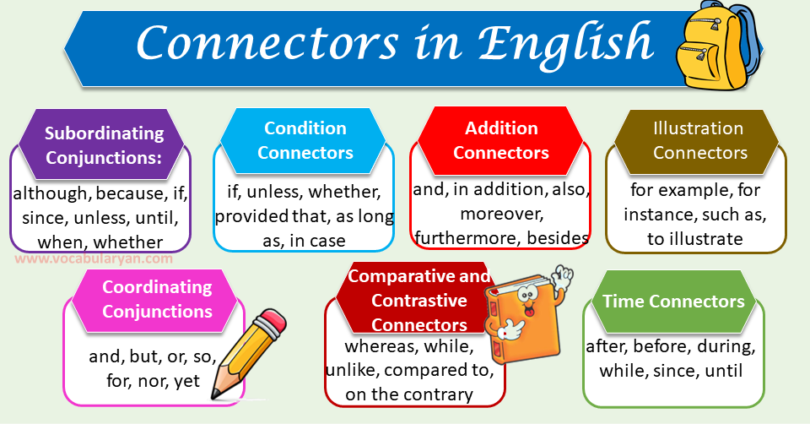
A sentence connector joins two ideas and signals the logical relationship between them: comparison, contrast, cause and effect, time, condition, purpose, addition, or illustration. English builds this system from three conjunction types plus eight connector categories, and mixing up two categories that sound similar, such as contrast and cause and effect, is one of the most common errors in student writing.
What a Sentence Connector Does
A sentence connector joins two clauses, sentences, or ideas and signals how they relate to each other. English organizes this vocabulary into eleven categories: three conjunction types, plus eight connector relationships.
- Conjunctions: coordinating, subordinating, and correlative conjunctions join clauses grammatically.
- Comparison and contrast: show a similarity or a difference.
- Cause and effect: shows a result.
- Time and sequence: shows when or in what order.
- Condition and purpose: show a requirement or a goal.
- Addition and illustration: add a supporting idea or introduce an example.
Contrast and cause and effect look similar in a sentence but signal opposite kinds of logic. Condition and purpose cause the same confusion. The categories further on keep each one separate.
Coordinating Conjunctions
A coordinating conjunction connects equal parts of a sentence: two words, phrases, or independent clauses. The seven coordinating conjunctions form the acronym FANBOYS: for, and, nor, but, or, yet, so.
- Maya studied hard, but she still felt nervous.
- Would you like coffee or tea?
- It was raining, so we decided to stay indoors.
Subordinating Conjunctions
A subordinating conjunction connects a dependent clause to an independent clause, showing a relationship such as time, cause, or condition. Common examples include because, although, if, when, and since.
- Although Maya studied hard, she still felt nervous.
- She couldn’t attend the party since she had a prior commitment.
- We’ll go swimming once the weather improves.
Correlative Conjunctions
A correlative conjunction works in a pair to link two equal sentence parts: either…or, neither…nor, not only…but also, both…and.
- Either you study for the test, or you’ll fail.
- Not only did she finish the project on time, but she also exceeded expectations.
- Neither the book nor the movie captured the true essence of the story.
- Both the parents and the teacher were concerned about the student’s behavior.
Comparison Connectors
A comparison connector shows a similarity between two ideas: similarly, likewise, just as, in the same way.
- Maya’s sister is talented; likewise, Maya has a gift for music.
- Both dogs and cats make great pets. Similarly, they provide companionship.
- Just as the sun sets in the west, the moon rises in the east.
Contrast Connectors
A contrast connector shows a difference between two ideas: however, on the other hand, nevertheless, conversely, although, whereas.
- Maya studied hard; however, she still felt nervous.
- He is talented and hardworking. On the other hand, his brother is laid-back.
- The team faced numerous challenges. Nevertheless, they persevered.
Although and whereas also work as subordinating conjunctions, joining a dependent clause to an independent one. A word can belong to a grammatical category and a relationship category at the same time: although is both a subordinating conjunction and a contrast connector.
Cause and Effect Connectors
A cause-and-effect connector shows that the second idea results from the first: therefore, consequently, as a result, thus, accordingly, hence.
- Maya studied hard; therefore, she passed the exam.
- The team failed to meet the deadline; consequently, the project was delayed.
- The battery died; thus, the device stopped working.
- The survey revealed low customer satisfaction; accordingly, the company began a service review.
A conjunctive adverbs lesson covers the full punctuation system behind these words in more depth.
Time and Sequence Connectors
A time connector shows the sequence or timing of events: first, meanwhile, next, afterward, finally, subsequently, while.
- First, we need to analyze the data. Next, we will present our findings.
- The chef was busy preparing the main course. Meanwhile, the waitstaff set the tables.
- She studied hard, practiced diligently, and finally, she won the competition.
- He attended the meeting, and afterward, he met with his colleagues for coffee.
Condition Connectors
A condition connector shows a requirement for something to happen: if, unless, provided that, in case, as long as, in the event that.
- If you study hard, you will pass the exam.
- You can borrow my car provided that you return it by Friday.
- I’m fine with any restaurant as long as they serve vegetarian options.
- Unless you finish your homework, you can’t go out to play.
Purpose Connectors
A purpose connector shows the goal behind an action: in order to, so that, so as to, for the purpose of.
- We saved money in order to go on vacation.
- She woke up early so that she wouldn’t miss the bus.
- She adjusted her diet so as to maintain a healthy lifestyle.
Addition Connectors
An addition connector adds an extra, supporting idea to a sentence: furthermore, moreover, additionally, in addition, besides.
- Furthermore, the company plans to expand its operations internationally.
- Moreover, the team implemented new strategies to improve productivity.
- Besides, the software update also includes enhanced security features.
Illustration Connectors
An illustration connector introduces a specific example: for example, such as, namely, for instance, to illustrate.
- For example, Maya enjoys outdoor activities such as hiking, swimming, and cycling.
- For instance, some popular social media platforms have billions of active users.
- To illustrate the concept of supply and demand, consider the market for smartphones.
Sentence Connectors Comparison Chart
The comparison chart organizes each category by test and example, keeping every cell to one short phrase so the chart stays readable on a small screen.
| Category | Test | Example |
|---|---|---|
| Coordinating | Joins equal grammatical parts | But in Maya studied hard, but she felt nervous |
| Subordinating | Joins a dependent clause to an independent clause | Although in Although Maya studied hard |
| Correlative | Works in a pair to link equal parts | Either…or in Either you study, or you fail |
| Comparison | Shows a similarity | Likewise in Maya has a gift for music, likewise |
| Contrast | Shows a difference | However in Maya studied hard; however |
| Cause and effect | Shows a result | Therefore in Maya studied hard; therefore |
| Time and sequence | Shows when or in what order | Meanwhile in The chef cooked; meanwhile |
| Condition | Shows a requirement | If in If you study hard |
| Purpose | Shows a goal | So that in She woke up early so that |
| Addition | Adds a supporting idea | Furthermore in Furthermore, the company plans |
| Illustration | Introduces an example | For example in For example, Maya enjoys hiking |
How to Identify Sentence Connectors
Five steps convert the categories into a method you run on any sentence:
- Find the connector and the clauses or ideas it joins.
- Check what logical relationship it signals: comparison, contrast, cause and effect, time, condition, purpose, addition, or illustration.
- Check whether the relationship matches the meaning of the sentence.
- Check the punctuation, especially for connectors joining two independent clauses.
- Confirm the connector is not confused with a similar-sounding word from a different category.
Common Mistakes With Sentence Connectors
Four confusions repeat across student writing, and catching them keeps you from reaching for the wrong connector.
Maya studied hard; consequently, she still felt nervous. ❌ Maya studied hard; however, she still felt nervous, since however signals contrast, while consequently signals a result that does not fit this sentence. ✅
Maya saved money as long as she could go on vacation. ❌ Maya saved money in order to go on vacation, since in order to signals a goal, while as long as signals a condition that does not fit this sentence. ✅
Furthermore, the results improved. Furthermore, the team celebrated. ❌ Furthermore, the results improved, and the team celebrated as a result. ✅
As revealed by the study, Maya enjoys hiking, swimming, and cycling. ❌ For example, Maya enjoys hiking, swimming, and cycling, since for example introduces a specific instance rather than citing a source. ✅
Although only functions as a subordinating conjunction and never as a contrast connector. ❌ Although functions as both at once: a subordinating conjunction grammatically, and a contrast connector by the relationship it signals. ✅
Sentence Connector Practice Questions
Test the five-step method against nine sentences before checking your answers.
- Classify likewise by category.
- Classify however by category.
- Classify therefore by category.
- Correct the error in Maya studied hard; consequently, she still felt nervous.
- Is so that a condition connector or a purpose connector?
- Correct the error in Maya saved money as long as she could go on vacation.
- Classify furthermore by category.
- Correct the error in As revealed by the study, Maya enjoys hiking.
- Can although function as both a subordinating conjunction and a contrast connector?
Answers
- Likewise functions as a comparison connector, since it shows a similarity between two ideas.
- However functions as a contrast connector, since it shows a difference between two ideas.
- Therefore functions as a cause-and-effect connector, since it shows that the second idea results from the first.
- The correct sentence is Maya studied hard; however, she still felt nervous, since however signals contrast rather than a result.
- So that functions as a purpose connector, since it shows a goal rather than a requirement.
- The correct sentence is Maya saved money in order to go on vacation, since in order to signals a goal rather than a condition.
- Furthermore functions as an addition connector, since it adds an extra, supporting idea.
- The correct sentence is For example, Maya enjoys hiking, swimming, and cycling, since for example introduces a specific instance rather than citing a source.
- Yes, although functions as a subordinating conjunction grammatically and as a contrast connector by the relationship it signals, since one word can belong to both systems at once.
FAQs
Q2. What is the difference between a condition connector and a purpose connector?
A condition connector, such as if or as long as, states a requirement for something to happen, as in If you study hard, you will pass the exam. A purpose connector, such as in order to or so that, states the goal behind an action, as in Maya studied in order to pass the exam.
Q3. What are examples of addition connectors?
Common addition connectors include furthermore, moreover, additionally, in addition, and besides. Each adds a supporting idea to a point already made, as in Furthermore, the company plans to expand its operations internationally.
Q4. How do you punctuate a sentence connector between two independent clauses?
Most connectors that join two independent clauses in one sentence need a semicolon before the connector and a comma after it, as in Maya studied hard; therefore, she passed the exam. A dedicated conjunctive adverbs lesson covers this punctuation system in full.
Q5. Is “so” a time connector or a cause-and-effect connector?
So functions as a coordinating conjunction that signals a result, not a time relationship, as in It was raining, so we decided to stay indoors. Genuine time connectors include meanwhile, afterward, and finally instead.
Q1. What is the difference between a contrast connector and a cause-and-effect connector?
A contrast connector, such as however, shows that the second idea differs from or conflicts with the first, as in Maya studied hard; however, she still felt nervous. A cause-and-effect connector, such as therefore, shows that the second idea results from the first, as in Maya studied hard; therefore, she passed the exam. Swapping one for the other reverses the logic of the sentence, even though both words can follow a semicolon in the same position.