
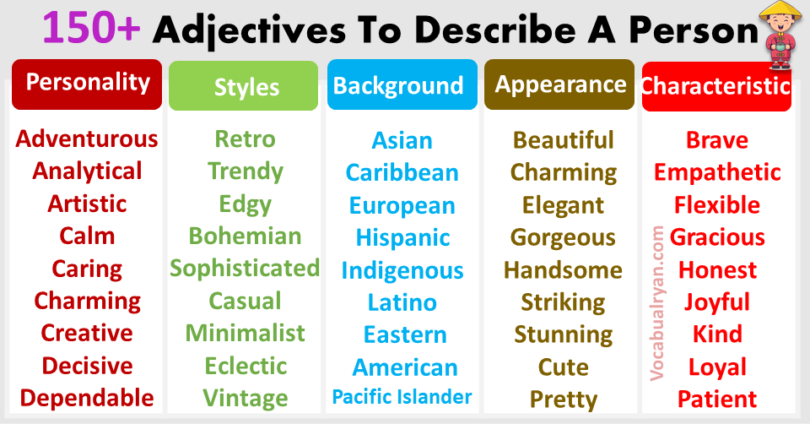
Adjectives to describe a person capture how someone looks, acts, and presents themselves, spanning personality, appearance, style, and heritage. A strong description reaches for a specific word rather than a vague one like nice or good, and a complete personality vocabulary needs difficult traits alongside admirable ones. The same underlying trait can even read as positive or negative depending on which word names it. A adjectives to describe food lesson works through the same specific-over-vague principle applied to a different subject.
What Makes a Strong Adjective for Describing a Person
A strong person-describing adjective names a specific quality rather than a vague judgment. English organizes this vocabulary into five categories.
- Positive personality traits: qualities most people view favorably.
- Negative personality traits: qualities that create friction or conflict.
- Physical appearance: how someone looks.
- Style and fashion: how someone dresses or presents visually.
- Nationality and heritage: where someone is from or their cultural background.
The same behavior can read as positive or negative depending on the word chosen. Determined and stubborn describe the exact same trait, framed two different ways.
Positive Personality Traits
A positive personality trait names a quality most people view favorably.
- Honest: telling the truth, even when it is uncomfortable. Maya was honest about the mistake instead of hiding it.
- Determined: staying focused on a goal despite obstacles. Maya stayed determined through three rounds of rejection before landing the job.
- Compassionate: showing genuine concern for others’ wellbeing. Maya’s compassionate nature made her the first to check on a struggling classmate.
- Hardworking: putting in consistent, dedicated effort. Maya’s hardworking attitude helped her finish the project ahead of schedule.
- Resourceful: finding practical solutions with limited means. Maya was resourceful enough to fix the leak with tools she already owned.
- Humble: not boasting about one’s own achievements. Despite winning the award, Maya stayed humble and credited her team.
Negative Personality Traits
A negative personality trait names a quality that creates friction or conflict. Use these words with care, since they affect how a real person is perceived.
- Stubborn: refusing to change one’s mind, even when reasonable. Maya was so stubborn that she wouldn’t reconsider the plan even after it failed twice.
- Selfish: focused on one’s own needs at others’ expense. His selfish decision left the rest of the team covering his workload.
- Arrogant: showing an exaggerated sense of one’s own importance. His arrogant tone made it hard for colleagues to offer feedback.
- Careless: acting without enough attention or caution. A careless mistake in the report cost the client’s trust.
- Impatient: unable to wait calmly for something. Maya grew impatient waiting for the results to arrive.
- Moody: prone to sudden, unpredictable shifts in temper. His moody reaction to small setbacks made the team cautious around him.
Several of these words describe the same underlying behavior as a positive trait, just framed differently. Determined and stubborn both describe someone who won’t give up, and the word you choose signals whether you view that persistence favorably.
Physical Appearance Adjectives
A physical appearance adjective describes how someone looks.
- Tall: above average height. Maya was tall enough to reach the top shelf without help.
- Athletic: physically fit and toned from regular exercise. His athletic build came from years of competitive swimming.
- Graceful: moving in a smooth, controlled way. Maya crossed the stage with a graceful, confident stride.
- Youthful: appearing younger than one’s actual age. Her youthful energy made her seem years younger than she was.
- Striking: unusually noticeable or attractive. His striking green eyes were the first thing people noticed.
- Petite: small and slim in build. The petite dancer moved with surprising strength.
Style and Fashion Adjectives
A style adjective describes how someone dresses or presents themselves visually.
- Elegant: refined and graceful in appearance or dress. Maya wore an elegant black dress to the gala.
- Casual: relaxed and informal. Maya kept her outfit casual for the weekend trip.
- Bohemian: unconventional, artistic, and free-flowing in style. Her bohemian wardrobe favored flowing fabrics and layered jewelry.
- Minimalist: simple, clean, and free of excess. His minimalist wardrobe stuck to a few neutral colors.
- Edgy: bold, unconventional, and slightly rebellious. Maya’s edgy leather jacket stood out at the formal dinner.
- Polished: neat, refined, and carefully put together. She arrived at the interview looking polished and prepared.
Nationality and Heritage Adjectives
A nationality or heritage adjective names where someone is from or the cultural background they identify with. Use these words to state a fact about someone’s origin, not as a stand-in for a personality or appearance description.
- Asian: from or connected to Asia. Maya’s Asian heritage shaped many of the recipes her family cooked.
- Hispanic: connected to Spanish-speaking countries or cultures. The festival celebrated Hispanic music and food from across Latin America.
- Middle Eastern: from or connected to the Middle East. His Middle Eastern background gave him fluency in both Arabic and English.
- Indigenous: native to a region prior to colonization. The museum exhibit highlighted Indigenous art from the Pacific Northwest.
- Pacific Islander: from or connected to the islands of the Pacific. Her Pacific Islander family traced its roots to Samoa.
Name heritage only when it is relevant to what you are describing, and use the term the person or group actually uses for themselves.
Person-Describing Adjectives Comparison Chart
The comparison chart organizes each category by test and example, keeping every cell to one short phrase so the chart stays readable on a small screen.
| Category | Test | Example |
|---|---|---|
| Positive personality | Names a quality most people view favorably | Honest in Maya was honest about the mistake |
| Negative personality | Names a quality that creates friction | Stubborn in Maya was too stubborn to reconsider |
| Physical appearance | Describes how someone looks | Tall in Maya was tall enough to reach the shelf |
| Style and fashion | Describes how someone dresses or presents | Elegant in Maya wore an elegant black dress |
| Nationality and heritage | Names where someone is from or their cultural background | Asian in Maya’s Asian heritage shaped the recipes |
How to Choose the Right Adjective for a Person
Five steps convert the categories into a method you run whenever you describe someone:
- Decide which dimension you are describing: personality, appearance, style, or heritage.
- Choose a specific word rather than a general one like nice or good.
- Check whether a trait word could read as positive or negative, and choose the framing you intend.
- Use a neutral word when a negative one might cause offense.
- Confirm the word fits the person and the context you are describing.
Common Mistakes With Person-Describing Adjectives
Four confusions repeat across everyday writing and conversation, and catching them keeps you from reaching for a vague or mismatched word.
Maya is a nice person. ❌ Maya is compassionate and hardworking, since a specific trait tells a reader far more than a vague word like nice. ✅
Maya is stupid when she forgets things. ❌ Maya is a little forgetful sometimes, since a neutral word avoids the harsh, insulting edge of a word like stupid. ✅
Maya is stubborn, which is a purely positive trait. ❌ Maya is determined, since determined frames the same persistence positively, while stubborn frames it as a flaw. ✅
Maya is Asian, so she must be quiet and reserved. ❌ Maya is Asian; her personality is friendly and outgoing, since heritage describes background, not personality. ✅
Maya’s minimalist style means she has a minimalist personality too. ❌ Maya’s style is minimalist, though her personality is bold and outspoken, since a style choice describes presentation, not character. ✅
Person-Describing Adjectives Practice Questions
Test the five-step method against nine questions before checking your answers.
- Classify compassionate by category.
- Classify stubborn by category.
- Classify graceful by category.
- Correct the error in Maya is a nice person.
- Name a neutral alternative to stupid for someone who is forgetful.
- Is determined a positive or a negative framing of persistence?
- Classify elegant by category.
- Correct the error in Maya is Asian, so she must be quiet and reserved.
- Correct the error in Maya’s minimalist style means she has a minimalist personality too.
Answers
- Compassionate functions as a positive personality trait, since it names a quality most people view favorably.
- Stubborn functions as a negative personality trait, since it names a quality that creates friction.
- Graceful functions as a physical appearance adjective, since it describes how someone moves or looks.
- A stronger sentence names a specific trait, such as Maya is compassionate and hardworking, rather than the vague word nice.
- Forgetful offers a neutral alternative to stupid, since it names the behavior without an insulting edge.
- Determined frames persistence positively, while stubborn frames the same underlying behavior as a flaw.
- Elegant functions as a style and fashion adjective, since it describes how someone dresses or presents.
- The correct statement separates heritage from personality, since a person’s cultural background does not predict their character.
- The correct statement separates style from personality, since a fashion choice describes presentation, not character.
FAQs
Q1. What are positive adjectives to describe a person?
Positive personality adjectives name qualities most people view favorably, such as honest, determined, compassionate, and hardworking. Maya was honest about the mistake instead of hiding it shows the word doing real descriptive work rather than a vague label like nice.
Q2. What are negative adjectives to describe a person?
Negative personality adjectives name qualities that create friction, such as stubborn, selfish, arrogant, and careless. These words affect how a real person is perceived, so a neutral word is the safer choice when describing someone you know personally.
Q3. What are adjectives to describe someone’s appearance?
Physical appearance adjectives describe how someone looks, including tall, athletic, graceful, and striking. Maya crossed the stage with a graceful, confident stride pairs the word with a specific, visual moment rather than a general impression.
Q4. Why do some personality traits sound positive or negative depending on the word?
Two different words can describe the same underlying behavior, each expressing a different judgment. Determined frames persistence as admirable, while stubborn frames the identical persistence as a flaw, even though both describe someone who refuses to give up.
Q5. Is it appropriate to use ethnicity adjectives to describe a person?
Yes, when the word names a real fact about someone’s background and fits the context, as in Maya’s Asian heritage shaped many of the recipes her family cooked. Heritage describes where someone is from, not their personality, so it should never stand in for a character description.

Leave a Comment